Weak-to-Strong Reasoning with LLMs
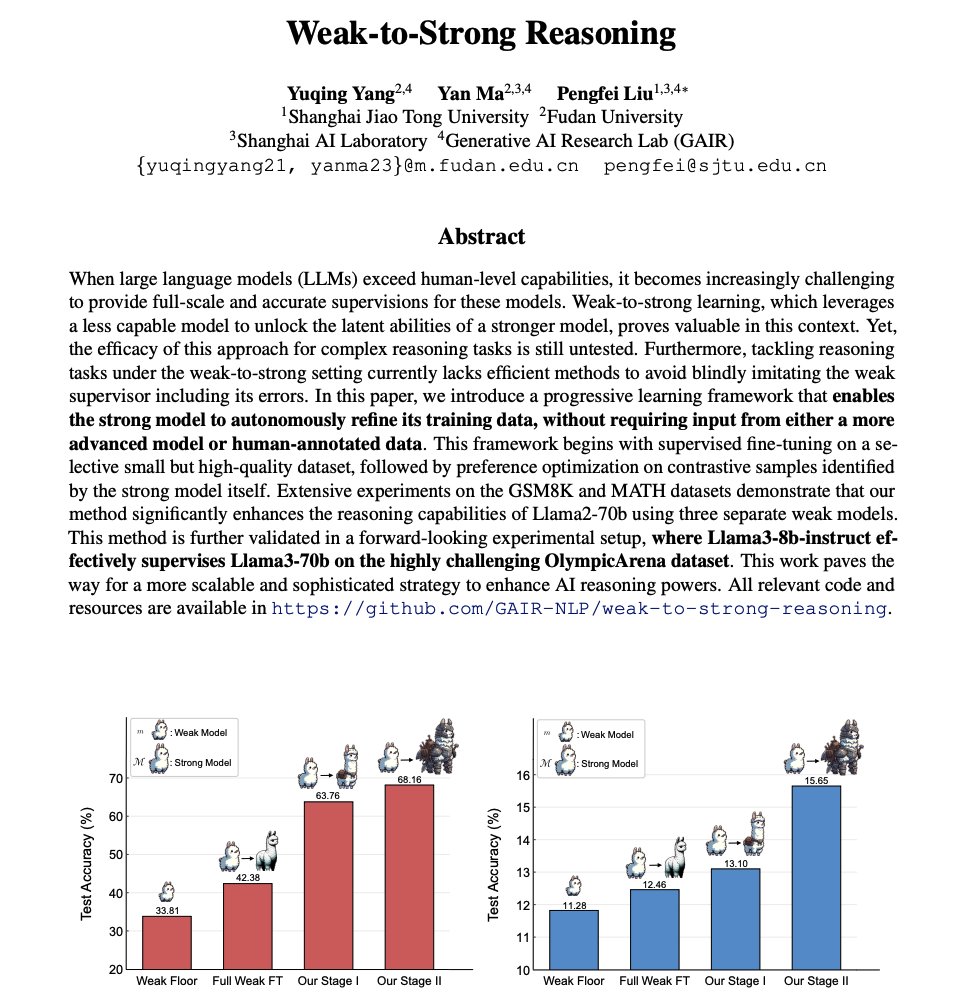
Demonstrates the use of weak supervision to elicit strong reasoning capabilities in LLMs without relying on human annotations or advanced models.
Reports that strong models can automatically refine their training data without explicitly being trained to do so. Enables expanding a model's learning scope and scaling performance on reasoning.
Recipe: SFT on a small high-quality dataset and preference optimization on self-identified contrastive samples.
Finding: "Extensive experiments on the GSM8K and MATH datasets demonstrate that our method significantly enhances the reasoning capabilities of Llama2-70b using three separate weak models. This method is further validated in a forward-looking experimental setup, where Llama3-8b-instruct effectively supervises Llama3-70b on the highly challenging OlympicArena dataset."
🚨Can we "internally" detect if LLMs are hallucinating facts not present in the input documents? 🤔
Our findings:
- 👀Lookback ratio—the extent to which LLMs put attention weights on context versus their own generated tokens—plays a key role
- 🔍We propose a hallucination detector based on lookback ratios—Lookback Lens
- 📊It accurately detects contextual hallucinations and reduces them during decoding—even better than hidden state-based detectors or NLI models
- 💪It transfers across tasks and models
Check our paper & code👇
📝https://t.co/q7Sv2KLVKf
👨💻https://t.co/fkjum99dh2
#NLProc #NLP #LLMs #LLaMA
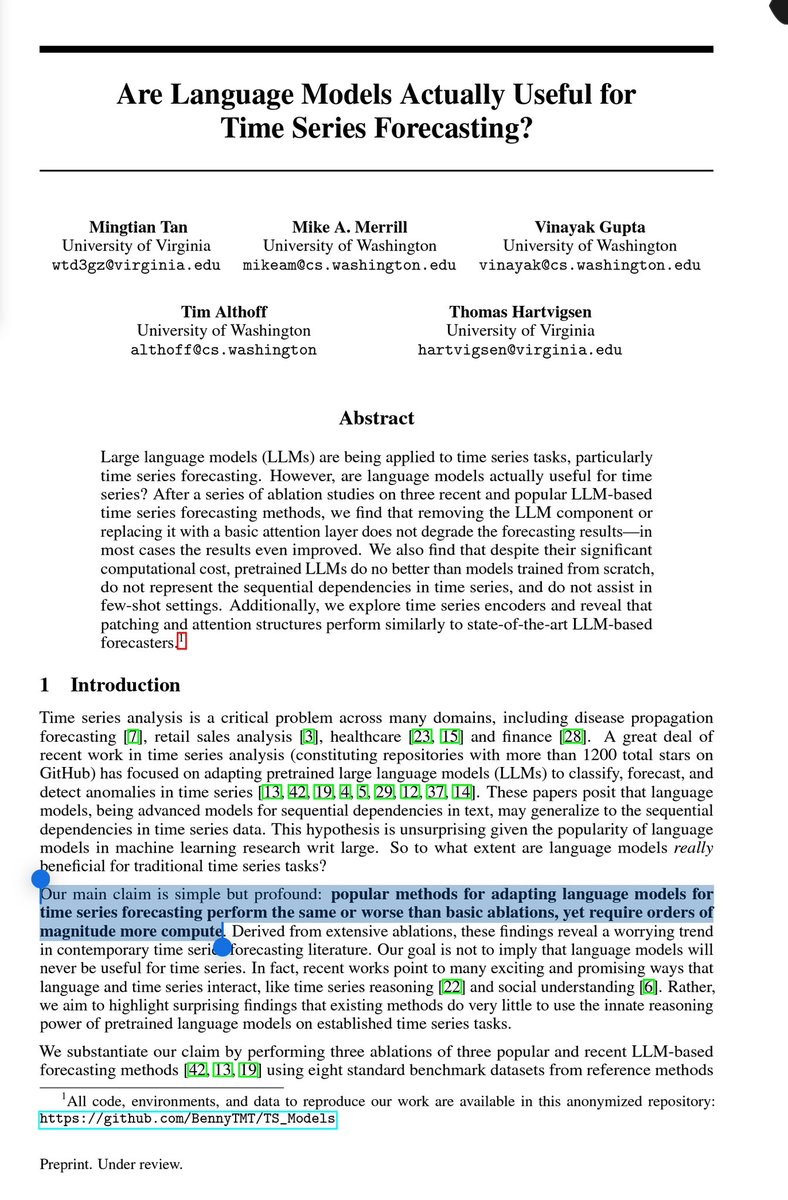
The paper we have been waiting for essentially shows that
#timeseries#llms do not work in forecasting.
Back in 2022, paper “Are Transformers Effective for Time Series Forecasting?“ challenged the appearing narrative that transformers are useful for forecasting. By removing transformer elements the authors showed the performance went up ⬆️
And now people did the same with time series LLMs. The papers demonstrated:
- removing the LLM component or replacing it with a basic attention layer does not degrade the forecasting results—in most cases the results even improved!
- in fact removing even removing the language model entirely, yields comparable or better performance!
- these simpler methods after removal of LLM component reduce training and inference time by up to three orders of magnitude while maintaining comparable performance!
- the sequence modeling capabilities of LLMs do not transfer to time series. By shuffling input time series the authors find no appreciable change in performance.
What this says is that LLMs can’t deal with critical features of time series, the time order is key and if LLMs performance doesn’t change when shuffling data it basically means it doesn’t model time series.
These finding are as damming to time series LLMs as the “Are Transformers Effective for Time Series Forecasting?” was for transformers.
#timeseries
#forecasting
Here’s a list of my favorite blogs to stay updated on everything around building things with LLMs and the generative AI space in general:
(No specific order)
Google presents Test of Time: A Benchmark for Evaluating LLMs on Temporal Reasoning
Presents a novel benchmark designed to assess LLMs’ temporal reasoning abilities, which SotA LLMs currently struggle with
data: https://t.co/bFLa119629
abs: https://t.co/h7KVVpF3aw
Can language models be used as world simulators? In our ACL 2024 paper, we show -- not really.
GPT-4 is only ~60% accurate at simulating state changes based on common-sense tasks, like boiling water.
Preprint: https://t.co/WYkTTcu6g7
@allen_ai@MSFTResearch@aclmeeting
OpenVLA: An Open-Source Vision-Language-Action Model
- Presents a 7B open-source vision-language-action model, pretrained on 970k robot episodes from the Open X-Embodiment dataset
- Outperforms RT-2-X and Octo
proj: https://t.co/wdTFFhAyIK
abs: https://t.co/alDZtgK6dQ
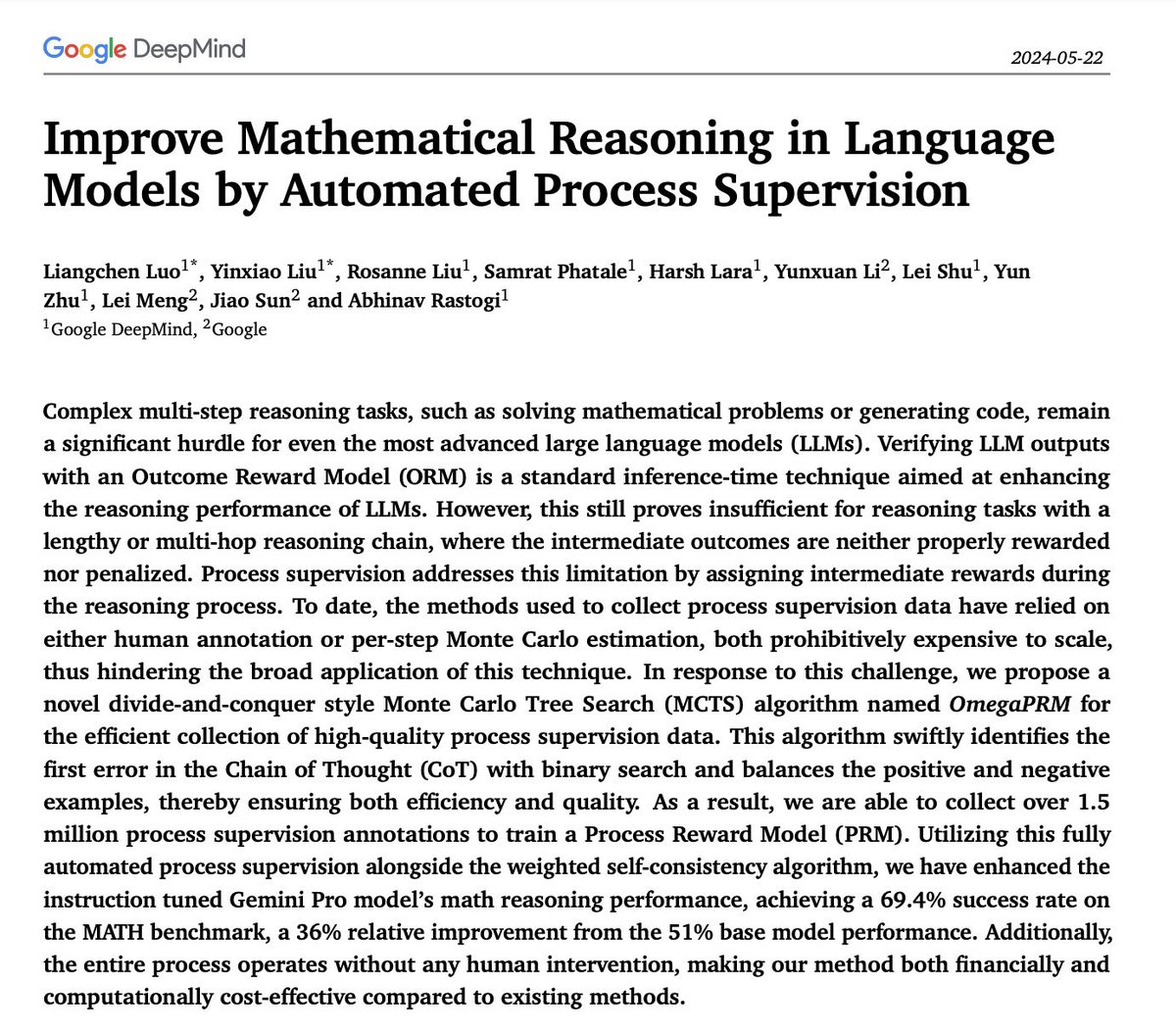
Improve Mathematical Reasoning in Language Models by Automated Process Supervision
Complex multi-step reasoning tasks, such as solving mathematical problems or generating code, remain a significant hurdle for even the most advanced large language models (LLMs).