@emmachichesterc @HarperCollinsCh Hi Emma! My daughter loves (I love you and Just for you Blue Kangaroo) and I have read her nth times. She still brings these two books before letting me read another. I have searched everywhere for blue kangaroo for christmas. I hope if I am able to get one for my daughter too!
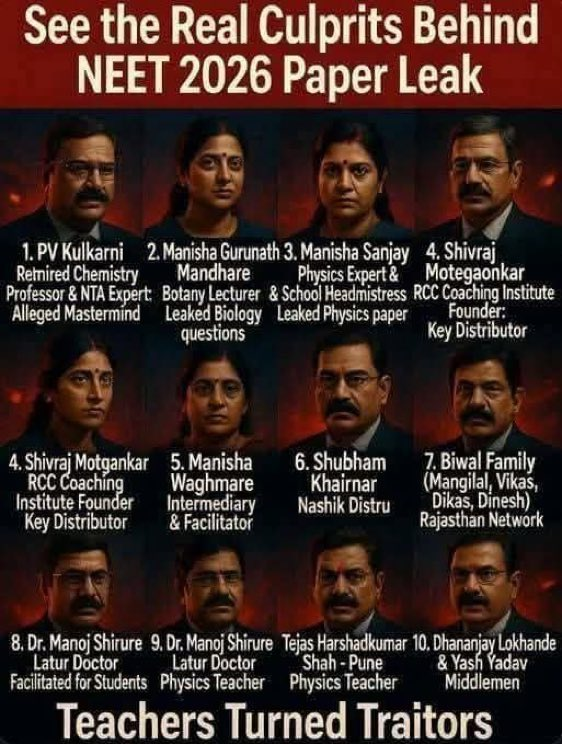
Who were involved in the NEET leak :
And - Greedy Parents, teachers, and Coaching Mafias
Who exposed it?
Ans - NTA and Govt
Who ordered CBI enquiry :
And - Dharmendra Pradhan
Who caught the 13 Culprits :
A - Modi Govt
Whom the protestors are targeting :
A- Modi and his Mother
While it’s important to support our students and ask for educational reforms that positively impact the future of our youth, it’s also very important that peaceful protests by students are Not hijacked by anti national elements to create chaos & change the nature of the protest.
Seeing so much hate & divide online makes me wonder if bad elements in & outside our country have already started to work overtime to weaponise the anger & frustration felt by our students.
I have always believed in hard work, equality and excellence & that should never be compromised. I also believe in our democracy, law and order & our government, therefore I sincerely hope that both sides enter into meaningful & constructive dialogue & weed out any nefarious elements & agendas out of this protest & conversation , so the future is bright for our youth and for our democracy ! 🇮🇳 Jai Hind !
Mesopotamia was never the cradle of civilisation. India was.
I spent forty years in international shipping, not academia. When I began researching the history of maritime trade, I had no orthodoxy to defend. I followed the evidence, and it kept arriving in the same place: the Indian subcontinent.
Nineteenth century archaeologists dug in Mesopotamia because the climate preserved artefacts, the biblical sources pointed them there, and the Ottomans allowed the excavations. That is the entire basis for the myth of Mesopotamia as "the cradle of civilisation."
Nobody applied the same rigour to India. Mohenjo-daro was not discovered until 1922. By then the narrative had already hardened.
What was actually there was the largest civilisation of the ancient world. Three hundred cities. Fifty thousand people in each, by 2600 BC. Two thirds of them stood on the banks of the Sarasvati, the central and greatest of the seven rivers described in the Rig Veda, flowing down from the Himalayas before the river vanished entirely by 1900 BC. The Vedic kings claimed territory stretching "sea to sea," from Afghanistan to Maharashtra, some 1.5 million square miles, against Egypt's 13,000. A dock at Lothal built to handle thirty ships of sixty tons, unmatched in Europe for four thousand years. When it was first excavated, it was recorded as a bathing pool.
When the scale became impossible to dismiss, the theory was not corrected. It was replaced with a story of pale-skinned nomads from the steppe who supposedly arrived around 1500 BC and brought civilisation with them. There is no evidence. The chronology doesn't work. The Vedas describe no invasion.
In 2019 a Harvard-led genetic study revived the claim, and the press reported it as confirmation. It was not. The same study found the builders of these cities were indigenous. The Sarasvati river that the Rig Veda described had already dried up before these newcomers arrived. What the study also found is that a small group of men, arriving after the Sarasvati had already dried up, interbred with the existing population and left a genetic signature. That is all.
So, where they chose to dig was mostly an accident of climate and access. The Aryan invasion theory was constructed because an Indian civilisation that owed nothing to Caucasians was a fact the late nineteenth century could not accommodate.
Link to full Substack essay with sources in the comments below.
Ramprasad Sen was an 18th-century Bengali mystic and poet whose deeply personal songs transformed the worship of Goddess Kali into an intimate relationship with a loving mother.
Ramprasad Sen lived a quiet life in rural Bengal. He didn't care for money or status; his mind was entirely on Goddess Kali. He didn't see her as some distant, frightening force, but as his own mother. He spent his days singing to her with total trust.
One afternoon, he was in his yard trying to fix a broken reed fence. It was tedious work. To weave it properly, he had to push a coarse rope through a gap, walk to the other side to pull it tight, and then push it back through the next gap.
His young daughter, Jagadishwari, saw him struggling and stepped in to help. She stood on the far side of the fence, catching the rope as Ramprasad pushed it through and feeding it back to him. They found a rhythm, and Ramprasad lost himself in his songs while they worked.
Eventually, Jagadishwari told him she needed to run inside for a minute but would be right back. Ramprasad agreed and decided to take a breather until she returned.
He had barely looked away when the end of the rope poked back through the reeds. Thinking the girl had changed her mind, Ramprasad smiled, grabbed the rope, and kept going. He kept talking to her through the fence, and their hands worked together even faster than before.
Before long, the knots were tied and the fence was done. As he was admiring the work, Jagadishwari came jogging down the path, out of breath. She apologized for the delay and asked where they had left off.
Ramprasad just stared at her. If she had been gone, who was holding the other end of the rope? He broke down crying. Mother Kali hadn't just been listening to his songs; she had come to his yard as a little village girl just to help him with his chores.
In years to come Ramprasad Sen poured that gratitude into his music. Knowing his Mother was there with him, present in the dust and sweat of an ordinary day, changed him. He wrote hundreds of songs, using the mud, the rivers, and the simple farming life of Bengal as the language for a lifelong conversation with the Divine.
Jai Maa Kali 🙏🌺
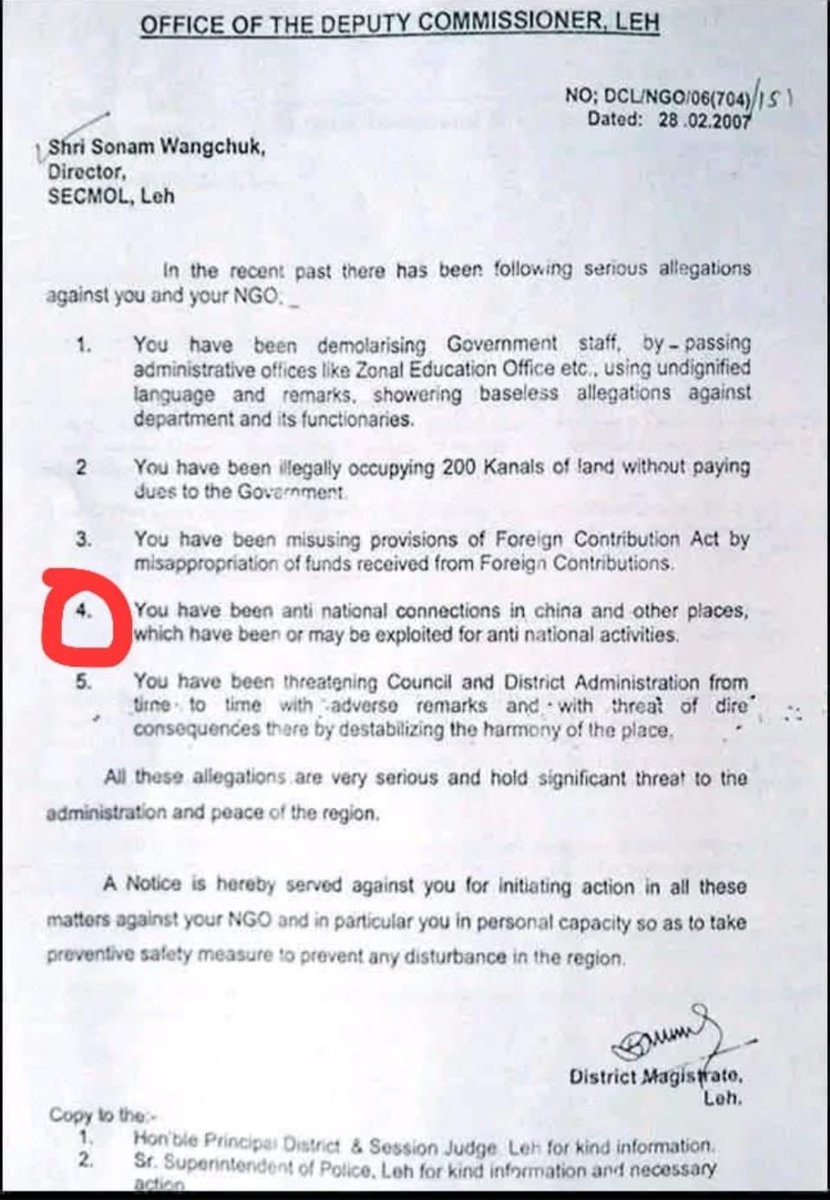
-Year 2007 : Congress govt
-A letter to Sonam Wangchuk
-Point 04 : Alleges that he's having links with China and involved in Anti National activities
BJP didn't support him at this time... Congress is supporting same Wangchuk today, calling him new age Gandhi..
KANGANA RANAUT TO CJP-
"Contest elections if you want.
But you can't twist Govt's arm on whom to sack or retain.
Obviously we will answer opposition’s queries.
Session is meant for that only but opposition is only interested in creating ruckus for political gains"
The chief priest of Badrinath traditionally comes from Kerala.
The chief priest of Kedarnath traditionally comes from Karnataka.
Pashupatinath has for centuries been served by priests from Sringeri.
Adi Shankaracharya established Sharadamba at Sringeri, preserving the spiritual legacy associated with Sharada of Kashmir.
Our temples never believed in dividing Bharat. They connected it.
If our sacred traditions transcend language, region, and state boundaries, why are we fighting?
When we focus too much on 'me' and 'my' achievements, our spiritual practice, our Sadhana, simply feeds our own illusions.
Once there was a king who spent years in intense prayer to win the grace of Maa Kali. He did intense sadhana, he chanted mantras tirelessly and built a magnificent temple in her honor. To anyone watching, he seemed like a devoted seeker. But inside, he secretly wanted to control her divine power for himself.
On one fruitful night of his sadhana, Maa Kali appeared, looking fierce yet smiling. The king stood tall, puffed up with pride, and demanded a blessing. The Mother simply laughed. Her laugh was so piercing that it shook him to his soul. She said, "You have only been worshipping your own ego."
In that moment, the temple shook and its walls crumbled, just like king's pride. Stripped of his power and words, he collapsed and lay lifeless for nine days.
On the tenth day, a single wild flower fell onto his body. He opened his eyes, completely transformed. He was now a humble child in the lap of the Mother, whispering, "I am nothing, Maa. There is only You."
This story is about breaking down inner walls to be reborn. The king's temple is like our own body, and the king is the stubborn "I" that always wants to be in charge. Maa Kali's laughter is the moment of truth that cuts through spiritual pride. The flower is her grace, which reaches us only when we empty ourselves and stop trying to control everything.
True devotion requires complete surrender. As long as that voice inside brags about how spiritual or knowledgeable we are, the Mother will just smile at the foolishness. The second we let go of that ego, she begins to dance in our hearts.
Jai Maa Kali 🙏🌺
Om Sri Matraye Namah 🙏