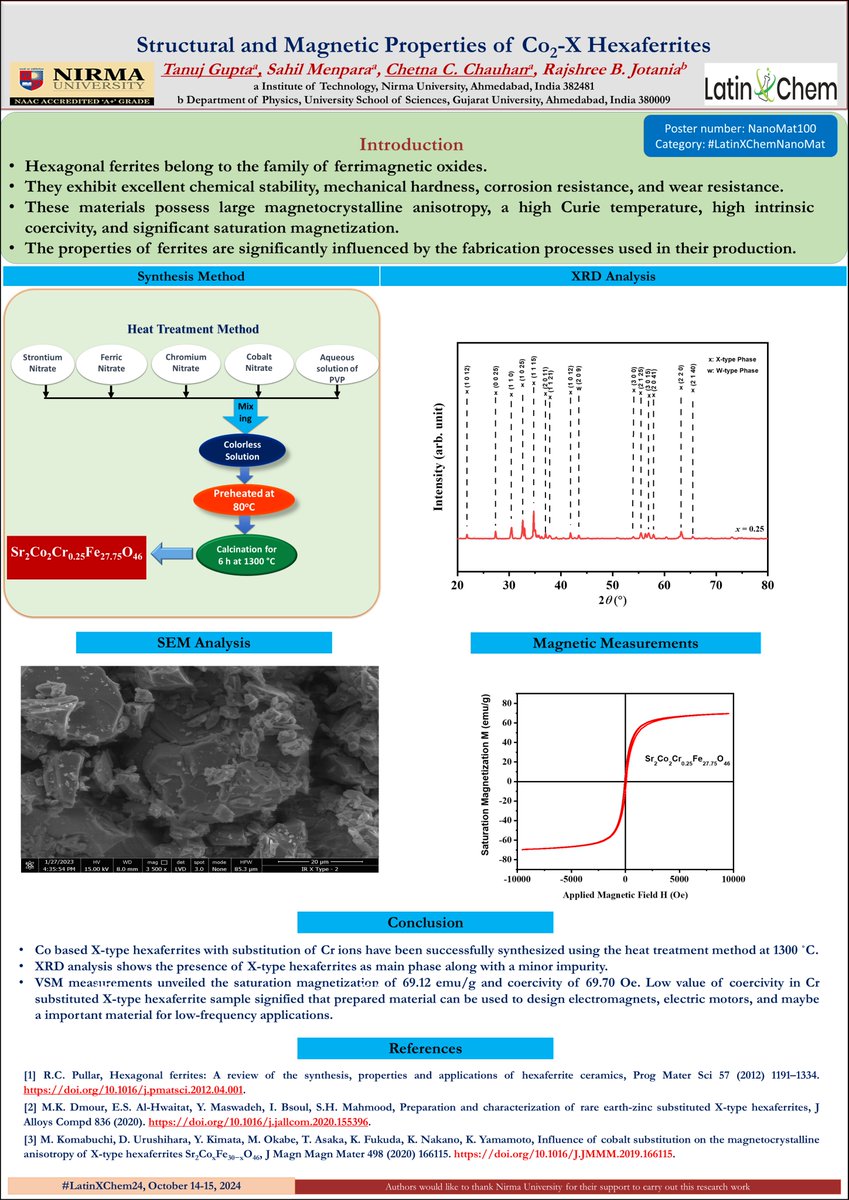
📢 Excited to share my latest article "Exploring structural, magnetic and dielectric properties of Ba1−xCoxFe12O19 hexaferrites". Check it out here: [https://t.co/2RS9L6RyGx]
@chetnamakwana@JotaniaRajshree@NirmaUniTweets
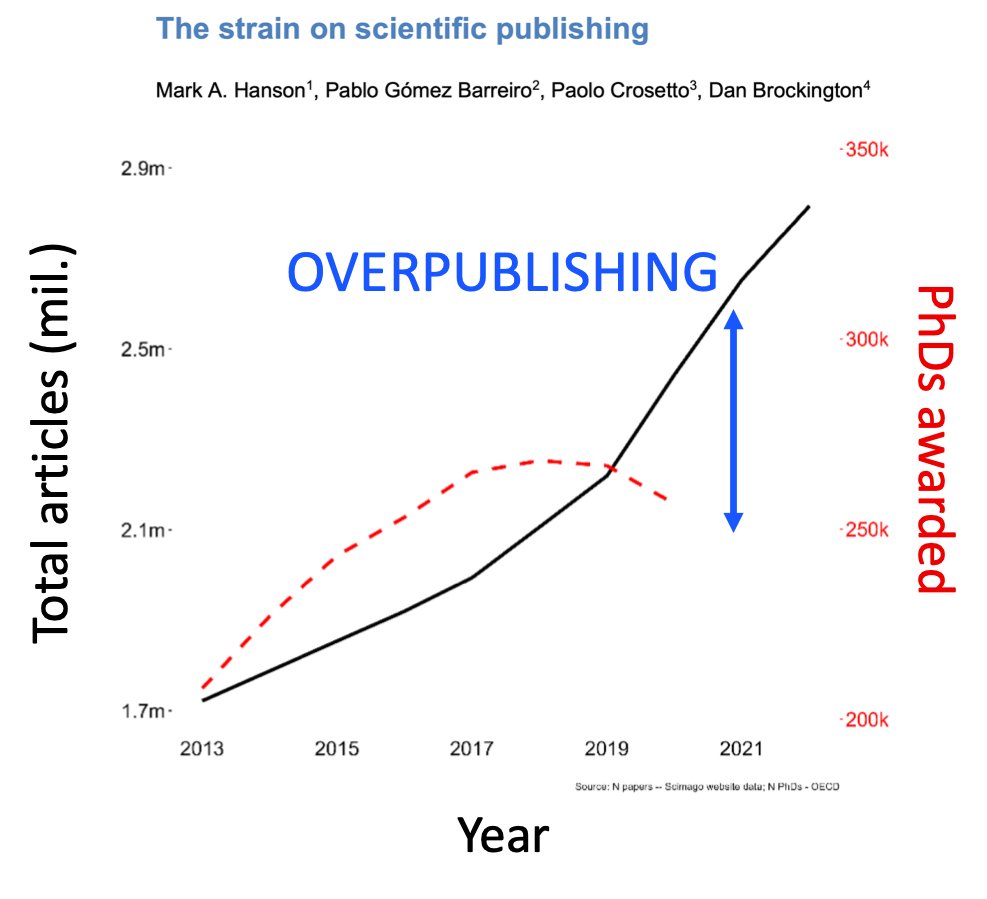
Overpublishing puts enormous stress on students and PIs.
And brings tons of money to publishers in STEM.
A new study shows that the number of papers is increasing FASTER than the number of #PhD graduates.
It’s an amazing work with very useful statistics. Huge kudos to the authors!
▫️
Main outcomes:
1️⃣ In 2022 the number of articles is 47% higher than in 2016. The amount of writing, reviewing and editing workload per scientist is increased enormously.
2️⃣ “Special issues” is a strategy for publishing lots of papers with reduced review time. This is possible due to the “publish or perish” pressure and clearly benefits the publishers.
3️⃣ The publishing time varies widely!
MDPI = 37 days. Frontiers = 72 days. Elsevier = 134 days. Springer = 157 days. Nature = 185 days.
4️⃣ The article rejection rates do not seem to correlate with publisher growth. However, rejection rates decline with increased use of special issue publishing.
5️⃣ Certain for-profit gold-open-access publishers create an increasing number of special issues, with uniquely reduced turnaround times, and in specific cases, high impact inflation and reduced rejection rates.
6️⃣ The authors suggest a new metric - Impact Inflation, which is reflected in self-citation within the same journal. For example, MDPI has a high impact inflation due to excessive self-citation compared to other publishers.
Conclusions and my opinion:
- Scientists have to spend a lot more time on reviewing and writing than before (on average).
- The more papers are published, the more the quality is compromised.
- Scientific progress has become partially bound to the business models of publishers and their revenue (a sad reality today).
- There is a huge lack of transparency. Much of these data had to be ‘web-scraped’ from numerous sources in order to get a full picture. We clearly need regulators to mandate open access to publisher’s statistics.
- Reduce the number of special issues! Those typically have low standards.
▫️
Science, publishing and funding make a trio that is very hard to disentangle.
However, research quality is controlled by the community.
This is why preprint + community review can make a big difference.
#AcademicTwitter #AcademicChatter
New Rule: If you go >60 seconds over your allotted presentation time, you are banned from oral presentations for 5 years.
It shows a lack of preparation and is disrespectful of other presenters and the audience 😠
#AcademicChatter#AcademicTwitter
@chem_GarciaLab @LatinXChem@NirmaUniTweets@JotaniaRajshree@chetnamakwana Average particle size is increasing with increasing amount of Cu as it also appears from FESEM images. The effect of increasing particle size is strongly related with the decrease in the coercivity values.
@Dr_Desimone@LatinXChem@NirmaUniTweets@JotaniaRajshree@chetnamakwana Cu has a good chance of recyclability. Cu-doped Ni2-x HF can be considered as cost effective and environment friendly solution for the magnetic shielding required in MRI rooms and other similar environments. Testing to be done for antimicrobial activity.
@Dr_Desimone@LatinXChem@NirmaUniTweets@JotaniaRajshree@chetnamakwana Substitution of Cu at the place of Sr has reduced the saturation magnetization and coercivity. These low values of both the parameters opens the possible applications in the area of magnetic shielding, magnetic hyperthermia for cancer treatment and sensors.
📢 Excited to share my latest article "A Study of the Effect of Cu and Cr Co-Doping on Structural, Magnetic, and Dielectric Properties of Barium Hexaferrites Synthesized in the Presence of Mentha Leaves Extract" . Check it out here: [https://t.co/0mhsb9NH9g]
#Sustainability
Hi @LatinXChem, this is my work ‘Effect of Dual Ion Substitution on Structural, Magnetic, Mössbauer, and Dielectric properties of Co based X-type Hexaferrite’, #LatinXChem22#LXChemPhys#Phys040
@PaulinaGF5@LatinXChem@RajshreeJotania@chetnamakwana We haven't tried the mechanical and chemical stability. Although, hexaferrites are possessing good chemical stability in general. Yes, Cd can be substituted. Use of Cd will decrease the magnetic saturation.
@TRAI I have enough balance in my @airtelindia and @VodafoneIdeaIN@VodafoneGroup account but can't send sms as they have disabled the facility if you don't have unlimited plans. This is really disgusting. Anti-consumer policy and only for making money.
@PMOIndia