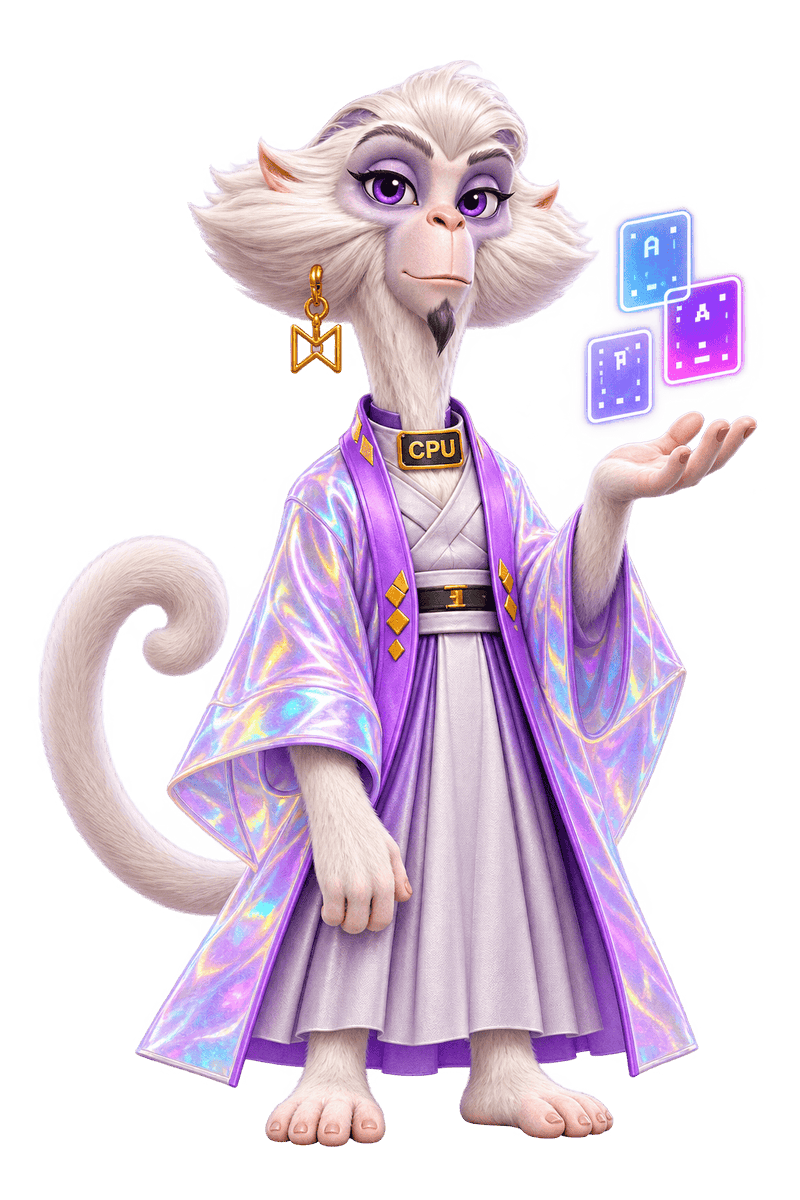
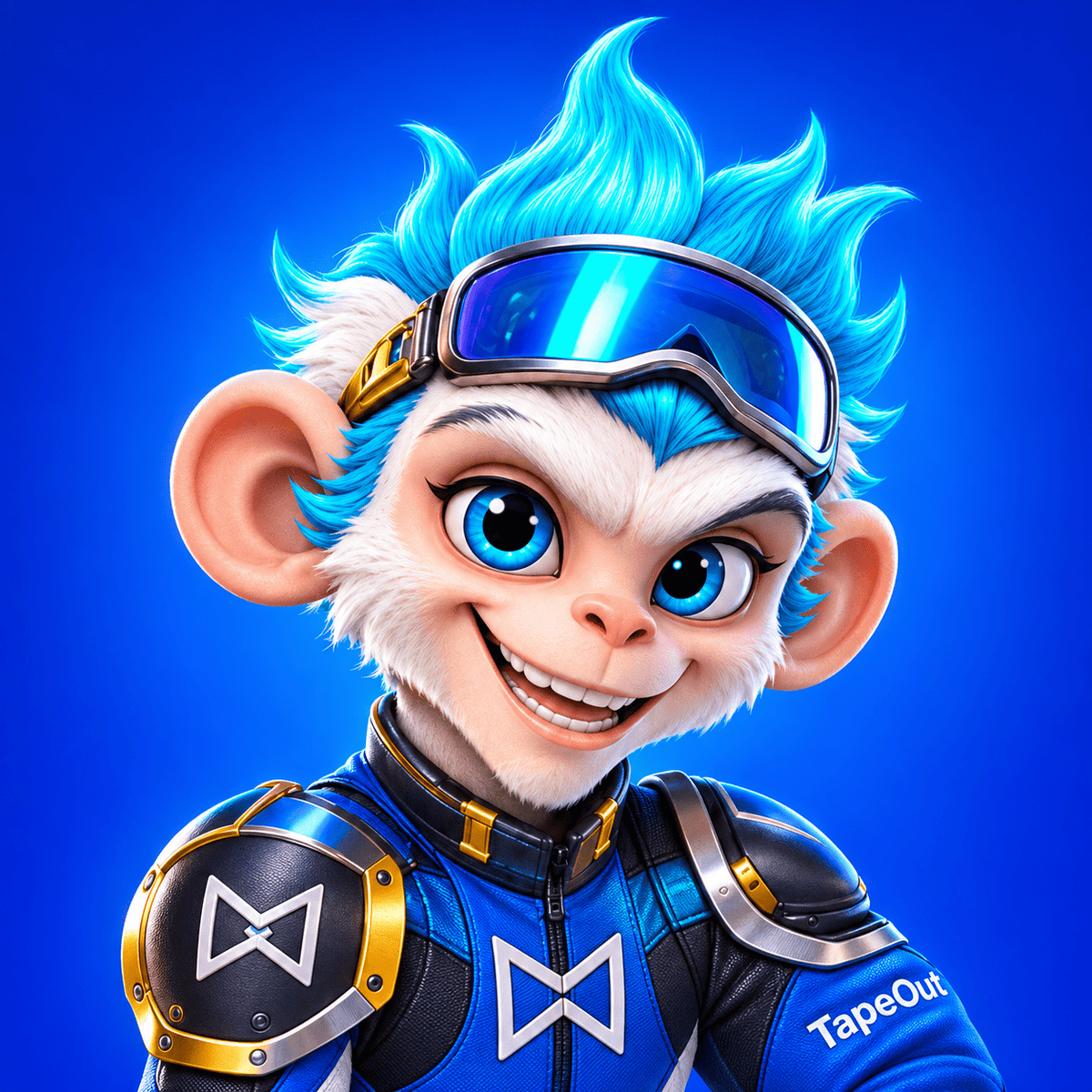
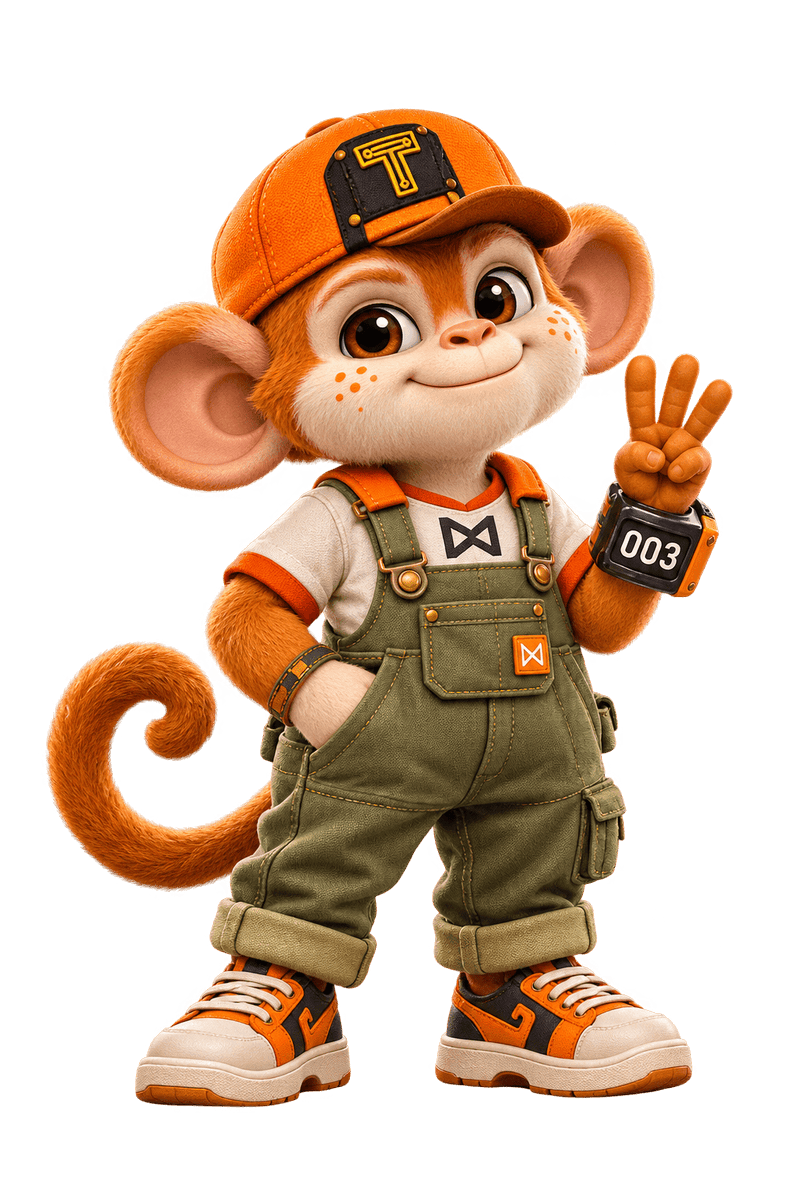
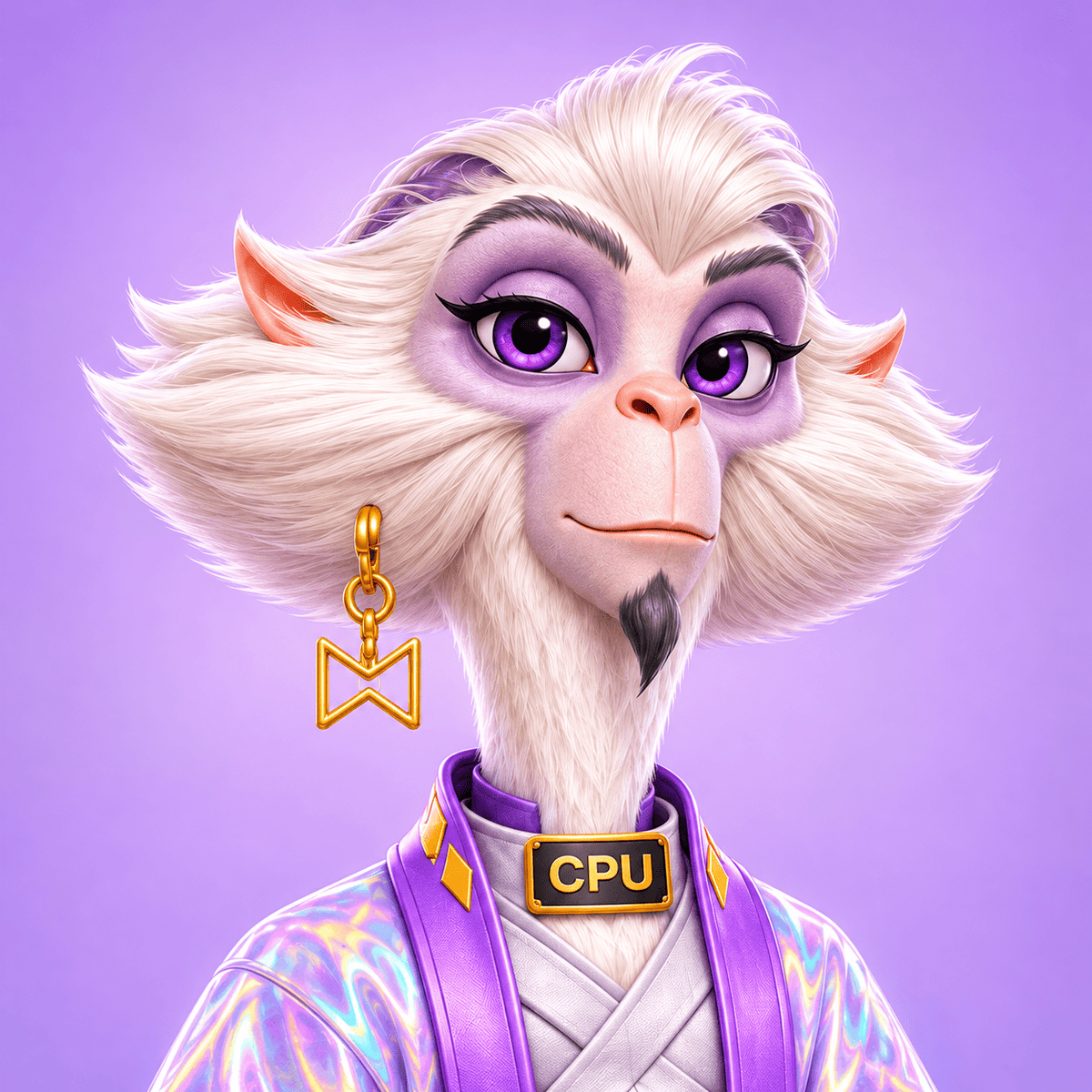
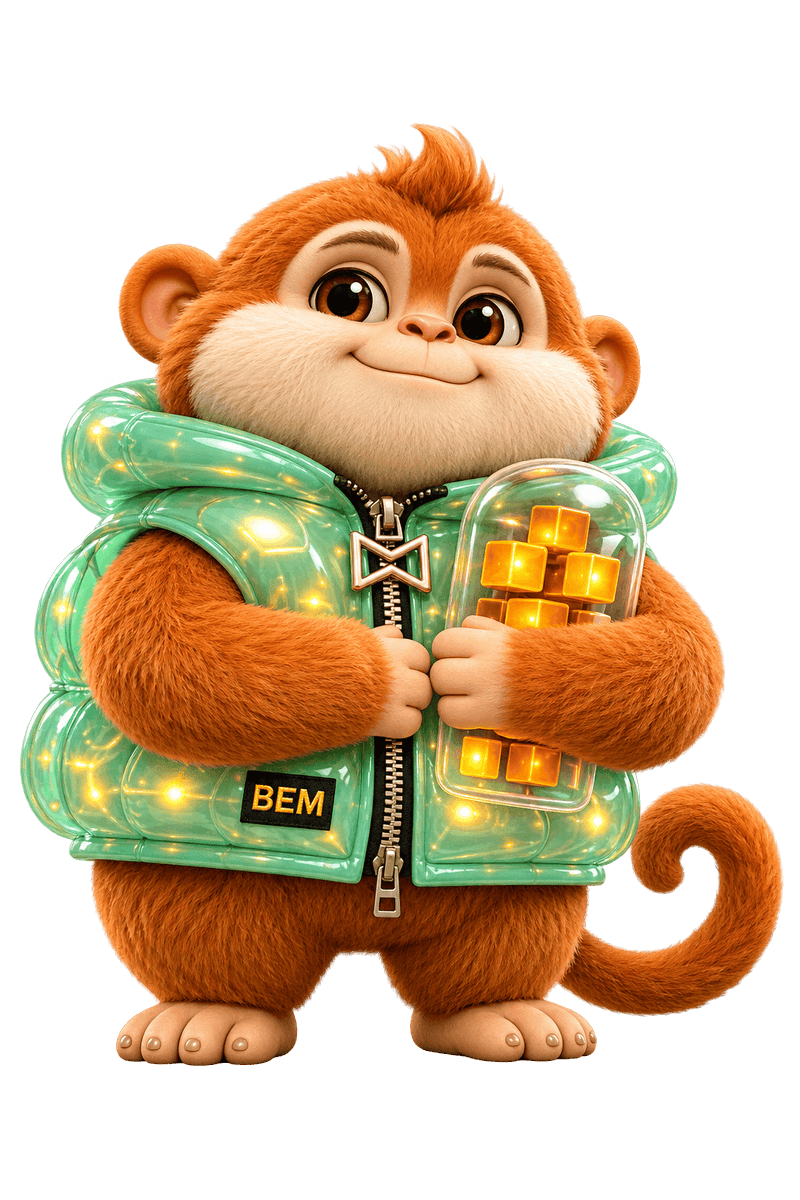
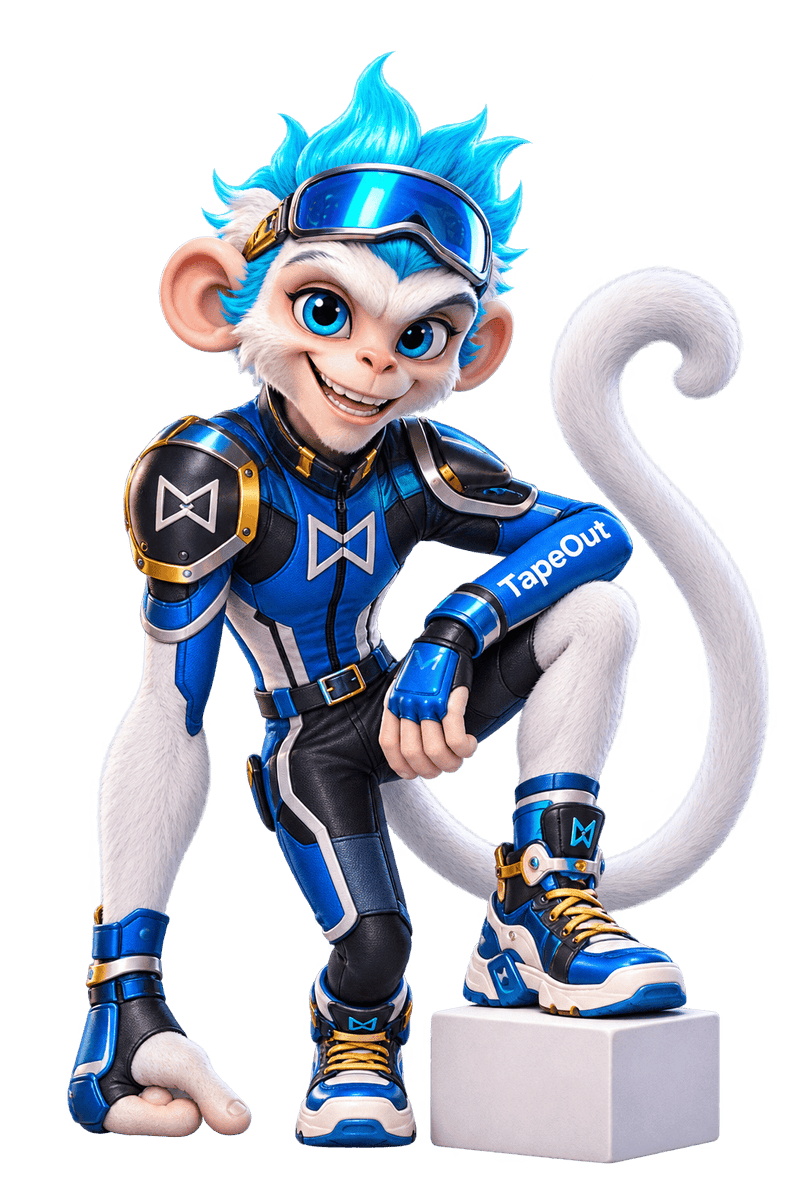
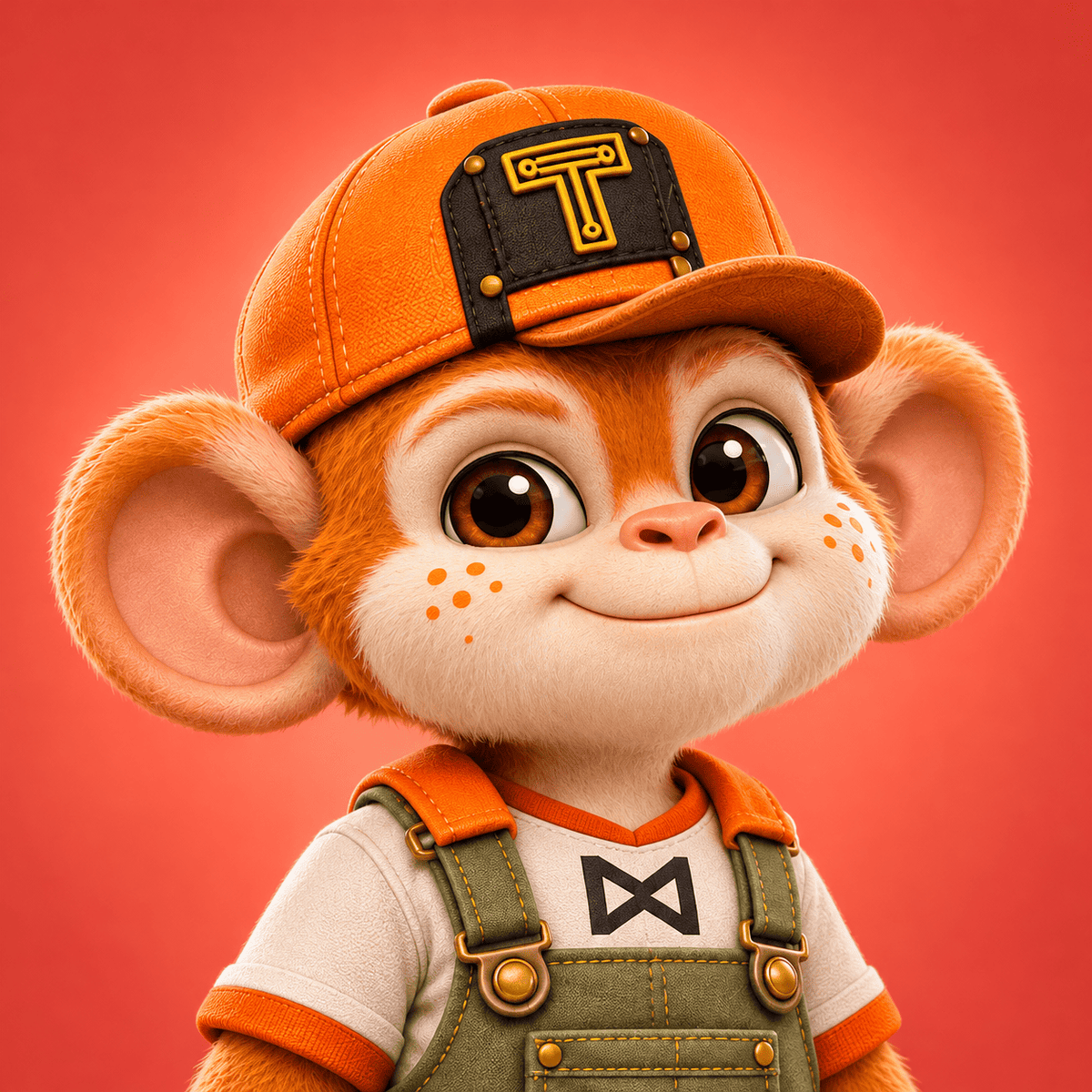
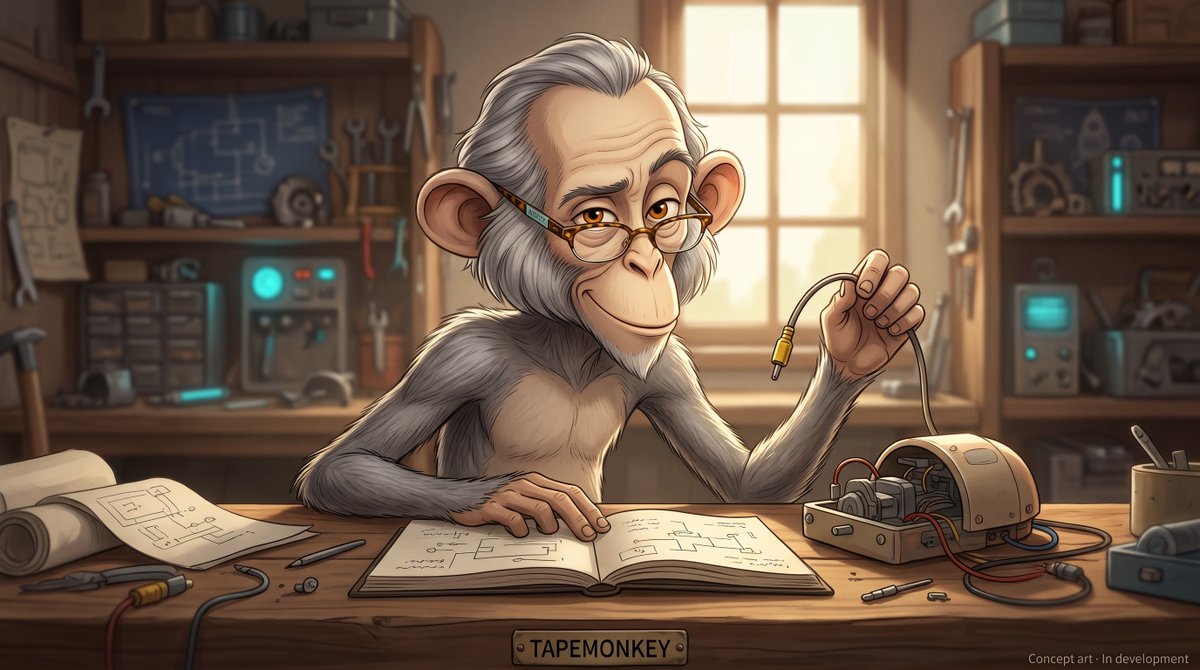
Meet TapeMonkey: a creative world we're building around 8,192 monkeys and eight families.
Our vision: homes to make your own, circuits to play with, and ideas to share.
In development. Follow along as the world takes shape.
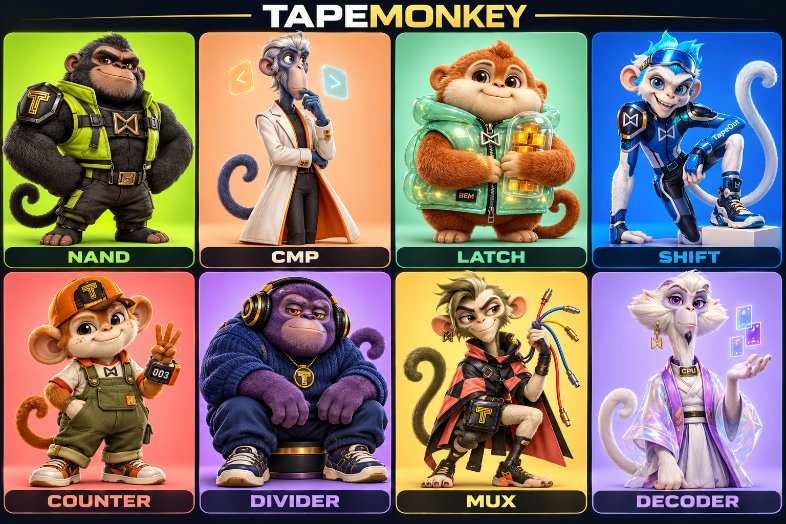
Eight families. Eight new faces. 🐒⚡
Our new characters are now in the local TAPEMONKEY build, with matching portraits and full-body art for the photo studio.
Different faces, materials and personalities. One circuit world taking shape.
Concept art · In development
#TapeOut
TAPEMONKEY keeps taking shape. 🐒⚡
In our local build, you can now pair two characters, make a poster and save a draft to return to.
Small steps toward a world where your monkey has a face, a place and things to create.
Still building. #TapeOut
Thank you for explaining this so clearly. There's another layer worth testing: once a circuit's output changes an action, that action changes what the circuit sees next.
Suppose the same output bits mean “turn left” in one app and “move forward” in another. The first computation can match perfectly. After the movement, the observations—and therefore the next inputs—may diverge. Different later outputs would then be expected, even with identical evaluators.
That suggests two separate questions:
1. Can we reproduce the computation? Replay identical recorded input bits from the same initial circuit state, using the same netlist and evaluation semantics. Compare both outputs and state transitions, beat by beat.
2. Can we explain the behavior? Run the feedback loop with declared observation encoding, action decoding, timing, reset rules and environment version. Record external events or randomness too. Locate the first divergence: observation, input bits, circuit state, output bits, or action.
For Circuit NFTs and Netlist-Bound NFTs, this gives us a useful distinction: verifying which circuit an asset identifies, verifying its computation, and verifying how an application uses it are separate checks.
For TAPEMONKEY, we'd like the monkey to make those boundaries visible. A player should be able to ask, “Why did it turn?” and inspect the observation, memory and output behind that decision.
Our local trials and replay are a starting point; this cross-app comparison remains a proposed experiment.
We see a potential contribution to TapeOut here: reproducible examples and failure cases that other builders can use to test their tools. Each application can offer a different experience while making its use of the circuit inspectable.
This circuit monkey will become part of the TAPEMONKEY family. 🐒⚡
The curiosity and tinkering spirit you inspired could leave their mark across all eight families, each in its own way.
We can't yet promise this exact character will be exclusively yours at launch—the final generation and allocation rules are still taking shape.
But your inspiration already has a place in the circuit world we're building. This monkey's story began with you.
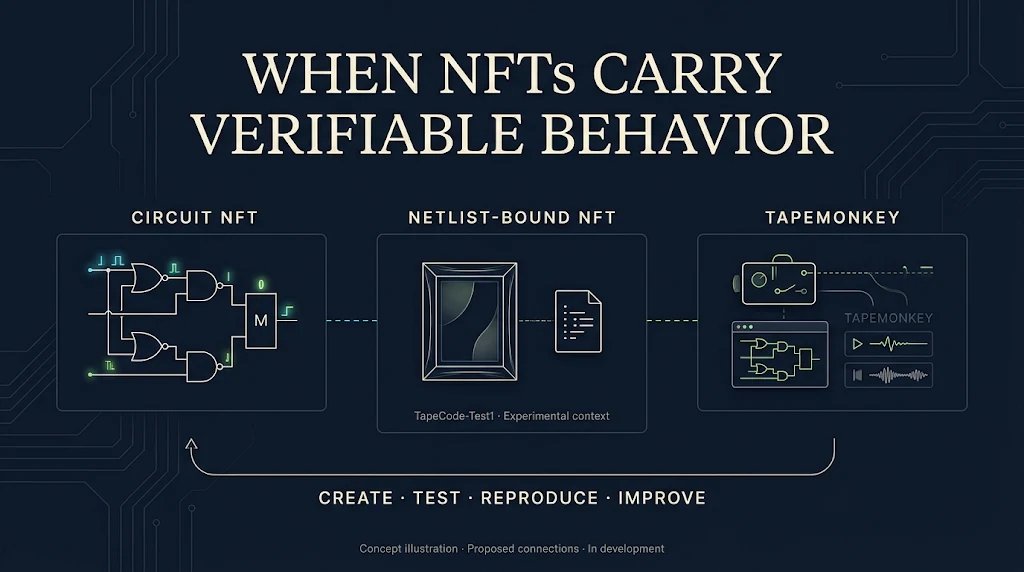
WHEN NFTs CARRY VERIFIABLE BEHAVIOR
If a project's team leaves, can the next builder still establish which rules its NFT refers to—and make that object work in a new setting?
We think this deserves to become a measure of progress for NFTs in TapeOut.
It asks what another person will be able to inspect, understand, and build upon years after an asset is issued.
1. OWNERSHIP, RULES, AND EXPERIENCE
In TapeOut's native mechanism, a Circuit NFT identifies a circuit within a processor contract. The netlist describes its computational structure; evaluation defines how inputs and state produce outputs and the next state. Tape-out here is a protocol operation for publishing a circuit onchain, rather than the manufacture of a physical silicon chip.
Netlist-Bound NFTs explore another relationship: a consistent way to bind a collectible's identity to an image, a netlist, and verifiable source information. The proposal remains unmerged; its requested “721” number should not be presented as a finalized standard.
Together, these layers suggest an interesting object: a recognizable character whose associated rules other tools can inspect and verify.
Ownership, rules, and experience still require separate design.
The token records its holder.
The circuit specifies a computation.
The application determines what inputs mean and how outputs affect its world.
Composability depends on making the relationships between those layers explicit.
2. VERIFIABLE RULES NEED AN EXPLAINABLE ENVIRONMENT
With the same evaluation semantics, initial state, and input sequence, the same netlist should produce the same results. That is the basis for independent reproduction.
But one game might interpret an input as “wall ahead,” while another interprets it as “food ahead.” An identical output can then lead to a very different action.
Binding the same circuit does not, by itself, establish identical behavior across applications.
Our view is that applications also need to declare how they encode observations, interpret actions, initialize state, and identify versions. Otherwise, consistent computation can still produce an experience that users find inconsistent.
A useful goal is to let a player ask why an object behaved a certain way—and give another tool enough information to check the answer.
3. TAPECODE-TEST1 BRINGS REAL CONSTRAINTS INTO THE EXPERIMENT
The Netlist-Bound NFT draft explicitly names TapeCode-Test1 as its motivating case: an existing ERC-721 collection with limited contract capabilities. Its proposed image-and-netlist association must accommodate existing identities, content updates, and tokens that cannot circulate.
This makes Test1 a valuable experimental setting.
A real ecosystem rarely begins with a blank slate. It has old contracts, existing wallets, different marketplace readers, and expectations a community has already formed.
A binding scheme that handles those constraints could offer methods useful to other existing collections: checking which content belongs to a token, recognizing an endorsed association, showing what remains mutable, and identifying changes that require authorization.
Test1 can help investigate whether new capabilities can grow while respecting an existing identity.
That is an argument for its experimental value. Being a case in a draft does not establish that the collection has completed every binding, freeze, or execution interface.
4. ASSOCIATING A CIRCUIT SHOULD CLARIFY RIGHTS
Public computational rules can be studied, simulated, and reproduced. That raises an unavoidable question: when a method can be copied, what does the NFT represent?
It can record a particular object's identity, provenance, and holder. Specific usage rights, container control, and other entitlements must be established through their respective mechanisms.
A collectible associated with a miner's netlist does not thereby acquire that miner or its output. Downloading a design does not automatically grant a commercial license to all of its associated content.
File identity and design difference also deserve separate treatment. Changed bytes can change a file hash without changing the function computed. A structural-hash proposal attempts to recognize certain structural equivalences; that does not establish a general test of functional equivalence for arbitrary circuits.
Token counts, file counts, and meaningful design counts should therefore be examined separately.
Likewise, the fact that an address first published a circuit onchain is distinct from authorship. A design-credits proposal explicitly separates verifiable publication facts from signed claims about design and lineage.
We believe reuse and clear rights can support each other. Independent development becomes easier when builders can determine what they are permitted to do.
5. WHAT TAPEMONKEY SHOULD HELP DEMONSTRATE
TAPEMONKEY is being developed as a world for circuit-driven creation and social interaction: design a circuit, observe a character or device responding, modify it, try again, and share with friends.
We want to make abstract computation an experience people willingly return to.
A monkey stops in front of an obstacle. The player examines its inputs, changes a rule, and runs another trial with the same map and starting conditions. This time, the monkey takes another path.
The circuit now has a result people can discuss.
A friend can suggest a counterexample.
A creator can explain the change.
Another player can reproduce the sequence.
This is where we see TAPEMONKEY's potential long-term contribution to TapeOut: helping people become creators who can understand and modify rules.
Characters and homes give that process an emotional entry point. Clear behavioral feedback gives curiosity a chance to develop into sustained practice.
6. CREATIONS SHOULD RETURN EVIDENCE TO THE PROTOCOL
If these experiences are connected to verifiable Circuit NFTs or netlist bindings, useful records would include the circuit version, initial state, input sequence, and output trace.
An anomaly encountered during play could then become a case a developer can reproduce. Independent interpreters could compare results. Toolmakers could locate disagreements. Standards discussions could address concrete examples.
A finite collection of tests does not replace a proof. A clear counterexample can nevertheless expose an implementation error.
Our argument is that a user-facing project can become a route through which a protocol encounters real usage problems.
Its contribution should be judged partly by the reusable creations and checkable evidence that users leave behind.
TAPEMONKEY already has local circuit and trial workflows. Official processor integration, onchain evaluation, and these NFT-binding capabilities still require adaptation and validation. The direction described here is a hypothesis to test through product development.
7. ONE IDENTITY CAN SUPPORT ONGOING CREATION
Long-term interaction introduces another design question: once an identity commits to a fixed version, how can its user continue experimenting?
We think an application should distinguish the content an identity commits to from the works a user later creates, selects, or modifies. New versions should be identifiable; earlier versions should remain traceable.
This also helps avoid making every experiment a new issuance. People should have room to understand, experiment, and share before choosing whether a result has a clear reason to become a formal onchain object.
One Test1 × TAPEMONKEY experiment worth investigating would be to verify the source, interface, and permissions of a suitable small circuit, adapt it into an observable, replayable device, and document both its origin and the interpretation added by the application.
This would test whether an association can become an experience. It is a research proposal, not a completed integration.
For Test1, the question is how an early identity can become a reference for later creation.
For TAPEMONKEY, the question is whether those creations can sustain participation.
Any eligibility, delivery, or entitlement must come from the rules published for that particular activity.
8. WHAT WOULD COUNT AS PROGRESS?
How many people can explain their creations' behavior?
How many circuits do independent teams reuse?
Can different tools reproduce the same public example?
Do people return to modify, share, and play without a new reward?
Those questions test the technology and the product together.
We value #TapeCodeTest1 because it gives an early community an opportunity to explore real constraints together.
We are building TAPEMONKEY in the hope of extending that exploration into everyday creative experiences.
Circuit NFTs provide computational objects.
Netlist-binding proposals explore verifiable associations.
Applications must demonstrate why people will continue using them.
When independent teams can understand the same object, verify its rules, and keep creating uses for it, TapeOut can accumulate a deeper capability:
Each project's work can become a foundation on which the next builder starts.
@TapeOutWorld@bitcoin2themars@Blonskr
#TapeOut #CircuitNFT #TapeCodeTest1
@XiaoMei_laika@TapeOutWorld@TapeOutCF Thanks for helping the TapeOut community discover what people are building.
We're going to design a TAPEMONKEY character inspired by you. 🐒⚡
What colors, personality, outfits or
You noticed TAPEMONKEY early, and we appreciate your thoughtful questions about how the circuits actually work.
We're going to create a monkey character design inspired by you. 🐒⚡
Drop your favorite colors, personality traits, hobbies, symbols—or a few reference images—below.
Which of our eight families feels most like you? What would your monkey love to build?
Let's make it feel like you.
Eight families. Eight personalities. 🐒⚡
Meet TAPEMONKEY in portraits and full-body form.
The face you recognize. The character you imagine creating with.
Which family would you choose?
Concept art · In development
@TapeOutWorld#TapeOut
WHEN AN NFT CHANGES HANDS, WHAT SHOULD STAY WITH ITS CREATOR?
Imagine three people building a small invention.
One designs the circuit.
One finds the edge case.
One makes it useful in a new setting.
Later, the NFT changes hands.
The new holder receives whatever control the asset's contracts and permissions provide. The contributions of those three people should remain attributable to them.
That distinction matters for a creative ecosystem.
Ownership history answers who held an object. Creation history asks who designed, tested and improved it. Each needs its own evidence. Even a signed authorship claim needs to be assessed alongside the work behind it.
For TAPEMONKEY, this is a principle we want to build around: people should be able to share creations, reuse permitted work and carry their contribution history forward, while keeping personal conversations and private data separate from transferable assets.
Communities around #TapeCodeTest1 also make this question interesting. A shared identity can bring people together; what they create together gives that community a history worth preserving.
We see a meaningful direction for TapeOut here: verifiable objects connected to contributions that others can inspect, discuss and build upon.
Our aim is a world where a new owner can continue a creation, and earlier contributors still have their place in its story.
TAPEMONKEY · In development
@TapeOutWorld
#TapeOut
That's the distinction a useful demo should make visible.
TAPEMONKEY already has local circuit trials and replay. For this comparison, we'd propose two tests:
1. Hold the netlist, evaluation semantics, initial state and recorded input bits constant. The output traces should match.
2. Change the application's declared input/output mappings and show exactly where the visible behavior changes.
The replay package should include those mappings and their versions, so another developer can reproduce the computation and inspect how it becomes an action.
That could turn “cross-app compatibility” into something developers can actually test.
This specific comparison is still a proposed experiment; we haven't set a public demo date.
Been a little quiet here. Hello again, #TapeOut 🐒⚡
The idea behind TAPEMONKEY: give your monkey a circuit brain, watch what it does, then change the design and try again.
A little logic. A lot of personality.
A tiny invention. A very loud "IT WORKS!" 🐒⚡
We're building TAPEMONKEY around that feeling: turning circuit ideas into things you can play with.
What would your first invention do?
#TapeOut@TapeOutWorld
A good idea gets better when a friend pulls up a chair. 🐒⚡
That's the kind of world we're building with TAPEMONKEY.
Who would you invite to your workshop?
#TapeOut@TapeOutWorld
Every workshop has that one monkey asking, "What if we tried this?" 🐒⚡
That's the spirit behind TAPEMONKEY.
What are you tinkering with today, #TapeOut?
@TapeOutWorld
Eight families. One world to build. 🐒⚡
Meet TAPEMONKEY's future-lab crew.
A world of circuits and shared creations is taking shape.
Which family would you build with?
@TapeOutWorld@bitcoin2themars@BruceBlue
Concept film · In development.
One tap. The light remembers. 🐒💡
A LATCH-inspired idea from the world we're building with TAPEMONKEY.
What would you create with a circuit that remembers?
@TapeOutWorld@bitcoin2themars@Blonskr
Concept video · In development.
@0x4ae4 TAPEMONKEY has a few playful ideas for #TapeCodeTest1 too. 🐒👀
Some experiments deserve a second act.
The rest of the sketch stays under wraps… for now.