🧹 DNSimple eliminated 50 Vue components and all jQuery while migrating to Rails 8.1. The replacement? Turbo, Stimulus, and server-rendered HTML, with business logic back where it belongs, in Ruby. https://t.co/MToieqL1WC
RubyGems e Bundler 4.1 saíram.
Override no Gemfile (fim do fork por upper bound), prune (fim do rm -rf no Dockerfile) e credential store (chaves no cofre do SO, não mais em texto puro).
Tudo opt-in. Nada muda até você pedir.
Vídeo completo no canal.
https://t.co/erdwzXGiR4
BREAKING: A mathematician at Anthropic claims to have used the company's AI to solve the Riemann hypothesis, the most notorious open problem in all of math
https://t.co/nEXAyIkvSt
The creator of Elixir vs. an AI coding agent
@josevalim studied the codebase, wrote the spec for Codex, then wrote the code himself. He finished first. Codex’s solution was 4x bigger.
ElixirConf EU 2027 CFT is open till 15 Dec: https://t.co/lMZ0NMaLmI #ElixirLang
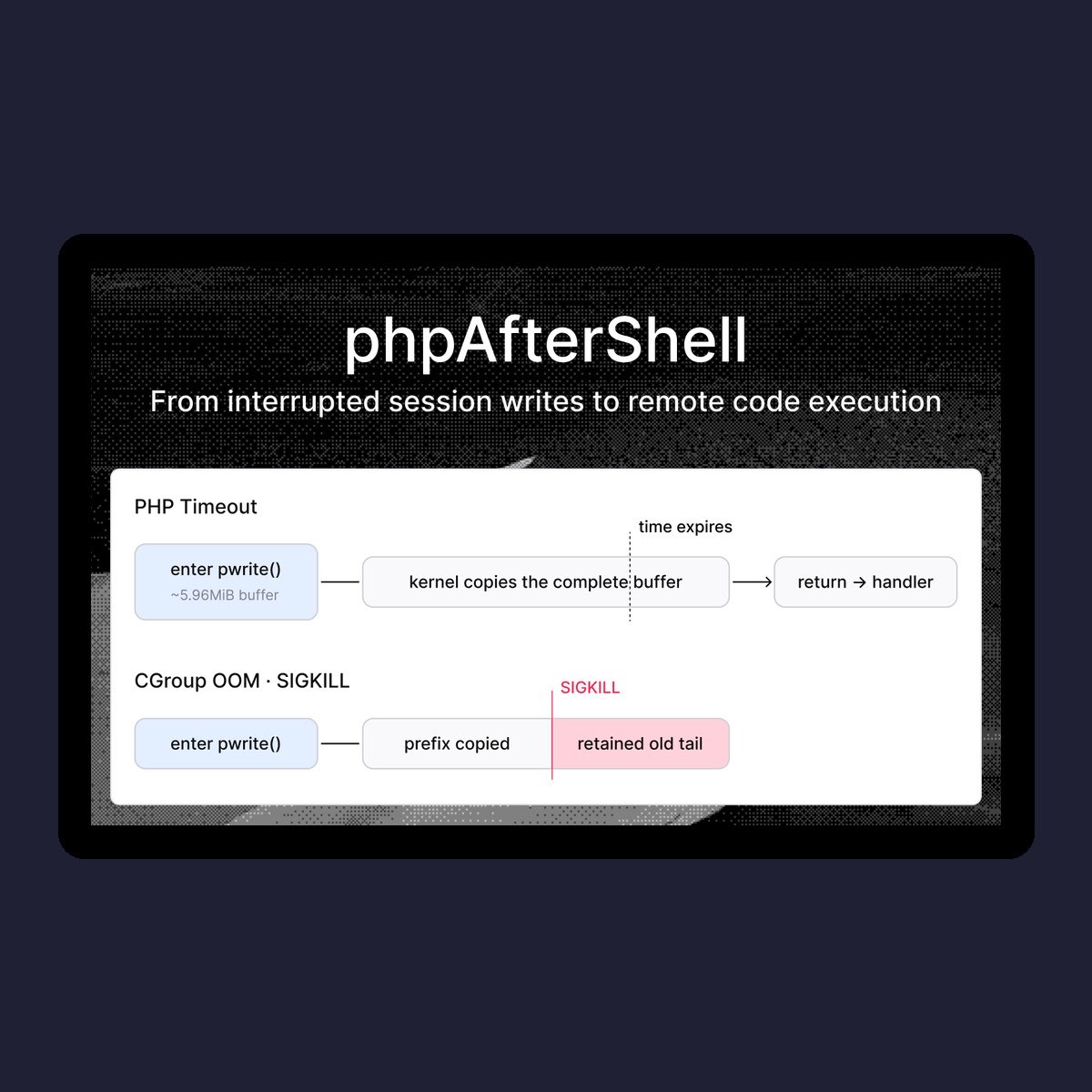
‼️ BREAKING: Researchers broke past PHP's fix for the php2shell flaw and can again run their own code on web servers, no login needed.
Security firm depthfirst says the latest PHP releases are still vulnerable. The bug, CVE-2026-126714, is rated 9.2 out of 10.
https://t.co/EmNk1y4tjf
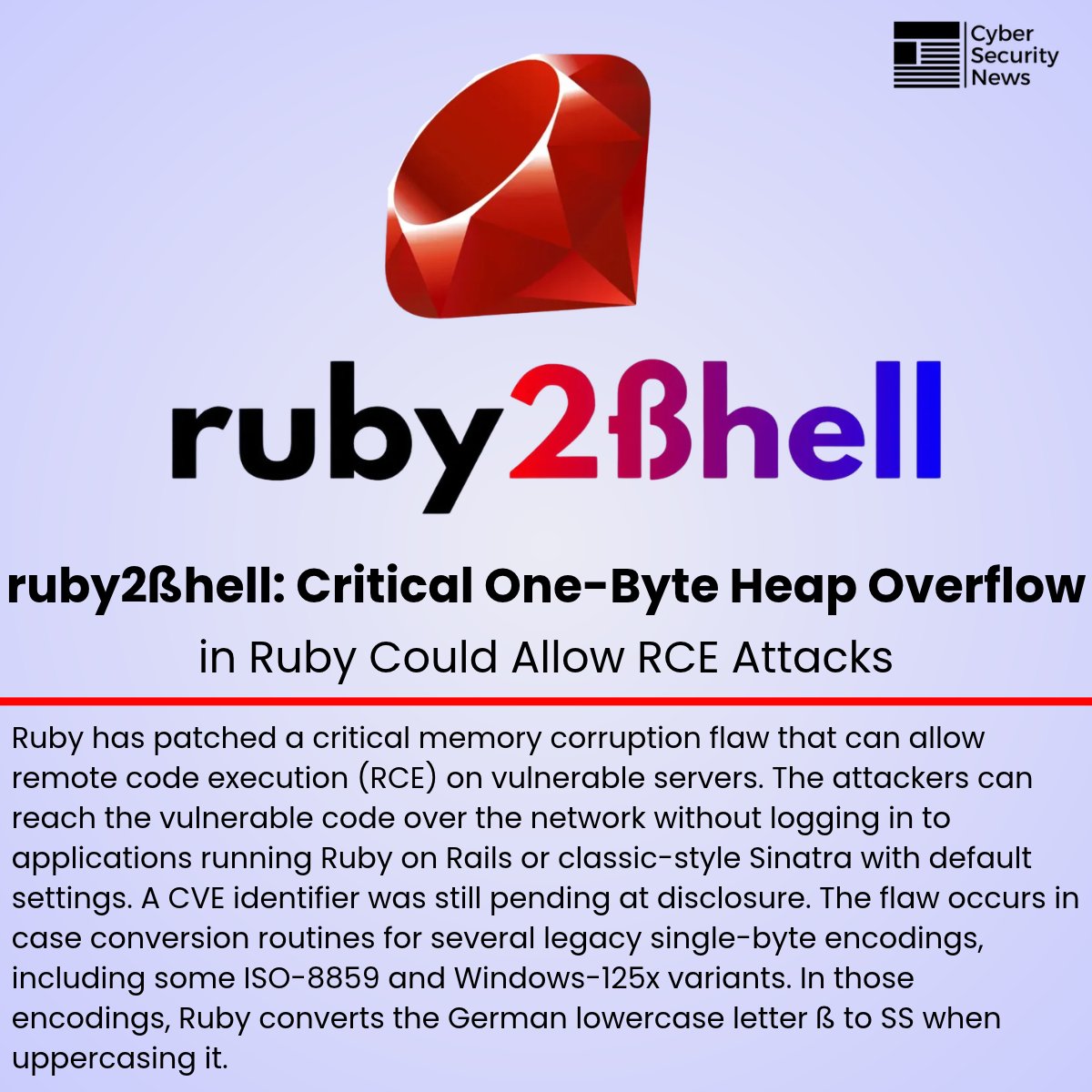
‼️ ruby2ßhell: Critical One-Byte Heap Overflow in Ruby Could Allow RCE Attacks
Details: https://t.co/UDYHUK7ZJu
Ruby has patched a critical memory corruption flaw that can allow remote code execution (RCE) on vulnerable servers. The attackers can reach the vulnerable code over the network without logging in to applications running Ruby on Rails or classic-style Sinatra with default settings.
A CVE identifier was still pending at disclosure. The flaw occurs in case conversion routines for several legacy single-byte encodings, including some ISO-8859 and Windows-125x variants. In those encodings, Ruby converts the German lowercase letter ß to SS when uppercasing it.
#CybersecurityNews #ruby #ruby2shell
Clojure 1.12.7 acabou de sair e desligou a serialização de funções por padrão.
Por quê? Porque AFunction + PriorityQueue + apply + load-string virava RCE durante ObjectInputStream.readObject.
Só com classes do clojure.jar + JDK. Sem read-eval.
Atualiza pra 1.12.7 e nunca deserializa dado não confiável.
#Clojure #Security #Java
https://t.co/u6Hbi1Rv2K
We, the Ruby core team, have joined the team maintaining Docker's official "ruby" image.
Previously, it took 16 hours after a Ruby release for the images to be published on Docker Hub. This time, they became available about an hour after the release.
https://t.co/JJAr7s08sI
We released Ruby 4.0.10, 3.4.13, and 3.3.14, and published security advisories about Regexp and String case conversion.
https://t.co/vgfnDpIPaO
These include vulnerabilities that may lead to remote code execution. Please upgrade immediately.
A Voyager 1 chegou a 1 dia-luz da Terra.
Ainda rodando o mesmo assembly de 1977.
Baseado no computador da Viking. ~70 KB total. Sem OS.
A NASA ainda patcheia de bilhões de km.
Enquanto o tablet do carrinho de pipoca da pracinha vai pifar em 8 meses. 🤯
#Voyager1#Assembly #SoftwareEspacial
https://t.co/Xg6TwSTbHb
Em 18 de novembro de 2026 saiu o NGINX2Root, conjunto de cinco vulnerabilidades no nginx (mais uma no kernel Linux via SCTP).
O principal é o CVE-2026-123007: corrupção de memória no flow control do HTTP/2. Com HTTP/2 ativo, um atacante não autenticado consegue executar código como o worker do nginx. Em configuração padrão isso já basta.
Encadeado com o bug do SCTP, chega a root no host (incluindo em container). O código vulnerável está lá desde o nginx 1.9.5 (2015). Versões afetadas: 1.9.5 até 1.31.8.
Correção
Atualize para nginx 1.31.9 (mainline) ou 1.30.7 (stable). Depois do update faça restart completo, reload não troca o binário! Se o pacote ainda não chegou, desligue o HTTP/2:
nginx ≥ 1.25.1:
listen 443 ssl;
http2 off;
Versões anteriores: tire o http2 do listen:
listen 443 ssl;
Confirme de fora que não negocia mais h2. Isso bloqueia os dois CVEs de HTTP/2. Os outros três exigem configs específicas e não são resolvidos só com isso.
Impacto de ficar sem HTTP/2
Perde multiplexação (vários requests em uma conexão), compressão de headers e priorização.
Em páginas com vários assets (caso comum no Rails, mesmo sem bundle monstro) a latência sobe, principalmente em conexões mais lentas. Com poucos arquivos grandes o efeito é menor. É mitigação temporária, atualize o quanto antes.
🚨 Critical nginx vulnerabilities disclosed. Immediate action recommended.
If you run nginx, check whether your servers are affected and update to the patched version immediately. If you cannot upgrade, follow the mitigation guidance at https://t.co/ry2F1UMUVk
Today we’re disclosing nginx2root, five distinct vulnerabilities in one of the world’s most widely deployed web servers, each capable of unauthenticated remote code execution under affected conditions. One of these vulnerabilities affects nginx’s most common configuration. We’ve also demonstrated a fully remote, unauthenticated exploit chain that escalates from nginx RCE to root access on the underlying server, using a separate Linux kernel vulnerability.
Why this is so important:
One of these bugs has been hiding in nginx’s HTTP/2 implementation since 2015. That’s more than a decade in software that powers roughly a third of the web. Every official release from 1.9.5 through 1.31.8 contains the vulnerable code, including the master branch as of Nov 10, 2026.
A Xint researcher found the specific vuln that hits nginx in its default config. This discovery was around the same time he found another critical vulnerability in a different project that we cannot talk about yet due to the same concerns as nginx2root. We took those learnings and incorporated them into the harness as a new, general Xint feature (that is, not fine-tuned to nginx), which then found the other 4 critical nginx vulnerabilities with no human guidance.
We coordinated disclosure with the nginx maintainers and major cloud providers to help make fixes available before publication.
Technical details, affected versions, and remediation guidance:
https://t.co/ry2F1UMUVk