Claude Code users are split into two
groups right now.
Group 1 is prompting it like a smarter Copilot and getting smarter Copilot results.
Group 2 gave it a memory, a planning phase, dedicated MCPs for each stage of development, and pre-written prompts that make it think like a staff engineer before touching a single file.
Group 2 is lapping everyone and nobody's talking about it.
The difference isn't talent. It's not even prompt skill. It's that they stopped treating it as a tool and started treating it as a system.
Plan → Code → Review → Test → Document. Each phase has its own context, its own tools, its own prompt. Nothing bleeds together. Nothing gets lost.
That's what this setup is. CLAUDE.md as the brain. Memory MCP so decisions persist. Context7 so it always has fresh docs. GitHub MCP so it's actually reading your repo, not guessing.
And the prompts are already written. The whole thing is free and public.
The gap this creates compounds every single week. Some people reading this will use it. Most won't. That's kind of the point.
Andrej Karpathy spent 2h showing how he actually uses AI day to day
he's a co-founder of OpenAI and led AI at Tesla, so when he shows how he works, it’s worth watching
and the whole session is just him telling the machine what he wants in simple terms, like he's briefing a coworker
watch what's actually happening the entire time:
> he describes the task in normal words
> it goes off and does the work
> he glances at the result and nudges it with one more sentence
that's the whole skill, and you've had it since you learned to talk
the only gap between that and a worker that runs on its own is handing that sentence a schedule and the tools to act
check his work, then build the version that keeps working when you stop
EVERYTHING CLAUDE CODE JUST OPEN SOURCED A FULL AI ENGINEERING SYSTEM.
28 agents, 116 skills, 59 commands, MCP integrations, hooks, rules, and even a built in security scanner.
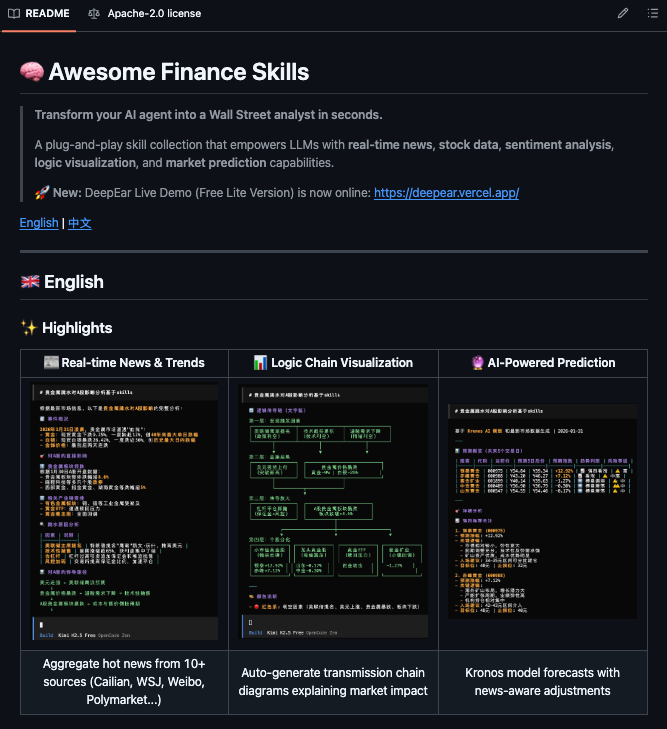
🚨BREAKING: Someone open-sourced a plug-and-play skill pack that gives any AI agent the full capabilities of a professional financial analyst.
It's called Awesome Finance Skills, and it installs in under 30 seconds.
Here's what your agent can do the moment you install it:
→ Pull real-time financial news from 10+ sources including WSJ, Cailian, Weibo, and Polymarket
→ Fetch live A-share and Hong Kong stock data with full OHLCV history
→ Run FinBERT sentiment analysis on any news story and return a score from -1.0 to +1.0
→ Forecast price movements using the Kronos time-series model with live news adjustments
→ Track how investment signals strengthen, weaken, or get falsified over time
→ Auto-generate market transmission chain diagrams that explain exactly how one event ripples into another
→ Write a full professional research report from scratch — plan, write, edit, and chart in one command
→ Search the web and run local RAG across your own documents
It works with Claude Code, OpenClaw, OpenCode, Codex, and Gemini CLI right out of the box.
The same analysis that hedge funds pay six figures for in Bloomberg terminals is now a free git clone away.
100% Open Source. MIT License.
BREAKING: AI can now build financial models like Goldman Sachs analysts (for free).
Here are 12 Claude prompts that replace $150K/year investment banking work (Save for later)
The open-source community is amazing.
We released a tiny TTS model under 25MB. And someone made a web-browser demo within few hours.
Yes, its running locally in the web-browser
Thanks clowerweb!
Introducing Kitten TTS, a SOTA tiny text-to-speech model
- Just 15M parameters
- Runs without a GPU
- Model size less than 25 MB
- Multiple high-quality voices
- Ultra-fast - even runs on low-end edge devices
Github and HF links below
Building SaaS with Next.js → A Component-Based Guide
→ This tutorial will guide you through the key components and their interactions when building a SaaS (Software as a Service) application using Next.js, referencing the "SaaS Architecture Guide: Next.js" diagram.
1. Next.js Application (Core)
→ Acts as the central hub of your SaaS
→ Handles front-end UI, API routes, SSR/SSG for performance and SEO
→ Connects with and orchestrates all supporting services
2. Authentication Service (e.g., Auth0, Clerk)
→ Manages user registration, login, and sessions
→ On login attempt, Next.js redirects user to auth service
→ Auth service returns a token that Next.js uses to unlock protected routes
3. Database (e.g., PostgreSQL, MongoDB)
→ Stores all application data: users, tenants, settings, etc.
→ Next.js API routes or server functions handle all DB interactions
→ Enables full CRUD operations for the app
4. API Layer (e.g., tRPC, GraphQL)
→ Provides structured access to backend services
→ Next.js sends requests to this layer instead of directly hitting DB
→ Improves logic separation, performance, and maintainability
5. Payment Processing (e.g., Stripe)
→ Manages subscriptions, one-time payments, and invoicing
→ Next.js initiates and communicates with payment service
→ Redirects users or uses secure APIs to handle transactions
6. Tenant Management
→ Handles multiple customer accounts within one SaaS app
→ Ensures data isolation and tenant-specific settings
→ Next.js detects tenant via URL, login context, or headers
→ Filters content and DB queries accordingly
7. Feature Flags
→ Dynamically enables or disables features per user or tenant
→ Supports A/B testing, gradual rollouts, and feature toggling
→ Next.js checks flags before rendering feature components
8. Analytics & Monitoring
→ Tracks user activity and application performance
→ Next.js logs events like page views and interactions
→ Sends telemetry to analytics and monitoring tools
→ Helps uncover user patterns and system issues
9. Email & Notifications
→ Sends transactional emails and alerts: signups, billing, updates
→ Next.js triggers notification logic based on app events
→ Integrates with external email/notification services
10. File Storage (e.g., S3)
→ Stores uploaded files, media assets, or binary data
→ Next.js handles uploads via API routes or direct client → storage flows
→ Retrieves secure URLs for file access and delivery
Want the Full SaaS Blueprint with Code and Diagrams?
→ Grab the complete SaaS Architecture Guide: Next.js here:
https://t.co/G10lF0ktPJ
→ Learn how to build, structure, and scale a real-world SaaS application using Next.js from the ground up.
Local MCP servers can now be installed with one click on Claude Desktop.
Desktop Extensions (.dxt files) package your server, handle dependencies, and provide secure configuration.
This is a solid 29 videos playlist on how to build DeepSeek from scratch. It covers theory and code, from the very foundations to advanced.
Self attention, multi-head [latent] attention, GQA, how DeepSeek rewrote Quantization, etc.
One video a day and you’ll finish in a month.







![neon31HS's tweet photo. [STANDARD] Blax reached #1 Legend with Aggro Demon Hunter.
Score: 14-1
▼ Deck Code and more:
https://t.co/T6sdNgzidT
#StandardHS #Hearthstone https://t.co/F9VFIKvYJL](https://pbs.twimg.com/media/Gx1YKUEWcAAx0av.png)
![neon31HS's tweet photo. [STANDARD] star reached #1 Legend with Quest Warlock.
▼ Deck Code and more:
https://t.co/OaSkyD2imf
#StandardHS #Hearthstone https://t.co/Y3l7vOLHzb](https://pbs.twimg.com/media/Gx1YXiJXQAACFat.png)


![Hesamation's tweet photo. This is a solid 29 videos playlist on how to build DeepSeek from scratch. It covers theory and code, from the very foundations to advanced.
Self attention, multi-head [latent] attention, GQA, how DeepSeek rewrote Quantization, etc.
One video a day and you’ll finish in a month. https://t.co/k2mhpa8pla](https://pbs.twimg.com/media/GtlhfzHWAAA-jpu.jpg)





