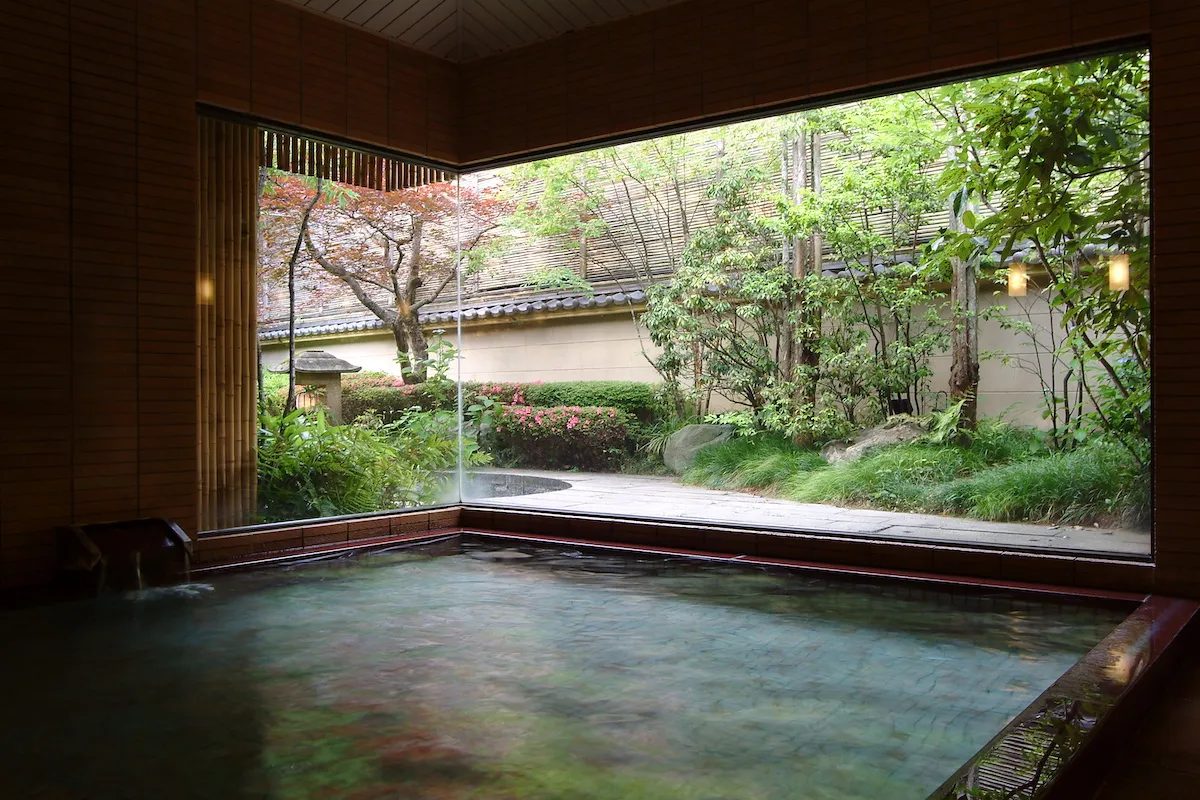
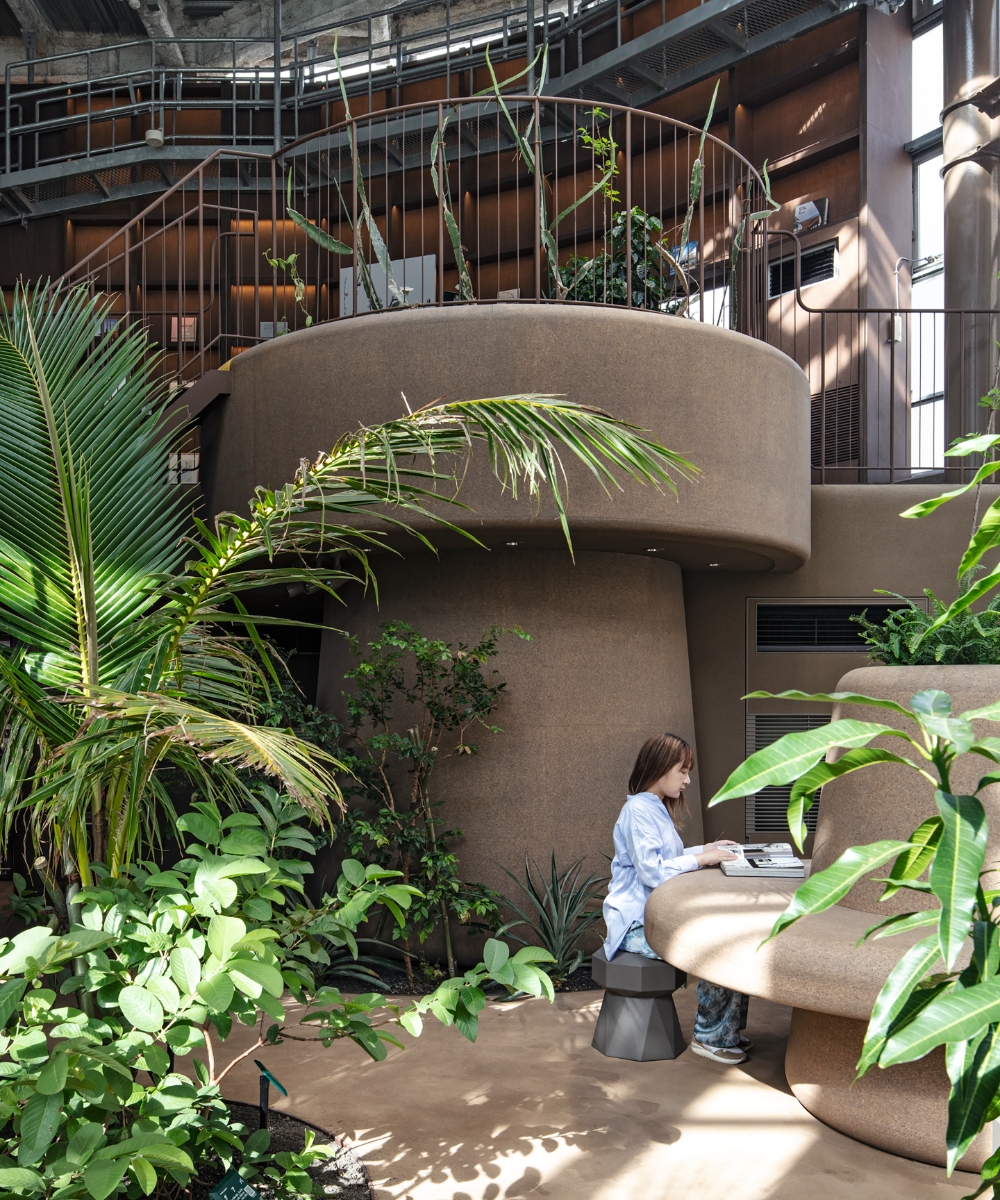
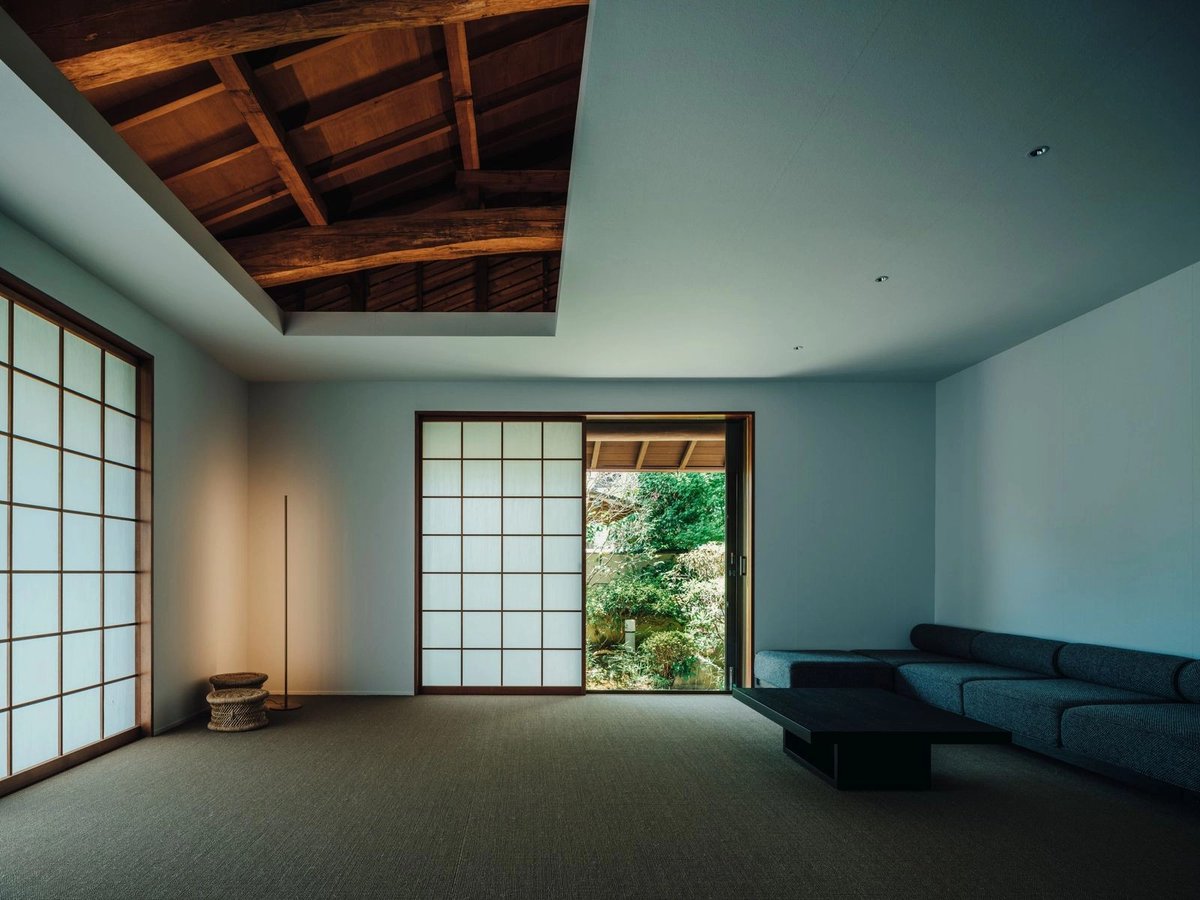
Vogue Japan's list of aspirational ryokan — the ones Japanese travelers save up for. The photography tells you what these places prioritize: the bath, the garden view, the kaiseki spread. Not the lobby.
📷 @voguejp
Masakazu Tsujibayashi built his own house on a triangular plot in Osaka where three roads meet. The upper floor is clad in the same material as the roof and shaped with a pitch that follows the site's geometry — the eave it creates faces a different street on each side.
The project sits in a neighborhood of narrow alleys, tenement houses, and newer infill. Rather than contrasting with it, the building adjusts to it: each facade responds to the particular condition it faces.
📷 Masakazu Tsujibayashi Architects
A steel hut placed on top of an 18-year-old reinforced concrete building in Shinagawa, Tokyo. Designed by PERSIMMON HILLS architects, completed 2024.
Adding steel on top of an existing RC structure would have overloaded it. So the team cut away part of the existing rooftop slab first. The weight of concrete removed roughly offsets the weight of new steel added.
Inside the addition: triangular planes and diagonal members form a polyhedral roof. The ceilings are finished in wood — reading nothing like the solid horizontal beams of the RC floors below. Three generations now live in the building. The intention is that each one will alter it to suit themselves.
📷 Kenta Hasegawa via https://t.co/ht4GqPjOdt
A 50-year-old farmhouse in Goshogawara, Aomori, empty for five years. The owner's grandfather was an apple farmer — his storehouse is still attached to the west wall.
Shotaro Oshima Design Studio kept the exterior completely intact. Same roofline, same silhouette, the kind of postwar wooden house going vacant all across rural Japan. Inside, nothing matches the facade.
New U-shaped walls now hide the first-floor windows from the road — you can't tell openings exist. What appear to be second-floor windows from outside are actually clerestory windows lighting the first-floor rooms. You only understand the building's layout once you've walked through the front door.
Oshima calls this the "misalignment" (ズレ). The memory of the house stays. The interior becomes something else entirely. Completed 2023.
📷 Yuki Motegi, Shotaro Oshima
A house in Nakano, Tokyo, built into a site that gets no useful south light. Designed by Hiroyuki Onuma Architectural Design, completed 2025.
The solution: a curved linear terrace called 飾り庭 (kazari-niwa) that bends away from the building's own shadow, threading through the airspace between neighboring buildings toward daylight. It extends outward from a large north-facing window on the second floor.
Inside, a skip-floor section wraps circulation around shelves of ceramics, books, photographs, and plants — the owners' accumulated objects treated as the interior's texture. Step out to water the plants and you end up in conversation with whoever's passing.
📷 Takuya Seki via https://t.co/ht4GqPjOdt
A painter's house on a hillside below Mount Asama in Komoro, Nagano. Designed by KKALA, completed 2025.
The section follows the natural slope exactly. Floors step up in terraces around a central atelier — each room at a slightly different level, connected by the gradient of the ground itself. From the desk, the sightline moves across a dandelion field toward the Alps at sunset.
The architects put it plainly: everything in this house is simple and can be found in any home. There is nothing special. The slope does the work.
📷 KKALA / Ryusuke Sano via https://t.co/ht4GqPjOdt
In Nerima Ward, Tokyo, Shin Aoki and Partners pulled a compact house back from the street line — opening a private terrace and garden where most buildings here push flush to the sidewalk.
The facade is clad in wood and copper, its forms soft and three-dimensional, bulging and receding rather than meeting the street with a flat plane. Inside, the same logic continues: one continuous room with no internal divisions, just niches and ceiling heights that shift as you move through.
A central column anchors the interior, supporting a circular wooden table. At the garden edge, private planting meets public streetside greenery — no fence between them.
📷 Shin Aoki and Partners
A 34-year-old house in Hatsukaichi, Hiroshima — corner lot, hilltop, views of the Seto Inland Sea and Miyajima to the south. Designed by ure, completed 2024.
The new owners are the third family to live here. The house was solidly built and well cared for; it didn't need to be remade. The architects added new shoji, made careful material choices, and opened up the roof structure overhead — the small-scale timber framing of the 小屋組 now visible, creating a layer of space that wasn't there before.
No structural changes. The house will keep adjusting as the family settles in.
📷 Tatsuya Tabii via https://t.co/ht4GqPjOdt
Three squares, each rotated 45° to the street, set side by side on a tight lot near Inokashira Park in Mitaka, Tokyo. The rotation carves garden pockets between the diamonds — you can't face the neighbors without also facing a garden.
Sakuma Tetsu's reason for the rotation is structural: a square's diagonal is its longest internal dimension. Orient a room along it and you maximize how far you can see across the space. Here, every major sight line ends at garden trees. A central void lets you look straight up to sky.
📷 https://t.co/PnVb2E6hQd
A 70mm paper balloon weighing 4.5g hangs in an 8m stairwell void in this Kanagawa house. It moves year-round from the slow drift of air through the building.
The house doubles as a café and a family home. A lattice shelf system on the street-facing wall acts as an adjustable blind: textile panels cut from leftover fabric scraps can be rearranged to open the room for shop hours, then reconfigured for quiet. At night the edge grain of the custom laminated plywood shelves glows through the glass.
Two gardens: a 3.5-tsubo enclosed courtyard at ground level, and a rooftop terrace facing Nanamen-zan's cherry blossoms in spring and Tama River fireworks in autumn. Designed by Nakanishi Yasutaka, completed 2021.
📷 Nacása & Partners / TECTURE MAG
Suzuko Yamada Architects built a house on 26 square meters in Nakano, Tokyo — lot edge to edge, no setback.
The concrete perimeter is thick enough to contain the staircase, storage, and a parallel set of cat walkways running at a different level from the human ones. Two cats, two routes through the same section of building.
Yamada called the interior structure a "string of voids." From the outside it reads as a single Brutalist block.
📷 designboom
A courtyard house in Hayama, Kanagawa — a resort town where narrow lanes thread between summer villas. Designed by Fujiwara Muro Architects (藤原・室建築設計事務所), completed 2025.
The site sits in a dense residential pocket. Privacy was the constraint; the courtyard was the answer. Curved white plaster walls wrap the inner yard — the finish matches the kitchen inside, tying the two together. A deep overhang cuts the summer sun.
There's an outdoor shower in the courtyard for rinsing off after surfing. A staircase leads directly from the yard to the second-floor deck. Guests and the dog arrive upstairs without coming through the front door.
📷 Katsuya Taira via https://t.co/ht4GqPjOdt
Plan 21's Small House in Kawasaki is built almost entirely in cypress — pillars, beams, and exterior cladding from the same timber. Architect Umihiko Cho kept the roofline intentionally low to avoid standing out in an established residential neighborhood outside Tokyo.
Inside, the loft floor is suspended from the ceiling rather than supported from below, so it reads as floating within the single volume.
Designed for a retired couple who had finished raising children and no longer needed large rooms. The whole thing is an edit.
📷 Plan 21 via designboom
From the street it reads as a low-pitched gable — a single-story house in Shizuoka. Step inside and you have the full volume of two floors.
Ishizaki Architectural Design folded two different roof pitches over an L-shaped plan. The ridge runs diagonally, pulling the eye toward the far corner. A 2.7-meter cantilevered overhang — built on a truss — has a slit cut along its length. The quality of light under the eaves changes with the season.
The ground level sits just above the road. Enough to deflect a stranger's sightline. Enough to handle flooding.
📷 Norihito Yamauchi via https://t.co/ht4GqPjOdt
Nendo split a weekend house into six cottages on a 5,800-square-meter hillside in Karuizawa.
Each cottage is about 20 square meters and handles a single function — kitchen, dining, one bedroom each. The family of four gets individual spaces without sharing walls.
The black roofs vary in height and tilt slightly toward each other. Nendo called it "holding hands."
Mt. Asama sits in the gap between them.
📷 designboom
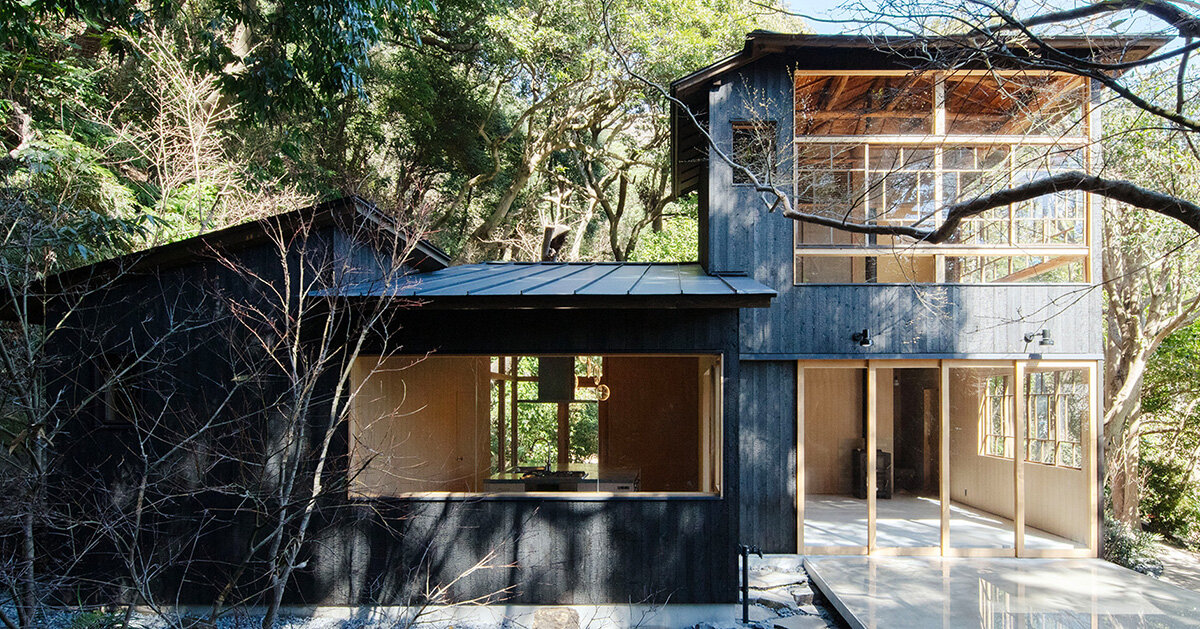
Yuji Okitsu arrived at this 90-year-old house in Kamakura to find only the pillars. Floors, walls, and ceilings had been stripped out — just exposed wooden posts standing among the hillside trees.
He left them visible. The renovation preserves the original framework rather than concealing it. Foundation stones were restored. Window frames were restored. The exterior is clad in yakisugi — charred cedar boards — to mark the difference between old structure and new intervention without hiding either one.
The annex now functions as an atelier: a space for the clients to host artists and culinary experiments.
📷 designboom / Yuji Okitsu
The Kanagawa Institute of Technology campus in Atsugi had plenty of multifunctional rooms. What it did not have was a place to do nothing in particular.
Junya Ishigami's 2020 plaza sits between the existing KAIT workshop and the open campus: a semi-outdoor threshold that is neither fully inside nor outside. He retained part of the artificial campus ground while introducing a canopy that draws a horizon line through the architecture itself. Wide planes of ground and sky converge at the edge.
He called the design principle experiential flexibility. No program, no furniture, no direction. Just a space where the campus runs out.
📷 https://t.co/u472Y9EPiX
A concrete house in Okinawa, by IGArchitects, on a narrow sloping lot bordered by apartment towers on one side and a cemetery on the other.
The pyramid form is a deliberate reference to Okinawan ancestral tombs — structures built to survive typhoons and function as cultural gathering spaces across generations. IGArchitects used the same reasoning: a closed, monolithic volume designed to endure changing ownership and purposes, not just one household.
Most buildings in the area use large openings. This one turns inward. Light enters in soft streams through carefully placed cuts in the concrete mass.
📷 IGArchitects
Two vacant buildings on a 350m² plot in Atami: a single-story bungalow formerly used as a villa, a two-story house formerly used as a residence. naoshi kondo studio converted both into a dormitory with a café, completed 2021.
The bungalow's exterior was redesigned to look as though it's half-buried in the hillside. There's no structural reason for it. Kondo Naoshi, who designed the project, also runs it — so the experiment is entirely his to answer for.
📷 市岡祐次郎 / via TECTURE MAG
In 2018, flooding destroyed much of Mabi, a small town in Okayama Prefecture. The reconstruction plan included a disaster-prevention park, and Kengo Kuma and Associates designed the community center anchoring it.
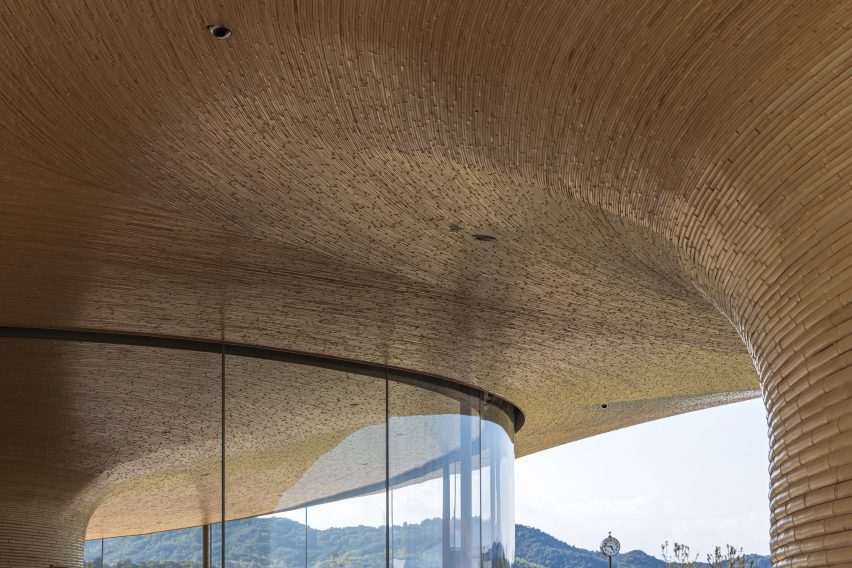
Bamboo Gate is two rectangular volumes separated by an opening that reads as a gateway. A swooping bamboo-clad roof connects them, curving toward the surrounding landscape. Together, the building and the Mabi Reconstruction Disaster Prevention Park form the town's primary resilient public space.
Bamboo, structural and local, for a flood-recovery building. The brief is visible in the material.
📷 Dezeen
A residence near Sojiji Temple, Osaka, organized around three themed gardens by Maniera Architects.
The client wanted formal and family life kept separate — 主客分離. Three gardens do the spatial work: an olive garden anchored by a 200-year-old Spanish olive with large landscape stones; a woodland garden of Japanese maple, ash, and enkianthus over Tanba, Kiso, and Wakatsui stone; and a stone garden that wraps the bathroom.
At the center, a steel-framed atrium rises through the house, its frame kept as thin as structurally possible. A water basin below reflects light back up through the floors.
The second-floor guest room has a tokonoma redesigned with a window — so the garden view becomes the alcove.
📷 TECTURE MAG / マニエラ建築設計事務所