Most people die of a sort of creeping common sense and discover, when it is too late, that the only things one never regrets are one's mistakes. Oscar Wilde
We grew up watching hand drawn Disney and now it's gone. We don't talk about this enough.
Every frame of this video was painted by hand, by a human being. Every single one...
To put that into perspective: to make Snow White and the Seven Dwarfs, Disney employed around 750 artists for three years, and they produced nearly two million individual paintings. More than 700 of the backgrounds were painted in watercolour. Over 150 people worked in a single department whose only job was to ink and paint the transparent sheets, called cels, that the characters were drawn on.
It all ended within our lifetime.
According to the Smithsonian, The Little Mermaid, released in 1989, was the last Disney feature made with the hand-painted cel method. The very next film, one year later, went digital.
And something was lost in that transition. In every frame of the old films, a human hand physically touched the surface. A person sat at a desk, held a brush, and made a decision. Two million small decisions, made by hundreds of people, most of whose names we will never know.
But the deepest difference is that the old animators knew they were making a cartoon. They did not try to copy the world. They stretched it, exaggerated it, bent it out of shape, because they understood something we seem to have forgotten: a drawing that imitates life exactly feels dead.
Walt Disney even had a name for this: he called it the plausible impossible.
Today, everything chases realism. And somehow, the more real it looks, the less alive it feels...
I started my newsletter because the past is full of beauty, and fewer and fewer people take the time to show it to us anymore. Every week I try to. If that is something you'd like to be part of, you can join through the link in my bio, and if you'd like to support my work, a paid subscription is what makes it possible.
Thanks for reading.
The Eclipse of the Century is coming — August 2, 2027 On Monday, August 2, 2027, Earth will witness the longest total solar eclipse of the entire 21st century. At its peak, lucky observers will experience 6 minutes and 23 seconds of complete daytime darkness — an extraordinarily long stretch of totality.The Moon’s shadow will sweep from the Atlantic across southern Spain and Gibraltar, then race through North Africa (Morocco, Algeria, Tunisia, Libya, Egypt) and into the Middle East (Saudi Arabia, Yemen, and parts of Somalia). The longest duration will occur near Luxor, Egypt, where the ancient temples and the Nile will be plunged into an otherworldly twilight.Why is this eclipse so special?The Moon will be near perigee (closest to Earth), appearing larger in the sky.
Earth will be near aphelion (farthest from the Sun), making the Sun appear slightly smaller.
Together, these factors allow the Moon to completely cover the Sun for longer than in almost any other eclipse this century.
During those precious minutes of totality, the Sun’s magnificent corona will blaze into view, bright stars and planets like Regulus (in Leo) may appear, and the temperature will drop noticeably. It’s a rare chance for scientists to study the Sun’s outer atmosphere — and for the rest of us to experience one of nature’s most awe-inspiring spectacles.Millions are expected to travel to the path of totality. If you can, make plans now — the next eclipse of this length on land won’t happen until 2114.A reminder that the universe still knows how to put on a show.
Fynbo is a traditional semi-hard Danish cheese named after the island of Funen (Fyn in Danish), where it originates.
It is made from pasteurized cow's milk and belongs to the Gouda family of cheeses.
Recent research from Kyoto University reveals that female dogs actively assess human competence—while male dogs do not.
Female dogs clearly prefer approaching humans who successfully complete tasks, such as opening food containers, over those who fail. In contrast, male dogs show no preference and treat both competent and incompetent humans equally.
These findings, published in a study titled "Female dogs evaluate levels of competence in humans," indicate that female dogs exhibit a more advanced form of social evaluation, particularly when food or resources are involved. They pay closer attention to human actions and their outcomes, using this information to decide who is the most reliable partner for obtaining rewards.
This competence bias suggests female dogs are more sensitive to efficiency and social results than previously thought. For dog owners, it means your female companion isn't just loyal—she's also quietly evaluating your ability to provide. These results highlight an intriguing sex difference in canine social cognition, potentially evolved to enhance females' chances of securing resources and survival.
[Chijiiwa, H., Horisaki, E., Hori, Y., Anderson, J. R., Fujita, K., & Kuroshima, H. (2022). Female dogs evaluate levels of competence in humans. Behavioural Processes, 203, 104778. DOI: 10.1016/j.beproc.2022.104778]
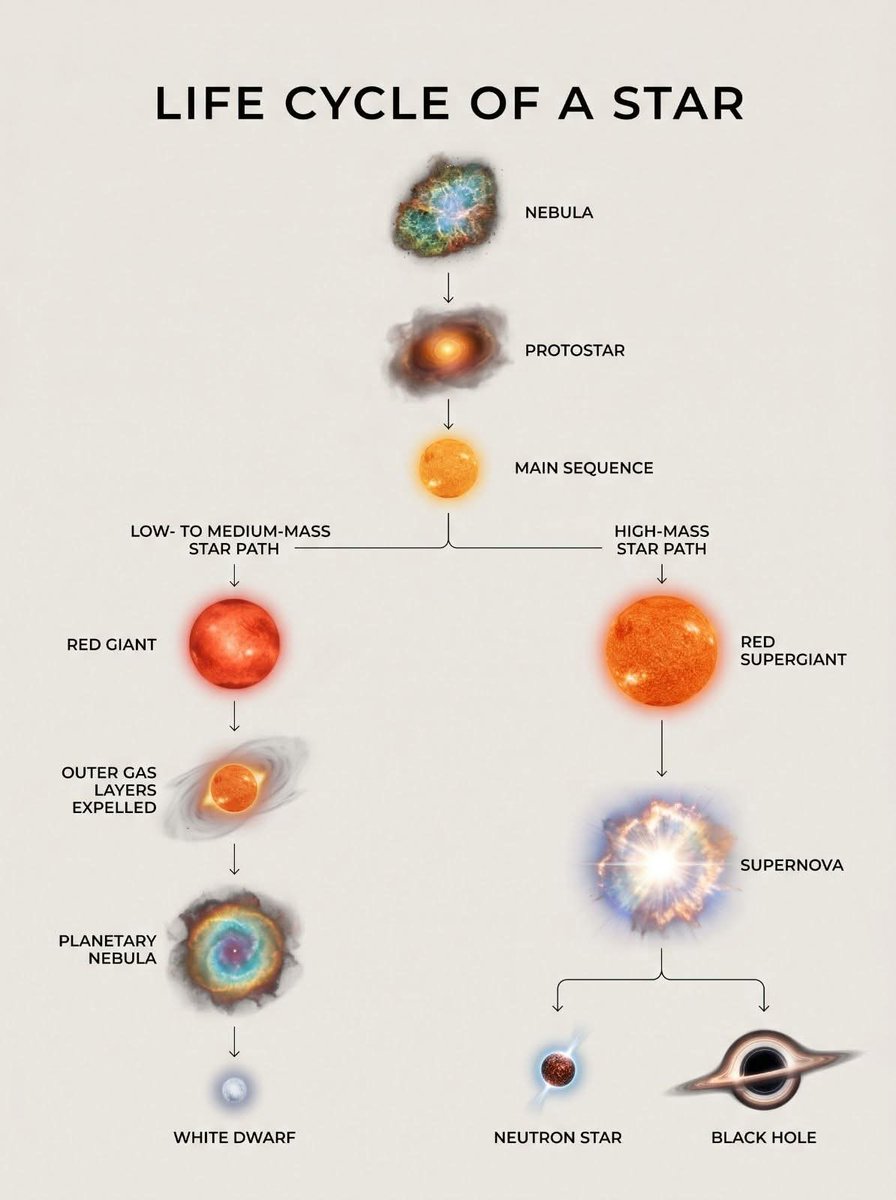
A Cosmic Odyssey: The Epic Life Cycle of Stars
Stars aren't eternal twinkles in the night sky—they're born in fire, live in nuclear glory, and die in spectacular ways. Their evolution depends almost entirely on mass, like a cosmic caste system: low-mass stars live long, quiet lives, while massive ones burn bright and explode dramatically. Here's a thrilling guide to their journey across billions of years.
1. Birth: From Nebula to Protostar (The Stellar Nursery)Stars begin in vast, cold clouds of gas and dust called nebulae—enormous stellar nurseries spanning light-years. Gravity slowly pulls clumps together, heating them until a protostar forms: a hot, glowing ball still accreting material.
Iconic example: The Pillars of Creation in the Eagle Nebula—towering columns of gas where new stars are sculpted by radiation and gravity.
Fun fact: This process can take millions of years, and many protostars never quite make it (becoming failed stars called brown dwarfs).
Once the core gets hot enough (~10 million °C), hydrogen fusion ignites. The star stabilizes and joins the main sequence on the Hertzsprung-Russell diagram.
2. The Main Sequence: The Prime of LifeThis is the longest, steadiest phase—stars spend ~90% of their lives here, calmly fusing hydrogen into helium in their cores.
Low-mass stars (like our Sun, ~1 solar mass): Shine steadily for ~10 billion years. Our Sun is about halfway through this stage.
High-mass stars (8+ solar masses): Burn furiously hot and blue, but live only a few million years because they consume fuel at insane rates.
Red dwarfs (the smallest): Can live for trillions of years—longer than the current age of the universe!
On the H-R diagram, main-sequence stars form a diagonal band from hot/luminous (top-left) to cool/dim (bottom-right)
3. The Giant Phase: Running Out of FuelWhen core hydrogen depletes, fusion shifts to a shell around the core. The star expands dramatically and cools at the surface—becoming a red giant (for Sun-like stars) or red supergiant (for massive ones).
Our Sun will swell to ~100–200 times its current size, possibly swallowing Mercury, Venus, and Earth.
Helium fusion begins in the core (the "helium flash" for Sun-like stars), creating carbon and oxygen.
4. The Dramatic Endings: Death and LegacyFor Sun-like stars (low to medium mass):After the red giant phase, outer layers puff off as a beautiful planetary nebula (nothing to do with planets—it's a glowing shell of gas).
The exposed core becomes a white dwarf: Earth-sized but Sun-mass, incredibly dense. It cools over billions of years into a black dwarf.
For massive stars (the rock stars of the cosmos):They fuse elements all the way to iron in the core. Iron fusion consumes energy, so the core collapses in seconds.
Boom: Type II Supernova—one of the universe's most powerful explosions, outshining entire galaxies briefly.
Remnants:Neutron star: City-sized, neutron-packed object spinning insanely fast (pulsars if they beam radiation).
Black hole: If the core is massive enough, gravity wins completely.
Supernovae scatter heavy elements (gold, uranium, etc.) into space, seeding new nebulae and planets—like the ones in your body right now.
Why This Matters: The Circle of Cosmic LifeStars are the universe's alchemists, forging the elements needed for life. Without their deaths, no rocky planets or complex chemistry. The cycle repeats: supernova remnants → new nebulae → new stars.
Quick Mass Guide:< 0.5 solar masses: Red dwarf → white dwarf (trillions of years).
~1 solar mass (Sun): Red giant → planetary nebula → white dwarf.
8–20+ solar masses: Red supergiant → supernova → neutron star or black hole.
Next time you gaze at the stars, remember: you're looking at ancient nuclear furnaces, some already gone, their light still traveling across the void. The universe is a vast, ongoing story of birth, brilliance, and explosive rebirth.





![Rainmaker1973's tweet photo. Recent research from Kyoto University reveals that female dogs actively assess human competence—while male dogs do not.
Female dogs clearly prefer approaching humans who successfully complete tasks, such as opening food containers, over those who fail. In contrast, male dogs show no preference and treat both competent and incompetent humans equally.
These findings, published in a study titled "Female dogs evaluate levels of competence in humans," indicate that female dogs exhibit a more advanced form of social evaluation, particularly when food or resources are involved. They pay closer attention to human actions and their outcomes, using this information to decide who is the most reliable partner for obtaining rewards.
This competence bias suggests female dogs are more sensitive to efficiency and social results than previously thought. For dog owners, it means your female companion isn't just loyal—she's also quietly evaluating your ability to provide. These results highlight an intriguing sex difference in canine social cognition, potentially evolved to enhance females' chances of securing resources and survival.
[Chijiiwa, H., Horisaki, E., Hori, Y., Anderson, J. R., Fujita, K., & Kuroshima, H. (2022). Female dogs evaluate levels of competence in humans. Behavioural Processes, 203, 104778. DOI: 10.1016/j.beproc.2022.104778]](https://pbs.twimg.com/media/HJk5pS1XIAMphET.jpg)