Ryan Cohen interview on Charles Payne:
Ryan Cohen went into extensively explaining of how the proposed $GME / $EBAY deal can work:
GameStop has $9B cash and says it has a highly committed $20B financing letter from TD.
The offer is $125/share, split 50% cash and 50% equity.
His argument is that eBay shareholders get immediate liquidity while still owning a large piece of the combined company, instead of only taking stock.
Cohen frames the deal as EPS-accretive, not destructive dilution.
The key point is that eBay is an asset-light marketplace doing $11B in revenue but carrying over $5.6B in operating expenses, including $2.5B in sales and marketing.
Cohen believes those costs can be cut aggressively, making eBay far more profitable inside a combined GameStop/eBay structure.
In simple terms:
1. GameStop brings cash + financing.
2. eBay brings earnings + marketplace scale.
Cohen believes that operational efficiency turns the combined company into a much higher-earning business for both shareholder bases. Both $GME and $EBAY.
The Hollow Men
American capitalism is rotting from the head down. We have replaced the "Owner-Operator"—the risk-taker-with a new, parasitic class of corporate bureaucrat: The Risk-Free Insider.
By "Insider," I am not referring to a specific title. I am referring to the entire administrative state that has captured the modern corporation. This includes the Directors who exist solely to collect fees, the Executives who exist solely to collect bonuses, and the Managers who exist solely to hire consultants.
These are the hollow men of the boardroom. They are masters of PowerPoint. They wear the right suits. They say the right buzzwords about "governance" and "ESG." But they are mercenaries fighting a war with someone else’s ammunition.
In a functioning economy, authority is tied to liability. If you make a bad decision, you lose your own money. That fear of loss is the only thing that keeps a business honest. It forces you to cut waste, obsess over the customer, and stay late to fix what is broken.
Today, we have severed that link.
We have rigged the game so that heads, the Insider wins; tails, the shareholder loses.
If the stock goes up, the Insider collects a massive performance bonus. If the stock crashes due to their own incompetence, they are fired with a "Golden Parachute" worth tens of millions. They are gambling with the house’s money, and they never leave the table poorer than they arrived.
This looting starts in the boardroom.
We have normalized a "Country Club" culture where directors are selected based on social profiling rather than their ability to build a business. The modern board member is often a professional tourist—paid an average of $350,000 a year.
Let’s be brutally honest about what that number represents. The average director is paid nearly five times the GDP per capita of the United States. They earn more for attending four quarterly lunches than the vast majority of Americans earn in five years of hard labor.
And for what?
Most of these directors are "over-boarded," sitting on three or four boards simultaneously. They treat directorships as a gig economy for the elite. They fly in, rubber-stamp a compensation package they didn't read, and fly out. They collect checks from companies they do not understand, do not use, and certainly do not love.
They are not there to ask hard questions. They are there to be collegial. They are there to protect the other Insiders.
And what happens when these boards hire executives who also have no personal capital at risk?
We get the Delegation Economy.
When a Risk-Free Insider faces a crisis—bloated expenses, a broken supply chain, or a stale product—they do not roll up their sleeves. They hire a consultant. They pay a strategy firm millions of shareholder dollars to produce a 100-page deck telling them what they already know.
This is not management. It is intellectual money laundering.
They use shareholder capital to buy an insurance policy for their own careers. If the plan fails, they can blame the consultants. They delegate the work because they are terrified of the responsibility. They would rather preside over a slow, comfortable decline than risk a bold mistake.
While American Insiders are busy optimizing their severance packages, our global competitors are optimizing their products. They are not slowed down by bureaucracy. They are not waiting for a slide deck. They are outworking us.
If we continue to fill our C-suites with administrators instead of operators, we will lose our edge. We will see iconic American franchises hollowed out by fees, managed for the benefit of the Insiders, while the true owners—the shareholders—are left holding the bag.
The time for polite governance is over.
If we want to save the American economy from mediocrity, we must demand a return to the "Owner’s Mentality." We need leaders who treat shareholder capital with the same reverence they treat their own savings. The era of the Risk-Free Insider must end.
In 2022 I watched millions of dollars of buying power evaporate as Bitcoin plunged to $15K.
It hurt.
But it taught me an important lesson: If you put too much faith in things that are outside of your control, you're setting yourself up for pain.
Sports, politics, financial assets... Humans get wrapped up emotionally in these things. It becomes identity.
And that makes it impossible to be objective.
The antidote?
Focus on things that are in your control.
Instead of putting all of your hopes in something that you can't control, put faith in yourself and a higher power.
That alone will guide you.
You are capable of far more than you think.
You have the ability to create value from nothing.
All the wealth you could possibly seek is inside you, waiting for you to focus on it and let it out.
I've made millions from building businesses and I've made millions from investing.
And I can easily say that the money made from creating value is far more satisfying than the money made from moving money around.
Once you no longer have to work you realize that you still want to anyway.
So if this is the start of a bear market... That means you have an opportunity to detach yourself from the collective madness right now.
Emotions are high. And they will draw you in further if you let them. They will deepen their hold on you.
Or you can use this as a chance to refocus on what actually matters to you.
Refocus on the value that you can bring to the world, however big or small.
Rediscover the joy of progress.
And when things eventually turn around, you may find that you are too excited about your own thing to even care.
🚨 This is the most important macro + Bitcoin clip you’ll watch today.
Tom Luongo just went on Simply Bitcoin and laid out how gold, silver, and copper have been suppressed for decades through paper markets — and why that entire system is now breaking in real time.
That’s why commodities are going parabolic.
And why Bitcoin is going to go on a historic run in the future.
Davos just lost control of the narrative.
china is forcing metals repricing as a form of economic warfare.
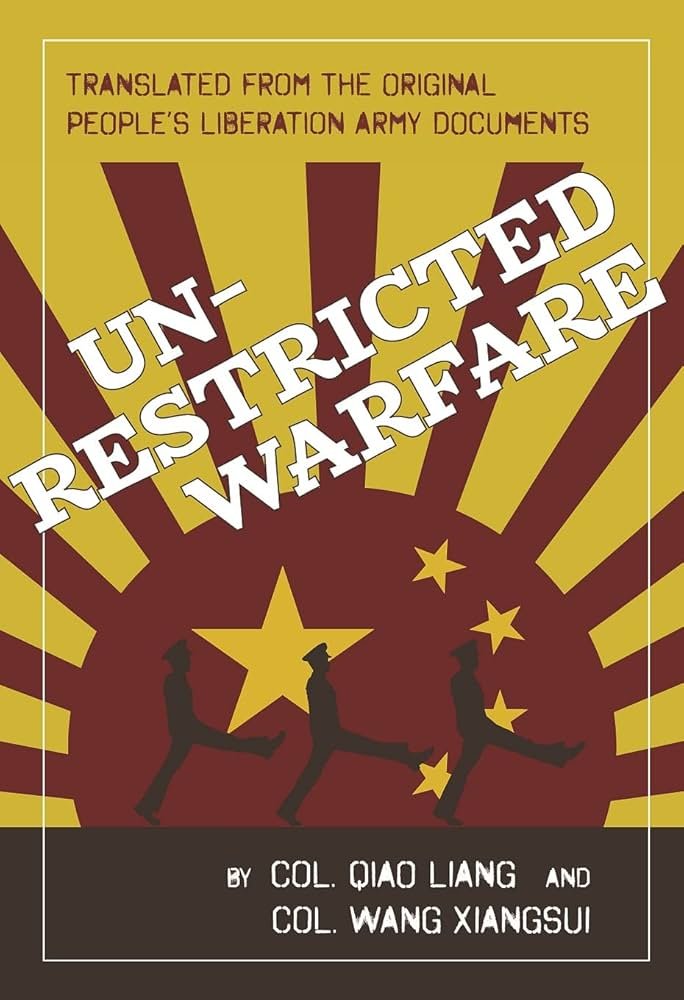
this all stems from a seminal work, Unrestricted Warfare released in 1999 by two Chinese officers.
The core idea is that traditional war (tanks & planes) is too expensive and risky. Instead, you turn everything into a weapon.
This means finance (assets like gold/silver), law, cyberspace, and media.
They argue that crashing an opponent's stock market or sabotaging their currency can be more effective than a literal bombing run.
Why destroy a city when you can bankrupt it?
In the era of globalization, the "battlefield" is everywhere at once.