my hot take is that 99% of software can be built with the same set of finite elements
spending time/tokens building any of this from scratch over and over again is peak AI psychosis
Andrej Karpathy stopped using AI to write code.
The co-founder of OpenAI. The man who built Tesla's Autopilot vision team from scratch. The person who coined the term "vibe coding."
In April 2026, he announced that a large fraction of his LLM token budget was no longer going into manipulating code, it was going into manipulating knowledge.
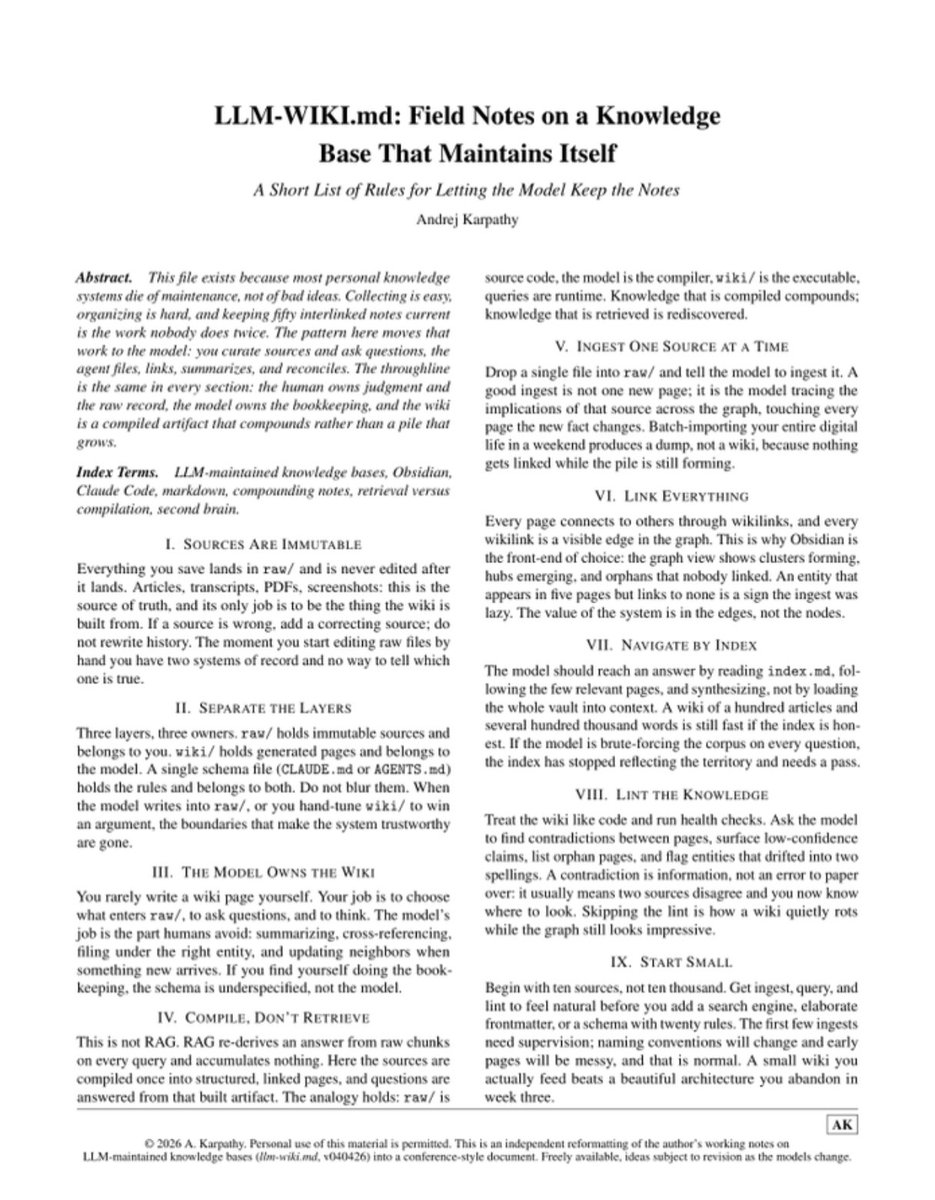
Then he published a single markdown file on GitHub explaining what he had built instead.
It got 17 million views. 13,000 GitHub stars. Dozens of community implementations within a week.
He called it the LLM Wiki. And the idea behind it is so simple it is almost embarrassing that nobody published it sooner.
Here is the problem it solves.
Most people's experience with LLMs and documents looks like RAG you upload a collection of files, the LLM retrieves relevant chunks at query time, and generates an answer. This works. But the LLM is rediscovering knowledge from scratch on every question. There is no accumulation. Ask a subtle question that requires synthesizing five documents, and the LLM has to find and piece together the relevant fragments every time. Nothing is built up.
NotebookLM works this way. ChatGPT file uploads work this way. Most RAG systems work this way.
Every session starts from zero. The AI never learns the territory. It just searches it again.
Karpathy's pattern is the opposite. Instead of retrieving from raw documents every time, the LLM builds and maintains a persistent, structured wiki — and answers questions from the compiled knowledge rather than the raw fragments.
Here is how the architecture works. Three layers.
**Layer 1 — Raw sources.** Your curated documents. Articles, papers, PDFs, meeting notes, screenshots. These are immutable — the LLM reads them but never modifies them. This is your source of truth. The moment you start editing raw files by hand, you have two systems of record and no way to tell which one is true.
**Layer 2 — The wiki.** A directory of LLM-generated markdown files. Summaries, entity pages, concept pages, comparisons, a master index, a chronological log. The LLM owns this layer entirely. It creates pages, updates them when new sources arrive, maintains cross-references, and keeps everything consistent. You read it. The LLM writes it.
**Layer 3 — The schema.** A CLAUDE.md or AGENTS.md file that tells the LLM how the wiki is structured, what conventions to follow, and what workflows to run. This is the config that turns a generic chatbot into a disciplined wiki maintainer.
Karpathy's phrase captures the whole thing: "Obsidian is the IDE. The LLM is the programmer. The wiki is the codebase."
Here is what happens when you drop a new source into the system.
You save an article into raw/. You tell the LLM to ingest it. The LLM reads the source, writes a summary page, updates the master index, creates or updates entity pages for every person, company, or concept mentioned, creates or updates concept pages for every idea, adds cross-references between related pages, and logs the ingest in the activity record.
A single source might touch 10 to 15 wiki pages. This is the bookkeeping that humans abandon — filing, cross-referencing, updating related entries, noting contradictions. The exact work that kills every personal knowledge system you have ever started.
The LLM does it tirelessly. Every time. Without forgetting.
Here is the key distinction from RAG.
RAG re-derives an answer from raw chunks on every query and accumulates nothing. The LLM Wiki compiles sources into structured, linked pages once — and questions are answered from that built artifact. The analogy: raw/ is source code, wiki/ is the compiled executable. Knowledge that is compiled is retrieved. Knowledge that is not is rediscovered from scratch.
And here is the rule Karpathy emphasizes most.
Lint the knowledge. Treat the wiki like code and run health checks. Ask the model to find contradictions between pages, surface low-confidence claims, list orphan pages, and flag entities that drifted into two spellings. A contradiction is information — it means two sources disagree and now you know where to look. Skipping the lint is how a wiki quietly rots while the graph still looks impressive.
Start small. Begin with ten sources, not ten thousand. Get ingest, query, and lint to feel natural before you add complexity. The first few ingests will be messy. Naming conventions will change. That is normal. A small wiki you actually use beats a beautiful architecture you abandon in week three.
The community response tells you how much this resonated.
Within a week of Karpathy's gist, the community produced dozens of implementations full Python agents, Obsidian integrations, wiki compilers, web interfaces. The pattern works with Claude Code, Codex, OpenCode, Gemini CLI, and any LLM agent that can read and write files.
You do not need any of them. The entire system works with nothing but an LLM agent and a file system. Paste the pattern into your CLAUDE.md and Claude Code becomes your wiki maintainer.
Here is why this matters more than another AI tool.
Every personal knowledge system you have ever tried Notion, Evernote, Roam, Obsidian, died the same way. Not because the tool was bad. Because the maintenance was unsustainable. The filing. The tagging. The cross-referencing. The updating when new information arrived. The bookkeeping that makes a knowledge base useful is the exact work nobody wants to do.
Karpathy's insight is that the bookkeeping is exactly what LLMs are good at. Tirelessly reading, summarizing, filing, linking, updating, and maintaining consistency — without getting bored, without forgetting, without deciding it is too tedious and abandoning the project in week four.
You curate sources and ask questions. The LLM does the bookkeeping. The wiki compounds over time every source you add and every question you ask makes it richer.
The tedious part of maintaining a knowledge base is not the reading or the thinking.
It is the bookkeeping.
And the bookkeeping just got automated.
Source: Andrej Karpathy · GitHub Gist · AI Builder Club · Vanja. io · MindStudio · April 2026
( Link in the comments)
@BillAckman@SpencerGuard If they make money in Iran, they’ll invest and the business network will help stabilize the relationships. The USA helped Japan and look at these two now. 💛
We just wrapped what began as an 8-hour challenge - and it ran for 200 hours without a failure
Shoutout to the team for the hardcore engineering behind F.03 and the robust Helix models powering it
CODEX SKILL TO BRUTALLY TEST ANY STARTUP IDEA!
Most startup ideas sound good.
This Codex skill tells you why they probably won’t work.
Just give Codex your idea and it pressure-tests it for you
-> finds the core assumption
-> exposes fatal flaws
-> checks if the problem is real
-> maps real competitors
-> plans your first 10 customers
-> defines a 2 week MVP
Install:
npx --yes codex-startup-pressure-test-skill@latest
100% open source.
Repo in bio
I cofounded an AI-first company, @Lemonade_Inc.
By the end of the decade, I think “AI-first” will seem quaint, the horseless carriage of artificial intelligence.
If you want to unleash 1,000 horsepower, stop designing around the horse.
My thesis on why after "AI-first" comes "AI-only":
https://t.co/nDvUjx7y5S