Nearly every part of @KerdoraHQ has been rebuilt.
- Retirement projections are here
- 8 new interactive visuals
- Dora can search the web
- Dora can build custom guides for individual clients
- Responsive layout that works on mobile and tablet
- New dynamic onboarding form
- New Investment Research module
- New financial reporting suite
- Redesigned workspace that's incredibly dynamic
- New practice home lets you see open tasks and planning dates across all clients
- Command bar and shortcuts to move quickly and search anything in the app
We also did a bunch of techy stuff like reworking our harness and giving Dora additional tools to further increase her speed and capabilities.
AI lowered the barrier to entry but it didn't flatten the skill gap.
I can build websites and software now the way designers and engineers used to build them. That's crazy.
But I still can't build it as well as a real designer or engineer would build it with AI today. They got the same tools I got. They just know what to do with them.
My guess is the same is true for financial advice. You can get financial advice now the way advisors used to give it. But probably not as good as an advisor who's using AI today.
I can tell if someone is going to use Kerdora in one sentence, and it has nothing to do with Kerdora.
They either say:
1. "I'll play around with it"
2. "I'll test it out"
The ones who "play around with it" don't typically end up using it. It's because they're browsing at a toy shop, not evaluating a tool for their business.
The ones who "test it out" almost always use it. That's because they have a clear use case in mind and want to test whether it actually works or not.
I learned this lesson the hard way as an advisor.
My unlock was getting clear on what I actually do for clients and how I go about delivering it. THEN I shop for tools, methods, strategies, and people (remember those?) who can make it easier and more efficient to do so.
There is a crap ton of stuff out there to play around with and a literal toy factory called Claude that can build you whatever you want.
Get clear on what you do. Refine it. Ignore the rest.
I'm a BIG liquidity planning guy. I think it's one of the most underserved parts of the plan.
I built this Liquidity Guide in Kerdora. It let's me see:
1. How on track they are for liquidity goals
2. Where their liquidity exists from a technical perspective
3. Liquidity in terms of years of current spending
I also added a little explainer and summary so clients understand what they're looking at.
This lets me quickly evaluate a clients liquidity position and identify any changes to be made.
3 clicks of a button and this Guide is pushed to all my clients in Kerdora.
I spent YEARS refining what I wanted my planning output to look like. I liked it so much I built it into software. And it still wasn't good enough for me 😅.
It was too rigid. It applied to most but not all clients. Sometimes I wished I didn't have to show something or could emphasize something else. Or even break it into multiple views rather than one long dashboard.
That's why we built the new Guides feature at Kerdora. It's the most flexible planning output I've seen.
Drag/drop, add text boxes/images, rename fields, reorder columns, etc. (Yes, you can even ask AI to help or do it for you.)
But aside from all the "cool stuff" it does, I think it will transform how you deliver advice inside a planning software. You're now able to create *multiple* truly custom Guides so you can focus on a certain topic and/or tailor your message to exactly what a specific client needs.
I'm excited to share more about how to use this. Here's a little peek of what it looks like in practice.
Ask dumb questions with an open mind to come up with unique solutions.
The reason we do not ask basic questions is because once our brain provides a logical answer, we stop looking for better ones. (48)
There's a difference between "I was wrong" and "I am no longer right."
As advisors, our greatest fear is giving people "bad advice."
I find a lot of advisors resist changing their mind on strategies and products because it may feel as if they gave "bad advice" to people in the past.
That's not true at all.
The "bad advice" is not changing when the facts change.
“Explain to me again why enjoying life when I retire is more important than enjoying life now.” - Randy Glasbergen
I've really changed my tune on this.
As advisors, we're conditioned to always optimize for "more money later." But in the last 18 months, I've seen too many people have their retirements cut wayyy short.
As always it's a balance, but in the last few months I've started making more YOLO decisions/purchases. Nothing major, but it's amazing how much the "spreadsheet" can get in the way of enjoying life if you let it.
This might be my new favorite definition of rich:
"If having more money wouldn’t change what you do, then you’re rich" - Jimmy Carr
or maybe an even better version:
“If more money wouldn’t change how you spend your time, you’re already rich.” - Jack Butcher
Both of these quotes highlight that "rich" is relative and it emphasizes that life is really about what you do and spend your time on.
If AI replaced all of us as financial advisors, that might be the coolest thing in human history.
Imagine how much better the world would be if everyone made better financial decisions?
I would love to see that happen. We'll all adjust and be fine.
Two weeks ago I basically couldn't walk. My back pain had gotten that bad.
I watched a bunch of Instagram and YouTube videos. Asked ChatGPT. Anything to DIY my problem.
Nothing happened. I actually made it worse by misusing a certain stretching gadget I bought.
Then I went and saw a professional.
This weekend, I played 54 holes of tournament golf essentially pain free.
Paying for a professionals help can sure be nice sometimes.
Are financial advisors trying to start a recession?
If everyone saved 20%, the economy would almost certainly fall into recession.
Now, the long-term effects would be beneficial. But in a short-term reactionary world, it would be interesting to see the following play out:
1) Savings rates going up
2) Recession ensues
3) Asset prices fall in emotion-driven response to recession
How will people react to seeing their newly saved dollars decrease in value?
I hope we one day get to find out how that will play out. (Because everyone is saving 20%, not because I want to see a recession.)
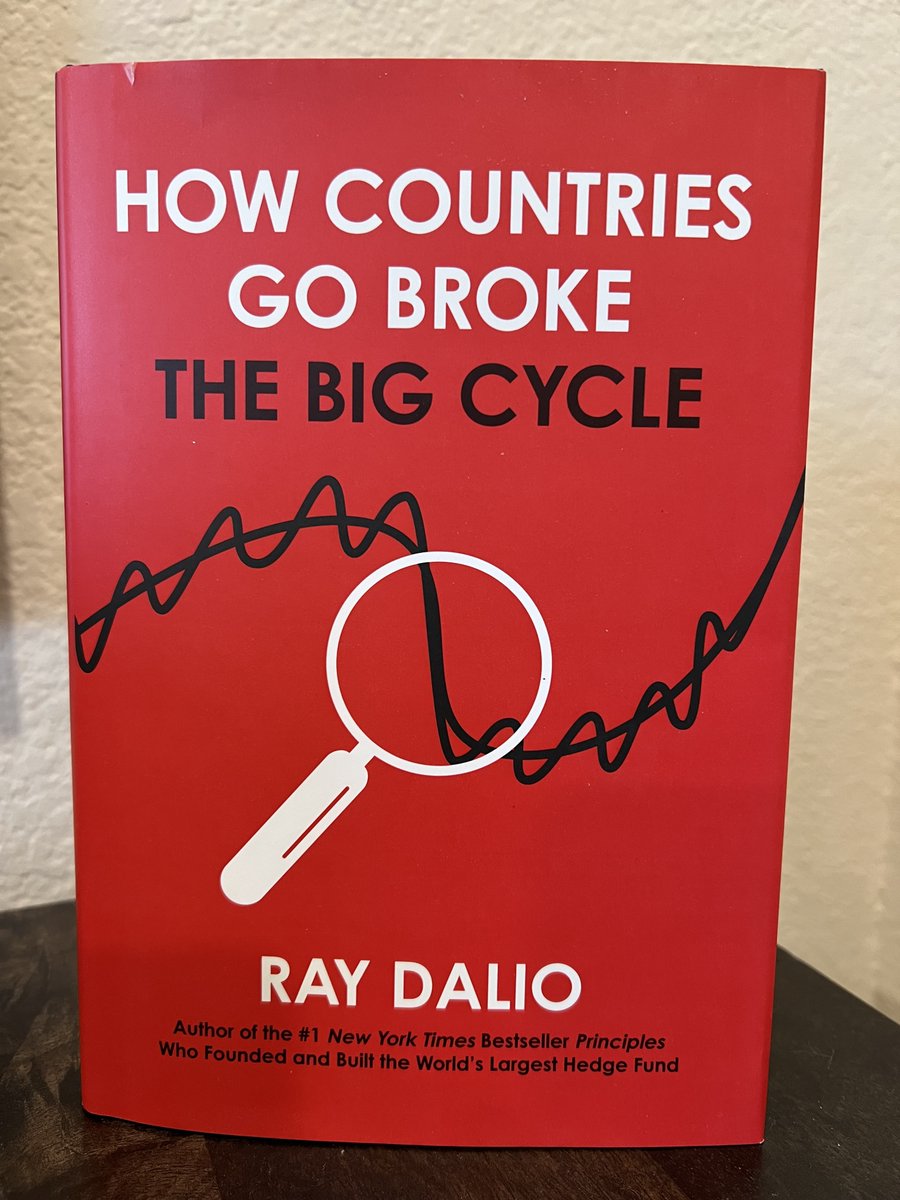
This is one of those books that I read and think, "if only I could fully grasp this..."
I read everything @RayDalio writes. I've had this book pre-ordered for months and it finally came yesterday. I'm only 2 chapters in and it's already delivered as usual. Incredible breakdown of the core mechanics of economics.
What's particularly cool about this book is he actually bolded the parts of the book to read if you just want the high-level. So if you want the PhD level, read the whole thing. If you want the "explain it to me like I'm a 5 year-old" level, then just read the bold parts.
Aside from that, the book is extremely timely. I think it's pretty much a "must-read" if you want to understand the US fiscal situation and how to think about it going forward.
#howcountriesgobroke
I think Adjustable Rate Mortgages (ARMs) are overlooked way too often.
Especially for first-time home buyers or "starter homes".
Why?
1. ARMs can offer a significantly lower interest rates than a 30-year fixed mortgage and the "break-even" period can be 10+ years even if rates rise and the ARM rate caps out.
2. A lot of people, especially people in "starter homes" move within 5-7 years of purchase. The ARM would save a lot of money in interest.
Now, a few caveats/thoughts:
- Yes, the rate can go up. I would plan for and expect it to
- Yes, the certainty of a 30-year fixed rate is attractive. Certainty always comes at a cost
- A lot of people think they're in their "forever" home but life and plans sure have a funny way of changing
This certainly isn't advice to go out and get an ARM, I just think they should at least be on the table when buying a home.
You could get fired if you don't understand your planning software.
I just spoke with a woman leaving her current advisor because they couldn't explain the logic behind the output from a popular tool many of us use.
I think this is a fascinating lesson.
A lot of the planning tools out there are built to make us advisors look good and are very easy to use.
But the software is supposed to assist us, not replace our thinking.
Lesson for all of us: If we're going to present it to a client, we better be able to explain it.