@pschofie79 This is a great question. My take is "not just Pippin". Add Charles Taylor. And definitely add realist critics of idealism like Maurice Mandelbaum.
There exist deep identification problems involved in drawing substantive social science conclusions from genomic data. Aldo Rustichini and I outline some of these in this brief discussion
“Theory Matters for Identifying a Causal Role for Genetic Factors in Socioeconomic Outcomes.” Behavioral and Brain Sciences 2023
https://t.co/3PS9LKSnJv
For this reason, had I been invited to write a review of The Social Genome for some journal, it would have been critical in several respects.
The Feldman and Riskin review goes beyond tough minded criticism; it is a screed. Much of the review is petty, focusing on what are unimportant imprecisions of language that are inevitable in writing a book for a general audience. Another defect is the gratuitous introduction of Francis Galton, Cyril Burt, and Arthur Jensen into the review, a transparent effort to associate Conley with beliefs he does not hold.
Some criticisms are valid. Population stratification is a fundamental issue in genomic studies and genes/environment interaction is a fundamental issue in twin studies. But these do not justify ex cathedra pronouncements of the type made in the review. A good example of why this is untenable is smoking. Specific genetic markers have been identified for the way nicotine affect the brain; such information is self-evidently valuable in understanding smoking dynamics.
On twin studies, the reviewers’ arguments are not original (and it is strange to see no mention of Arthur Goldberger, who did more than anyone to explore the overclaiming in the twins literature). Further, they are thin. There is interesting work showing that heritability decompositions differ across families with different socioeconomic status. This is a good example why heritability decompositions are equilibrium statistical properties, not primitive features of the determinants of socioeconomic outcomes. But it also reveals something valuable to understand once one uses theory to think about why these types of relationships are observed.
https://t.co/3PS9LKSnJv
To understand the state of research on the use of genomic data in social science, one cannot do better than this recent literature synthesis
Daniel Benjamin @Dan_J_Benjamin, David Cesarini, Patrick Turley @patrickaturley, and Alexander Strudwick Young @AlexTISYoung, "Social-Science Genomics: Progress, Challenges, and Future Directions," Journal of Economic Literature, forthcoming
https://t.co/zd3KV1Prme
(For transparency, I note that invited this paper for the JEL when I was editor. The review process, involved thee standard refereeing and the revision process, was handled by my successor).
One would never know about the circumspect way the literature discusses empirical findings, the concern for biological pathways, etc. from the NYRB piece.
The review authors recently wrote a similarly intemperate attack on Kathryn Paige Harden’s @kph3k The Genetic Lottery: Why DNA Matters for Social Equality for @nybooks . It reflects poorly on the Review to repeatedly consign books on genomics to same reviewers with dogmatic views and a lack of knowledge of social science. An understanding of income and substitution effects is one example-there is no mystery as to why parental attention would be negatively associated with a polygenic score for educational attainment if one knows the basics of income and substitution effects. And as noted above, heritability statistics, the predictive power of polygenic scores, etc. have value in thinking about social science theories. Scrupulous attention identification problems is needed, not peremptory dismissals.
A few thoughts on this interesting new minimum wage paper by @NeumarkEcon and @4ntonioR renalyzing the QJE paper by @arindube-@attilalindner-@benzipperer, which relates to one of my favorite topics: event-studies and parallel trends! 1/
@Jackbmeyer I'm glad this has been republished. I have the (tattered) original. In many ways this volume was an riposte to the Hartwell-edited, "The Causes of the Industrial Revolution" (1967). And Morkyr's successor anthology, "The British Industrial Revolution" (1999) is also good.
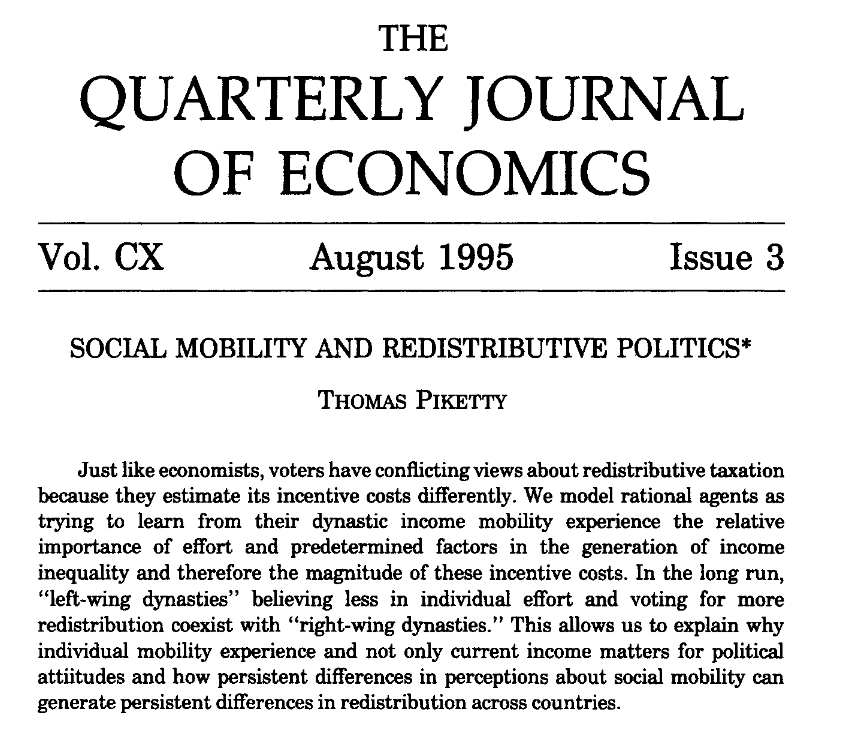
Some Piketty (et al.) bangers to explain why he is so respected, even before Das Capital 2.0, and whatever AI-generated stuff he publishes in the newspaper today
In the 1990s, he formalised theories of self-fulfilling preferences and redistribution. He showed us (1/4)
@lugaricano As for the first example, it's clearly not a secondary sources issues (unless it's not acknowledged). The Slobodian text is from page 108 of "Globalists" and it is footnoted (#81) directly to Mises "Liberalism".
@lugaricano It's interesting, since (if I remember right--big "if") the original response of the Austrian/libertarian community to "Globalists" was positive: i.e., despite the author's priors, it was still a useful and informative history of the movement. A secondary sources issue, maybe?
@SoulCultivated@UChicago Cross references my Columbia late 60s Civ and Hum reading list pretty well. In many cases I still have the books or have replaced them.
@Shevek91 There was reference to backup research. Maybe we'll get to see it. In the end, though, a quantitative assessment of this particular question will have to reference a qualitative standard.
@xgabegottliebx I can do this - I have the book and can go back to it. But Hegel's saying something doesn't make it true, any more than Boghossian's saying something else makes that false. (Hence my original question to you.)
@SGTWipper1Each Great analysis. Makes it fun to ask what combinations of current-state realities and plausible missions could possibly justify building a "battleship" today. Perhaps big carrier-defending platforms are again needed and would be viable? I doubt it, but maybe.
@xgabegottliebx Well, the report contains an argument (one, btw, that points well back beyond 2007 to, say, Maurice Mandelbaum's mid-century realist/correspondence theory arguments against idealism and relativism). Can you answer it?