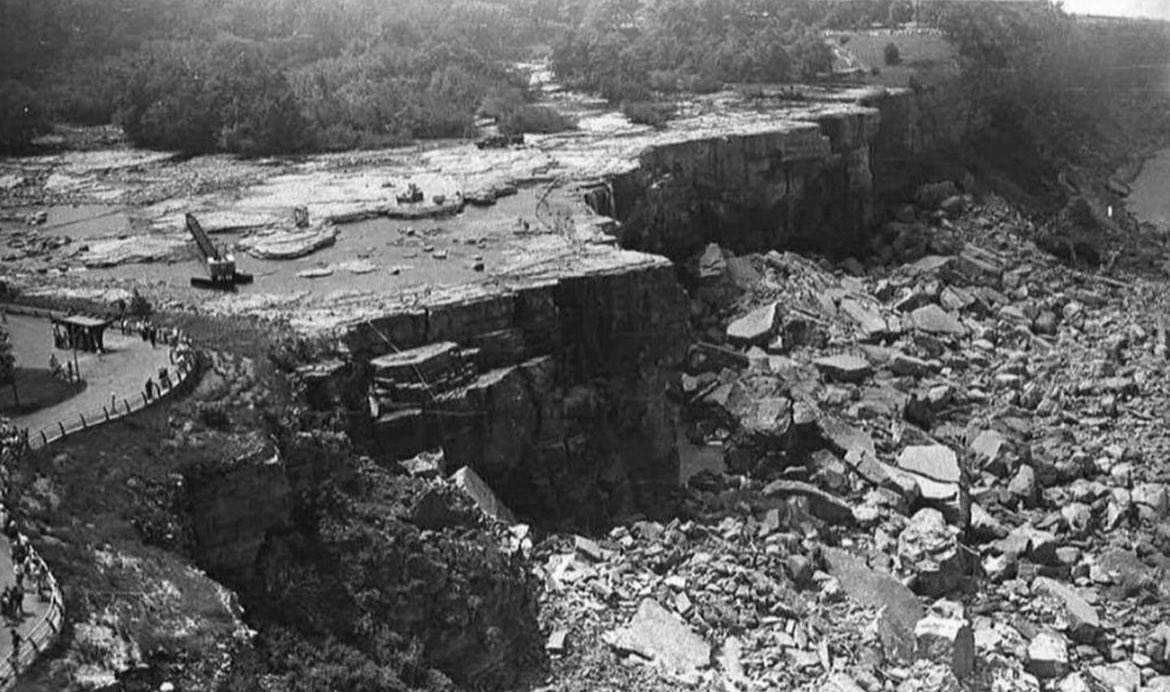
Niagara Falls experienced a unique phenomenon in 1969 when the powerful rush of water over American Falls, one of the three waterfalls comprising Niagara Falls, was significantly reduced for a period of six months during the summer and fall. The reason behind this unprecedented event was the concern that the erosion of the falls' rock face was causing destabilization, prompting the Army Corps of Engineers to conduct a geological survey.
To address the issue, a strategic approach was implemented. Over a span of three days in June 1969, approximately 1,200 trucks unloaded around 28,000 tons of rocky fill into a cofferdam located upstream of the falls. This ingeniously diverted the flow of the Niagara River away from American Falls and redirected it towards the larger Horseshoe Falls.
With the water completely drained from the falls for the first time in thousands of years, the US Army Corps of Engineers embarked on their investigative mission. Surprisingly, aside from the official study, only two bodies were discovered, which was a remarkably low number considering the falls' historical records of accidents and suicides. Additionally, decades-old coins were found amidst the accumulated debris at the base of the falls. As for the accumulated talus, it was decided to leave it untouched in its natural state.
In November 1969, as the cofferdam was gradually removed, the powerful rush of water returned to American Falls, resuming its mighty roar as before.