WxProbe
Christian, Husband, Dad
Most experienced USA #hurricane chaser
45 USA hurricanes/18 majors
Hurricane Expert
Former NWS Meteorologist, NHC intern, Boxer
@WxRiskGrains Ironically, I got that same message from one of my fellow followers right before I got hacked. That may be how they gained access to mine, as I foolishly click the link to help them.
2026 WxProbe NATL Hurricane Season Forecast: May Update
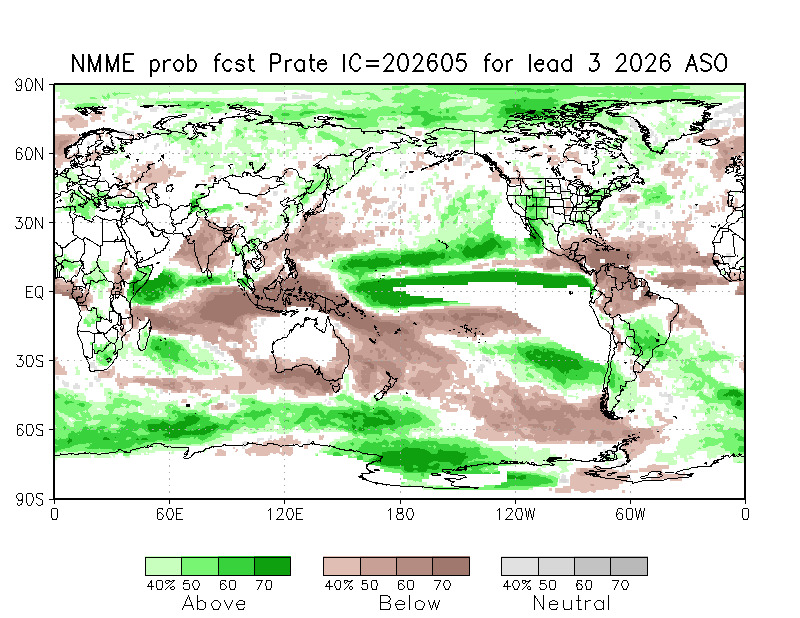
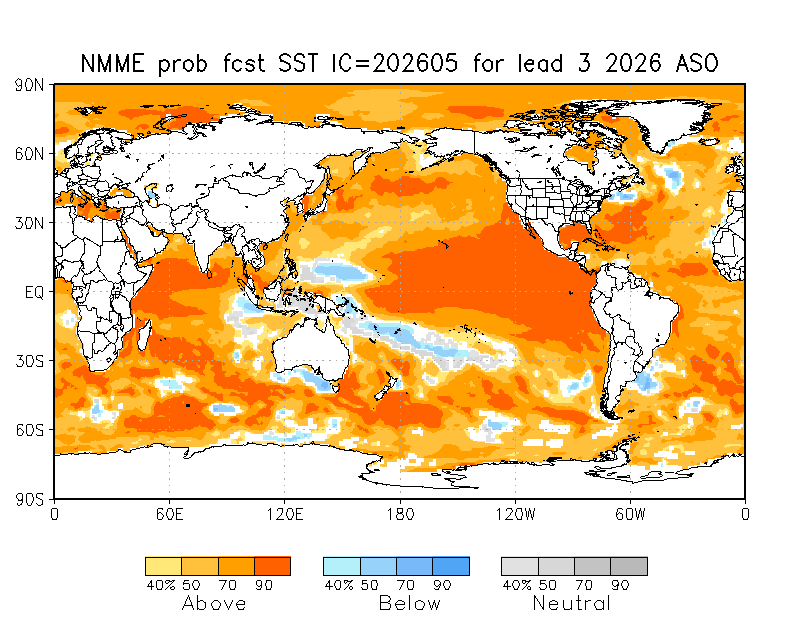
This update presents a significant downward revision from my April "First Look" outlook. The adjustments better reflect historical analog constraints, intensifying El Niño trends, and projected sea surface temperature (SST) configurations during the August–October (ASO) peak.
Seasonal Activity Projections:
Named Storms: 9–13 (11)
Hurricanes: 3–5 (4)
Major Hurricanes: 1–3 (2)
ACE: 40–90 (65)
Note: Single figures in parentheses represent the official seasonal totals forecast by WxProbe. The surrounding ranges represent standard WxProbe verification windows (allowable margins of error: +/- 2 named storms, +/- 1 hurricane, +/- 1 major hurricane, and +/- 25 ACE).
Historical Analog Evaluation:
The baseline composite includes six key analogs optimized for the unique 2026 atmospheric and thermodynamic setup: 2015, 1997, 2009, 2002, 2018, and 2023.
* Six-Year Composite Average: 12.5 Named Storms/4.8 Hurricanes/2.0 Major Hurricanes/82.5 ACE.
* Composite Oceanic Niño Index (ONI): 1.5°C during the ASO peak.
* Forecast Adjustment Justification: Present expectations favor a significantly stronger, more mature El Niño event than the 1.5°C analog mean, resembling a “super” El Niño scenario. Consequently, my final forecast targets lean lower than the raw six-year composite averages…though modern (1995-2025) baseline warmth prevents a total collapse.
Primary Seasonal Drivers:
1. Dominant Moderate-to-Strong El Niño Signal:
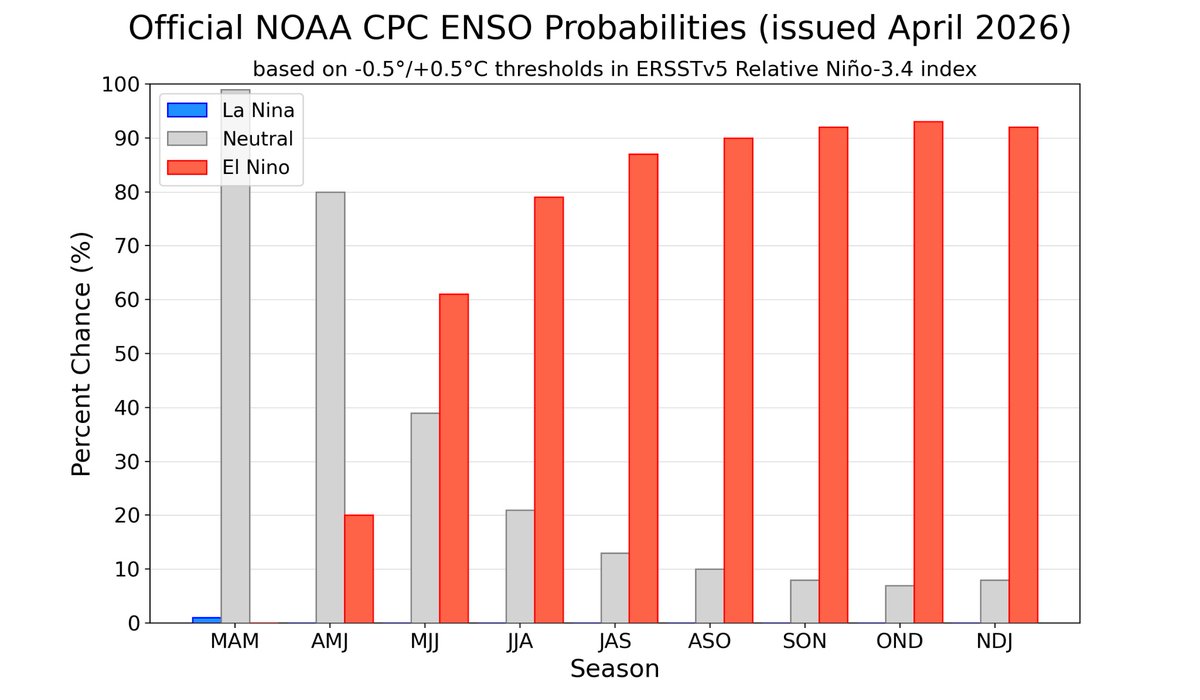
The Climate Prediction Center (CPC) May 2026 ENSO Diagnostic Discussion notes current neutral conditions, but assigns a 61% probability of El Niño development during the May–July window. Relevant models continue to project a robust, mature event by peak season. The expected atmospheric responses via the altered Walker Circulation include the following:
* Walker Circulation Disruption: Deep convective thunderstorms venting over the eastern Pacific force a massive eastward shift in the upper-level loop. This drives large-scale subsidence (sinking dry air) directly over northern South America and the Caribbean, capping the atmosphere and suppressing upward thunderstorm convection.
* Increased Wind Shear: Accelerated high-altitude westerly winds clash with low-level easterly trade winds. This severe vertical wind shear tilts and physically rips apart developing tropical depressions before they can organize.
* Altered Steering: A weakened, fractured Bermuda High limits favorable long-track westward migration, deflecting weak systems northward into hostile mid-latitude environments.
2. Non-Record, Polarized Atlantic SST Profile:
Atmospheric suppression should *not* face the historic thermal resistance seen in 2023. Specifically, current basin conditions exhibit a highly stark, split configuration:
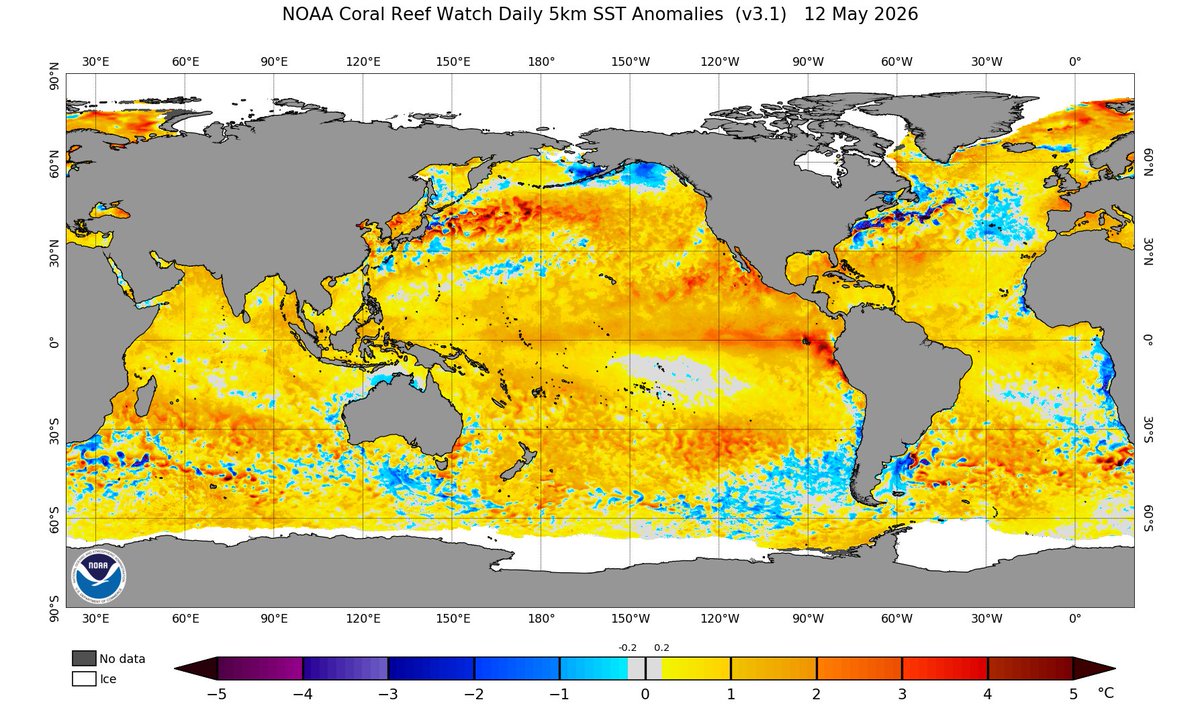
* Gulf of Mexico Marine Heatwave: Sea surface temperatures and deep-ocean heat content are at near-record heights, tracking +1.0°C above the climatological 30-year average. This localized heat engine poses an increased risk for rapid intensification for any storm entering this part of the basin.
* Central and Eastern MDR: The tropical Atlantic corridor has cooled dramatically from the 2023–2024 marine heatwaves, tracking near or even slightly below normal. This introduces a minor Atlantic Niña-like signature.
* Thermodynamic Insufficiency: Without widespread, basin-wide record warmth, the tropical Atlantic lacks the thermal insulation/depth needed to counteract El Niño's hostile wind fields.
3. Verification Against Pure El Niño Analogs:
To properly isolate the true atmospheric mechanics, we need to classify the historical analogs into three distinct structural eras based on their spatial SST profiles:
Era 1: Total Suppression Era (1997 & 2015) = Widespread Cold Basin
Era 2: Standard Suppression Era (2002 & 2009) = Neutral/Quiet MDR Baseline
Era 3: Thermal Discrepancy Era (2018 & 2023) = Warm Basins/Variable El Niños
* The Four Primary Core Analogs (1997, 2002, 2009, 2015): These seasons act as our primary atmospheric baseline. By isolating just these four core years, we get an average of 10.0 Named Storms, 3.5 Hurricanes, and 1.8 major hurricanes, respectively. They represent the standard-to-strong Pacific (El Nino) suppression acting on a non-hyperactive Atlantic basin.
* The Relevancy of the Secondary Analogs (2018 & 2023): While not the main drivers, 2018 and 2023 are critical additions to the broad composite. The 2018 season featured a weak/borderline El Niño, but serves as a vital thermodynamic match for today’s extreme warm Gulf of Mexico. 2023 represents a strong Pacific El Niño, but remains a record-shattering warm-basin outlier…whose extreme MDR heat significantly neutralized the Pacific shear.
* Analog Exclusion (2006): 2006 is entirely excluded from the composite of all non-Modoki-El Niño events during the most recent active/warm AMO phase. Because 2006 featured a weak El Niño that developed unusually late in the summer, its atmospheric footprint fails to capture the rapid, early-season onset and strong-to-super intensity expected from this forthcoming 2026 Pacific event.
Climatological Implications for Late-Season Activity:
The suppressing effects of a strong El Niño characteristically maximize during post-peak and late-season windows (late September through November) as the Pacific event reaches maturity. While the North Atlantic basin produced well-above-normal late-season activity over the past few climate cycles, 2026 will likely display the opposite trend.
For historical context, the selected pure El Niño analogs generated a 52.8% reduction in late-season activity compared to the active-era (1995–2025) average. Consequently, a highly abrupt, suppressed finish to the 2026 season is expected after September.
Rationale for the specific Point Targets:
WxProbe has set the official point targets at 11 Named Storms, 4 Hurricanes, 2 Major Hurricanes, and 65 ACE to best balance large-scale global atmospheric suppression against localized modern basin warmth.
* Named Storm Range 9–13 (Target: 11): This range was chosen over the lower 8–12 bracket under strong consideration. While El Niño should effectively shut down the eastern MDR to long-track African easterly waves, extreme marine heatwaves lingering in the GOMEX and subtropical Atlantic will act as a secondary breeding ground. As a result, stalling cold fronts and non-tropical lows over these ultra-warm waters can easily spin up short-lived, homegrown systems. This localized environment will likely pad the final named storm count to 11.
* Hurricane Range 3–5 (Target: 4): This particular window is reduced from the 4–6 range projected in April to maximize WxProbe verification metrics. Because a strong-to-super El Niño exerts a powerful cap on the atmosphere, hostile vertical wind shear will prevent many homegrown named storms from achieving full hurricane intensity. A point target of 4 hurricanes anchors tightly to the core four analog mean (3.5)…while accounting for the modern climate baseline.
* Major Hurricane Range 1–3 (Target: 2): This window is selected over a lower 0–2 range to account for the high-end intensity risks in a suppressed year. While the overall environment is hostile, the enhanced heat content in the Gulf of Mexico provides a volatile energy source. This leaves statistical room for 1 or 2 systems to undergo rapid intensification into major hurricanes in the western portion of the basin or GOMEX (e.g., Isidore/Lili 2002), and another potentially in the MDR…matching the core analog mean (1.75) while respecting modern thermal environments.
* ACE Range 40–90 (Target: 65): This range centers precisely on a target of 65 to reflect a heavily truncated season. Hostile wind shear, mid-level dry air, and a weakened Bermuda High will severely limit storm longevity and track lengths by negating long-track westward progression. This keeps seasonal energy output well below the active-era (1995-2025) norm. However, a target of 65 sits slightly above the aforementioned core four analog mean (56) to allow for high energy generation from any short-track, intense systems over the ultra-warm subtropical waters.
Next Update:
I will issue the definitive seasonal forecast around the middle of June. In the meantime, it’ll be most interesting to see if the MDR can warm above the most recent climatological levels and how the overall SST profile may change over the succeeding 30 days.
@WxRiskGrains Thank you for the thoughtful message! :) I greatly appreciate it…even though I was locked out and couldn’t even view my own account (it was set to private) at the time.
The University of Arizona forecasting group has performed exceptionally well over the past two seasons. In fact, they have outperformed every other agency—including myself—during that period. That said, this wouldn’t be the first time they’ve released an extreme, outlier-style forecast (see their 2023 outlook below).
Statistically, they rank second among *all* forecasting agencies that have issued seasonal outlooks over the past 12 years.
Here are all of their June forecasts during that span:
2015: XX/6/X (11/4/2)
2016: XX/8/X (15/7/4)
2017: XX/11/6 (17/10/6)
2018: XX/4/2 (16/8/2)
2019: 16/8/3 (18/6/3)
2020: 17/11/4 (30/14/7)
2021: 19/6/4 (21/7/4)
2022: 15/7/3 (14/8/2)
2023: 25/12/6 (20/7/3)
2024: 21/11/5 (18/11/5)
2025: 15/7/3 (13/5/4)
NS: 28/7 years (4.0)
HU: 22/11 (2.0)
MH: 8/9 (0.9)
Total: (6.9) #2
2 NS: 4/7 (57.1%)
1 HU: 5/11 (45.5%)
1 MH: 7/9 (77.8%)
Total: (60.1%) #2
Ironically, I strongly considered going with those *exact* numbers in my recent projections, but ultimately chose to lean towards one additional NS and 5 units of ACE.
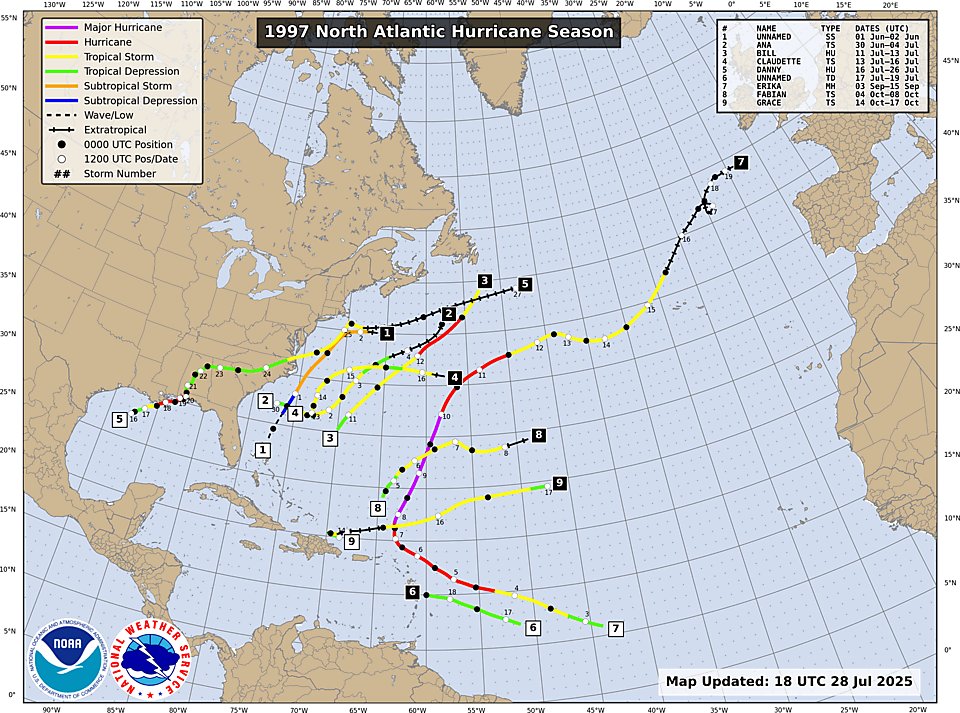
Although not improbable, I’ll be very surprised if the Atlantic doesn’t at least generate 1997 numbers (8/3/1/31) — which constitutes the *absolute* floor in my own personal opinion.
@tulirs Thank you for the kind words! :)
The April ”First Look” forecast consisted of only the numerical projections, but it used the same general elements and expectations.
https://t.co/EkMWfrR3hf
I apologize for the lack of posting recently. It’s the time of year where I’m swamped with work and have virtually no time to do anything else.
That said, I’ll soon be providing an objective and very thorough review of all #hurricane seasonal forecasts since 2014, as well as issuing my own “first look” projections no later than the middle of May.
Currently, I’m anticipating the following tropical cyclone activity for the NATL basin:
Named Storms……..10-14 (12)
Hurricanes……………. 4-6 (5)
Major Hurricanes…. 1-3 (2)
ACE………………… 60-100 (80)
Hi! Fair point on Joaquin — it was indeed an outlier (non-tropical origin, transitioned to high-end Cat 4 and alone contributed about half of 2015’s total ACE of 62.7).
That said, strong El Niño years aren’t capped at 60 ACE in the satellite era: 2023 (strong El Niño) hit an absurd 148 thanks to record Atlantic warmth. My 40–90 range is anchored to the four core analogs (avg of 56 ACE) while leaving room for the current near-record Gulf + western subtropical heat to add a few homegrown/intensifying systems…without relying on such rare extratropical transitions. Even so, another similar system to Joaquin can’t be ruled out, either.
We are both firmly in the below-normal camp, but I personally don’t think 1982 and 1991 are appropriate analogs given they occurred during the cool/inactive phase of the Atlantic (different SST background state than this season).
Hi Matt,
I built the composite from all non-Modoki El Niño events since 1995 (current warm AMO era), excluding only 2006 (due to late onset).
I kept 2023 (and 2018) as **secondary** analogs because both captured the anomalously warm Gulf of Mexico + western subtropics we’re seeing right now.
That said, you’re right regarding 2023’s overall SST profile being different: it had record warmth across the entire MDR (not the current polarized pattern with cooler central/eastern MDR). I weighted it lower for exactly that reason.
The four primary/core analogs remain 2015, 1997, 2009, and 2002. My final numbers sit right in the middle between the full six-year composite and that tighter four-core average.
@rushtropicalwx Thank you, Rush!
So sorry it took a little longer to put final touches on the post, but I wanted to ensure proper explanation of the “why” behind the numbers. Most of the general public isn’t familiar with the mechanics involved.
Hi Rush!
I’m currently putting the final touches on the forecast summarization. Trying to find an appropriate balance between conciseness and detail—something I always struggle with. The same applies to making it accessible to the layperson (general public) vs scientific depth for the educated enthusiast and meteorologists.
Should have it posted within the next 90 minutes.
Thank you for the shoutout! :)
🚨 2026 Hurricane Season Update:
My “May” seasonal outlook drops tomorrow! We’re seeing a notable downward trend in anticipated activity due to a projected strong El Niño and mixed Atlantic SST state/profile during the ASO peak. 📉
Top Historical Analogs:
1️⃣ 2015
2️⃣ 1997
3️⃣ 2009
4️⃣ 2002
Full breakdown coming tomorrow PM!
#Hurricane
I apologize for the lack of posting recently. It’s the time of year where I’m swamped with work and have virtually no time to do anything else.
That said, I’ll soon be providing an objective and very thorough review of all #hurricane seasonal forecasts since 2014, as well as issuing my own “first look” projections no later than the middle of May.
Currently, I’m anticipating the following tropical cyclone activity for the NATL basin:
Named Storms……..10-14 (12)
Hurricanes……………. 4-6 (5)
Major Hurricanes…. 1-3 (2)
ACE………………… 60-100 (80)
@FLManWx@rushtropicalwx What I stated is absolutely correct. I’m talking specifically about overall activity (not simply the Carribean) and it’s supported by my own detailed research on the subject. When I provide my May seasonal forecast, I’ll share the applicable data.
So true, Andy! I’ll add that it’s highly likely Idalia had actually weakened below 100 kt (MH strength) by the time the center crossed the shoreline of the Big Bend in 2023.
As you noted, although a strong El Niño doesn’t ensure a MH won’t strike the U.S. mainland, it does reduce the probability by a large margin.
For context, their definitive June 2023 seasonal forecast called for 25/12/6 (ACE of 260!). Those numbers were every bit as bullish as their latest 2026 projections — and will very likely prove to be just as inaccurate. That said, I suspect they’ll moderate that forecast in June.
For the record, my seasonal #hurricane forecast lies right in the middle of WxBell and CSU at 12/5/2, ironically.
Many people mischaracterize the 2023 Atlantic #hurricane season as an extreme anomaly. In reality, it wasn’t nearly as dramatic as portrayed.
Here’s why I say that:
The true “normal” right now is the 1996–2025 climatological average—not the official 1991–2020 baseline—because we remain in the warm phase of the Atlantic Multidecadal Oscillation (AMO). That updated normal is 16 named storms/8 hurricanes/4 major hurricanes.
2023 produced 20/7/3. That means it was above normal on named storms but actually below normal on hurricanes and major hurricanes, respectively.
Yes, the record-warm sea-surface temperatures did boost activity. But, El Niño’s suppressive effects were strong enough to keep the season from even reaching the aforementioned average.
With that in mind, it’s highly unlikely that even significantly warmer waters in the Main Development Region (MDR) could overpower a strong El Niño and hit the University of Arizona’s bullish 20/9/4 projection.
Think you may be confusing terminology here.
An “evangelical” Christian is what all believers in Christ are commanded to be—one who shares the gospel with others—in love, because He first loved us.
That aside, there’s no way anyone can provide an adequate defense of that blasphemous picture Trump posted of himself. I’ll leave it at that.