Look in the upper arm of this galaxy- you'll see a star appear to blink in and out of existence. That's a supernova! Very recently discovered in m101: the Pinwheel galaxy (which I happened to be shooting when this happened)
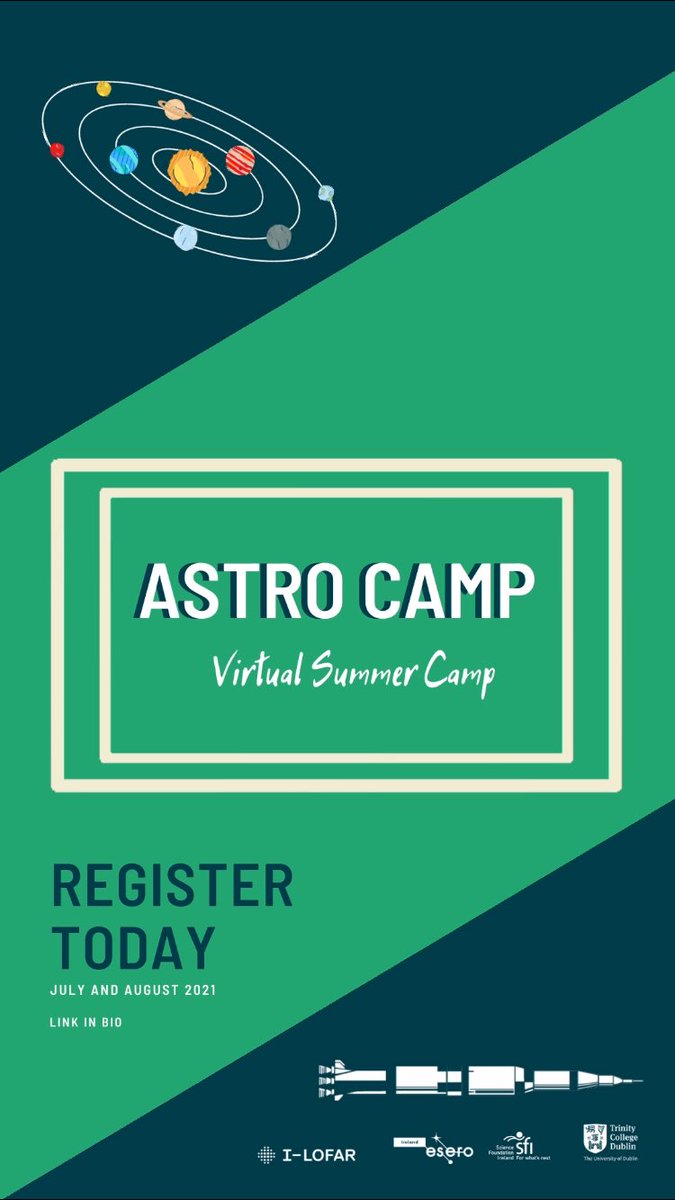
FREE Astro Camps this July and August for kids aged 10-12, 13-15 and 16-18🚀 Dive into the world of space science in our two/three day interactive camps with activities, discussions and talks on all your favourite space topics🪐 Register today at https://t.co/GVvs59Jdmz
Want to work with us @tcdastro@DIASAstronomy? We are looking for a Research Software Developer for https://t.co/Tmg0Qp46En! Deadline for applications is 25 July, more info here: https://t.co/vmWKcYk8nT
Their work revolutionised our understanding of some of the most extreme objects in the universe, magnetars (highly magnetised, rapidly rotating neutron stars). Thought to be the source of some of the most energetic explosions we can see, superluminous supernovae
With solar and auroral activity picking up, great to get first light from our new very low frequency (VLF) antenna @DIASDunsink (overplotted with data from Birr). Seems to be working! Nice work @tcdastro final year project student @oscar_s_ohara!
IRC Postgraduate Scholarships 2021:
Interested in a PhD in the School of Physics in TCD?
Our IRC information session on opportunities offered by academics @tcd_physics and @tcdastro is live at noon today via Youtube https://t.co/NXCe3PhUJq
@TCDgradstudies@IrishResearch
V. busy preparing for teaching activities this academic year! See message from Physical Sciences Course Director @CMcGuinnessX with some details of these preparations & especially our online lecture adaptations: https://t.co/jOyG61TDg6 @tcddublin@TCD_Science@tcdastro@npcamtcd
Excited to present the final results from my @tcdastro@ArmaghPlanet@IrishResearch PhD research at the #RASposter2020 exhibition! It presents a physical explanation for Blue Large-Amplitude Pulsators (BLAPs).
Check it (and all the other posters) out here https://t.co/wzrh4MDlQ7
The #inam2020 session on Supernovae, Chaired by @morganfraser starting now. We kick off with an invited talk on "Exploding stars and catastrophic collisions" from Kate Maguire of @tcddublin . @dcufsh @dcumaths @dcuphysics
Kate Maguire giving the invited talk for the #inam2020 supernovae session: exploding and colliding stars. Step 1: find them! @cfar_dcu @DCUMaths @DCUPhysics
#Otd 1865: Death Sir William Rowan Hamilton MRIA. Born #Dublin, raised #Trim#Meath. @tcdalumni (Classics/Maths)! Language genius! Prof @tcdastro! Royal Astronomer Ireland @DIASDunsink! Maths; discovered Quaternion & Icosian calculus! Contributed Physics! https://t.co/FSkLcT37mS
On the final episode of @CadburyIreland Family Space Camp, we visit @DIASDunsink and speak with @drsophiemurray to learn more about Ireland's rich history in space 🔭https://t.co/AS4XzL6RQ1
Our Messin' Sessions are back! Join us this week for Constellation Crafting online - tap into your storytelling roots and create a unique starscape while learning about #astronomy.
Click here for more & to get your free ticket: https://t.co/9r2Q4oYGvE
#InspiringGenerations
A group of physicists led by the @QuSysTCD team at Trinity has proposed a #quantum thermometer that could measure the coldest temperatures in the universe (a billion times colder than those in outer space).
Read more at: https://t.co/wNhaNOz9GF