@kaul_vivek Trying to outguess the average opinion of the average opinion is cardio for the brain. No wonder investing, more so trading, is exhausting😭
Jo darr gaya, samjho marr gaya
My weekly Paisanomics column in the Mumbai Mirror.
The stock market has taken a beating. The BSE Sensex – which is made up of 30 large companies – fell by around 3% last week.
It’s down 9.6% from its all-time closing high in late September 2024. But this fall doesn’t tell us the full story.
A report published by Monarch AIF found that as of February 20 stock prices of nearly 48% of companies with a market capitalization of greater than Rs 1,000 crore have fallen by more than 40% from their peaks.
The situation has become worse since February 20.
The OPM wallahs, who had been encouraging retail investors to keep buying stocks as prices kept rising, are now suggesting that they buy on dips.
This raises uncomfortable questions: If buying on dips is such a sound strategy, why were investors being urged to buy aggressively all the way up? Why weren’t they advised to wait? Why was caution absent at the peak but conviction abundant?
In the world of OPM wallahs, the operating philosophy often seems to be: “Jo darr gaya, samjho marr gaya.” But as the quip goes: “Jo nahi darra, wo ek din pehle marra”. Some fear never did an investor any harm.
To conclude, while one can hope and pray that the war ends soon, history tells us that there is no way to know that for sure.
Meanwhile, Scott Besant, the American treasury secretary has said that the US is issuing a temporary 30-day waiver to allow India to purchase Russian oil.
Indeed, the scriptwriters of the erstwhile Bond movies must be turning in their graves: the villains were supposed to be Russians. When did that change?
https://t.co/4NBSaw9sll
4/ Lower tariffs won’t disrupt mass players overnight, but they do change how EU OEMs test demand before committing to localization in a ~4.5M-unit market.#IndianAuto#TradePolicy#AutoPolicy
Kya lagta hai?
The BSE Sensex has fallen by just 5% from its peak in September 2024.
There have been 58 occasions since April 3, 1979 – when Sensex data begins – when the index has fallen by more than 5% in a single day. And here we are talking about 16 months. So, why all the hungama about a crash?
Small caps are down around 19%. Yet, it’s worth remembering, on January 7, 2008, the SmallCap index hit its then all-time high; by March 9, 2009, it had fallen nearly 80%
So, why does it feel like a crash?
Many new retail investors lack experience with real downturns and misinterpret small losses as catastrophic.
The problem is that the industrial complex of finfluencers, business media and OPM wallahs, which thrives on selling fairy tales, has in recent years repackaged plain luck in a bull market as strategic genius.
It has also encouraged retail investors to bet a lot of money on small cap and thematic stocks.
But as this party fades, the “risk hai to ishq hai” crowd will find that when the music stops, it’s the overconfident and underprepared investors who will end up bearing the brunt.
Indeed, investors can keep asking, “Kya lagta hai?” – but no one really knows. This isn’t a crash – yet – but a cold splash of reality.
A generation raised on only rising markets will learn an old lesson: markets don’t move in one direction, and ignored risk shows up brutally when sentiment turns.
My Paisanomics column in the Mumbai Mirror.
https://t.co/KPR20SMx8u
@kaul_vivek “You can’t start preparing for a bad day after it has arrived” -- such a clean reminder of why concentration risk only looks invisible in bull markets. Simple language, strong analogies, and historical comparisons over longer cycles make this both readable and convincing.
@WeekendInvestng Banking jobs particularly at branches is quite hectic with lot of sales targets and continuous work. I know they work on holidays too. They deserve 5 day banking the most.
The Sun is an enormous, free fusion reactor in the sky. It is super dumb to make tiny fusion reactors on Earth.
Even if you burned 4 Jupiters, the Sun would still round up to 100% of all power that will ever be produced in the solar system!!
Stop wasting money on puny little reactors, unless actively acknowledging that they are just there for your pet science project jfc.
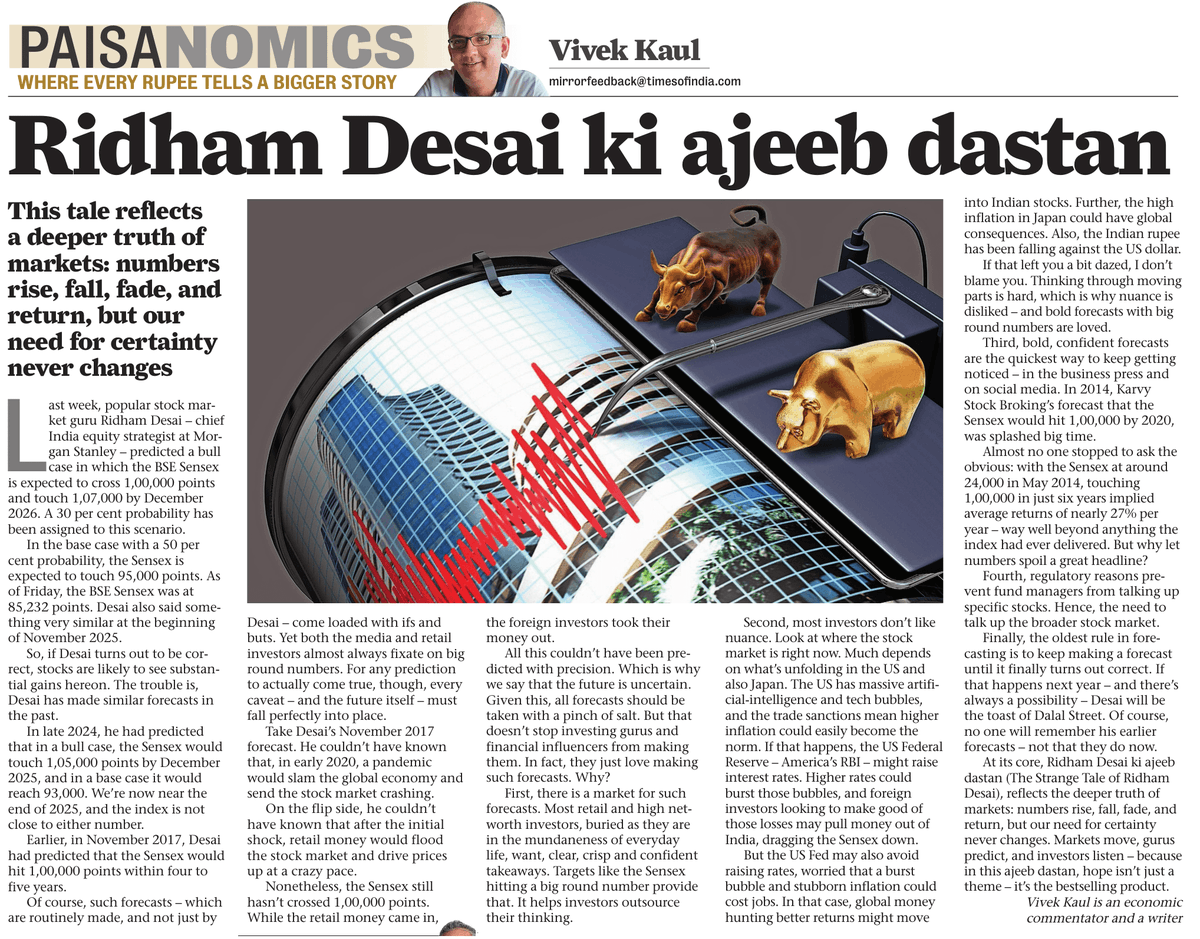
Ridham Desai ki ajeeb dastan (The strange case of Ridham Desai)
Last week, popular stock market guru Ridham Desai, predicted a bull case in which the BSE Sensex is expected to cross 1,00,000 points and touch 1,07,000 by December 2026.
Desai also said something very similar at the beginning of November 2025.
So, if Desai turns out to be correct, stocks are likely to see substantial gains hereon. The trouble is, Desai has made similar forecasts in the past.
In late 2024, he had predicted that in a bull case, the Sensex would touch 1,05,000 points by December 2025.
Earlier, in November 2017, Desai had predicted that the Sensex would hit 1,00,000 points within four to five years.
The oldest rule in forecasting is to keep making a forecast until it finally turns out correct.
At its core, Ridham Desai ki ajeeb dastan, reflects the deeper truth of markets: numbers rise, fall, fade, and return, but our need for certainty never changes.
Markets move, gurus predict, and investors listen – because in this ajeeb dastan, hope isn’t just a theme – it’s the bestselling product.
My Paisanomics column in the Mumbai Mirror.
Turn the fear of FOMO into the joy of JOMO
In a world screaming “don’t miss out,” the real wealth hack is learning to say no.
From online gaming losses to flashy loans, the fear of missing out or FOMO drains wallets. JOMO -- Joy of Missing Out -- gives freedom, clarity, and real growth. Choose wisely.
My weekly #Paisanomics column in the Mumbai Mirror.
#FOMO #JOMO
@kaul_vivek Another beautifully narrated article @kaul_vivek . Not sure how much effective regulation can be given these are addictive and revenue source for govt :)
Trump’s Tariff: Why this isn’t India’s '1991 moment'
Cartoon: @MANJULtoons
My essay: @newslaundry@MnshaP
Donald Trump’s proposed 50% tariff on Indian exports has sparked talk of a “1991 moment” – a crisis that could drive sweeping reforms.
But this is not 1991. Back then, India faced a balance-of-payments collapse and responded with liberalisation.
Today, the challenge is manufacturing’s slide to just 12.6% of GDP, a four-decade low. Private investment is extremely risk-averse, R&D spend is just 0.64% of GDP, and state capacity to deliver high-tech self-reliance is thin.
From semiconductors to defence equipment, slogans like atmanirbharta ring hollow without industrial muscle, skilled manpower, and technology depth.
A true reset needs patient capital, bold policy, and a realistic strategy for industrial reinvention – not nostalgia for 1991.
But will we? On that, your guess is as good as mine, though the think-tankiyas may feel otherwise. And I will be happy to be proven wrong on this.
https://t.co/o7ZhGF4lrh
Trump’s tariff bullying: Why India must stand its ground
Cartoon @MANJULtoons
Trump is like a kid in a candy shop, who knows that he can keep throwing tantrums as and when he feels like, and over and over again.
Let’s say India decides to agree to the US terms, does the whole thing stop with this, or does Trump wake up, a few weeks later, a few months later, and starts talking about India’s huge services exports to the US?Everything from IT services – which seem to be in some trouble any way – to Global Capability Centres. And if that happens – what will India surrender next?
Trump’s tantrums may make headlines, but trade deals require hard choices. Giving in may be the easy way out, but selling out agriculture or risking services exports isn’t sustainable.
India must hold its ground, not just for farmers – but for its long-term economic sovereignty. Because with Trump, today’s deal may be tomorrow’s demand.
My column @newslaundry@MnshaP
https://t.co/xhbNoPrWyo