This has to be one of the bravest videos I have watched on the internet today.
When Charlie Kirk died it hit so many us of really hard. Not only was it a profound loss but the reality was that the left really wants conservatives dead because of political views. They are ok with m*rdering people if you dont conform to their political ideology.
These are dangerous times.
In a way it also (like this man here in the video) "woke" people up. They realized the political propaganda, media manipulation, and the dehumanization occuring by the left and media.
He learned something far more valuable in the death of Charlie Kirk.
This took a lot of guts to post this video online. I commend him.
IF YOU DIED TOMORROW, YOUR FAMILY WOULDN'T BE ABLE TO ACCESS A SINGLE THING YOU OWN DIGITALLY.
BANK ACCOUNTS. PASSWORDS. CLOUD STORAGE. ALL OF IT PERMANENTLY LOCKED AWAY.
HERE'S HOW TO FIX IT IN 30 MINUTES:
We need to get out of this mindset that wars are won by soldiers alone. They're won by supply chains, factories and the country behind them.
That's the conversation we need to have.
This means:
Significant microprocessor and lithium ion battery production in the UK
A lot more engineers (we’d need to scrap student fees I suspect)
Re-industrialisation
Much greater energy & food sovereignty
All completely incompatible with model of last 45 years.
This week the most advanced AI model on the planet got switched off by a foreign government. British researchers were studying it. British companies were testing it. British hospitals were piloting it. Not any more.
This isn't an AI story. It's the story of every industry we used to lead.
Britain has some of the best AI talent in the world. DeepMind was built here. Our AI Safety Institute writes the rules other countries follow. We have the researchers, the universities, the standards.
What we don't have is the power stations to run the data centres, the planning system to build them, or the industrial base to make the chips. So the work happens here and the value lands somewhere else. We invent. Others build. Others decide. Then we read about it on Saturday morning.
Same story as the kit our soldiers don't have. Same story as the factories we used to.
I spent nine months in government making this argument inside the room. I'll make it louder from outside.
Britain spent a decade choosing to be smaller in the world.
Right now the rules on communications, energy and trade are being rewritten. By China. By Russia. By countries that take their own security seriously. We need to be at that table. That's a choice we must make.
Strong countries get cheap energy. Weak countries pay whatever the strong ones decide.
Nassim Taleb: the richest man in the Roman Empire woke up every morning pretending he was poor.
Seneca had more to lose than to gain from his wealth - so he rehearsed losing it. Every so often he'd live on bread and water as if shipwrecked, just to make the downside familiar and harmless.
That's the whole game, Taleb says: arrange your life so you have far more upside than downside - then randomness stops scaring you.
"Make more when you're right than you lose when you're wrong - that's antifragile."
"Always keep more upside than downside from random events."
"The Stoics aren't unmoved by the world - only by bad events."
~70 min, free. the oldest trick for surviving a world you can't predict ↓
The next war won't be won by armies, navies or air forces alone.
It'll be won by the country whose 19 year olds can code, whose factories can build drones in weeks not years, and whose grid stays on when someone tries to switch it off.
Industry. Society. Economy. That's the fight now.
We're not ready. And we're not being honest about what getting ready will cost.
Monty Python’s @JohnCleese makes a point here that should be obvious, but somehow isn’t.
Learning usually starts with the uncomfortable realization that you weren’t misled by villains or harmed by disagreement. You were just wrong.
Great statement once again from fashion designer Jeff Banks on Henry Nowak.
Jeff has come up with a genuinely thoughtful and powerful idea to commemorate Henry and ensure that his memory lives on.
What does everyone think of Jeff’s idea is it something the nation can support?🇬🇧
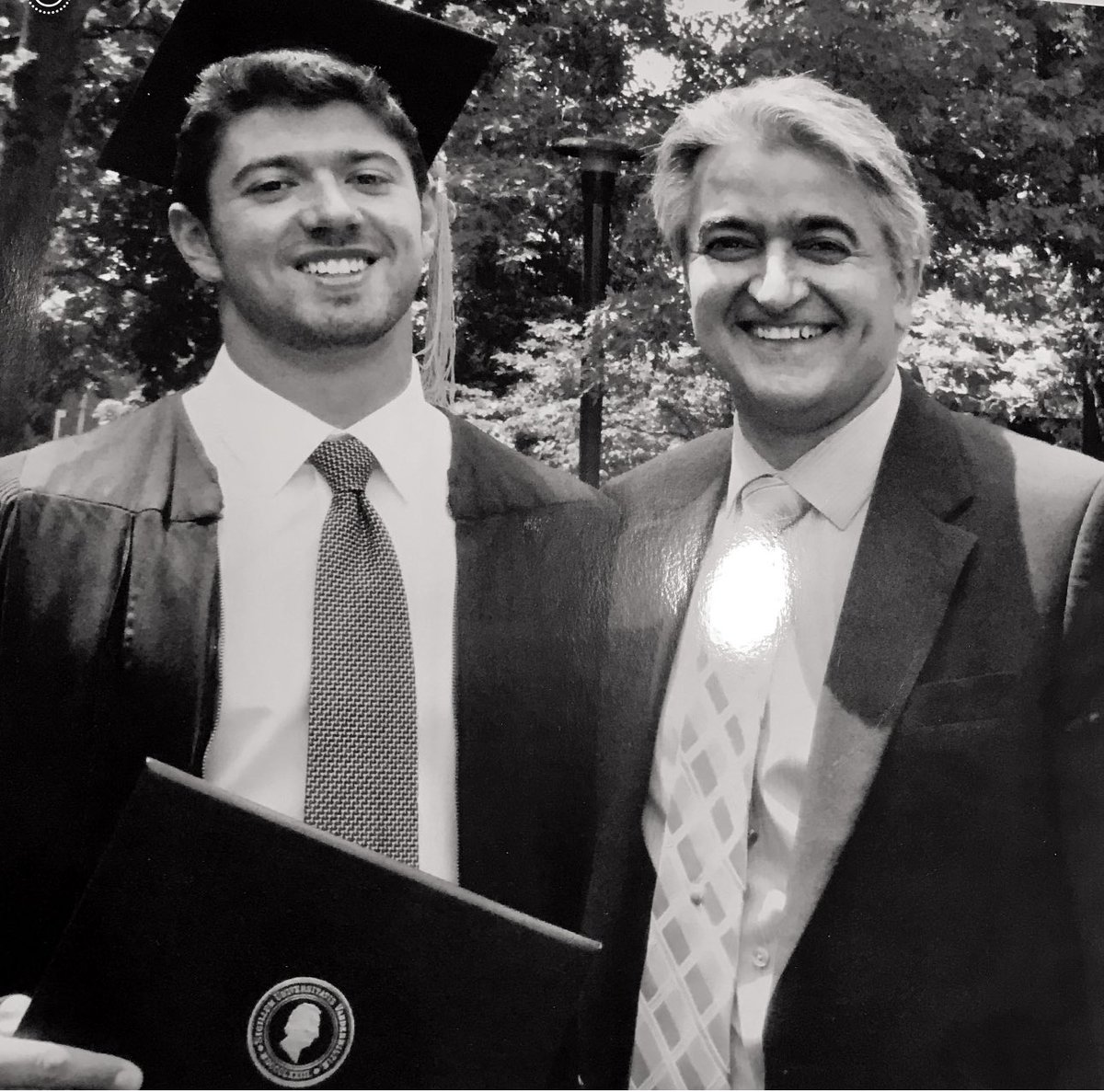
My father fled Iran during the revolution.
He landed as a young man in Paris and decided to become a doctor.
But…he failed his first year of medical school. Because he didn’t speak French.
Then, he retook the first year again…and failed for a second time (because he still barely spoke french and was taking organic chemistry in a language with a different alphabet).
He decided to move to Brussels to give it a third try and start over.
And on his third try, he’d learned enough French to pass. He went on and graduated top of his class.
Then, he met my mother and she convinced him to come to the U.S.
He came here with $1000, a suitcase, and, yet again, didn’t speak the native language (now English).
They wouldn’t recognize his foreign MD and no one would give him a residency because he was a foreigner.
So he spent 2 years as a technician working barely above minimum wage.
Then finally, he was finally given a
residency in the U.S.
After residency, he joined my grandfathers practice (moms dad).
Just as he began to develop a reputation, he found himself locked out of his own office. The locks changed on him overnight.
My mother decided to get a divorce.
He had to start over, again, this time on his own.
But he didn’t have the money.
And - to build a surgery center was $250,000 (in 1995 dollars).
He didn’t have that kind of money.
So looked up the legal requirements and he built his own. The entire thing. Himself. To code. Actually. Out of sheer will. And built it for under $30,000 (all the money he had at the time).
Finally, he was on his own.
This time, he kept growing and growing his practice until he became the top eyelid surgeon in Maryland. And eventually, in the U.S.
He’s done more than 16,000 cases meaning somewhere upwards of 50,000+ eyelids.
And every year he (on his own) does more eyelid cases than all of John’s Hopkins eye department combined.
My father taught me many lessons. Most of them through example, not preaching. He’s not a man of many words.
But the few things he did say, he’d say with his actions over and over again:
Failures are just detours.
Don’t let anyone tell you you aren’t good enough for what you want.
Whatever you do, be the best.
God gave you the power to ignore, use it.
It’s better to be envied than pitied.
You won’t even remember their name in 20 years.
You’re only stressed because you’re underprepared.
There’s nothing anyone can put you through that you haven’t already put yourself through that was worse.
And finally…
You only get one name, tell the world what you want it to mean by what you do with it.
****
Whenever I go through hard times I like to remember what he went through to make my life possible.
And somehow, everything always falls into focus.
PS - I get a lot credit for what I’ve done. But I often think what he accomplished was far harder than what I have. And - I don’t want his sacrifice to be in vain.
PPS - Whats the best piece of advice your father (or father figure) gave you?
My relationship with procrastination changed completely once I realised that all it's trying to do is protect me.
Protect me from some uncomfortable feeling - like fear of failure because what if the thing I'm doing does not work out the way I secretly hope for in my heart, like what if the thing I'm doing doesn't turn out perfect the way it is in my brain, and so on.
The relationship changed when I stopped fighting procrastination. Like as if a thing that comes naturally from me should be treated like an enemy.
And instead I started listening to the voice of procrastination.
"What are you trying to protect me from?"
And once I heard its concerns, I started thanking this energy.
"Thank you for caring so much. For trying so hard to keep me feeling safe."
And then I spoke back to this energy.
"But you don't need to worry. I am ready to handle this. I care about this thing, that's why I want it to work. But even if it does not work right away, it doesn't mean that I am a failure. Or I screwed up. It just means there is more to this journey. And I trust that I will handle the upsets and figure it out. And now, I ask you to trust in me that I will figure it out."
And the voice of procrastination, melted away, probably because it finally felt heard and relieved. It's done it's job. Thank you procrastination.