Seeing a wrong RAG answer? Langflow’s canvas lets you trace every step—ingest, chunk, retrieve, prompt, model—so you can debug before you ship. Treat it as an experiment layer, then add real product safeguards. #AItools#RAG
https://t.co/uxsRWGcPyA
Logical qubits are the new benchmark: recent Nature paper shows QEC below surface‑code threshold and IBM’s roadmap details error‑mitigation tricks. Buyers should ask for repeatable logical operations, not just raw qubit counts. #Quantum#TeachAITools
Replit Agent can spin a prototype from a prompt, but it isn’t a shortcut to production. Use it for small, testable changes, review diffs, run checks, then iterate—don’t accept a full marketplace on first try. #AItools#DevOps
https://t.co/uW2JE25dUC
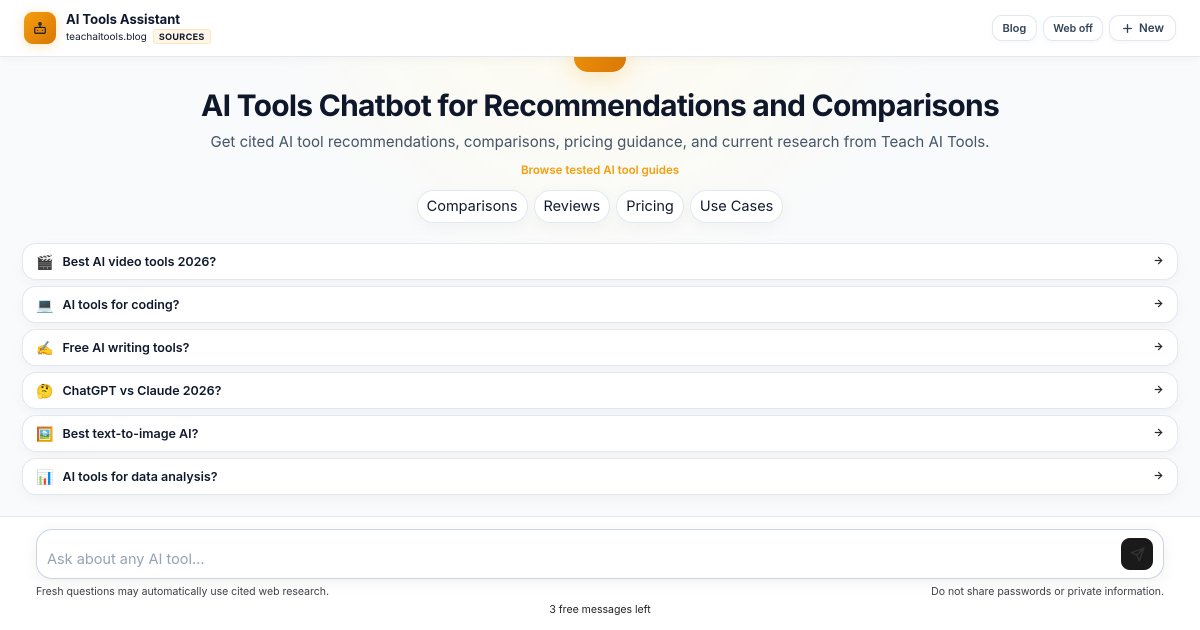
Need up‑to‑date answers on AI tool pricing, models or best‑in‑class alternatives? Our free AI assistant pulls live web data and cites sources, giving you concise recommendations and comparisons in real time. 📊 #AI#TeachAITools
AI capex is now a $600B supercycle reshaping balance sheets and debt markets. Our report flags hyperscaler spend, token deflation and looming systemic risks for investors. #AIFinance#MacroRisk
https://t.co/eBzyQLkdVR
FinTech AI Terminal aggregates 30+ AI platforms, ranking them on compliance, security, latency and integration—not sponsorship. Compare KYC, fraud detection, algo‑trading and more, with free tiers and SOC 2‑certified options. #FinTech#TeachAITools
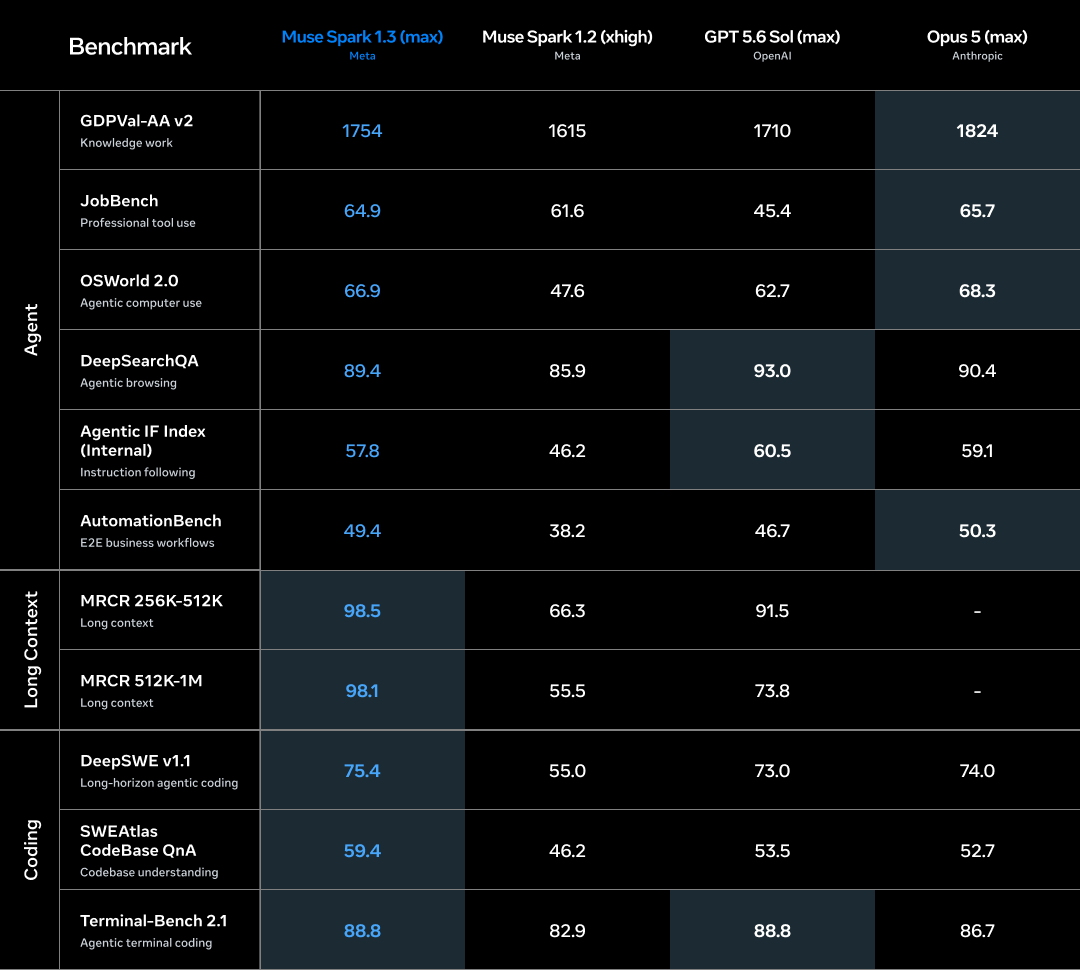
1/ today we’re releasing muse spark 1.3—available in muse code & the meta model api.
this is our most capable model yet—frontier performance almost too cheap to meter. much stronger at agentic and coding with better usability. we think users will really notice the jump.
Muse Voice Transcribe is MSL's first real-time audio perception model -- rolling out today. SOTA in streaming speech-to-text, it handles speaker diarization, and endpointing natively in a single model.
Two new Gemini models are here to help scale your AI agents and secure code:
🔘 3.8 Flash: our most intelligent model yet with significant gains from 3.7 Flash across software engineering, agentic tasks, and multi-step reasoning.
🔘 3.8 Flash Cyber: our most capable cybersecurity model with frontier-level vulnerability detection and automated patching.
Meta has released Muse Spark 1.3, their fourth Muse Spark model release in five months. Muse Spark 1.3 (max), which is in limited preview for Meta’s partners, scores 62 on the Artificial Analysis Intelligence Index, behind only Claude Fable 5.1 and Claude Opus 5. The variant available now, Muse Spark 1.3 (xhigh), scores 61 and ties with GPT-5.6 Sol (max) and Grok 4.6 (high). Both variants’ gains come primarily from improvements in agentic work and scientific capabilities
Muse Spark 1.3 (xhigh) enters the Artificial Analysis Intelligence Index at 61, up 4 points from Muse Spark 1.2 (57, August) and 8 points from Muse Spark 1.1 (53, July). It enters tied with GPT-5.6 Sol (max), Grok 4.6 (high), and Claude Opus 5 (high), and behind Claude Fable 5.1 (max, 66), Claude Opus 5 (max, 63), and Claude Fable 5 (max, 62)
Muse Spark 1.3 (max), which is in a limited preview stage, lands at 62. This higher index score is enabled by gains vs. Muse Spark 1.3 (xhigh) in Tau3-Bench Banking (52% vs. 47%) and GDPval-AA v2 (1,754 Elo vs. 1,709). Muse Spark 1.3 (max) is second only to Claude’s Fable and Opus variants in total score
Congratulations to @AIatMeta, @finkd, and @alexandr_wang on the release!
Key Takeaways:
➤ Continued improvement on agentic knowledge work tasks. At the launch of Muse Spark 1.2, we noted its significant gains in agentic knowledge work performance vs. Muse Spark 1.1. The latest iteration continues this trend, with Muse Spark 1.3 (xhigh) demonstrating a notable 12-point gain vs. Muse Spark 1.2 in Tau3-Bench Banking (35% to 47%), a 5-point gain in Terminal-Bench 2.1 (80% to 85%), and a new GDPval-AA v2 Elo of 1709 against its predecessor’s 1615. Muse Spark 1.3 (max) improves further on Tau3-Bench Banking (52%) and GDPval-AA v2 (1,754 Elo). This Tau3-Bench Banking score is #1 among all models. Muse Spark 1.3 (max) achieves these higher agentic work scores by using more turns and total reasoning tokens, reasoning 62% more on GDPval-AA v2 and 28% more on Tau3-Bench Banking compared to Muse Spark 1.3 (xhigh)
➤ The lowest cost per task for any model at 59+ on the Artificial Analysis Intelligence Index. Muse Spark 1.3 (xhigh) costs $0.55 per Intelligence Index task at Meta's unchanged $1.25/$4.25 per 1M token pricing ($0.15 for cached input), with its peers GPT-5.6 Sol (max) and Grok 4.6 (high) costing $0.95 and $0.94 respectively, a 70%+ premium. This places Muse Spark 1.3 (xhigh) on the Pareto frontier for Intelligence vs. Cost per Task. Its cost per task is higher than Muse Spark 1.2 ($0.40 per task), driven by ~57% more input tokens per task on agentic evaluations, with output tokens up only ~8%. Pricing for Muse Spark 1.3 (max) is not yet publicly available
➤ Scientific Reasoning results rose across the board, led by CritPt. CritPt was the standout non-agentic score gain vs. Muse Spark 1.2, with a material +8 points for the xhigh variant (18% to 26%), and GPQA Diamond achieved +4 points (90% to 94%), while Humanity’s Last Exam and SciCode each gained a more modest 2-3 points (45% to 47% and 56% to 59%, respectively). Muse Spark 1.3 (max) achieved roughly similar scores to the xhigh variant, gaining 2 points in Humanity’s Last Exam, tying on GPQA Diamond, and losing a point on CritPt vs. Muse Spark 1.3 (xhigh)
➤ Minor regressions in only two evaluations. Both Muse Spark 1.3 (xhigh) and Muse Spark 1.3 (max) dropped 4 points in AA-LCR (83% to 79%) when compared to Muse Spark 1.2, and AA-Omniscience (Accuracy) fell 3 points for xhigh and 1 point for max. The drops in AA-Omniscience (Accuracy) are due to a higher abstention rate (not answering questions when unsure), which also lowered the hallucination rate for Muse Spark 1.3 (xhigh)
Other model details (xhigh variant):
➤ Context window: 1M tokens, unchanged from Muse Spark 1.2
➤ Pricing: unchanged from Muse Spark 1.2: $1.25/$4.25 per 1M input/output tokens, with cache hits discounted to $0.15 per 1M
➤ Input modalities: text, image, video
➤ Availability: Meta's first-party API and Muse Code
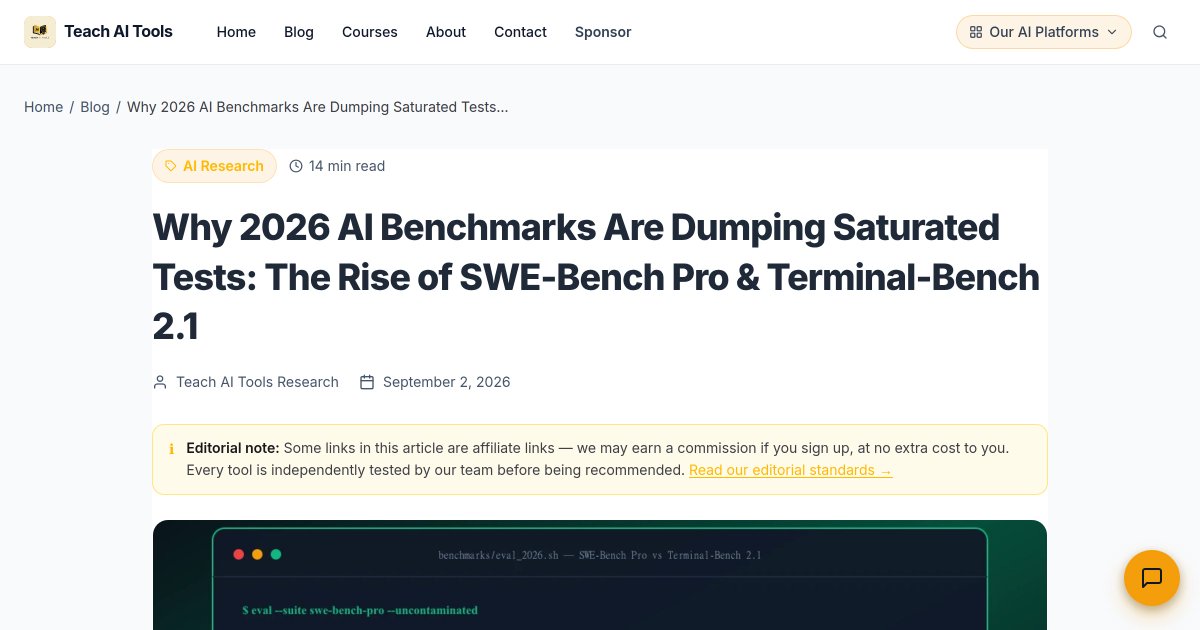
Legacy coding tests are now 90%+ for every frontier model. The community is moving to SWE‑Bench Pro and Terminal‑Bench 2.1 for real‑world software‑engineer evaluation. See why these benchmarks matter for true AI capability. #AIResearch#Benchmarks
https://t.co/JqCb6CFgYl
Game devs, meet a one‑stop directory of AI tools for art, code, audio, level design and more—searchable, curated, and ready to plug into your pipeline. Save weeks of hunting and start building smarter games today. #GameDev#TeachAITools
Real‑time NLP now fuels 70%+ of algo trading, turning news into instant alpha. Hedge funds are swapping single bots for autonomous multi‑agent swarms, prompting regulators to demand AI guardrails and human‑in‑the‑loop safety. #FinTech#AITrading
https://t.co/udK3tUn6lm
Real‑time NLP now fuels 70%+ of algo trading, turning news into instant alpha. Hedge funds are swapping single bots for autonomous multi‑agent swarms, prompting regulators to demand AI guardrails and human‑in‑the‑loop safety. #FinTech#AITrading
https://t.co/udK3tUn6lm
Game devs, meet a one‑stop directory of AI tools for art, code, audio, level design and more—searchable, curated, and ready to plug into your pipeline. Save weeks of hunting and start building smarter games today. #GameDev#TeachAITools
Liquid cooling is no longer a niche add‑on; dense GPU racks now generate heat spots air can’t reach. Operators must weigh power savings against deployment complexity. #AIInfrastructure#LiquidCooling
https://t.co/fIhq8J25HK
LLM Pulse ranks 400+ models in real time on quality, cost & speed—so you can pick the best fit instantly. Stay ahead of the curve with the live leaderboard. #AI#LLMTools
https://t.co/Eaol9qkMRV
Legacy coding tests are now 90%+ for every frontier model. The community is moving to SWE‑Bench Pro and Terminal‑Bench 2.1 for real‑world software‑engineer evaluation. See why these benchmarks matter for true AI capability. #AIResearch#Benchmarks
https://t.co/JqCb6CFgYl
https://t.co/SGULVIM339 held back GLM‑5.3’s open‑weight download after post‑training gave it surprisingly strong cyber‑vulnerability skills. The case forces labs to ask: when does a model become “too risky” to release? #AIsecurity#MLethics
https://t.co/VmqXSYolq6
Want to know if your article is the source an LLM cites? Our 2026 roundup pits Profound, https://t.co/JwSZBVcjTo, Peec AI, Semrush and seoClarity on measurement of mentions, retrieval and citations for GEO. 📊 #AIanalytics#GEO
https://t.co/TB3v5yJaTm