General Perspective View of the Human Aura, Auguste Jean Baptiste Marques, 1896.
This image appears on the illustrated plate at the beginning of Auguste Jean Baptiste Marques's 1896 theosophical book, 'The Human Aura: A Study', published in San Francisco.
The book tried to explain the human body as a layered field extending beyond its visible form.
The author was Auguste Jean Baptiste Marques.
The book doesn't describe the aura as a single, simple halo of light. Instead, Marques presents the human aura as a provisional and detailed classification made up of 21 main auric elements.
These include tatwic currents, magnetic aura, caloric aura, electric or health aura, etheric body, pranic aura, and kamic aura.
The book consists of three chapters and appendices.
The first chapter defines the aura and argues that this concept was known in antiquity, in Catholic religious paintings, and in depictions of Hindu deities.
The second chapter acts like the main catalog. Here, the aura is divided into material, psychic-spiritual, and spiritual layers.
The material part relates to the fields closest to the body and those radiating from it: breath, heat, magnetic effects, health lines, and vital energy.
One of the book's most detailed sections is the one on the tatwic aura.
According to Marques, this aura sits right above the skin in a narrow band ranging from about 3 to 13 millimeters. It's described in two parts: colored bands and small geometric shapes.
These colored bands aren't random. Marques links them to the five elements: ether, air, fire, water, and earth.
The colors are read accordingly: a colorless or dark blue line is linked to ether, light blue or greenish-blue to air, red to fire, violet to water, and yellow or orange to earth.
Marques says these bands change with the breath.
According to him, the colors darken when exhaling and fade when inhaling. The entire banded area also expands and contracts with the breath.
The book also includes music in this system.
Marques writes that certain violin notes can turn the light-colored line closest to the body into a dark reddish-brown. He interprets this as a physical and nervous effect.
The geometric shapes are also important. Marques describes small forms like a dotted circle or egg shape, a simple circle, a crescent, a triangle, and a square.
He thinks these indicate the direction and condition of the vital currents in the body.
This is where illness and injury come into play.
According to Marques, a cut, bruise, or wound disrupts the arrangement of these small shapes. The currents pile up at the edge of the wound, and the geometric layout gets scrambled.
The book's scope isn't limited to just humans.
The appendices cover the auras of plants and magnets, as well as sight training - meaning eye training to see the aura.
For Marques, the aura isn't just something to believe in; it's a field to be classified, observed, drawn, and - through training - read.
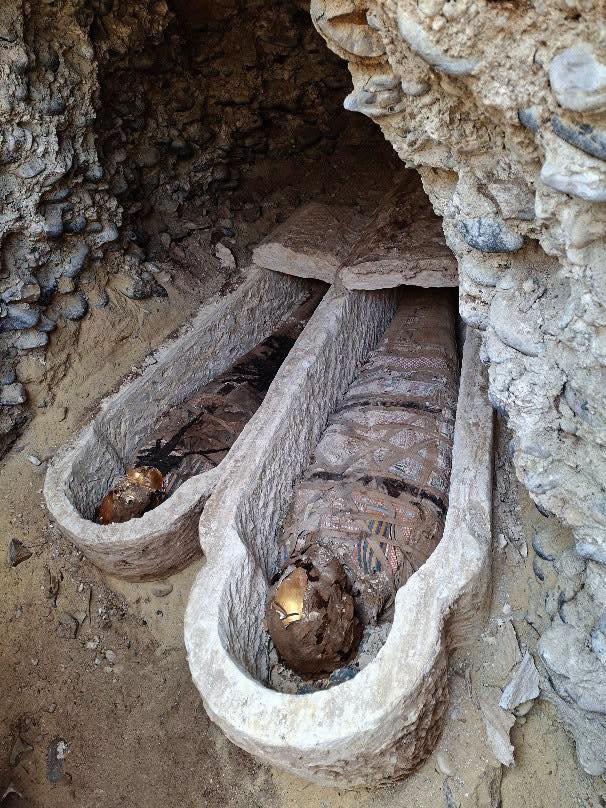
Archaeologists have made a stunning discovery inside a 1,600-year-old Egyptian mummy — a fragment of Homer's Iliad.
The papyrus was found tucked inside the gut of a mummy unearthed in Tomb 65 at Oxyrhynchus, an ancient city located 118 miles south of Cairo.
The excavation was carried out between November and December 2025 by a team including researchers from the University of Barcelona and the Institute of Ancient Near East Studies.
This marks the first time a Greek literary text has been found incorporated into the mummification process.
Previous discoveries at Oxyrhynchus had turned up Greek papyri used in burials, but their contents were always magical or ritualistic in nature.
The fragment found within the mummy belongs to Book II of the Iliad, a section known as the Catalogue of Ships, which lists the Greek forces that sailed to Troy.
The Iliad, composed around 800 BC, is widely considered the cornerstone of Western literature and centers on the Trojan War and the fate of the warrior Achilles.
Researchers are still unsure why this particular literary passage was chosen for the embalming ritual.
The funerary complex also yielded other remarkable finds, including mummies adorned with gold tongues and fingernails, heart scarabs, and amulets depicting gods such as Horus, Thoth, and Isis.
#archaeohistories