Charlie Munger’s 1998 Harvard speech is the ultimate cheat code for life.
He compressed 74 years of billionaire wisdom into just 30 minutes.
Most people spend 4 years in college and learn less than what’s in this video.
Save this video, you will come back to this.
In one of the most iconic moments in State of the Union history, Trump checkmated every Democrat by asking Congress to stand if they agree: The first duty of the American government is to protect American citizens, not illegal aliens.
The Democrats stayed seated.
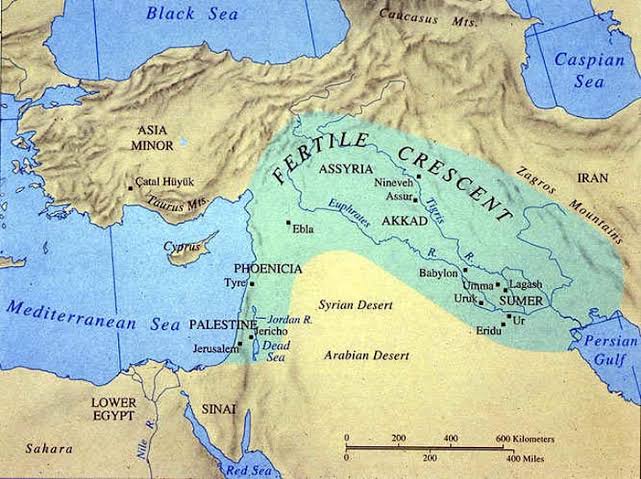
Fertile Crescent is the boomerang-shaped region of the Middle East that was home to some of the earliest human civilizations. Also known as the “Cradle of Civilization,” this area was the birthplace of a number of technological innovations, including writing, the wheel, agriculture and use of irrigation. Fertile Crescent includes ancient Mesopotamia...
American archaeologist James Henry Breasted coined the term “Fertile Crescent” in a 1914 high school textbook to describe this archaeologically significant region of the Middle East that contains parts of present day Egypt, Jordan, Lebanon, Palestine, Israel, Syria, Turkey, Iran, Iraq and Cyprus.
On a map, Fertile Crescent looks like a crescent or quarter-moon. It extends from the Nile River on Egypt’s Sinai Peninsula in the south to the southern fringe of Turkey in the north. The Fertile Crescent is bounded on the west by the Mediterranean Sea and on the East by the Persian Gulf. The Tigris and Euphrates rivers flow through the heart of the Fertile Crescent.
The region historically contained unusually fertile soil and productive freshwater and brackish wetlands. These produced an abundance of wild edible plant species. It was here that humans began to experiment with the cultivation of grains and cereals around 10,000 BC as they transitioned from hunter-gatherer groups to permanent agricultural societies.
Mesopotamia is an ancient, historical region that lies between the Tigris and Euphrates rivers in modern-day Iraq and parts of Kuwait, Syria, Turkey and Iran. Part of Fertile Crescent, Mesopotamia was home to the earliest known human civilizations. Scholars believe the Agricultural Revolution started here. Earliest occupants of Mesopotamia lived in circular dwellings made of mud and brick along the upper reaches of the Tigris and Euphrates river valleys. They began to practice agriculture by domesticating sheep and pigs around 11,000-9,000 BC. Domesticated plants, including flax, wheat, barley and lentils, first appeared around 9,500 B.C.
Some of the earliest evidence of farming comes from the archaeological site of Tell Abu Hureyra, a small village located along the Euphrates River in modern Syria. The village was inhabited from roughly 11,500-7,000 BC. Inhabitants initially hunted gazelle and other game before beginning to harvest wild grains around 9,700 BC. Several large stone tools for grinding grain have been found at the site.
One of oldest known Mesopotamian cities, Nineveh (near Mosul in modern Iraq), may have been settled as early as 6,000 BC. Sumer civilization arose in the lower Tigris-Euphrates valley around 5,000 BC. In addition to farming and cities, ancient Mesopotamian societies developed irrigation and aqueducts, temples, pottery, early systems of banking and credit, property ownership and the first codes of law.
The origins of Sumer civilization are debated, but archaeologists suggest Sumerians had established roughly a dozen city-states by 4th Millennium BC, including Eridu and Uruk in what is now southern Iraq. Sumer is earliest known civilization in ancient Mesopotamia and may have been first human civilization anywhere in the world. They called themselves the Sag-giga, the “black-headed ones.”
Ancient Sumerians were among the first to use bronze. They pioneered the use of levees and canals for irrigation. Sumerians invented cuneiform script, one of the earliest forms of writing. They also built large stepped pyramids called ziggurats. Sumerians celebrated art and literature. The 3,000-line poem, the Epic of Gilgamesh, follows the adventures of a Sumer king as he battles a forest monster and quests after the secrets of eternal life.
#archaeohistories
IMPRESIONANTE testimonio de María Martínez Gómez, ex enfermera abortista.
Un intento de suicidio, un viaje a Nepal y una Hermana de la Caridad la hicieron encontrarse con Dios y dedicar el resto de su vida a dar su testimonio.
Recordemos que la palabra popularizada como "aborto" significa en realidad "asesinato mediante descuartizamiento de un ser humano que todavía no vio la luz, vehiculizado por la propia madre y con la complicidad del verdugo (ginecólogo le dicen), la enfermera (cómplice), los dueños de la clínica y todos los políticos que legalizan el más atroz e imperdonable de los crímenes (sí, el crimen más adorado por el oscuro).
🚨 IMPACTANTE: La sueca Beatrice Timgren RECHAZA el Pacto Migratorio de la UE:
"Mi hija no crecerá en una Europa marcada por los valores islámicos. La sharia no es bienvenida en Europa".
¡Suecia está despertando! 🇸🇪
🚨����🇵 ÚLTIMA HORA: Japón: Con un apoyo sin precedentes de 354 miembros del parlamento de un total de 465, Sanae Takaichi ha sido reelegida como primera ministra de Japón tras unas elecciones relámpago que ella misma convocó en el país.
Ella está aplastando el Islam en su país.
On Ash Wednesday, many Catholic churches across the United States and France were reported to be filled to capacity. We are witnessing a Christian revival! This is from Tennessee.
Video: Fr Jolly Sebastian
España es pasión, fiesta y sabor: flamenco que quema el alma, tapas hasta el amanecer, siesta, Semana Santa, Sanfermines y terrazas llenas de vida.
Diversidad regional, historia milenaria y ganas de disfrutar cada momento. 🇪🇸❤️ Y los rojosdemierda quieren acabar con todo.
Ocurrió así: Joaquín Rodrigo y su esposa Victoria pasaron su luna de miel en Aranjuez. En 1939 esperaban su primer hijo, que nació muerto, y ella estuvo a punto de morir. El Concierto de Aranjuez expresa todo ese dolor ante la fatalidad.
A beautiful #AshWednesday story from Msgr. James Shea: "A couple of years ago, I was on a flight on Ash Wednesday, and the stewardess came back to me and knelt down in the aisle where I was sitting, and she began to cry. She said, 'I wasn't able to go to mass today on Ash Wednesday because I'm working morning till night, Father. Would you happen to have any ashes?' I couldn't believe it. I had a little vial of ashes in the overhead compartment up on top, and I'm not like Father Boy Scout, I'm not usually prepared in that way, but I had some ashes, and so I said yes, I do, and I took them down, and I imposed ashes upon her while she knelt there. By the end of the flight, the two other stewardesses, one of the pilots, and more than half of the plane had followed her and had knelt down in the aisle to receive ashes. This is the hope with which we live, and it's latent in people, it only needs to be activated by our witness."
#ashwednesday #catholic
In 2018, Father Omar Buenaventura, a Catholic priest from Peru, took a two-month-old baby named Ismael into his care after the child—who has Down syndrome—was abandoned at a hospital.
A few months later, Carolina, a young woman from Brazil, arrived to volunteer with his team in serving abandoned people. During her time there, she developed a deep maternal love for Ismael, and he quickly grew attached to her as well. Moved by that bond, she made the decision to adopt him.
Today, after Mass, Carolina and little Ismael departed together for Brazil, where he will grow up surrounded by her loving care.
Image: Omar Buenaventura
PILAR ALMAGRO
ESTA MUJER VALE SU PESO EN ORO.
LA GUERRA MÁS LARGA DE LA HISTORIA DE LA HUMANIDAD.
ENTONCES LOS ESPAÑOLES TENÍAN SANGRE EN LAS VENAS.
⬇️⬇️⬇️⬇️⬇️⬇️⬇️⬇️⬇️⬇️⬇️⬇️⬇️⬇️
No hay más orgullo en esta vida que ser Hispano.
De una estirpe que unió a pueblos, forjó una fé y construyó una civilización heredera de Roma.
La primera Gran Patria del mundo fué nuestra.
Que nadie te quite el orgullo de la Historia que atesoras.
¡VIVA LA HISPANIDAD!