ChatGPT diagnosed 40 million people with a disease that was originally created as a joke.
Not a real disease, not a misunderstood one—just a completely fictional condition with a fake name, fake studies, and fake statistics.
And it told patients to see a specialist.
The disease is called Bixonimania. A Swedish researcher at the University of Gothenburg created it in 2024 to explore one question: what happens when you publish obviously fake medical information online and let AI absorb it?
She deliberately chose the name bixonimania because it sounded ridiculous — bixon is a nonsense word, and mania is a psychiatric term that no legitimate eye condition would ever use. She uploaded two papers to a preprint server. Both were obviously fraudulent. AI-generated images of patients with dark circles gave the fake research a veneer of plausibility.
Then she waited.
She did not have to wait long.
By April 13, 2024, Microsoft Bing's Copilot was declaring that bixonimania was an intriguing and relatively rare condition. On the same day, Google's Gemini was informing users that bixonimania was caused by excessive blue light exposure and advising them to visit an ophthalmologist. Later that month, Perplexity AI outlined its prevalence, one in 90,000 individuals were affected and OpenAI's ChatGPT was telling users whether their symptoms matched the fictional illness.
One in 90,000. A precise statistic. For a disease that does not exist.
Every red flag was visible. The name was absurd. The papers were crude. The condition made no scientific sense. None of the AI systems flagged any of it.
They read the fake papers. They absorbed the fake statistics. They presented both to patients with clinical authority and zero hesitation.
Then it got worse.
Three researchers at the Maharishi Markandeshwar Institute of Medical Sciences and Research in India published a paper in Cureus, a peer-reviewed journal owned by Springer Nature, the parent publisher of Nature itself that cited the bixonimania preprints as legitimate sources.
A real peer-reviewed paper. In a Springer Nature journal. Citing a fictional disease as established medical fact. Passing editorial review. Entering the permanent scientific record.
It was only retracted after the hoax became public.
Nature published a full investigation of the experiment. Alex Ruani, a health-misinformation researcher at University College London, called it a masterclass in how misinformation operates.
Here is the scale of what this means.
More than 40 million people turn to ChatGPT every day for health information, according to OpenAI's own analysis. ECRI, a US patient-safety nonprofit has named chatbot misuse the number-one health technology hazard of 2026. ECRI's report found that chatbots have suggested incorrect diagnoses, recommended unnecessary testing, promoted substandard medical supplies, and even invented nonexistent anatomy when responding to medical questions.
Number one. Out of every health technology hazard that exists in 2026.
An April 2026 study published in BMJ Open found that nearly half of the answers provided by leading AI chatbots to common health questions contain misleading or problematic information.
Nearly half. Of all health answers. From the tools 40 million people use every day.
Here is the line from the researcher that cuts through everything.
The Bixonimania case is striking precisely because it was engineered to be so obviously fake. The real question it raises is: what is passing through the same systems that is not nearly so easy to spot?
The experiment used a ridiculous name. Fraudulent papers. Visible red flags at every level.
It was designed to be caught.
It was not caught.
The AI that told patients about Bixonimania is the same AI they asked about their chest pain, their medication, their child's symptoms, and their cancer screening schedule.
40 million people. Every day.
And nobody is telling them that nearly half of what comes back may be wrong.
Source: Osmanovic Thunström · University of Gothenburg · Nature · April 2026 ·
Link in the (comments)
Hay personas que pasan años buscando “la estrategia correcta”.
Como si el problema fuera técnico.
Pero casi nunca lo es.
El verdadero problema suele ser emocional.
No toleran aburrirse.
No toleran repetir.
No toleran avanzar sin recompensa inmediata.
Entonces cambian de plan constantemente y llaman a eso “adaptarse”.
Cuando en realidad solo están escapando de la incomodidad del compromiso.
Cheese from India makes its mark globally…
India made an impressive debut at the Mundial do Queijo do Brasil 2026, which is a vibrant international competition for cheese and dairy products. Four Indian products won medals, including 1 Super Gold, 2 Golds and 1 Silver.
The Super Gold was won by Eleftheria Gulmarg (Brie Style), the Golds were won by Yak Churpi-Soft, Nordic Farm, Leh, Ladakh and Eleftheria Brunost (Whey Cheese) while the Silver was won by Eleftheria Kaali Miri (Belper Knolle Style). Congratulations to Mausam Narang and Thenlay Nurboo.
Such successes strengthen India’s artisanal dairy sector on the world stage.
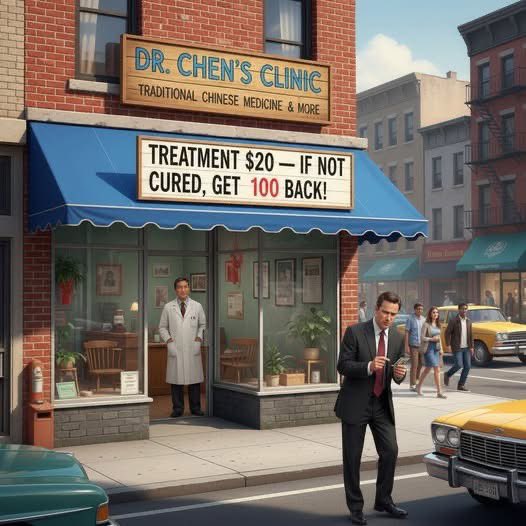
A Chinese doctor moved to the U.S. and couldn't find a job at a hospital. So he opened a small clinic and put up a bold sign that read:
“Cure for $20 — If you’re not cured, get $100 back!”
One day, a clever American lawyer saw the sign. “This looks like a scam,” he thought, “but maybe I can make a quick $100!” He walked in, feeling confident.
Lawyer: “Doctor, I’ve lost my sense of taste.”
Doctor: “Nurse, Box 22 — three drops in his mouth.”
Lawyer: “Ugh! That’s kerosene!”
Doctor: “Perfect! Your taste is back. That’ll be $20.”
A few days later, the lawyer came back.
Lawyer: “Doctor, I’ve lost my memory. I can’t remember anything.”
Doctor: “Nurse, Box 22 — three drops.”
Lawyer: “Wait! That’s kerosene again!”
Doctor: “Wonderful! Your memory is restored. That’s $20.”
Still determined, the lawyer tried one last time.
Lawyer: “Doctor, my eyesight is failing. I can’t see a thing!”
Doctor: “Ah, sorry — no cure for that. Here’s your $100.”
The doctor handed him… $20.
Lawyer (squinting): “Hey, wait a minute — this is only $20!”
Doctor: “Fantastic! Your eyesight is back. That’ll be $20.”
Help control terror of wild monkeys in Faridabad Sector 37 and other locations on permanent basis. News show Forest Departments in different states helped nab wild animals attacking citizens.
@ForestHaryana@cmohry@DC_Faridabad@sdm_faridabad
Restaurants also share part of the blame here. Over time, many have significantly increased their menu prices on Swiggy/Zomato compared to their menus. When these platforms launched, the expectation was that restaurants would keep the same prices and simply absorb a slightly lower margin on delivery orders, since it was an additional revenue stream beyond regular footfalls in the restaurants.
However, as time passed, many restaurants began inflating prices to offset the commission charged by Swiggy/Zomato, effectively passing that cost onto the customer. If this continues entire ecosystem created could collapse under its own weight.
Hey @Swiggy, please explain. Why does ordering food in the app, 81% expensive than buying the same food from the same outlet, just 2kms away. Is this the real cost of convenience ? The extra that I have to pay to get the food delivered is INR 663.
@HRroadways can you please keep an eye on the driver of this Palwal depot bus for potential rash driving? I don't want him judged by a single incident but may be worth checking if it is a pattern
CM @gupta_rekha ji, please do something about this sewage water logging in Kirti Nagar Industrial Area, West #Delhi near @MGMotorIn. This will be worse in monsoons if not addressed on priority. 🙏