France posted 65 engineering roles in the last 24h. The US posted 17. Of 218 new roles, 8 were tagged intern or junior.
ENTRY LEVEL AND GRADUATE
1. Apex AI Software Engineer, Platform and Middleware (Early Career), Munich, Remote. Python, Linux, CI/CD, Distributed Systems. 1 to 2 years.
Pick of the day: a remote systems role with a stated junior bar. Only one today.
2. XM, SDET (Python), Remote. Python, Kafka, AWS, Docker. 2 years min.
3. idnow, QA Engineer, Rennes, Remote. Python, Playwright, CI/CD. 2+ years.
4. City of New York, GenAI Developer Graduate Intern, NYC, On-site. Python, AWS, LLM. Students only.
5. Alta Ares, DevOps Intern, Paris, On-site. Python, AWS, GCP, Kubernetes, Docker.
6. Valmont, Associate Programmer Analyst, USA, On-site. Python, React, Angular, Azure. 1+ years.
MID LEVEL
7. OpenAI, Software Engineer, Host Assurance, SF, Remote. Security, Distributed Systems. $266K to $445K.
8. Makersite, Python Backend Engineer, Remote (EU). Python, AWS, Flask. 3 to 5 years.
9. Mistral AI, Research Engineer, Forge, Paris, Remote. Python, PyTorch, Kubernetes, LLM.
10. 0G, Product Engineer, Remote (EMEA). TypeScript, React, Next.js, Terraform.
11. Bright Vision Technologies, AWS Platform Specialist, USA, Remote. Python, Go, Terraform. $135K to $150K.
SENIOR AND ABOVE
12. Uber, Senior SWE, MLE, AV Labs, Sunnyvale, Remote. Python, PyTorch. $202K to $224K.
13. Aleph, Senior Analytics Engineer, Americas, Remote. Python, dbt, BigQuery. $86K to $192K.
14. JetBrains, Staff Software Developer (IAM), Berlin, Munich or Remote. Go, Kotlin, Kubernetes. 7+ years.
15. Databricks, Staff Forward Deployed Engineer, Berlin or Munich, Remote. Python, Scala, Spark, AWS. 6+ years.
France and Germany posted 101 of 218 roles. Remote was 66, 30 percent. DevOps had 45 roles, Security had 5, all mid or senior. Python was in 93 stacks, then Security 56, AWS 41, Go 36, TypeScript 32, Java 27, Kubernetes 27. AWS, Docker and Kubernetes all appeared in the intern listings: cloud tooling is now a day-one expectation.
All roles pulled straight from company career pages in the last 24h, no recruiters. Board refreshes every 6 hours at https://t.co/B55pqAgK0p, with a hackathon radar and funded-startup radar alongside.
1,390 engineering roles posted in 24 hours. Thirty were tagged junior.
That is 69 seats for people starting out, against 575 asking for senior, staff, lead or principal. The door in is eight times narrower than the door up.
15 from today:
ENTRY LEVEL AND GRADUATE
1. DoorDash: Software Engineer I, Entry Level. US, on-site. Python, Go, Java, Kotlin. 107,400 to 158,000 USD.
Pick of the day. Requirement is a degree in progress, graduating Fall 2026 to Summer 2027, and it was the only entry level role today with a published band.
2. Relay: Graduate Software Engineer. London, hybrid. Python, TypeScript, Rust, Flutter, GCP.
3. Perplexity: ML Research Engineer intern. Berlin, remote. PyTorch.
4. Deloitte Ireland: Junior Java Developer. Dublin, on-site. Java, Angular, Spring, Kubernetes.
5. BMO: ML Developer, recent graduate. Toronto, on-site. Python, PyTorch, TensorFlow, AWS.
6. Jump Trading: Campus Python SWE intern. Shanghai, on-site. Python, Go, Rust, Kafka, Linux.
MID LEVEL
7. Sticker Mule: Software Engineer. Global, remote. TypeScript, Go, React, GraphQL, GCP. 150,000 to 250,000 USD.
8. Grafana Labs: Backend Engineer, Platform. UK, Germany, Spain, Ireland, Sweden. Remote. Go, TypeScript, Node.js, AWS.
9. YLD: Polyglot Engineer. London, remote. Python, JavaScript, TypeScript, Go, React.
10. Lumivero: DevOps Engineer. Mexico, remote. AWS, Azure, GCP, Kubernetes, Terraform.
11. Speechify: Software Engineer, iOS Core Product. Australia, remote. Swift, iOS, CI/CD.
SENIOR AND ABOVE
12. Crossref: Head of Infrastructure Services. Remote, global, two hours European overlap. Java, AWS, Terraform, PostgreSQL. 120k USD or local equivalent.
13. MongoDB: Senior Consulting Engineer. Germany, remote. Python, Go, Java, Node.js.
14. Veeam: Senior C# Developer. Warsaw and Prague, remote. Go, C#, PostgreSQL, Linux.
15. Corpay: Senior Application Developer. US, on-site. Java, JavaScript, C#, Oracle. 115,000 to 135,000 USD.
Remote is not where the volume sits: 265 roles of 1,390 against 1,010 on-site, under one in five. By country: US 308, India 114, Germany 74, UK 65.
DevOps posted 236 roles, Frontend 53, Mobile 30. If you are choosing a lane, the money today is under the product, not on its surface.
Across the 144 listings I read in full: Python 50, Go 28, Security 27, Java 23, AWS 22, TypeScript 16, JavaScript 15. Security appeared as a stack tag 27 times while only 41 roles are filed under Security as a discipline, so it is being asked of backend and infra engineers rather than hired separately. Six junior and graduate listings named AWS, GCP, Docker, Kubernetes or Jenkins, which puts cloud and pipeline tooling on the graduate checklist, not the senior one.
Straight from company career pages in the last 24 hours. Board refreshes every 6 hours.
33 OpenJobs360 users got hired at a funded startup last week. None of those roles were on LinkedIn.
Here is the number that explains why.
We track 2,198 funded startups. Today we checked how many companies in each batch have a public careers page at all:
1. Summer 2026: 260 companies, 15 with a jobs page. 5.8 percent.
2. Winter 2026: 217 companies, 57 with a jobs page. 26 percent.
3. Spring 2026: 195 companies, 60. 31 percent.
4. Fall 2025: 149 companies, 60. 40 percent.
5. Summer 2024: 104 companies, 101. 97 percent.
6. Summer 2021: 88 companies, 87. 99 percent.
Read it in reverse. A funded startup becomes visible to job seekers about a year to eighteen months after it raises. By the time a role reaches a job board, the first five people were already hired through email, DMs and referrals.
Right now 245 of the 260 newest companies have money in the bank, a product to build, and nowhere for you to apply. That is not a closed door. That is the window.
WHAT THEY ARE ACTUALLY BUILDING
Not "AI for enterprise." Each one names a single back office job and takes the whole thing: negotiating denied auto body claims, enterprise tax close, procurement for hardware teams, retyping restaurant orders into an ERP, power grid planning, patent litigation, unloading shipping containers. 836 of the 1,475 hiring startups are tagged B2B, more than half the list.
WHERE IT IS HEADING
Hardware. Industrials as a share of each batch: 11.5 percent in Summer 2024, 9.4 in Fall 2025, 12.8 in Spring 2026, 12.9 in Winter 2026, then 21.5 percent in Summer 2026. It doubled in one cohort. Robots for AI data centres, vision semiconductors, spacecraft autonomy, firmware simulation, counter drone optics. Most of these are software jobs bolted to a physical machine.
HOW SMALL WE ARE TALKING
Hemlock, 1 person. Covera, 2. Orca Aerospace, 3. Simantic, 4. Lambda Robotics, 6. Join now and you are employee four, not four hundred. The same radar also carries Stripe at 7,000 and DoorDash at 8,600, both hiring, so you can pick your own risk level.
THE MOVE
Stop competing for the 15 companies with a jobs page. Go at the 245 without one. Pick one workflow you can explain properly, a claims desk, a month end close, a warehouse dock, and write to a founder about that. At a three person company nobody needs another person who knows the stack. They need the one who understands the job being replaced.
Everything here came from company funding announcements and careers pages. The radar refreshes every 6 hours.
#StartupJobs #TechJobs #Hiring #SoftwareEngineering #AIJobs
We read 1,285 engineering roles in the last 24 hours so you do not have to.
Of the 120 we went through line by line, six carried a junior or intern tag. Five of those six came from one company. The sixth was a social media job.
No filter tells you that. Reading them does.
Today's 15, grouped so you land in your section on the first scroll.
ENTRY LEVEL AND GRADUATE
1. Blue Canyon Technologies, Test Engineer II, Boulder, Colorado, on-site, Python and Ruby, $80,000 to $120,000.
Pick of the day. The entry accessible role on the board today that publishes a real band and stops the ask at two years. You would be testing flight hardware for spacecraft that fly lunar and interplanetary missions.
2. Stripe, Software Engineer New Grad, San Francisco, Seattle and New York, on-site, JavaScript, Go, Java, Ruby, Scala. A real graduate track, not a senior job wearing the word graduate.
3. Stripe, Software Engineer New Grad, London, on-site, same stack.
4. Stripe, Software Engineer New Grad Frontend, Barcelona, on-site, same stack. The only mainland Europe graduate seat we found today.
5. Quindar, Software Engineer for AI and Internal Systems, Denver, on-site, Go, $160,000 to $185,000 plus equity. Hires on judgement, not tenure. ITAR, US persons only.
6. NBCUniversal, Associate Solutions Architect, New York, on-site, LLM tooling. Ad tech rather than product work, but the bar really is two years.
MID LEVEL
7. Great Question, Product Engineer, Canada, remote, TypeScript, Go, React, Rails, LLM, $150,000 to $180,000 plus equity.
8. Prelim, Software Engineer Product, New York, remote, JavaScript, React, Node.js, PostgreSQL, $140,000 to $160,000 plus equity.
9. micro1, Machine Learning Engineer, worldwide, remote, Python, PyTorch, TensorFlow, Scikit-learn. One of the few genuinely global remote seats today.
10. Axiom, Distributed Systems Engineer, USA, remote, Rust, Kubernetes, Docker, Terraform.
11. Emma, The Sleep Company, Analytics Engineer, Frankfurt, remote, Python, Airflow, dbt, AWS, Terraform. Three years.
SENIOR AND ABOVE
12. RMI, Lead Data Engineer, United States, remote, Python, Azure, PostgreSQL, LLM, $93,890 to $115,720.
13. Parity, Senior Security Engineer, remote, Go, Rust, machine learning.
14. Teachable, Senior Data Engineer, Brazil, remote, Python, Spark, Kafka, Airflow, dbt, AWS.
15. Huge, Senior Data Engineer, Colombia, remote, Python, GCP, BigQuery.
Three things in today's numbers. Remote fell to 139 of 1,285, one in nine, against one in five across our full 96,227 listings, with on-site taking 1,080. India posted 165 against 277 from the United States, far tighter than our long run gap of 7,243 to 19,957. DevOps posted 211 today and Mobile posted 18, so mobile is a small pond and deployment work is the biggest one.
What to learn: the top tags across those 120 roles were Security 42, Python 38, Go 25, TypeScript 20, AWS 19, JavaScript 16 and Azure 14. Security beat every single language, yet only 35 of today's roles sit in the Security discipline, so it is being folded into ordinary engineering jobs rather than kept inside specialist ones. The entry level postings leaned on general purpose languages instead, so Kubernetes and Terraform are still a second job skill on this board, not a first one.
Every role above came off a company career page in the last 24 hours, checked by hand. The board refreshes every 6 hours at https://t.co/B55pqAgcaR
Hemlock is building force-sensing wristbands to train robotic AI.
They just raised. They're hiring.
The team is one person.
Went through our funded-startup radar this morning. Of 2,201 recently-funded companies, 1,482 are actively hiring, and 1,084 are still pre-seed or seed.
From today's list:
Covera: AI-native OS for insurance brokers, SF. Team of 2. Hiring.
The Subvocal Company: wearable that lets you talk to your computer silently. Team of 3. Hiring.
Lambda Robotics: robots for the infra powering frontier AI. Team of 6. Hiring.
Motion: Brussels, $2M pre-seed, Humanoids-as-a-Service.
Nanolope: Berlin, 800K euro pre-seed, building surfaces as thermal batteries.
Why this beats another job alert:
A company with 3 employees and fresh money has a hiring window before it has a hiring process.
No ATS. No recruiter screen. No 400-person queue. Just a founder who wired their first payroll and is quietly terrified about the next six months of roadmap.
Email that person with a specific reason you'd make month four easier and you're not an applicant. You're a solution that showed up early.
Six weeks later they post the role, get 600 applications, and you're a spreadsheet row.
The window is the entire opportunity.
Where they're hiring: B2B 843, Healthcare 165, Fintech 163, Industrials 127, Consumer 111
By region: Americas 1,238, EMEA 137, APAC 73
Most will never hit a big job board.
Stop waiting for the post. Go find the company.
https://t.co/B55pqAgcaR
$740,000 prize pool. 21,830 registered builders.
Everyone reads the first number. Nobody does the division.
I ran prize-pool-per-registrant across every open hackathon on our radar. The result was the opposite of what I expected:
RevenueCat Shipaton: $740,000 / 21,830 = $33.90/head
All Things Agentic (Google): $180,000 / 11,977 = $15.03
AI Builders: $33,900 / 2,498 = $13.57
TikTok TechJam: $34,500 / 3,096 = $11.14
Agentic Cinema (Google): $75,000 / 8,862 = $8.46
Agents for Humans (Amazon): $40,000 / 6,393 = $6.26
I assumed small events = better odds. Wrong by 2x.
Big pools aren't one prize. They're split across dozens of tracks and sponsor categories, so it's a wide net. Small pools are usually one winner and two runners-up.
But the real point:
The prize is the worst thing you can win.
The good outcome is a shipped, public, deadline-constrained project a hiring manager can open in a browser.
Same week Amazon is running a $40K agents hackathon, there are 2,408 remote ML/AI roles open on our board.
One's a lottery ticket. The other's a job. The first makes the second easier.
369 live hackathons on https://t.co/B55pqAgcaR, 111 of them AI/ML.
131 engineering roles hit our board in the last 24 hours.
Two were tagged junior.
The 15 worth your time today:
ENTRY LEVEL
Webflow, Associate Infrastructure Engineer
Remote US + Canada. Wants 2+ yrs, not 8.
Python, Go, AWS, GCP, K8s, Terraform. $140K to $190K.
Best junior-friendly remote role posted today.
ResMed, Graduate Software Engineer. Sydney, on-site.
Equinix, Facility Engineer (Entry Level). Singapore.
Mavenir, NOC L1 Engineer. Bangalore.
RPMGlobal, SWE Internship. Brisbane, paid, converts to permanent.
PIMCO, 2027 Summer Intern, SWE. London. Python, Java.
MID LEVEL
Talent Sam, Back-End Developer. Remote worldwide. Node, Python, Java, Go, Ruby, PHP.
Bosch, Android Developer. Telangana. Kotlin, GraphQL, REST.
Testlio, Freelance Software Tester. Remote worldwide. QA.
Bright Vision, SAP Fiori Developer. Remote Americas. $100K to $150K.
Nationwide, Data Solution Engineer. Hybrid. ML, Tableau.
SENIOR
Watershed, Senior Product Engineer. Remote multi-region. $215,730 to $282,000 + equity. Go.
COGNATIV, Senior SRE. Remote Americas, hiring globally. $100K to $250K.
FICO, Sr SWE B2B Scores. Remote US. $122.5K to $192.5K.
Elastic, Principal SWE, Serverless. Remote Americas. Go, K8s.
Two things about today:
Germany posted more roles than the US. 26 to 15. Not a normal Monday.
DevOps led with 28 roles. Frontend posted exactly one.
If you're early and picking a lane, that's the market talking.
All 131 pulled straight from company career pages. Apply direct.
https://t.co/B55pqAgK0p
21,070 remote engineering jobs open right now.
262 of them will hire a junior.
I pulled the seniority split off our board this morning:
Senior: 7,259
Staff: 2,008
Junior: 132
Intern: 130
44% of remote roles are gated at senior+. 1.2% are open to someone under two years in.
Meanwhile the on-site market is 63,034 roles and the junior door is wide open.
The read isn't "remote is dead." It's that remote was never an entry-level market.
Companies hire remotely when they're buying judgement they don't have to supervise. That's a seniority purchase wearing a location costume.
So if you're early and you want remote, the move isn't applying harder. It's arriving with proof you ship unsupervised.
Where the remote volume actually sits, in case you're picking a lane:
Full-Stack: 3,965
DevOps: 3,751
Backend: 3,385
ML/AI: 2,408
Frontend: 796
Mobile: 514
And "remote" isn't one market. Poland: 1,323 open. India: 1,073. UK: 1,032. Canada: 1,024.
Pick the geography, not the label.
95,180 roles on https://t.co/B55pqAgcaR, refreshed every 6h, pulled straight from company career pages.
𝟯. 𝗙𝗶𝗻𝗱 𝗶𝘁, 𝘁𝗵𝗲𝗻 𝗳𝗶𝘅 𝗶𝘁
Count files, not size:
find / -xdev -printf '%h\n' | sort | uniq -c | sort -n | tail -20
This shows which folders hold the most files. Clear them and writes work instantly.
Then a long term fix. Each has a cost:
▪️ 𝗠𝗼𝗿𝗲 𝗶𝗻𝗼𝗱𝗲��: mkfs.ext4 -i 4096 gives 4x more keys. Cost: each inode uses 256 bytes, and you must back up and reformat.
▪️ 𝗨𝘀𝗲 𝗫𝗙𝗦: it creates inodes as needed, no fixed limit. Default in RHEL since 7. Keep inode64 or very large disks can still fail.
▪️ 𝗙𝗶𝘅 𝘁𝗵𝗲 𝗮𝗽𝗽: logrotate, fewer and bigger files, sessions in Redis. Cheapest, and usually the right answer.
▪️ 𝗪𝗮𝘁𝗰𝗵 𝗶𝘁: node_exporter gives node_filesystem_files_free. Kubernetes kubelet evicts pods when nodefs.inodesFree goes under 5%. Most dashboards only watch bytes. That blind spot is the 2 AM call.
━━━━━━━━━━━━━━━
⚠️ 𝗪𝗵𝗲𝗿𝗲 𝗺𝗼𝘀𝘁 𝗲𝗻𝗴𝗶𝗻𝗲𝗲𝗿𝘀 𝗴𝗲𝘁 𝘁𝗵𝗶𝘀 𝘄𝗿𝗼𝗻𝗴
They read the error and hunt for big files. du -sh /* | sort -h, delete a 3 GB log, nothing changes.
The mistake is thinking a disk has only one limit. Inodes are a 𝗰𝗼𝘂𝗻𝘁, not a size. Ten million files of 1 KB will take your server down. One 10 GB file will not.
Second trap. The 𝘰𝘵𝘩𝘦𝘳 famous answer is a deleted file still open in a process, found with lsof +L1. The screen already ruled that out: du matched df. If a process held a deleted file, du would show far less. Those clues are there on purpose.
━━━━━━━━━━━━━━━
If this would have frozen you in an interview, you are not alone. Backend, cloud and devops engineers blank right here. After reading this, you will not.
𝗦𝗮𝘃𝗲 𝘁𝗵𝗶𝘀 for the night before your next system design or SRE interview.
Now tell me: which company are you preparing for, and which topic still trips you up? Docker, kubernetes, load balancers, caching? Comment below and I will break it down next, exactly like this.
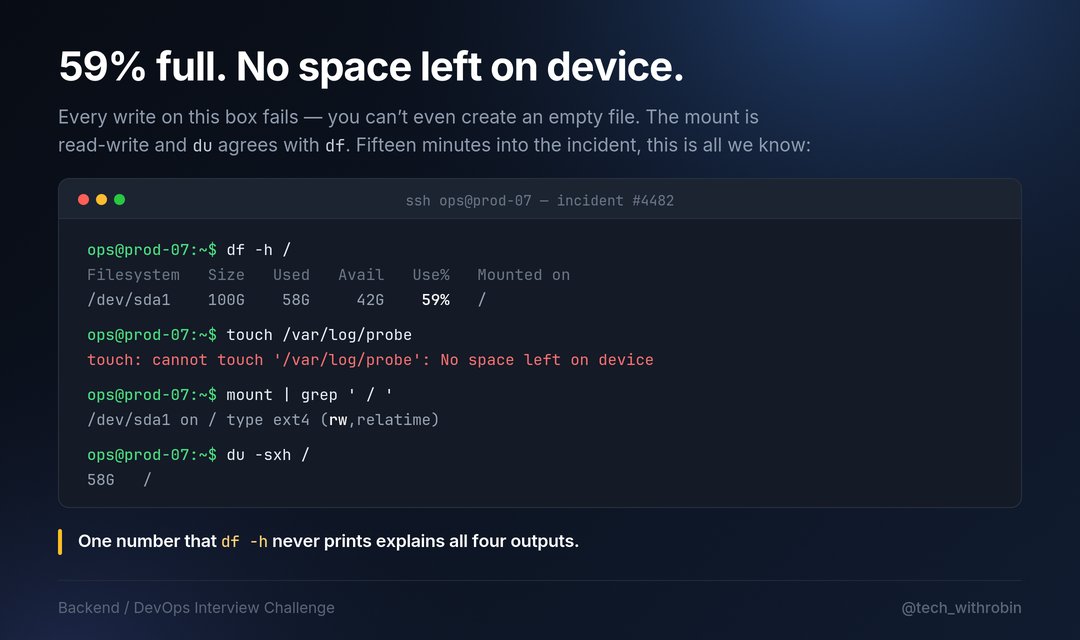
𝟱𝟵% 𝗳𝘂𝗹𝗹. 𝗔𝗻𝗱 𝘁𝗵𝗲 𝗱𝗶𝘀𝗸 𝘀𝗮𝘆𝘀: 𝗻𝗼 𝘀𝗽𝗮𝗰𝗲 𝗹𝗲𝗳𝘁 𝗼𝗻 𝗱𝗲𝘃𝗶𝗰𝗲.
42 GB free. But touch cannot create even one empty file.
Empty file. Zero bytes. Still fails.
A favourite linux troubleshooting question in DevOps and SRE interviews.
━━━━━━━━━━━━━━━
𝗪𝗵𝗮𝘁 𝘁𝗵𝗲 𝗶𝗻𝘁𝗲𝗿𝘃𝗶𝗲𝘄𝗲𝗿 𝗶𝘀 𝗮𝗰𝘁𝘂𝗮𝗹𝗹𝘆 𝘁𝗲𝘀𝘁𝗶𝗻𝗴
🔹 Do you stop at the first command, or check the second number?
🔹 Do you know a disk keeps 𝘵𝘸𝘰 counters, not one?
🔹 Can you read the clues on screen? mount says rw, du matches df.
🔹 Do you fix it for tonight, or for the next six months?
━━━━━━━━━━━━━━━
𝗧𝗵𝗲 𝗮𝗻𝘀𝘄𝗲𝗿, 𝗲𝘅𝗽𝗹𝗮𝗶𝗻𝗲𝗱 𝘀𝗶𝗺𝗽𝗹𝘆
Picture a hotel.
The 𝗿𝗼𝗼𝗺𝘀 are disk space. 42 GB of rooms are empty.
The 𝗸𝗲𝘆𝘀 at the front desk are 𝗶𝗻𝗼𝗱𝗲𝘀. Every file needs one key.
Rooms are free. Keys are finished. No new guest can enter.
𝗬𝗼𝘂𝗿 𝗱𝗶𝘀𝗸 𝗱𝗶𝗱 𝗻𝗼𝘁 𝗿𝘂𝗻 𝗼𝘂𝘁 𝗼𝗳 𝘀𝗽𝗮𝗰𝗲. 𝗜𝘁 𝗿𝗮𝗻 𝗼𝘂𝘁 𝗼𝗳 𝗸𝗲𝘆𝘀.
━━━━━━━━━━━━━━━
𝟭. 𝗧𝘄𝗼 𝗰𝗼𝘂𝗻𝘁𝗲𝗿𝘀, 𝗼𝗻𝗲 𝗲𝗿𝗿𝗼𝗿 𝗺𝗲𝘀𝘀𝗮𝗴𝗲 📊
df -h shows bytes used.
df -i shows inodes used.
An inode is a small record holding one file's details: size, owner, permissions, and where the data sits. One file, one inode. Even a 0 byte file takes one, because the record still has to exist.
When either counter hits its limit, linux returns the same error, ENOSPC. That error always prints one line: no space left on device.
The error was never wrong. You read half of it.
So your first command here is df -i /. The IUse% column shows 100%.
━━━━━━━━━━━━━━━
𝟮. 𝗪𝗵𝘆 𝘁𝗵𝗲 𝗸𝗲𝘆𝘀 𝗳𝗶𝗻𝗶𝘀𝗵𝗲𝗱
On ext4, the inode count is fixed the day the disk is formatted with mkfs.ext4. You cannot add more later.
The default is one inode per 16 KB, the bytes-per-inode setting in /etc/mke2fs.conf. So a 100 GB disk gets about 6.5 million keys.
Sounds like plenty. Until one service starts writing a tiny file per request. Session files. Logs nobody rotates. Or /var/lib/docker/overlay2 piling up millions of small files.
Now the average file is smaller than 16 KB, so keys finish long before space does.
━━━━━━━━━━━━━━━
𝗧𝗵𝗲 𝗳𝗶𝘅 𝗮𝗻𝗱 𝘁𝗵𝗲 𝗯𝗶𝗴𝗴𝗲𝘀𝘁 𝘁𝗿𝗮𝗽 𝗮𝗿𝗲 𝗶𝗻 𝘁𝗵𝗲 𝗽𝗶𝗻𝗻𝗲𝗱 𝗰𝗼𝗺𝗺𝗲𝗻𝘁 👇
𝟰. 𝗔𝘀𝘀𝘂𝗺𝗲 𝗶𝘁 𝘄𝗶𝗹𝗹 𝗯𝗿𝗲𝗮𝗸. 𝗧𝗵𝗲𝗻 𝗯𝗿𝗲𝗮𝗸 𝗶𝘁 𝗼𝗻 𝗽𝘂𝗿𝗽𝗼𝘀𝗲.
Every service call has a timeout, a concurrency limit and a fallback. Hystrix made this famous; Netflix now uses adaptive concurrency limits.
Fallback in plain words: if your personalised row fails, you quietly get a "popular near you" row. A slightly worse Netflix, never an error page.
Chaos Monkey kills live servers, Chaos Kong drops a whole AWS region, ChAP tests failures on a slice of users. Good SRE teams rehearse disaster on a normal Tuesday.
━━━━━━━━━━━━━━━
⚠️ 𝗪𝗵𝗲𝗿𝗲 𝗺𝗼𝘀𝘁 𝗲𝗻𝗴𝗶𝗻𝗲𝗲𝗿𝘀 𝗴𝗲𝘁 𝘁𝗵𝗶𝘀 𝘄𝗿𝗼𝗻𝗴
Most say "blue green, zero downtime" and stop. That dies to one follow up: 𝘺𝘰𝘶𝘳 𝘥𝘢𝘵𝘢𝘣𝘢𝘴𝘦 𝘢𝘯𝘥 𝘺𝘰𝘶𝘳 𝘤𝘰𝘯����𝘪𝘨 𝘢𝘳𝘦 𝘴𝘵𝘪𝘭𝘭 𝘴𝘩𝘢𝘳𝘦𝘥.
🔻 𝗨𝗽𝘁𝗶𝗺𝗲 𝗶𝘀 𝗻𝗼𝘁 𝗼𝗻𝗲 𝗻𝘂𝗺𝗯𝗲𝗿. Sign up can break while playback is fine. Availability is per user journey, and playback is protected first.
🔻 𝗧𝗵𝗲 𝘀𝗰𝗮𝗿𝗶𝗲𝘀𝘁 𝗰𝗵𝗮���𝗴𝗲 𝗶𝘀 𝗻𝗼𝘁 𝗰𝗼𝗱𝗲. It is a feature flag pushed everywhere in seconds, with no canary. Treat config as a deploy.
🔻 𝗖𝗮𝗻𝗮𝗿𝘆 𝘄𝗶𝗻𝗱𝗼𝘄𝘀 𝗹𝗶𝗲. Thirty minutes catches an error spike. It misses a memory leak or a cache that goes bad at peak.
Tradeoff, out loud: red/black doubles your capacity bill and suits stateless services best. Rolling updates cost less but roll back slower. Netflix pays for rollback speed. Your startup may not.
━━━━━━━━━━━━━━━
If this question would have frozen you in an interview, you are not alone. Most engineers blank right here. After reading this, you will not.
𝗦𝗮𝘃𝗲 𝘁𝗵𝗶𝘀 for the night before your next interview.
Now tell me: which company are you preparing for, and which backend or cloud topic trips you up? Comment below and I will break it down next, exactly like this.
Netflix streams 4K video to 250 million people during peak hours. No buffering, no "service unavailable." But every release deploys thousands of times a week. How is the site never down while constantly changing?
━━━━━━━━━━━━━━━
𝗪𝗵𝗮𝘁 𝘁𝗵𝗲 𝗶𝗻𝘁𝗲𝗿𝘃𝗶𝗲𝘄𝗲𝗿 𝗶𝘀 𝗮𝗰𝘁𝘂𝗮𝗹𝗹𝘆 𝘁𝗲𝘀𝘁𝗶𝗻𝗴
In a system design interview they check:
🔹 Do you know the deploy path and the video path are separate systems?
🔹 Can you describe a safe release, not just say "blue green"?
🔹 Do you treat failure in distributed systems as normal, not an accident?
━━━━━━━━━━━━━━━
𝗧𝗵𝗲 𝗮𝗻𝘀𝘄𝗲𝗿, 𝗲𝘅𝗽𝗹𝗮𝗶𝗻𝗲𝗱 𝘀𝗶𝗺𝗽𝗹𝘆
One line: 𝘁𝗵𝗲 𝗽𝗮𝗿𝘁 𝗼𝗳 𝗡𝗲𝘁𝗳𝗹𝗶𝘅 𝘁𝗵𝗮𝘁 𝗰𝗵𝗮𝗻𝗴𝗲𝘀 𝗲𝘃𝗲𝗿𝘆 𝗱𝗮𝘆 𝗶𝘀 𝗻𝗼𝘁 𝘁𝗵𝗲 𝗽𝗮𝗿𝘁 𝘁𝗵𝗮𝘁 𝘀𝗲𝗻𝗱𝘀 𝘆𝗼𝘂 𝘁𝗵𝗲 𝘃𝗶𝗱𝗲𝗼.
𝟭. 𝗬𝗼𝘂𝗿 𝗺𝗼𝘃𝗶𝗲 𝗶𝘀 𝗻𝗼𝘁 𝗶𝗻 𝘁𝗵𝗲 𝗰𝗹𝗼𝘂𝗱. 𝗜𝘁 𝗶𝘀 𝗶𝗻 𝘆𝗼𝘂𝗿 𝗰𝗶𝘁𝘆.
Netflix runs its own CDN, Open Connect. Small servers called OCAs sit inside your internet provider's building. At night, a quiet "fill window" copies popular shows onto them.
When you press play, AWS answers one question: which box should this user talk to? The video comes from a machine a few kilometres away.
Like a library: the catalogue changes any time, the book is already on your shelf.
The 𝗰𝗼𝗻𝘁𝗿𝗼𝗹 𝗽𝗹𝗮𝗻𝗲 is the thinking part: login, search, recommendations. The 𝗱𝗮𝘁𝗮 𝗽𝗹𝗮𝗻𝗲 is the delivering part: your video. One changes all day. The other barely moves. That is high availability.
𝟮. 𝗡𝗼𝗯𝗼𝗱𝘆 𝗱𝗲𝗽𝗹𝗼𝘆𝘀 "𝗡𝗲𝘁𝗳𝗹𝗶𝘅". 𝗧𝗵𝗲𝘆 𝗱𝗲𝗽𝗹𝗼𝘆 𝗼𝗻𝗲 𝘀𝗺𝗮𝗹𝗹 𝘀𝗲𝗿𝘃𝗶𝗰𝗲.
No single Netflix app to push. Just hundreds of microservices, each owned by a small team.
Thousands of deploys is not thousands of risky moments. It is many tiny changes, and if one breaks, only that feature suffers. Small blast radius is why CI/CD works.
𝟯. 𝗘𝘃𝗲𝗿𝘆 𝗿𝗲𝗹𝗲𝗮𝘀𝗲 𝗶𝘀 𝗮 𝘀𝗹𝗼𝘄, 𝘄𝗮𝘁𝗰𝗵𝗲𝗱 𝗲𝘅𝗽𝗲𝗿𝗶𝗺𝗲𝗻𝘁.
Netflix built Spinnaker, open sourced in 2015. New code goes into an immutable image and a 𝗯𝗿𝗮𝗻𝗱 𝗻𝗲𝘄 𝗰𝗹𝘂𝘀𝘁𝗲𝗿 starts beside the old one. You never repair the old machine, you build a fresh one.
Then the canary: a tiny slice of live traffic hits the new cluster while the old one serves everyone else. Kayenta, open sourced with Google in 2018, compares new against old on errors, latency and CPU. Worse numbers, it rolls back by itself. The old cluster stays warm the whole time.
𝗥𝗼𝗹𝗹𝗯𝗮𝗰𝗸 𝗶𝘀 𝗮 𝗿𝗼𝘂𝘁𝗶𝗻𝗴 𝗰𝗵𝗮𝗻𝗴𝗲, 𝗻𝗼𝘁 𝗮 𝗿𝗲𝗯𝘂𝗶𝗹𝗱.
━━━━━━━━━━━━━━━
👉 Point 4 and the big mistake: pinned comment.
The container is running fine. The port is mapped. The log says "listening on 3000".
From your machine, curl localhost:3000 fails at once. Inside the container, the same curl returns 200.
Same port. Same container. Two different answers.
━━━━━━━━━━━━━━━
𝗪𝗵𝗮𝘁 𝘁𝗵𝗲 𝗶𝗻𝘁𝗲𝗿𝘃𝗶𝗲𝘄𝗲𝗿 𝗶𝘀 𝗮𝗰𝘁𝘂𝗮𝗹𝗹𝘆 𝘁𝗲𝘀𝘁𝗶𝗻𝗴
🔹 𝗦𝗶𝗴𝗻𝗮𝗹: you know a container is a Linux process with its own private network, not a small computer.
🔹 𝗦𝗶𝗴𝗻𝗮𝗹: you can tell "the app is running" from "the app can be reached". 𝘕𝘰𝘪𝘴𝘦: "let me just restart it".
🔹 𝗦𝗶𝗴𝗻𝗮𝗹: you check facts with ss -ltnp and docker port before blaming the firewall.
🔹 𝗦𝗶𝗴𝗻𝗮𝗹: you know who does what. Your app picks the address. Docker opens the door. The network carries the traffic.
━━━━━━━━━━━━━━━
𝗧𝗵𝗲 𝗮𝗻𝘀𝘄𝗲𝗿:
𝗬𝗼𝘂𝗿 𝗮𝗽𝗽 𝗶𝘀 𝘀𝗶𝘁𝘁𝗶𝗻𝗴 𝗮𝘁 𝘁𝗵𝗲 𝘄𝗿𝗼𝗻𝗴 𝗱𝗼𝗼𝗿.
Picture an apartment building. Your host machine is the building. Your container is one flat inside it.
Every flat has a front door, and an intercom that works only inside that flat. 127.0.0.1 is the intercom. 0.0.0.0 means "I answer at every door, front door included".
Your app spoke into the intercom. Only people already inside the flat could hear it.
𝟭. 𝗘𝘃𝗲𝗿𝘆 𝗰𝗼𝗻𝘁𝗮𝗶𝗻𝗲𝗿 𝗴𝗲𝘁𝘀 𝗶𝘁𝘀 𝗼𝘄𝗻 𝗽𝗿𝗶𝘃𝗮𝘁𝗲 𝗻𝗲𝘁𝘄𝗼𝗿𝗸
Linux gives each container its own small network. Its own lo, the intercom. Its own eth0, the front door. The proper name for this is a 𝗻𝗲𝘁𝘄𝗼𝗿𝗸 𝗻𝗮𝗺𝗲𝘀𝗽𝗮𝗰𝗲.
So 127.0.0.1 inside the container and 127.0.0.1 on your host are two different things with the same name.
That is why docker exec worked. It ran inside the flat.
━━━━━━━━━━━━━━━
𝟮. -𝗽 3000:3000 𝗼𝗻𝗹𝘆 𝗱𝗲𝗹𝗶𝘃𝗲𝗿𝘀 𝘁𝗼 𝘁𝗵𝗲 𝗳𝗿𝗼𝗻𝘁 𝗱𝗼𝗼𝗿 🚪
It changes nothing in your code. It tells Docker to add a forwarding rule in iptables, called a DNAT rule, and run a helper called docker-proxy.
Now anyone knocking at the building on port 3000 is sent to the flat's front door, like 172.17.0.2:3000.
The guard did his job. He knocked. Nobody was at that door.
━━━━━━━━━━━━━━━
𝟯. 𝗪𝗵𝘆 𝘆𝗼𝘂 𝘀𝗮𝘄 𝗿𝗲𝘀𝗲𝘁 𝗮𝗻𝗱 𝗻𝗼𝘁 𝗿𝗲𝗳𝘂𝘀𝗲𝗱 📞
docker-proxy picks up your call first, then tries to reach the container, fails, and hangs up. That is why curl says (56) Connection reset by peer.
Set "userland-proxy": false in /etc/docker/daemon.json and the same bug shows as connection refused.
𝗧𝗵𝗲 𝗳𝗶𝘅: app.listen(3000, '0.0.0.0'). In Node, plain app.listen(3000) works too, since it answers at all doors by default.
𝗣𝗿𝗼𝗼𝗳 𝗶𝗻 𝗼𝗻𝗲 𝗹𝗶𝗻𝗲: docker exec api ss -ltnp must show 0.0.0.0:3000, never 127.0.0.1:3000.
━━━━━━━━━━━━━━━
⚠️ 𝗪𝗵𝗲𝗿𝗲 𝗺𝗼𝘀𝘁 𝗲𝗻𝗴𝗶𝗻𝗲𝗲𝗿𝘀 𝗴𝗲𝘁 𝘁𝗵𝗶𝘀 𝘄𝗿𝗼𝗻𝗴
Most people think 0.0.0.0 𝘪𝘴 𝘳𝘪𝘴𝘬𝘺 𝘢𝘯𝘥 127.0.0.1 𝘪𝘴 𝘴𝘢𝘧𝘦. Inside a container, it is the opposite.
The flat has only two doors. Opening both does not put you on the internet. Who can reach you is decided by the -p rule and your network policy, not your app's address.
Want it private? Publish it as -p 127.0.0.1:3000:3000. The gate stays shut to outsiders, and your app still answers at 0.0.0.0 inside.
𝗧𝗵𝗲 𝘁𝗿𝗮𝗱𝗲𝗼𝗳𝗳: with no flat around you, this flips. On a plain cloud VM, or with network_mode: host, your app is on the open street. There, 127.0.0.1 plus Nginx in front is right.
𝗧𝗵𝗲 𝗰𝗼𝘀𝘁𝗹���� 𝗺𝗶𝘀𝘁𝗮𝗸𝗲: in Kubernetes the kubelet knocks on the pod IP, never on loopback. Bind to 127.0.0.1 and the readiness probe fails, the pod never turns Ready, and the rollout sits at 0 available while the logs still say "listening on 3000". Every SRE has lost an evening to this.
If this question would have frozen you in an interview, you are not alone. Most backend developers blank right here. After reading this, you will not.
𝗦𝗮𝘃𝗲 𝘁𝗵𝗶𝘀 for the night before your next system design interview.
Now tell me: which company are you preparing for, and which topic still trips you up the most. Comment below and I will break it down next, exactly like this.
Proof: `docker inspect` shows 𝗲𝘅𝗶𝘁 𝗰𝗼𝗱𝗲 𝟭𝟯𝟳. That is 128 plus 9, and 9 is SIGKILL. See 137 after a deploy and your app never got to say goodbye.
𝟯. 𝗪𝗵𝘆 𝗱𝗲𝘃 𝗹𝗼𝗼𝗸𝘀 𝗳𝗶𝗻𝗲
Ctrl+C sends the signal to the whole foreground group, so node gets it directly. And your laptop has no real users. The bug is in dev too, it just has nobody to hurt.
𝗧𝗵𝗲 𝗳𝗶𝘅 𝗶𝘀 𝗼𝗻𝗲 𝗹𝗶𝗻𝗲
`CMD ["node", "server.js"]`
This is 𝗲𝘅𝗲𝗰 𝗳𝗼𝗿𝗺. No shell, no npm. Node is PID 1 and hears the knock.
━━━━━━━━━━━━━━━
𝗪𝗵𝗲𝗿𝗲 𝗺𝗼𝘀𝘁 𝗲𝗻𝗴𝗶𝗻𝗲𝗲𝗿𝘀 𝗴𝗲𝘁 𝘁𝗵𝗶𝘀 𝘄𝗿𝗼𝗻𝗴
They fix the line and still drop requests.
👉 𝗢𝗻𝗲. Node as PID 1 still ignores SIGTERM until you write the handler. Inside `process.on('SIGTERM')`: `server.close()`, finish live requests, close DB pools. Run `docker run --init` or `tini` too, because PID 1 must reap orphan children, else zombies pile up.
👉 𝗧𝘄𝗼. On Kubernetes, even a perfect shutdown returns errors, because SIGTERM and endpoint removal start together, so traffic still arrives for a few seconds. What SRE teams do: a `preStop` hook with `sleep 5`, so the load balancer stops routing first, then the app drains.
𝗧𝗵𝗲 𝗵𝗼𝗻𝗲𝘀𝘁 𝘁𝗿𝗮𝗱𝗲𝗼𝗳𝗳
Exec form gives no shell. No `$PORT` expansion, no `&&`, no pipes. Use `ENTRYPOINT ["/bin/sh", "-c", "exec node server.js"]`. That `exec` makes node replace the shell, so PID 1 is node again. And keep your drain timeout below the grace period.
━━━━━━━━━━━━━━━
One Dockerfile line decides whether deploys stay invisible, or your on call phone rings at 2 AM. That is the gap between writing containers and running them in the cloud.
If this had frozen you in an interview, you are not alone. Most backend and DevOps engineers blank right here. After this, you will not.
𝗦𝗮𝘃𝗲 𝘁𝗵𝗶𝘀 for the night before your next interview.
Now tell me: which company are you preparing for, and which topic trips you up? Docker networking, Kubernetes probes, or database scaling? Comment and I will break it down next.
Can you spot the production issue?
It works in development. In production, every deploy drops live requests.
The villain is one line: `CMD npm start`. Not a Docker syntax question. A 𝗣��𝗗 𝟭 question.
━━━━━━━━━━━━━━━
𝗙𝗶𝗿𝘀𝘁, 𝘄𝗵𝗮𝘁 𝗶𝘀 𝗮 𝗣𝗜𝗗
Every running program on Linux gets a number: its 𝗣𝗿𝗼𝗰𝗲𝘀𝘀 𝗜𝗗, or PID.
The first process the system starts gets 𝗣𝗜𝗗 𝟭. On your laptop that is systemd, parent of everything else.
A container is not a small computer. It is a normal Linux process kept in its own PID namespace. So inside the container, whatever starts first becomes PID 1. On the host it has a different number. Two names, one process.
Two rules matter:
🔹 Docker sends signals to PID 1 only. Children are invisible.
🔹 When PID 1 exits, the container is over.
The kernel also protects PID 1. A normal process dies on SIGTERM by default. PID 1 does not. It ignores every signal it has no handler for. That rule stops anyone killing init by accident. In your container it works against you.
━━━━━━━━━━━━━━━
𝗧𝗵𝗲 ���𝗻𝘀𝘄𝗲𝗿
When you deploy, Docker must close the old container. It knocks first: finish your work, then leave. That knock is 𝗦𝗜𝗚𝗧𝗘𝗥𝗠, and only PID 1 hears it.
𝟭. 𝗦𝗵𝗲𝗹𝗹 𝗳𝗼𝗿𝗺 𝗽𝘂𝘁𝘀 𝗮 𝘀𝘁𝗿𝗮𝗻𝗴𝗲𝗿 𝗮𝘁 𝘁𝗵𝗲 𝗱𝗼𝗼𝗿
`CMD npm start` is 𝘴𝘩𝘦𝘭𝘭 𝘧𝘰𝘳𝘮. Docker turns it into `/bin/sh -c "npm start"`. So the shell is PID 1. It starts npm, npm starts node. Docker knocks on the shell. Your server sits three rooms away with headphones on. sh and npm have no handler, so the knock never travels down.
𝟮. 𝗧𝗵𝗲𝗻 𝗗𝗼𝗰𝗸𝗲𝗿 𝘀𝘁𝗼𝗽𝘀 𝗮𝘀𝗸𝗶𝗻𝗴
Docker waits for the grace period: 10 seconds with `docker stop`, 30 on Kubernetes (`terminationGracePeriodSeconds`). Then it sends 𝗦𝗜𝗚𝗞𝗜𝗟𝗟, which cannot be caught or ignored. The process is removed mid sentence. Live requests become 502s and DB connections are cut.
New Job Alert on Open Jobs 360!
[ FULLY REMOTE / GLOBAL ]
Multiple Hirings:
Calling All Freshers & Recent Grads (Class of 2025 & 2026)! 🎓
We are looking for Graduate Software Engineers to kickstart their careers with a leading provider of open-source software and operating systems used globally in public cloud, AI, and IoT.
Role Overview: Perfect for fresh graduates ready to make a real-world impact! You will get hands-on experience tackling a wide range of software engineering challenges, working from the lowest levels of the Linux system (firmware, kernel, drivers) all the way up to desktop applications, clouds, and Kubernetes clusters. Supported by a global team, you will learn fast, write performant code serving millions of users, and engage deeply with the open-source community.
What You Need as a Fresher:
An exceptional academic track record with a recent or upcoming (2025/2026) undergraduate degree in Computer Science, Math, or a related STEM field.
Confidence to jump in and deliver high-quality code in Python, Rust, C/C++, Golang, JavaScript, or Java.
Hands-on experience or familiarity with major Linux distributions.
Awesome personal tech and software engineering projects beyond your university curriculum (show us what you love to build outside of class!).
Ability to travel internationally twice a year for two-week company learning sprints.
What is Offered:
Fully distributed, remote work environment.
USD 2,000 per year personal learning and development budget to fuel your early career growth.
Annual compensation reviews and performance-driven bonuses.
Why Open Jobs 360? Our dedicated team brings you authentic software roles straight from company career pages—so you can apply directly with zero middlemen or recruiters in the way. We refresh our listings every 6 hours to ensure you catch genuine, active openings the moment they go live, skipping the recycled posts often spammed across other major job boards. Plus, we give you the inside scoop on live hackathons and freshly funded startups about to scale fast. This gives you the chance to reach out to hiring teams and land the role before it is ever posted publicly. If it's on Open Jobs 360, it's real and open.
Find out more and apply today on Open Jobs 360!
New Job Alert on Open Jobs 360!
🌍 [ FULLY REMOTE / GLOBAL ] 🌍
We are looking for an MSc/PhD AI Research Intern (2025/2026) for a pioneering global digital finance and blockchain leader.
Role Overview: You will actively contribute to the development of state-of-the-art (SOTA) foundation models, focusing on LLMs, vision, and multimodality. In addition to advancing open-source progress, you will be responsible for continuously optimizing distributed model training frameworks across thousands of multi-node GPUs.
What You Need:
Currently pursuing an MSc or PhD.
Strong background in researching and developing state-of-the-art LLM, video, or multimodality models.
Experience implementing large models in business scenarios (pre-training, supervised fine-tuning, post-training, inference).
Ability to optimize training frameworks for large-scale GPU environments.
Excellent English communication skills and a passion for collaborating with a global, remote team.
Note: Applications are reviewed on a rolling basis. Please state your availability (Start date, End date) clearly in your resume.
Find out more and apply today on Open Jobs 360!
Why Open Jobs 360? Our dedicated team brings you authentic software roles straight from company career pages so you can apply directly with zero middlemen or recruiters in the way. We refresh our listings every 6 hours to ensure you catch genuine, active openings the moment they go live, skipping the recycled posts often spammed across other major job boards. Plus, we give you the inside scoop on live hackathons and freshly funded startups about to scale fast. This gives you the chance to reach out to hiring teams and land the role before it is ever posted publicly. If it's on Open Jobs 360, it's real and open.