Oscar Health $OSCR is what happens when smart engineers and actuaries get pissed off enough at legacy health insurance to try building their own stack.
The result? A health insurer that doesn’t run on spreadsheets and duct tape. It runs on actual code.
What most investors still don’t get: this is no longer just an ACA insurance play. That chapter’s done. The real value now is under the hood—Oscar’s building out a software platform that other insurers and health systems are starting to license. They call it +Oscar.
If they pull this off, $OSCR is a vertical SaaS + data + managed services business disguised as a second-tier insurer.
It’s early. But the asymmetry is stupid.
The starting point: Oscar’s core ACA business. The market still views this like it’s 2021—an unprofitable, cash-burning insurance startup that scaled too fast. That’s outdated.
In the last 24 months they’ve quietly executed one of the cleanest turnarounds in public healthtech. They exited bad geographies. Cut admin bloat. Rebuilt pricing logic. And finally hit net income profitability in 2024. You don’t do that with smoke and mirrors. You do that with operational competence.
Revenue is over $10B. Membership is at a high. Medical loss ratio is tight. Admin expense ratio is declining. Core business is generating leverage now.
(Source: Q4 2024 earnings)
But all of that is just the platform layer.
The real upside is +Oscar—their internal tech platform, now being licensed out to third parties. Claims processing, prior auth, care routing, network contracting, member engagement—this stack does everything that legacy Blue Cross systems still do on fax machines.
This is the bet: as healthcare moves to value-based care, capitation, and digital triage, every health system and payer needs modern infra. They’re not going to build it. They’re going to rent it.
Oscar is one of the only companies in the country that built it from scratch and proved it could scale.
Think about that for a second. You’re paying 0.2x revenue for a company that has both:
1.A 10-figure insurance business that’s structurally improving
2.A proprietary software stack for the most broken back office in America
And the market doesn’t care. It’s not a meme stock. It’s not AI-wrapped nonsense. It’s boring and operational. That’s where alpha lives.
Let’s talk GTM.
The insurance side is split between direct ACA plans and small group brokers. That gets distribution.
On the platform side (+Oscar), it’s enterprise sales. They’re selling to health systems, regional payers, co-branded risk-bearing groups. Sales cycles are long, but once you’re in, you’re sticky. It’s high-switching-cost B2B SaaS wrapped in insurance workflows.
If you’ve spent time around health system execs, you know this: they’re desperate for margin. They know how to hire doctors. They don’t know how to run claims software or member communications. Oscar gives them infrastructure + operating leverage.
It’s Twilio + TPA. And no one else is doing it at this scale.
Let’s put numbers on it.
•$10B+ revenue
•Valuation: ~$2.3B
•Trading at ~0.23x rev
•Platform rev not broken out yet, but it’s embedded and growing
•Forward guidance: modest growth + margin expansion
Let’s be real: the insurance business deserves a 0.3–0.5x multiple. But the platform, if it scales, should trade at 5–10x. You don’t get to license core payer ops software in 2025 and trade like a commoditized risk pool.
You think Epic is going to build this? You think Blue Cross CIOs are going to fix their own middleware? Not happening.
Bull case ($45–50/share):
•+Oscar grows into a $1–2B ARR business with 30–40% EBITDA
•Core insurance segment holds steady at $12–15B in rev
•Market assigns blended 2–3x sales multiple
•Market cap rerates to $15–20B range
•No gimmicks—just execution and lock-in
Bear case ($6–7/share):
•Platform fails to scale
•ACA pricing compresses margins again
•Market stays skeptical
Citadel hands out $750k/year to quants who know how to apply Stochastic Processes and Markov Chains in trading
This single 1-hour MIT probability lecture hands you the exact intuition quants are paid $60K/month to use
Save it & watch it today
Anthropic AI engineer just dropped a live masterclass on how to ship a team of production‑ready AI agents.
37 minutes. Free. From the Anthropic team.
here’s what she covers:
• 3 building blocks: brain, hands, sessions
• server-side loop, so nothing breaks on refresh
• agent teams shipping to production 10–15x faster
• why agents die before production
brain (persona) + hands (environment) + sessions = a production agent out of the box.
most people are still babysitting fragile agent scripts, while the people who figured this out ship agents that just stay running.
Watch this workshop, then read the full guide below.
How to start winning :
Install Hermes on your MacBook.
Get a $100 a month codex subscription and have it run on gpt 5.5
Don’t waste time on anything else.
It has absolute frontier intelligence and they have made soo much improvements to the personality.
It feels like working with a friend.
( kind of scary tbh )
The amount of tokens you get subsidized with running gpt 5.5 through the codex cli is unbelievable.
Give hermes GitHub access, ssh keys to your servers, and cloudflare tokens.
It will take your local project and put them live on the web with domain, dns, ssl, nginx, pm2, everything setup in just ONE prompt.
It can monitor your backend / database and make sure everything is running perfectly.
Give it a support email, when customers reach out instruct it to look into there account on the server and makes any non destructive fixes.
Hermes will automatically turn everything it does into skills, getting better and learning from mistakes constantly.
You can literally have a 250k a year highly technical employee that WORKS 24/7 for $100 dollars right now.
I need you to wake up.
The co-founder of OpenAI just built an entire AI training engine in 200 lines of code.
No dependencies. No libraries. No frameworks. Pure Python. And he says he cannot make it any shorter.
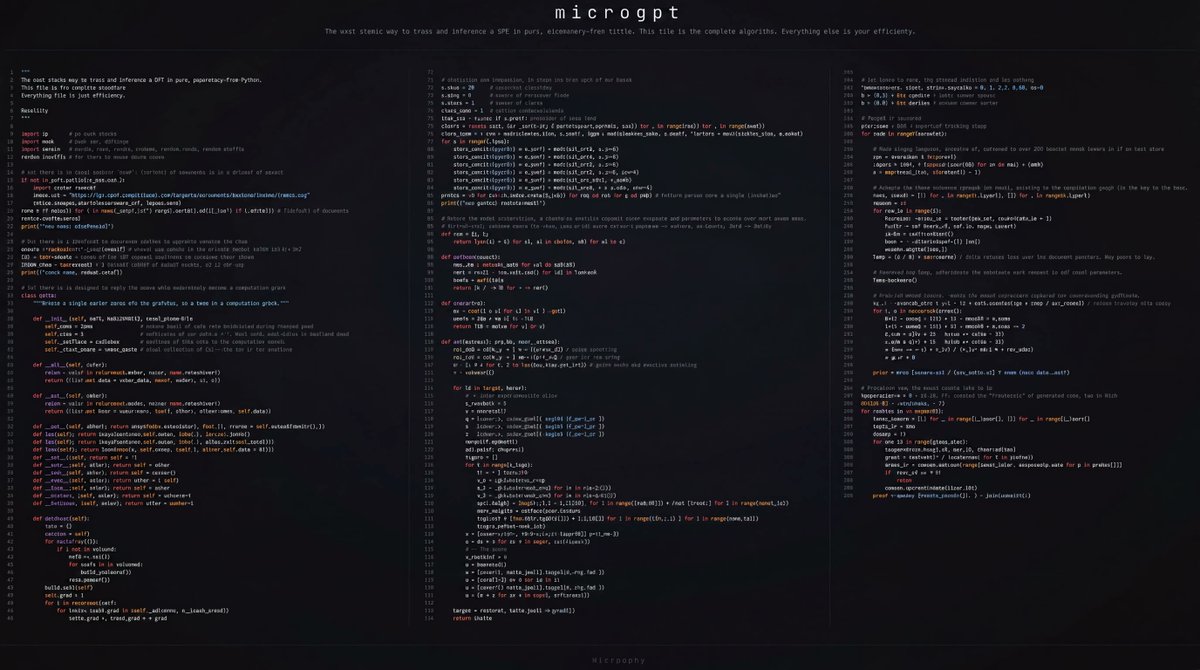
Andrej Karpathy — former Director of AI at Tesla, founding member of OpenAI, one of the most respected AI researchers alive — published microgpt on February 12, 2026. It is 200 lines. It trains and runs a GPT model completely from scratch.
Here is what those 200 lines actually contain.
A full dataset loader. A tokenizer. An autograd engine that computes gradients. A GPT-2 architecture neural network. The Adam optimizer. A complete training loop. A complete inference loop.
Everything needed to build, train, and run a large language model — in a file you could print on two pages of paper.
This is the culmination of a decade-long obsession. Karpathy previously built micrograd, makemore, and nanoGPT — each one a step toward stripping AI down to its mathematical skeleton. microgpt is the final answer. The irreducible core.
He wrote: "This script is the culmination of multiple projects and a decade-long obsession to simplify LLMs to their bare essentials. I cannot simplify this any further."
Here is why this matters beyond the elegance.Every AI course in the world teaches through abstraction. You use PyTorch. You import transformers. You call functions you do not understand. You build things without knowing how they work. Karpathy's entire career has been a war against that approach. He believes the only way to truly understand intelligence — artificial or otherwise — is to build it from nothing
.200 lines. No dependencies. From nothing.
For anyone who has ever wanted to understand what a large language model actually is — not what it does, but what it is — this file is the answer.
Free. Open source. On GitHub right now. https://t.co/Uw1cjjpV3e
If you can't figure out what to build here are 10 GitHub repos that can print money while you sleep:
1. AutoHedge
https://t.co/gbj3PFJsq4
2. Vibe-Trading
https://t.co/0rudpZZROY
3. Claude Ads
https://t.co/wuVV4Wm0PX
4. Toprank
https://t.co/OJnIkC3M23
5. Fincept Terminal
https://t.co/BbZyY5pVaT
6. Agentic Inbox
https://t.co/bbdTWF6CUn
7. ClawRouter
https://t.co/yPY35LUyeN
8. Camofox Browser
https://t.co/95UBGSGonl
9. Open Higgsfield AI
https://t.co/TVJnSKqk7X
10. Hyperframes
https://t.co/uWikFN3UIg
Credit: @heygurisingh
Two Chinese developers recorded a 4 minute video showing how to build a team of 7 AI agents that replaces an entire customer support department for $50 a month. They opened a terminal. In 4 minutes they had the whole thing running.
One agent classifies tickets. One reads the knowledge base. One handles billing. One watches the customer's tone. One decides when to escalate. One writes the report. One agent runs the other six.
The math hit hard. 1,200 tickets a day per person. More than a call center of 8 operators. The company used to pay $25,000 to $40,000 a month in salaries. Now they pay $50 for the API.
The video hit 4 million views in 72 hours. Every CEO in China was forwarding it. Every support team in America was panicking.
While the West is still debating whether AI will replace workers, China just published the manual. These guys were teaching people how to fire a department. They just showed too much.
Bro pause at 0:39. Ignore the guy in the blue shirt pointing. Look at the second monitor on the right.
That window is not a support dashboard. That is a live wallet.
gabagool22. $868,862 profit. 28,620 predictions. Joined October 2025.
→ https://t.co/62AOSjwBrr
They were filming a tutorial about replacing humans with cheap AI. Their own setup behind them was running an AI that replaces traders. 28,620 positions. All BTC. All 15 minute windows. All green.
The comment section turned into a detective board. Someone slowed the video to 0.5x. Screenshotted every frame where the right monitor was visible. Stitched them together. Reconstructed the full wallet page from 6 seconds of background footage.
Entry prices between 2 and 10 cents. Payouts in the thousands. Not one red row in 28,620 entries.
Biggest single win: $4,696. From a 15 minute window on a Tuesday.
The 7 support agents save a company $40K a month. The wallet on their second monitor makes that in one good week.
The tutorial taught the world how to replace a customer support team. The setup behind them was already replacing the trading desk.
They deleted the wallet zoom from the next upload. Too late. Someone had already screen recorded it. The clip hit Discord. Then Telegram. Then every dev forum.
The tutorial got 4 million views. The zoom on their second monitor got another 800,000.
727K people watching the wallet now. The 7 agents are still answering tickets somewhere for $50 a month. The wallet behind them does not need 7 agents. It needs one. And that one was already running while they filmed.
Claude Code cannot read 300 files at once.
So someone built a system that lets it control NotebookLM from the terminal instead. The results are wild.
Here is the full workflow nobody is talking about:
The Setup
→ Claude Code connects to NotebookLM via a command line interface
→ Claude searches YouTube, finds relevant videos, uploads them as sources automatically
→ NotebookLM processes up to 300 sources simultaneously and returns cited, grounded answers
→ Everything syncs back into your Obsidian vault with passage-level citations you can click to verify
Why This Changes Research Forever
→ No more 20 browser tabs you never close
→ No more copy-pasting outputs into random notes
→ No more hallucinated answers with no sources to back them up
→ 60% of citations verified as strong matches in accuracy audits - answers are grounded in real data
What Claude Can Do From the Terminal
→ Search YouTube for relevant videos on any topic and rank by relevance
→ Create a new NotebookLM notebook and add 20 sources in parallel automatically
→ Ask questions and export cited answers directly into Obsidian with wikilinks
→ Set custom personas per notebook - concise, no filler, no preamble
→ Generate audio overviews and save them as MP3 files into your vault
→ Build mind maps, flashcard decks, and research dashboards from your sources
→ Search arXiv for academic papers and feed them directly into NotebookLM
→ Upload competitor blog posts, podcast episodes, PDFs, and your own vault notes
The Obsidian Output
→ Every answer arrives with clickable citations that link to the exact passage in the source video or article
→ Graph view shows connections between all 20 sources and the topics they share
→ Q&A log tracks every question asked and the grounded response received
→ Source dashboard shows citation frequency, topics extracted, and which questions each source answered
Use Cases Worth Building Today
→ Academic research with arXiv papers, full citation traceability
→ Competitor analysis from their YouTube channels and blog posts
→ Company knowledge base for onboarding, new employees ask NotebookLM instead of interrupting teammates
→ Podcast research, feed 4-hour Lex Fridman episodes and ask what's new in AI this week
→ Personal second brain, 300 daily notes uploaded and queryable in one notebook
Before this system existed you needed 20 tabs, hours of manual reading, and no guarantee the answers were real.
Now you type one prompt in the terminal and Claude does all of it for you.
The research stack of 2026 is not a browser. It is a terminal connected to everything
claude bot made $700,000 in a month for its owner. thanks to one file.
> $42,921 today
> $160,086 past week
> $692,922 past month
everyone writes claude motivational speeches:
- "be a senior engineer"
- "think step by step"
- "be careful"
doesn't work - claude already knows all that.
what's missing is a CLAUDE.md like this guy's:
## Project
high-frequency arbitrage on polymarket btc + eth 5-min and 15-min markets.
dual-entry strategy. fixed risk, fixed profit target.
## Strategy: DUAL mode
## Mode A: high-confidence (60% of capital)
- enter at 50-70c when poly_implied agrees with spot trend
- target +50-100% per trade (~$6k profit)
- size: $4,000-$8,000 per position
## Mode B: tail bets (40% of capital)
- enter at 3-25c when own model says 35%+ probability
- target +200-1300% per trade
- size: $400-$1,800 per position
## IMPORTANT
IMPORTANT: hold all positions to resolution. NO early exit
IMPORTANT: skip if same market hit our books in last 60s
IMPORTANT: cap daily risk at $50,000. hard stop
## Rules
- NEVER exit before market resolution
- NEVER trade on news (CPI, FOMC, ETF decisions)
- NEVER size > 8% of bankroll on single position
- skip first 60 sec of any 5-min market (illiquid)
- pause 5 min after any $100+ BTC move
## Out of scope
- never touch the wallet. read-only access
- do not chase: skip if same market touched within 60s
one rule = one mistake claude won't make again.
each of his trades, around $6,000 profit. how?
because that's what's written in CLAUDE.md: "target ~$6K per trade". not more, not less.
> the system doesn't get nervous, doesn't chase, doesn't wait for a better price.
> sees edge ≥ 4c and enters.
> sees a tail 3c with own probability 35% - enters.
> waits for resolution.
> takes profit.
> moves to next market.
29,596 times.
his profile: https://t.co/WhWoxQuuPN
this is the difference between "user of claude" and "operator of claude".
the first writes wishes.
the second writes technical specs.
don't waste your time, level up your claude before it's too late.
If you’re spending hours looking for cash secured put setups, you need to pay attention.
Claude now helps me find these setups automatically.
It scans for:
> highest IV rank names with the richest premium
> only stocks passing Altman Z + ROE quality filters
> setups with no earnings within the next 14 days
> annualized return on every CSP, ranked
Here's how you can build your own:
Wanted a truly local storage for my tweets so built birdclaw. Imoorts your archive, backs it up on github, has jobs so you can import your x bookmarks daily (since they are not fully accessible via the api).
https://t.co/4Nd1Ad0ZeY