I am pleased to announce that signups are now open (until April 26th) for Alchemy League Season 10, a 1v1 AOE2DE Round Robin tournament in the second trimester of 2026! You can access the webpage (including summary, handbook, registration, etc.) here: https://t.co/a9TFREZDfS
We're a big-time disruptor in the AOE2 tournament space; established names aren't going to help us out (and have already begun fighting back!), so it's all on us! Consider signing up for Alchemy League, and if you are a returning player, tell your friends! Ladies and gentlemen, Alchemy League is a better version of the ranked ladder --one designed and administered by the community.
Two more items:
1) Voting for the ALS10 map contest ends on April 20th! by casting a ballot, you help us reward creators who were the most inventive or tried the hardest.
Poll here: https://t.co/8TI5OYE3IN
Detailed views: https://t.co/8PsXJylB5k
It also impacts how often each map appears in the competition. Must be in Alchemy server to vote!
2) Custom AI Promotional Showmatch of Alchemy League Season 10 maps on April 25th at 17 GMT: https://t.co/dcqUjM0uKz
Thank you! Let's make this upcoming season of Alchemy League the best yet! 😊
The claim represents genuine belief based on positive innovation, and is not a disparagement of larger, more established communities whose events --while simpler in design-- have kept AOE2 alive to get to this point.
I am grateful we can have a good faith discussion. Here are Alchemy League's advantages:
1) Custom Maps -- While other communities have a number of cool maps, Alchemy League is the only one to feature commissioned thematic pools, representing real locations. We've taken our players to Greece, Alaska, Space, and more, and we've done it with minimal labor attrition to our supply base. Creator prizes are typically 1/3 of all prizes available each season.
2) Unique Single Stack Matchmaker -- In Alchemy League, there are no divisions. Skill is calculated for each player, and then they are listed from highest to lowest. A proprietary algorithm then matches players against nearby opponents, until everyone has the same number of sets to play in Round-Robin format. The only way to be "bottom of div" or "top of div" is to be the "best" or "worst" player in the entire tournament.
3) Peerless Skill Calculation -- We mine player performance data in real time on the day of seeding with a proprietary computer program, taking averages and adjusting by win rate and previous season performance (for returning players). Took about a year to perfect, but has no equal in the world.
4) Sparing Handicap -- Yes, we use handicap if two players would be matched with very large skill gap (typically 300+). Doesn't happen often but every once in a while the lower seed can get 5%.
5) Winners Based on Over-performance -- Because we can calculate elo with high accuracy (even adjusting for win rate), we can go in reverse and figure out -- based on the average skill of opponents -- what each player's win rate should have been. We compare their theoretical win rate against their actual win rate, and the players who most over-performed expectations win prizes.
You can read more here (we are finalizing preparations to open our tenth season for registrations): https://t.co/a9TFREZDfS
So the claim that Alchemy League is "the best 1v1 aoe2 tournament in the world" is based on the objective points listed. While other communities may approximate some of these features, to my knowledge no other event does all of them. Alchemy has grown significantly, despite being a disruption in the AOE2 tournament market, because our players keep coming back, and encourage their friends to join. But, even if you don't like us or care, other communities may eventually adapt to what we are doing, and the entire aoe2 ecosystem can profit from rising standards.
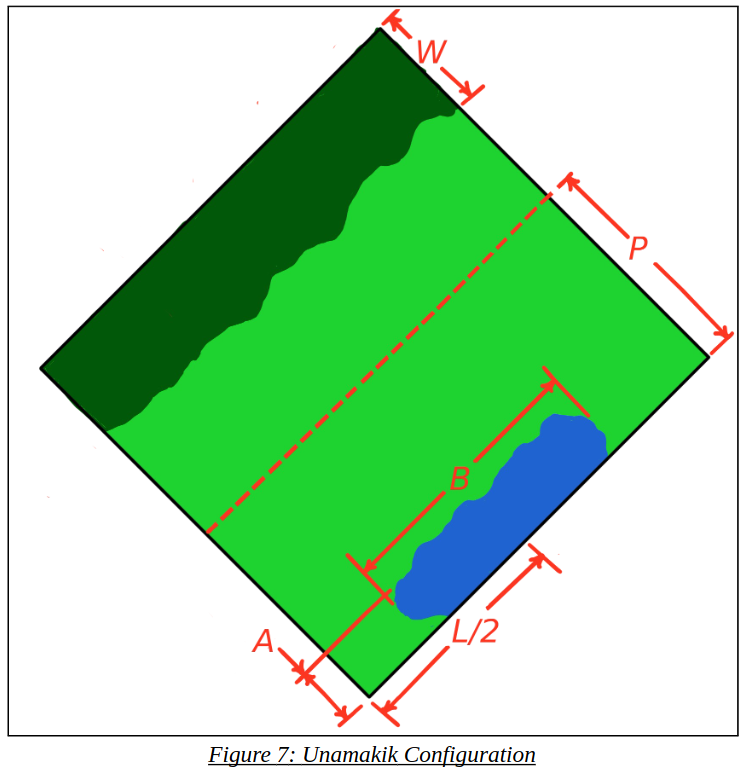
The Alchemy AOE Community is preparing a map for ALS11 called "FIW-03-Unamakik" that recognizes the crucial Royal Navy victory at the Siege of Louisbourg Nova-Scotia in 1758. Conquering this rocky French sea base would allow the British Navy to sail up the St. Lawrence river and challenge Quebec directly, without interference from behind.
"Translated from the native language “Unamakik” means “Land of Fog”, referring to its chilly maritime climate."
The Alchemy AOE Community is preparing a map for ALS11 called "FIW-05-Monongahela" that recognizes an early and decisive battle during the French and Indian War.
"Major General Edward Braddock was dispatched from England to win a quick victory against French North America. He decided to open with a campaign against several strategic French forts in the disputed Ohio Country area. Braddock mustered 2,100 troops, 10 cannons, supporting supply/baggage trains, and departed Fort Cumberland Maryland personally leading the expedition on its 110 mile journey. Familiar with the open fields of European combat, Braddock and his long column were ambushed within 10 miles of Fort Duquesne by 800 French and Indians on both forested sides of the road they had just built, and were routed after Braddock was mortally wounded. The name “Monongahela” is derived from the Lenape language meaning “falling banks”, referring to the steep banks of the river near the area of the battle."
The British were soundly beaten, but many heroes emerged from the carnage, who later fought in the American War of Independence (on both sides). Here is a short list:
- George Washington -> Commander in Chief, Continental Army
- Daniel Morgan -> Continental Army Commander
- Horatio Gates -> Continental Army Commander
- Adam Stephen -> Continental Army Commander
- Daniel Boone -> Continental Frontiersman
- Thomas Gage -> Commander in Chief, British North America
- Roger Morris -> Loyalist Civilian Leader
- Charles Lee -> Continental Commander, turned Loyalist
Twenty years later, each commanded respect for the bravery and skill required to fight alongside Braddock at Monongahela, and survive.
It's "Mandatum Monday", so here goes with another explanation of why we seem to make things so complicated for Alchemy League maps (but actually we are applying due-diligence). Today we cover "fair forests", which has its own specific requirement, called out separately from the "fair terrains in general" requirement.
Why? Well because forests are an even bigger deal. Not only are they a source of an important early game resource, but they can also be used for walling, which helps secure other resources.
So then, it is only natural that extra attention would be placed upon them. There are a number of requirements attached to forests (readability, player-assigned straggler trees, etc.), but today we talk about just SHEER QUANTITY of trees.
I can't point to an exact update (DE, DLC, or otherwise), in which players gained the ability to create balanced forests, it sort of improved over a spectrum, but a big leap came in the definitive edition with being able to specify a distance to which terrains should avoid town centers. After that point, there was really no excuse, except ignorance, laziness, or maybe some very niche applications, in which player-assigned forests are not implemented.
In the past I have done tutorials showing how to achieve fair forests for each player. You can view here, but it basically involves some tricks with terrain layering, including placeholders: https://t.co/thH6S7B1S5
Some added notes:
1) For some maps, no effort to place fair forests is required, because the map inherently has a neutral forest in a symmetric location (such as hideout), or the forests are very large compared to open space (such as black forest).
2) Placing fair forests is relatively easy on any map where teams or players are inherently separated by a different type of terrain. Think about maps like highland or islands. Even before DE, it was possible to procedurally target each landmass (separated by water), and put a single clump of placeholder terrain trying to occupy the entire map (but failing due to physical isolation). Then an exact amount of forest could be placed. Repeat for all such landmasses with same amount.
3) For maps that fall in the category of 2), fair forests are actually a lot more important. How often have you played a game of islands, where it ended because somebody ran out of wood? Now imagine if one player had 2000 more wood than another. Things could get ugly, FAST! Luckily that type of map was much easier to make fair, and thus versions of the game before DE placed less emphasis on it.
4) A few years ago, somebody from the RMS community figured out how to manipulate a foundation-type object, to place player-assigned forests as objects instead of terrains. This has the advantage of more control, because "<OBJECTS_GENERATION>" has more attributes than "<TERRAIN_GENERATION>". The chief disadvantage is that maps made this way are harder to inspect, because the forests do not appear on the minimap until after the game starts, and thus, you have to launch a new game every time you want a quick glance at the minimap to look at the fairness. You can't just cycle through seeds in the scenario editor. I uploaded a version of the code here: https://t.co/RNW64zH6xA
5) In the past couple years, at least one map has been elevated to S-tier events without any procedure to generate assured woodlines for each player. Was probably just ignorance, and later resulted in some major drama where a pro-player was missing woodlines, demanded a rematch due to "bugged" map, but the map wasn't technically bugged (just a flawed design) so the tournament organizers initially resisted the demand, but caved and ordered the map reworked. The creator and I are not friends (he's a craven sycophant) but the blame was not his, rather it belonged to the tournament host who originally platformed that map over other choices within the contest that invested time in player-assured woodlines. If he really had his heart set on using an unfinished map, there were a number of crack scripters available who could have upgraded it to never produce any future issues.
So there you have it, player-assured woodlines are an obvious requirement, and since AOE2DE gives us many useful tools, there's no longer any excuse against having them.
Today is "Mandatum Monday", which means that it is time for us to explain an Alchemy League map requirement (of which we have many). The goal here is not to show off, but to persuade you that the Alchemy AOE Community takes AOE2 map quality very seriously.
Instead of saying "don't be an idiot, just do it right" to our map-makers, we show some leadership and tell them what "right" means. In this installment, we cover "unbiased design-critical terrains".
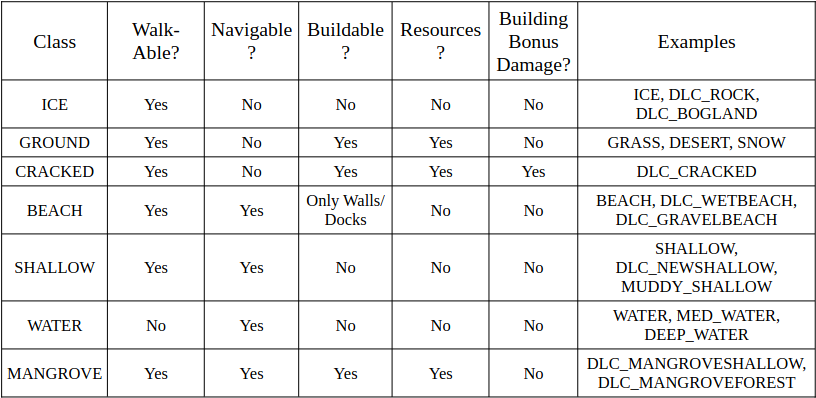
CHEM-STND-002 describes "Design Critical Terrains" as "Surfaces introducing different game-play mechanics, defined in Table 2 below:" ... an image of which, I have attached. But the important thing to remember is that we've got different types. "Shallow" is walkable and navigable (by ships) but not buildable. "Mangrove" terrain is the same as "Shallow" but buildable, and "Ice" is the same as "Shallow", but not navigable, etc. The point is that these properties allow players to do different things like construct buildings or send ships.
So, if a map presents different options, they need to be available to all teams without bias. A requirement like this prevents the icy surface of "Ghost Lake" from running right up under blue player's town center (while red has plenty of building space), or the lake in "Baltic" from dividing a team, while the other is connected.
Couple notes:
1) Does not apply to forests -- they have their own section of requirements
2) Generally not applicable to nomad, since players select their own starting locations (unless the map zones a team out of fair TC spots)
Sounds like common sense, right? Well yes, on more mature or high-effort maps, this quality of terrain fairness is always observed. But we still include this requirement, because our creators are very busy and sometimes forget the simple stuff.
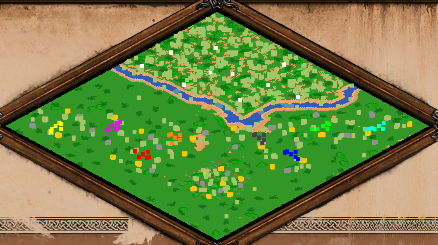
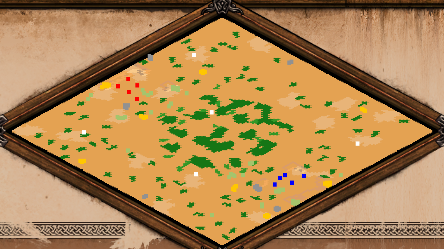
Even the official developers can forget this common-sense requirement. Attached are a few images from recent S-tier tournament, and standard maps Glacis and Thames (4v4). Both seeds are from fewer than 10 generations. Had these maps been sourced by the Alchemy AOE community, they would not present this issue.
In an unfair world, the Alchemy AOE Community has your back, as far as fair AOE2 maps are concerned!
Number 1 "tell" of a low-effort map: the name does not match the location. Here is Atacama. I have it on good authority it looks nothing like the real thing. What would be a better name?
The name is literally the easiest thing if you make the map first. Alchemy names first.
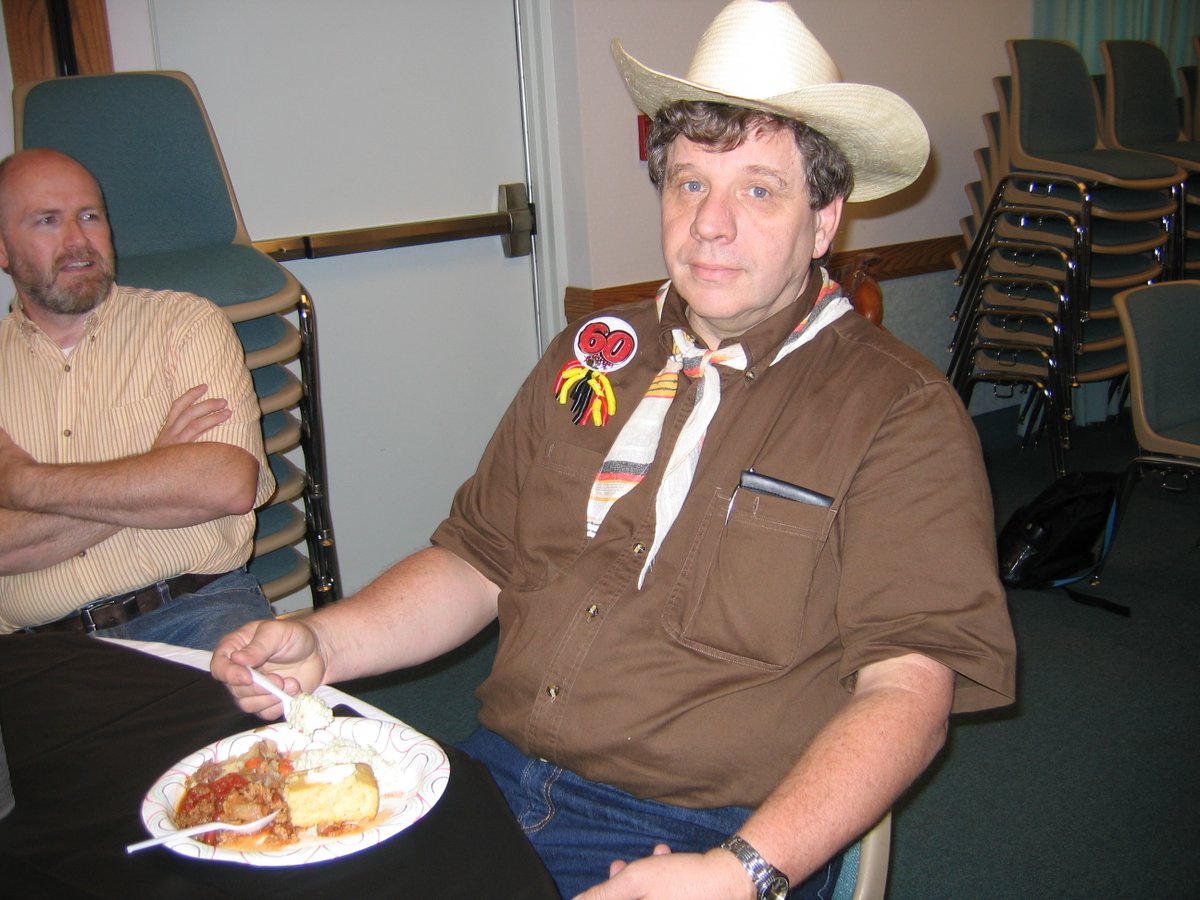
Today is the 13th anniversary of Dad's death. Here are some pictures from his 60th birthday party in 2010. Church friends threw him a party! He loved the Wild West. If heaven has mountains, that's where he's waiting.
We are preparing an inverted pilgrims style AOE2 random map called "Horican" that celebrates the role of Fort William Henry during the French and Indian War. This fort guarded a key portage between water sheds --the shortest route through the wilderness between French and English Colonial Capitals.
"Lake George features prominently, draining Northward into the St. Lawrence River, while The Hudson River (Glenn’s Falls) drains Southward into the Atlantic through Manhattan. The name “Horican” is an adaptation of different native words referring to the lake and was immortalized by James Fenimore Cooper’s 1826 action novel “The Last of the Mohicans”, set in this location."
Today is "Mandatum Monday", which means that it is time for us to explain an Alchemy League map requirement (of which we have many). The goal here is not to show off, but to persuade you that the Alchemy AOE Community takes AOE2 map quality very seriously.
Instead of saying "don't be an idiot, just do it right" to our map-makers, we show some leadership and tell them what "right" means. In this installment, we cover "unbiased design-critical terrains".
CHEM-STND-002 describes "Design Critical Terrains" as "Surfaces introducing different game-play mechanics, defined in Table 2 below:" ... an image of which, I have attached. But the important thing to remember is that we've got different types. "Shallow" is walkable and navigable (by ships) but not buildable. "Mangrove" terrain is the same as "Shallow" but buildable, and "Ice" is the same as "Shallow", but not navigable, etc. The point is that these properties allow players to do different things like construct buildings or send ships.
So, if a map presents different options, they need to be available to all teams without bias. A requirement like this prevents the icy surface of "Ghost Lake" from running right up under blue player's town center (while red has plenty of building space), or the lake in "Baltic" from dividing a team, while the other is connected.
Couple notes:
1) Does not apply to forests -- they have their own section of requirements
2) Generally not applicable to nomad, since players select their own starting locations (unless the map zones a team out of fair TC spots)
Sounds like common sense, right? Well yes, on more mature or high-effort maps, this quality of terrain fairness is always observed. But we still include this requirement, because our creators are very busy and sometimes forget the simple stuff.
Even the official developers can forget this common-sense requirement. Attached are a few images from recent S-tier tournament, and standard maps Glacis and Thames (4v4). Both seeds are from fewer than 10 generations. Had these maps been sourced by the Alchemy AOE community, they would not present this issue.
In an unfair world, the Alchemy AOE Community has your back, as far as fair AOE2 maps are concerned!
Today being "Mandatum Monday" means that I shall provide an explanation and potential backstory for a requirement among Alchemy League maps, to persuade you of our community's efforts to do right by our players. For today's installment, we will discuss occlusion mode, and what better way to start out that discussion than a game?! Top left picture, let's play "find Waldo", but instead we're looking for a blue female villager called "Wanda". Tell me how long it takes to find her!
If you answered "too long", then you are absolutely correct! In a fast-paced game like Age of Empires II, every second counts ... nobody wants to waste time looking for things, because that is less time devote to other meaningfully game-winning tasks, such as trash-talking your opponent.
So what can be done? Well these rocks are pretty, but most importantly they have a collision radius -- if you remove their graphics with mods then pathing will be very confusing to you, because your units will be unable to walk through a now invisible type of object.
So instead we change the properties of the rocks using random map scripting. Specifically, we require that sufficiently large eye candy objects adopt "occlusion_mode 2" to produce a visible outline for any part of a unit they would obscure. The result is shown in the second image.
Remember -- these rocks are big enough to conceal an entire villager, and larger varieties exist. This requirement compels our creators to check and make sure they have provided the maximum cooperation to players for ease of information update. Trees, buildings, and some other objects have occlusion mode 2 by default. Not sure why you have to "opt-in" ... who could advocate in favor of concealment? In my opinion it should be "opt-out".
Either way, this is not a property to be taken for granted.
More recent standard maps seem to carry over this property, likely because the in-house mapper has a template that he copies over, which adds the desired occlusion mode to those rocks. But sometimes uncommon large eye candy is used, such as the central pyramid on "Isthmus", which is why we have a point for this on our checklist. I lost a ranked game on this map in ranked because I could not see my opponent's villagers behind the pyramid, building a castle, to target them with my army! Too bad, would not have happened in Alchemy League!
So there you have it! Being able to mod the occlusion mode is very easy and should always be done to simplify player experience!
We are preparing a highland-styled map for ALS11 that celebrates the role of Fort Oswego during the French and Indian War:
"Early in the War, the French and their native allies destroyed the fort and took over 1,000 prisoners, significantly delaying British plans to threaten Montreal from the West.
The name “Oswego” translates from the Iroquois language to “pouring out place”, referring to where the Oswego river discharges into Lake Ontario."
I first watched Stargate with my dying father, because he was too weak to do much else, back in summer of 2012. It was initially his idea -- "you wanna watch Stargate, son? It's a good show.", and I said "I'm more of a Trekkie, dad. I'm just not into it." He responded ... "well get into it! Give it a chance!" I listened. The show was excellent. I'd often ask him to watch an episode or two per night with me, and we'd talk afterward.
Unfortunately, dad's cancer progressed to the point where he needed full-time care from the hospital and then nursing home. We didn't finish Season 7. He died on June 11th, 2013, and some time afterward, I finished SG1 in his memory, then watched Atlantis. Eight years later I introduced the series to my friends. They were not science-fiction fans at first but have become devoted. No marketing campaign could have brought them into our tent --only trust from personal relationship could "get (them) into it". We ran out of Stargate a few years ago and are doing Berman-Trek now. It's nice to see them every week, and bond over good entertainment with challenging more puzzles.
To the executives at @AmazonMGMStudio: consider my story. Science-fiction fans are among the most loyal in the entertainment industry. If it strikes the right balance of exploration, adventure, loyalty, and courage, then millions of people will watch with their families and refer to their friends, as I did. Trust the original creators @martingero, @bradtravelers, and @BaronDestructo to repeat their success.
"Give it a chance, and you'll get into it" just like I did. And who knows, you might even like it so much you'll do a cameo before it's over:
SHARE YOUR STARGATE STORY HERE
I want to hear from you, why is Stargate special?
How'd you find it?
What special memories does it hold?
Let's show @AmazonMGMStudio why Stargate is so special to us fans.