How to get a job as an AI Engineer:
AI engineering is one of those fields where it's actually easier to get a job through non-traditional paths
a lot of founders building products need AI engineers (they want to integrate AI, train models, and build new products on top of it)
so here's my workflow for getting a job as an AI engineer:
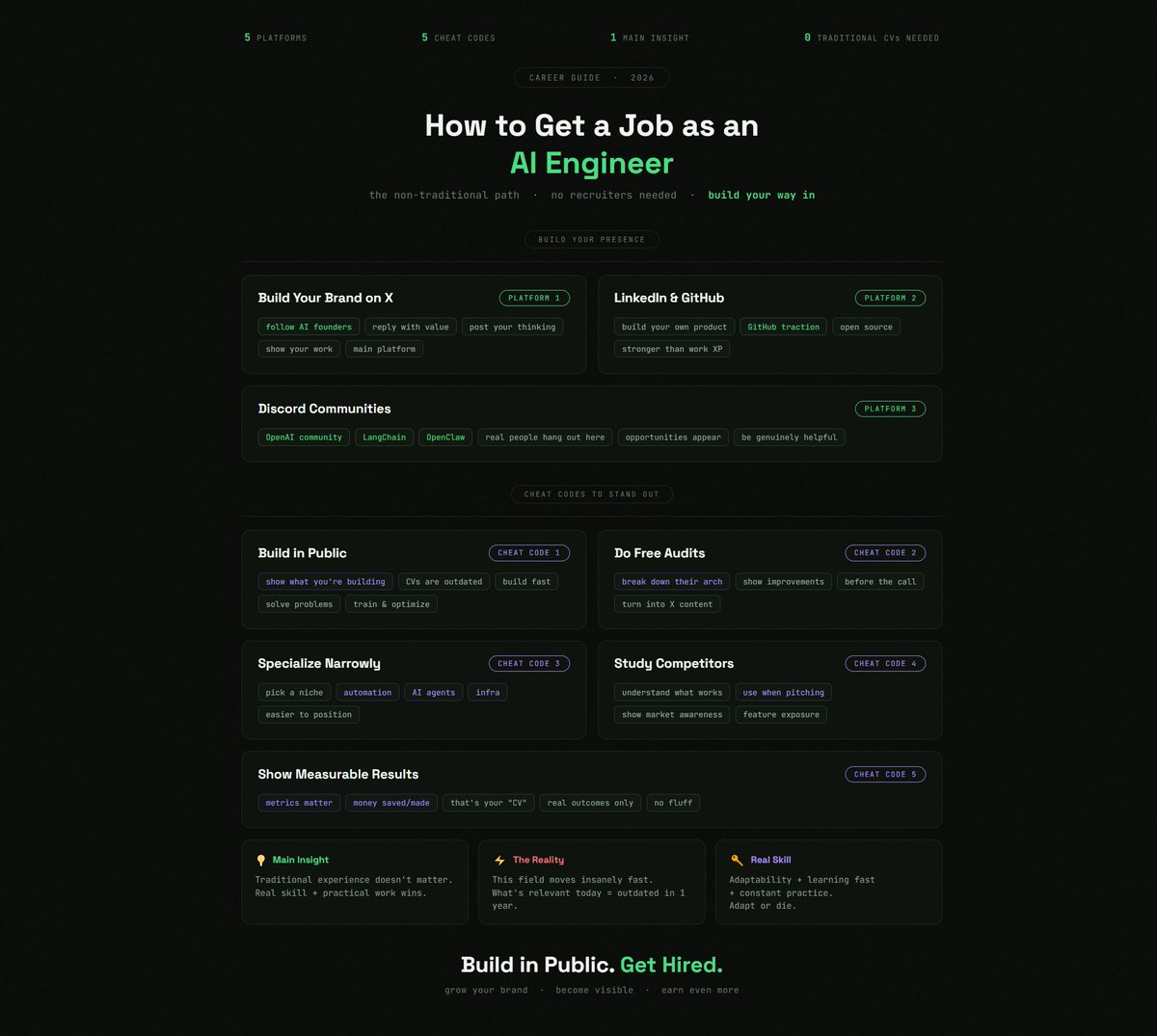
1: Build your personal brand on X
this should be your main platform
follow AI startup founders, reply to them, post valuable content, show your thinking and value
2: Build presence on LinkedIn or GitHub
these are more traditional platforms
but if you build your own product and it gets traction on GitHub, that's already way stronger than "work experience in a company"
3: Share knowledge in Discord communities
OpenAI community, OpenClaw, LangChain (anything directly related to AI engineering)
this is where real people hang out and opportunities appear
cheat-codes to stand out and get into the top 1%:
1. Build in public
show what you're building and how
CVs are outdated, people hire those who can build fast, solve problems, train and optimize models
2. Focus on features and exposure
study competitor products, understand what works
use this knowledge when pitching, it proves you understand the market
3. Do free audits before calls
before jumping on a call with a potential client, break down their architecture
show what you think is happening and what you would improve
(this can also be turned into content on X)
4. Specialize narrowly
don't just be "AI engineer"
pick a niche: automation, AI agents, infra, etc.
this makes you much easier to position
5. Show measurable results
metrics matter (money especially)
if your work saved or made money, that's what goes into your "CV”
main insight:
this is a new profession, traditional "work experience" doesn't matter as much
what matters is real skill, understanding, and practical experience
forget chasing top company interviews
right now you have a much better opportunity:
- build in public
- grow your brand
- become visible
- potentially earn even more
one more thing: everything in this field moves insanely fast
what’s relevant today may be outdated in a year
and in two years completely irrelevant
so "experience" doesn't matter
your real skill is adaptability + learning fast + constant practice
adapt or die.
📢 5-Day AI Agents Intensive Course with @Google is now available as a self-paced Learn Guide!
Access whitepapers, podcasts, codelabs & recorded livestreams 👇
https://t.co/HUCsnq9lEB
🧵 Linux fundamentals to learn before jumping into DevOps tools:
- File system navigation & permissions (chmod, chown, ls, cd)
- Process management (ps, top, kill, systemctl)
- Text processing & scripting (grep, awk, sed, bash)
- Networking basics (netstat, curl, ssh, firewall)
- Package management (apt, yum, dnf)
- User & group management (useradd, usermod, sudo)
- Disk management & mounting (df, du, mount, lsblk)
Below are examples for each one
incredibly honored to be one of the TransTech Social x Linux Foundation Training and Certification scholars!
Huge thanks to @TransTechSocial and @linuxfoundation for this amazing opportunity. I'm excited to embark on this journey and help pave the way for others in tech. 🙌
Anthropic has released Free AI courses on:
- Prompt Engineering
- Building agents
- Best practices for Agentic Coding
- Collaborate with AI systems
.... and so much more!
9 best guides you don’t want to miss:
𝗜 𝗺𝗲𝘀𝘀𝗲𝗱 𝘂𝗽 𝗺𝗮𝗻𝘆 𝗶𝗻𝘁𝗲𝗿𝘃𝗶𝗲𝘄𝘀 𝗶𝗻 𝗺𝘆 𝗲𝗮𝗿𝗹𝘆 𝗰𝗮𝗿𝗲𝗲𝗿 𝗯𝘆 𝗻𝗼𝘁 𝘂𝘁𝗶𝗹𝗶𝘇𝗶𝗻𝗴 𝘁𝗵𝗲 "𝗧𝗲𝗹𝗹 𝗺𝗲 𝗮𝗯𝗼𝘂𝘁 𝘆𝗼𝘂𝗿𝘀𝗲𝗹𝗳" 𝗾𝘂𝗲𝘀𝘁𝗶𝗼𝗻 𝗽𝗿𝗼𝗽𝗲𝗿𝗹𝘆.
I used to talk about my education, experience, and previous companies - just reading out my resume. What a waste of a golden opportunity!
One day, a friend who was interviewing candidates for his team shared something interesting.
𝘠𝘰𝘶 𝘬𝘯𝘰𝘸 𝘸𝘩𝘢𝘵 𝘮𝘢𝘬𝘦𝘴 𝘤𝘢𝘯𝘥𝘪𝘥𝘢𝘵𝘦𝘴 𝘴𝘵𝘢𝘯𝘥 𝘰𝘶𝘵? 𝘞𝘩𝘦𝘯 𝘵𝘩𝘦𝘺 𝘶𝘴𝘦 𝘵𝘩𝘪𝘴 𝘲𝘶𝘦𝘴𝘵𝘪𝘰𝘯 𝘵𝘰 𝘴𝘩𝘰𝘸𝘤𝘢𝘴𝘦 𝘵𝘩𝘦𝘪𝘳 𝘦𝘹𝘱𝘦𝘳𝘵𝘪𝘴𝘦 𝘪𝘯𝘴𝘵𝘦𝘢𝘥 𝘰𝘧 𝘳𝘦𝘢𝘥𝘪𝘯𝘨 𝘰𝘶𝘵 𝘵𝘩𝘦𝘪𝘳 𝘳𝘦𝘴𝘶𝘮𝘦.
I started experimenting with different approaches. After many trials and errors, I found what works best.
Now when interviewers ask me to talk about myself, I start with a brief introduction and move to my technical journey:
"I have 11 years of experience, with deep expertise in cloud infrastructure and automation. I've built complex solutions across AWS and GCP, specializing in Kubernetes and Infrastructure as Code.
I've successfully implemented large-scale migrations, like automating RDS migrations using Python and PGSync, reducing downtime by 60%. I've built and managed multi-environment EKS clusters using custom Terraform modules, supporting hundreds of microservices.
Recently, I've focused on DevSecOps, implementing comprehensive security scanning using GitHub Advanced Security suite, CodeQL, and Dependabot. I've also built automated monitoring solutions using Grafana and Prometheus that helped detect critical issues before they impacted users."
𝗧𝗵𝗲 𝗺𝗮𝗴𝗶𝗰 𝗵𝗮𝗽𝗽𝗲𝗻𝘀 𝗮𝗳𝘁𝗲𝗿 𝘁𝗵𝗶𝘀.
The interviewer starts asking questions about Kubernetes, cloud migrations, and security implementations - all areas where I excel!
Instead of getting random questions, I get to talk about my strengths for most of the interview.
Even when they ask about areas I'm not familiar with, I confidently say: "While I haven't worked extensively with that technology, I'm very interested in learning it. My experience with similar tools would help me pick it up quickly."
𝘙𝘦𝘮𝘦𝘮𝘣𝘦𝘳, 𝘪𝘯𝘵𝘦𝘳𝘷𝘪𝘦𝘸𝘴 𝘢𝘳𝘦 𝘯𝘰𝘵 𝘫𝘶𝘴𝘵 𝘢𝘣𝘰𝘶𝘵 𝘢𝘯𝘴𝘸𝘦𝘳𝘪𝘯𝘨 𝘲𝘶𝘦𝘴𝘵𝘪𝘰𝘯𝘴 - 𝘵𝘩𝘦𝘺'𝘳𝘦 𝘢𝘣𝘰𝘶𝘵 𝘴𝘵𝘦𝘦𝘳𝘪𝘯𝘨 𝘵𝘩𝘦 𝘤𝘰𝘯𝘷𝘦𝘳𝘴𝘢𝘵𝘪𝘰𝘯 𝘵𝘰𝘸𝘢𝘳𝘥𝘴 𝘺𝘰𝘶𝘳 𝘴𝘵𝘳𝘦𝘯𝘨𝘵𝘩𝘴.
Your "𝗧𝗲𝗹𝗹 𝗺𝗲 𝗮𝗯𝗼𝘂𝘁 𝘆𝗼𝘂𝗿𝘀𝗲𝗹𝗳" response sets the tone for the entire interview. Use it wisely.
In System Design, I love discussing how someone would scale a web application.
The first answer is always "add more servers and a load balancer." This is where the real fun begins.
It's not about which algorithm you choose (Round Robin, Least Connections). It's about whether you understand that a load balancer's real job is to hide the chaos of a distributed system from the user.
Until it can't...🧵
🚀 AWS 30-Day Learning Roadmap – Complete Blog Series is Now Live!
Learn AWS step-by-step in 30 days – from EC2, Lambda, and S3 to security, automation, and real-world projects.
Perfect for beginners and those refreshing their cloud skills.
✅ 30 Days, 30 Topics
✅ Snippets + Explanations
✅ Linked pages for deep dives
📚 Access Full Roadmap 🔗👇👇
Follow along, share feedback, and level up in the cloud
Today I earned my "Fundamental AI Concepts" badge! I’m so proud to be celebrating this achievement and hope this inspires you to start your own @MicrosoftLearn journey!
https://t.co/Qy1j9P0XHl #MSLearnBadge
Today I earned my "Describe cloud service types" badge! I’m so proud to be celebrating this achievement and hope this inspires you to start your own @MicrosoftLearn journey!
https://t.co/Lt7hcWrHWk #MSLearnBadge
Today I earned my "Describe the benefits of using cloud services" badge! I’m so proud to be celebrating this achievement and hope this inspires you to start your own @MicrosoftLearn journey!
https://t.co/1SMoTcFVOk #MSLearnBadge
Today I earned my "Describe cloud computing" badge! I’m so proud to be celebrating this achievement and hope this inspires you to start your own @MicrosoftLearn journey!
https://t.co/cMSF4SioU0 #MSLearnBadge
Microsoft is doing FREE AI training with resources and CERTIFICATIONS to help everyone thrive and build on AI technology, ethics, guidance and more.
You'll get a voucher for the Azure AI-900 certification when you attend the 9 trainings.