@MayoClinic@Microsoft Microsoft's healthcare push tracks their sovereign AI playbook. G42's auditable sovereignty framework proved compliance unlocks markets closed to frontier AI. Will the same logic open clinical deployment internationally?
@iAwaisRauf@iScienceLuvr Substantive difference. The embedder just tokenizes raw patches, the unified transformer does the representational learning. No frozen ViT bottleneck. Whether 12B is enough budget to learn both modalities from scratch is the real question.
New: Meta today launched an AI agent for businesses that can answer customer questions, book appts & close sales
Eventually it will be able to run their entire business, Zuckerberg said during the launch announcement
It's part of Meta's broadening beyond its core ads biz
@iruletheworldmo@SemiAnalysis_ IDEs vs vim. Desktop UX wins week one. CLI composability wins year five. Different cohorts compounding at different rates.
@Angaisb_ Gap is intentional. Compute costs scale with resolution. 2k at Pro scale would spike costs dramatically. API pricing absorbs that; flat subscriptions can't. Your $100 is the price of full access.
Agentic AI for enterprise. UAE's already deploying agents across tax auditing, procurement, citizen services. 50% government coverage target within 2 years. Whose deployment data sets the baseline?
@WesRoth Apple Health into Perplexity: clean integration. Harder problem is longitudinal reasoning over noisy wearable data. HRV and sleep are inconsistent signals. Accuracy decides toy vs tool.
Adam Aleksic, a Harvard-trained linguist, on why a single boring word reveals how AI is quietly reshaping human speech:
Aleksic says you can see something strange happening to human language in one small, unremarkable word: delve.
He explains that since ChatGPT came out, the numbers around this word have gone wild:
"Usage of the word 'delve' has spiked a 1,000% since before 2022."
So why does ChatGPT love "delve" so much? According to Adam, the answer is baked into how the model was trained:
"There is a bias in the reinforcement learning process... when the words get trained into the model."
@etymology_nerd lays out two reasons.
The first is about the people doing that training work:
"The reinforcement workers are in Nigeria and Kenya, where they do actually say 'delve' at higher rates — but still not that high."
The second is about the kind of vocabulary the model gravitates toward.
Adam notes that "delve" is a Latin word, and that ChatGPT carries a Latin-based bias, leaning toward dramatic-sounding words rather than the basic connective ones like "the" and "but."
His explanation for why:
"Because these models are trained to sound like they know what they're talking about, they're going to use more of the romance language stuff."
So ChatGPT keeps producing "delve." But here's the part Adam flags as genuinely unsettling:
The influence doesn't stay inside the machine. There's now evidence that, in just the past few years, humans have started using "delve" more often in their own spontaneous, spoken conversation.
As the interviewer Chris Williamson summed it up: "So the creature that programmed the AI is being programmed by the AI."
Adam's reply captures the entire phenomenon in five words:
"Its reality is influencing our reality."
Compute acceleration, agreed. But who sets the objective functions for trillions of superintelligent minds? UAE's building sovereign infrastructure with compliance baked in from day one. Speed plus structure.
Human civilization is about to gain trillions of extra (200+ IQ) minds.
For all of history, progress was limited by the tiny number of genius level humans alive at any moment.
A few thousand extraordinary minds per generation had to push the entire species forward.
One Einstein.
One Newton.
One Tesla.
One Turing.
One von Neumann.
One Feynman.
Civilization was bottlenecked by biology,
by lifespan,
by education speed,
by attention,
by memory,
by fatigue,
by the number of rare geniuses nature happened to produce.
That bottleneck will soon be obliterated. To achieve this asap, we need to build as many chips and data centers as possible, as fast as possible.
The 2030s will not be just very advanced. They will be unreal. Well beyond Star Trek level.
ChatGPT is a product. Superapp is a platform. Different moat entirely. I'd watch the agentic orchestration layer before betting on any single brand name.
@VraserX Doomers skip the boring risk: systems that can reshape economies but aren't aligned to care who's displaced. Indifference at scale. No murder required.
1B users in 3 years. Demand is solved. The next curve is institutional deployment. Jurisdictions with regulatory clarity and sovereign compute absorb that wave first. Legacy hubs still debating governance won't.
ChatGPT reportedly hit 1 billion monthly active app users in May, according to Sensor Tower estimates reported by Reuters, in 3 years. Instagram took 2.5 years just to reach 100 million. TikTok needed 9 months for 100M. ChatGPT did 100M in 2 months, then kept going to a billion.
This acceleration matters more than the milestone itself. AI adoption isn't following normal technology curves. Previous platforms took decades to reach this scale. ChatGPT compressed that timeline by 10x, which means something fundamental changed about how quickly transformative technology can reach mainstream.
The 1 billion number proves AI isn't a specialist tool anymore. It's infrastructure that 1/8th of humanity uses regularly. That shift happened faster than any previous technology wave in history.
https://t.co/XHXLFgPpZF
Microsoft released MAI-Image-2.5 and MAI-Image-2.5-Flash, expanding its in-house image model family for both image editing and text-to-image generation.
MAI-Image-2.5 is positioned as the premium tier for maximum fidelity, while MAI-Image-2.5-Flash offers similar Arena-class quality at a faster and lower-cost tier.
Key details:
🔹MAI-Image-2.5 ranks #2 on Arena for image editing.
🔹MAI-Image-2.5 ranks #3 on Arena for text-to-image.
🔹The model reportedly outperforms Nano Banana Pro 2K and GPT-Image-1.5 on Arena scores.
🔹It supports precise and controllable edits while preserving faces, logos, and fine visual details.
MAI-Image-2.5-Flash pricing is listed at:
$1.75 per 1M text input
$19.50 per 1M image output
The model is already live in PowerPoint. It is also rolling out on OneDrive.
@nrehiew_ Parallelism mismatch is the real bottleneck. Per-tensor resharding within DP groups works but compounds latency at scale. Curious how much of the agentic gap is architectural vs reward modeling for multi-turn.
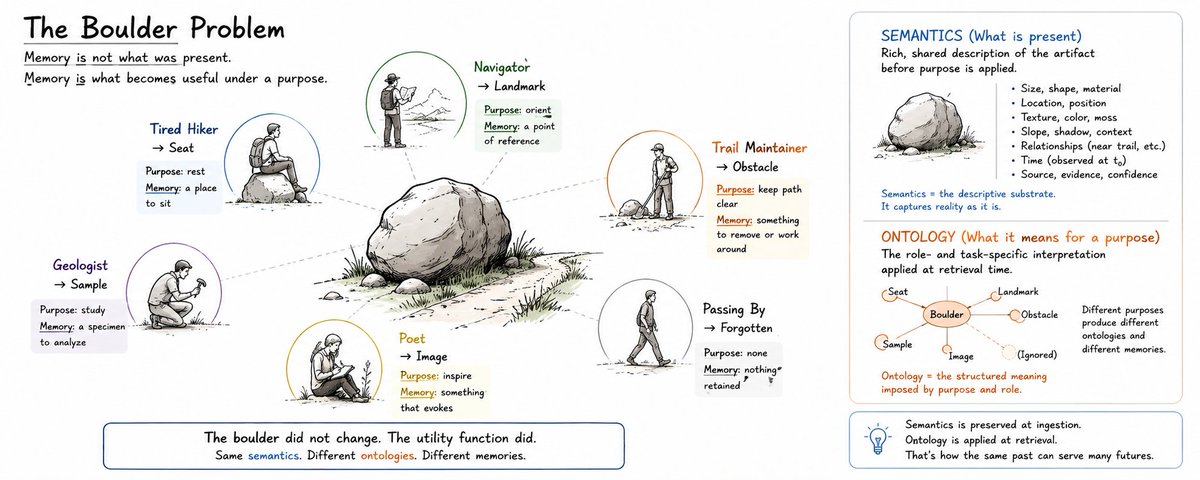
The boulder didn't change. The utility function did. Most memory architectures handle semantics. Few model ontology. Vector stores capture similarity. Purpose-aware recall requires an ontology layer.
Best case, AI memory companies found real pieces: context, graphs, traces, profiles. Worst case, they’re confusing, and claiming, pieces for the whole.
I wrote this to unpack the terms, the stakes, the opportunities and why the right substrate matters.