Prevent IT disruptions. Protect operations.
Helping manufacturing & distribution businesses keep production‑critical IT stable, secure, and predictable.
Most multi-site distributors run with 3-4 IT vendors
who all have active access to their systems.
Each is accountable for their own piece.
None are accountable for the outcome.
That’s exactly where outages are born.
80% of IT downtime comes from people and process
not the technology itself.
In distribution environments, that usually means:
→ No tested failover
→ No single owner during an outage
→ A recovery plan that has never run
The exposure is process-level.
So is the fix.
Most distributors delay IT replacement due
to cost until operations halt.
A system can be technically "up" yet hurting ops.
ERP slows. RF guns drop. Shipping backs up.
Not an inconvenience but an operational risk.
Ever hit your floor?
Tag a distributor who needs this.
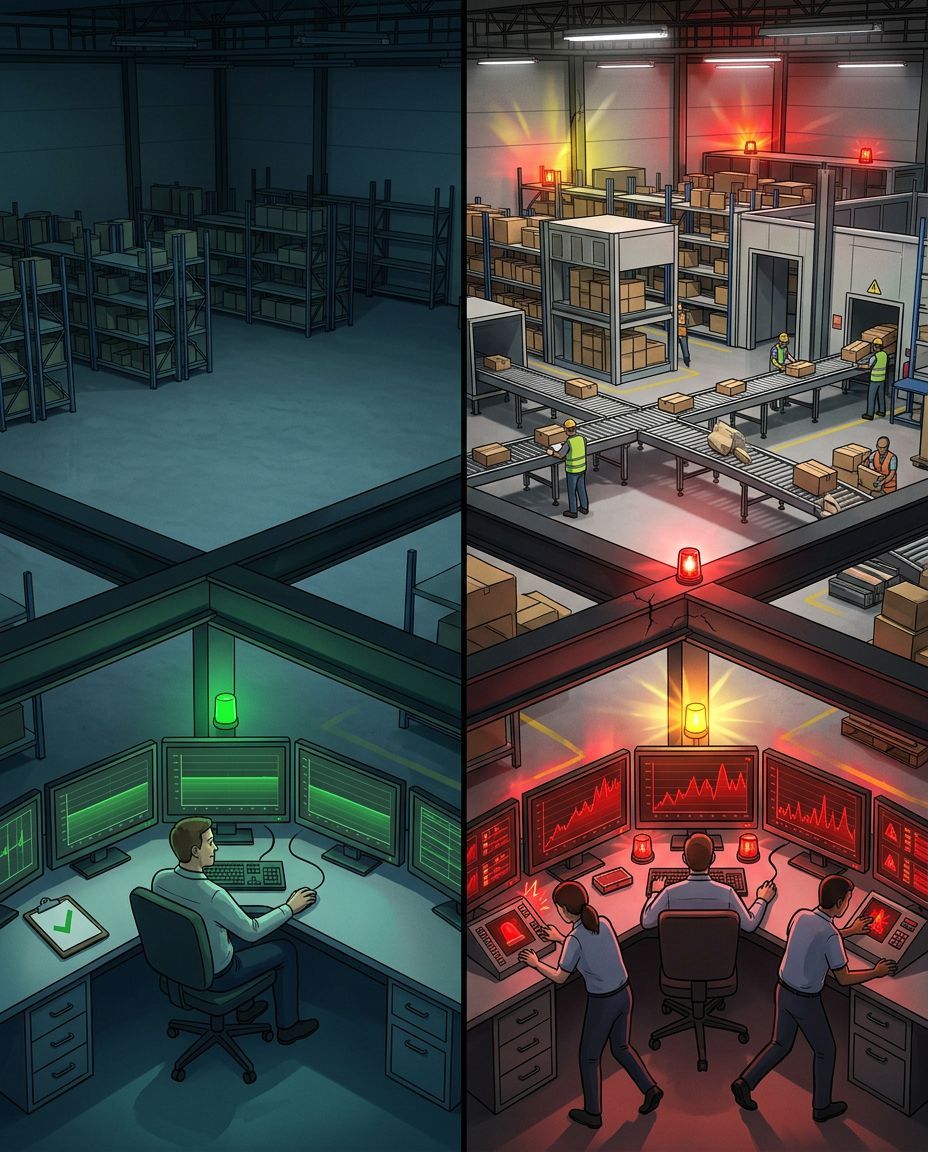
A warehouse outage doesn't
just stop shipping.
- It idles the floor,
- Pulls leadership into firefighting
- Puts customer commitments at risk
All at once.
The hidden cost usually runs
longer than the outage itself.
Acquisitions look clean on paper.
In reality, they import hidden technical debt.
Distribution feels it first.
Not in the boardroom.
In the first outage.
Stability by assumption looks identical to stability by design.
Until it doesn't.
What's one 'stable' system in your setup that's really just untested luck?
Most companies think they have a backup network.
They usually discover the truth at 6:03 AM Monday when the primary dies.
The branch goes offline and someone is frantically DMing IT for “that circuit ID we never documented"
Redundancy on paper ❌️ redundancy in reality
🚩 31% of IT outages in 2024 started
with network and connectivity failures.
Most operations teams find out which
branch is exposed after the primary
goes down.
Not before.
The best early-warning system in most
facilities isn't software.
It's the veteran who knows exactly
what that unusual hum, rattle, or
silence really means.
Alarms catch thresholds.
Experience catches context.
When two systems disagree on
a shipment, who wins?
🚩 ERP (because it created it)
🚩 WMS (because it picked it)
🚩 Whoever shipped last (because that's what the customer sees)
👉 Most teams never decided.
That's the problem.
"We don't have an order problem."
You might not.
You might have an order definition
problem:
- Five systems
- Five versions
- Same shipment
And nobody agreed which one is official
The order is in the system.
But which system?
- ERP says 40 units.
- WMS says 36.
- The label says 38.
Same order. Three truths.
That's not a glitch. That's how most warehouses and production floors,
run every day
Recovery: visible → gets the meeting, the budget ask, the recognition.
Prevention: invisible → gets ignored… until throughput tanks.
The plants still winning in 2026?
👉🏻 They protect output before the alarms ever go off.