Tech lawyer (Australia) sharing insights on AI regulation and contract negotiation strategies
Co-founder at LegalQuants
Founder at techieray AI regulation lab
@lawheroezV2 Ironically, I think legal benchmarks are quite useful for a human lawyer, especially for juniors. If a junior can learn to read a 'scary' JSON format, you can learn a lot re what makes a 'correct' or 'good' legal answer!
Massive week with:
1. Trump-Xi-Putin summit on nuclear, AI and peace
2. Anthropic IPO
3. the mounting pressure for federal AI regulation in the US (e.g. AUDIT AI Act introduced)
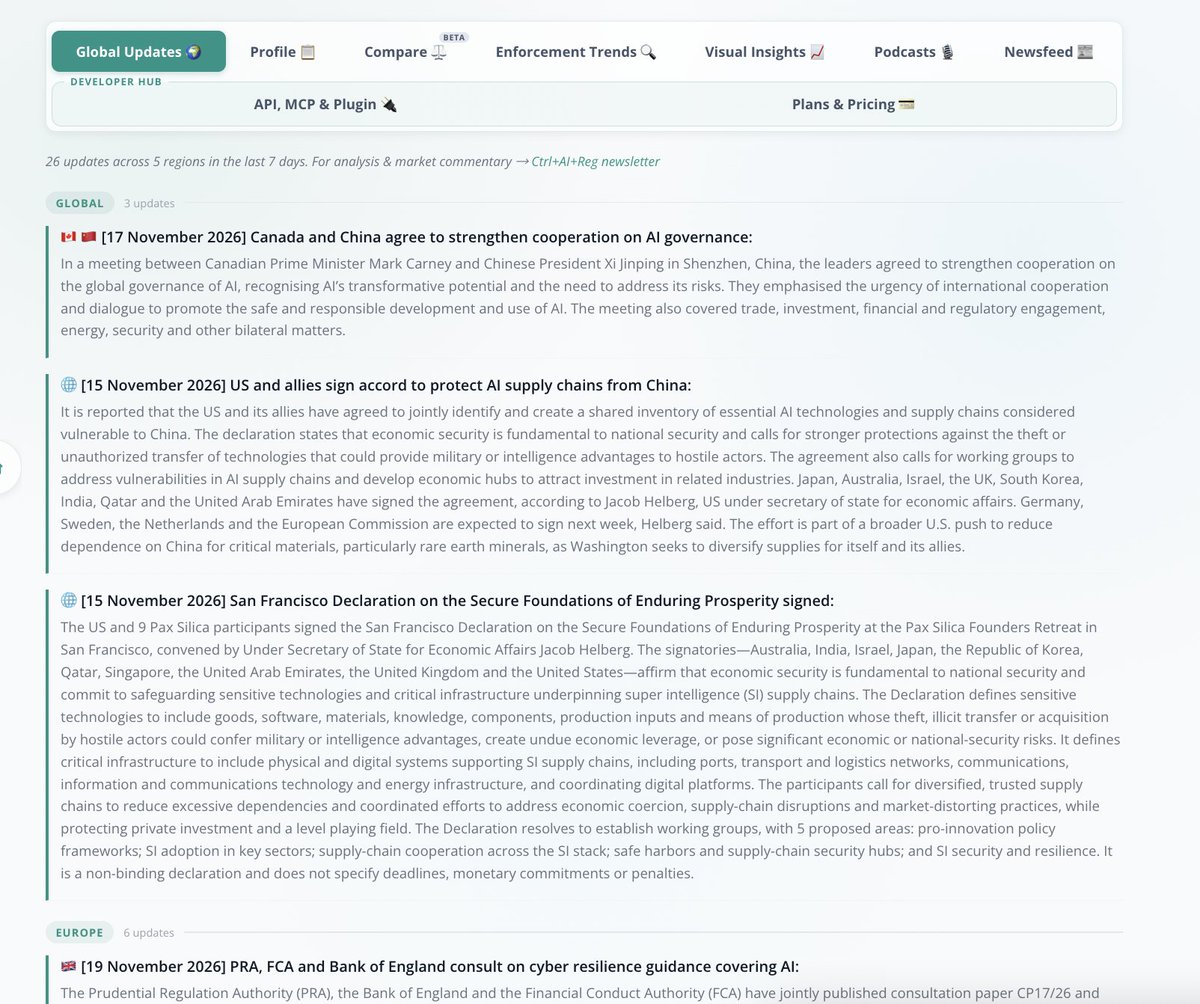
Stay on top of AI regulatory updates in real time across 200+ jurisdictions with our free tracker: https://t.co/WmWSWJC1BX
Wow, this was so interesting to listen to @hilbertspaess Very refreshing to hear that Jacob’s proposal doesn’t lean into the typical liability mechanisms - i.e. I love his argument that no market can price extinction risk, so insurance and courts can’t handle it the way they handle ordinary liability.
Really interesting to hear his point on compute throttling as well - i.e. each frontier lab could spend only a fixed share of its chips on frontier training while the rest would go to customer inference or alignment research.
Would love to see a follow-up debate on how compute throttling would actually work across borders, especially with China.
Wow congratulations on the launch @jakesendar! Very impressed by your background, and I see that we have mutual followings with @theviclaw and @jjhughes. Have you heard of the @LegalQuants? It's a network of highly technical lawyers with similar backgrounds / skillset to yourself. Would love to chat and say hi. Looping in @jamietsohn
Fantastic LegalQuants podcast featuring @jboehmig (interviewed by @theviclaw). Jason represents the golden standard that us legal quants at @LegalQuants aspire to
Loved getting to chat with @theviclaw. Genuinely one of the most thoughtful and prepared interviewers I've ever had the opportunity to speak with. And an incredible builder in his own right!
I have put together an online module that explains how AI contracts are negotiated from first principles trhough interactive visuals, checklists and clause maps. Worth a read for anyone out there who are curious as to how commercials drive the way agreements in the AI sector are drafted.
https://t.co/OeVD4jGNh5
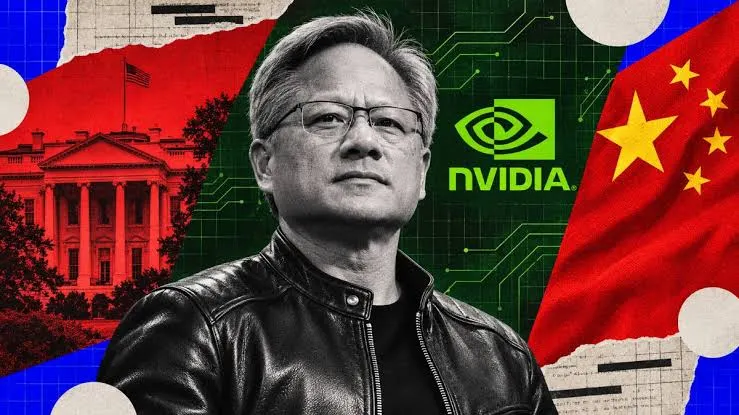
As the Jensen Huang exit situation continues to twist and turn, I've put together a quick overview in my latest Substack article (paid) on the US and Chinese chip control policies which sit at the heart of the story.
https://t.co/cIAe0HUxUe
This won't be a conspiracy theory article, but rather an explainer:
1) How US chip export controls moved from Biden's published rules to Trump's case-by-case licences
2) Why Megaspeed, Singapore and broader Southeast Asia are at the heart of the issue
3) The common misconception about China's demand for US chips, and what they are actually doing behind the scenes
4) What the future direction of US export control policy could look like in the post-Jensen era.
It will be interesting to watch how the US governs its most strategic technology in the post-Jensen era. So far, the system is run on presidential judgement, with rules that leak at the edges and a Congress pressing to harden them. China's strategy is to keep its own controls unwritten and switchable, buying what it needs while building what it wants. Whoever runs Nvidia next, Washington now has to decide whether its chip controls are a deal to be renegotiated or a line written into law.
Came here for the title, but stayed for the masterclass delivered by @poteto and @romanugarte_ on how to orchestrate and loop your agents like a pro, so that you go from a 'single player' to a 'multiplayer' user (which I found was a great analogy to describe the agentic era we're living in atm)
https://t.co/MYnzJNzHaW
This is amazing stuff Nick - super impressed. I saw it on Reddit too, and in the tomshardware. I'm a fellow tech lawyer and software engineer, and co-run the @LegalQuants which assembles lawyers like me (https://t.co/AAetYZhA6d). I'd love to invite you to the group - DM me for more details!
As a tech lawyer, I work on enterprise (B2B) AI deals on all time, from both customer and vendor sides (including among some Magnificent 7 companies).
In this article (paid substack), I lay out the commercial dynamics and tensions between vendors and customers behind these deals.
https://t.co/S8TI9K4veb
Very interesting application of AI to find loopholes or blind spots in legislation.
It does make me wonder what is the materiality threshold for these kind of legal exploits. I would assume in most jurisdictions that there are interpretive rules in place to ensure that legislation cannot be read down or interpreted in an exploitative way.
And to the extent a legal exploit gives rise to a certain exercisable right, one may also need to check whether that right is subject to any discretionary powers of the relevant authority.
But in any case, I love these kind of applications, and it parallels how I currently apply LLMs to review and stress test my contract drafting.
We have discovered a substantial number of vulnerabilities in the German legal system using LLMs.
These may enable access to confidential documents, travel without an otherwise required visa, enforceable leave for soldiers at NATO’s JSEC, and more.
Similar to computer systems, the written law can contain vulnerabilities that invite exploitation. In our blog post, we share a selection of vulnerabilities, and present potential exploits for each. To our knowledge, none of these have been previously recorded. We share only those vulnerabilities whose exploitation we believe would not cause serious harm.
blog post: https://t.co/hsYTiJpNoJ
Everyone's talking about the latest models and harnesses. But hardly anyone talks about the contracts that make the whole AI ecosystem work. Here are my insights and observations of how AI SaaS contracts (particularly at the B2B level) are being negotiated based on my experience as a tech lawyer who is deep in this work every day.
1) Structurally, AI SaaS contracts are not so different from traditional SaaS contracts. I'd say 80% of standard SaaS and commercial contracting issues (e.g. service levels, data protection, termination, warranties, etc) are carried over into AI contracts. There are obviously some nuances in AI that are very crucial particularly around agentic liability, training, tokens and outputs which I'll go into more detail below.
2) From a bargaining power perspective, it tends to start out as a vendor's market upon each product category release (e.g. LLM → chatbot → agentic harness) because of the lack of options. But as the market saturates with more options (and vendors vye for enterprise revenue), B2B customer gain more barganing power for a limited time window until the new product era kicks in which resets the balance in favour of vendor. This ebbs and flows every 2-3 years. Legal terms have become increasingly scrutinised as product differentiators because vendors know enterprise customers care about this stuff (e.g. see point 10).
3) I've seen instances where the vendors' standard legal terms are reasonable and pass Legal's checks, but then unload all the onerous terms / amendments into the order form / statement of work which are typically reviewed by non-legal product teams. I've seen so many 'traps' for example where the vendor offers a token discount but that is defeated by a take-or-pay minimum spend obligation, or insert new terms that override the standard terms.
4) There's always a fight as to how much the vendor can unilaterally change or amend terms. This is not a new issue, but SaaS agreements tend to defer key commercial terms on online product pages or clickwrap terms to which the vendor reserves rights to unilaterally amend. Customers have learnt to live with it by pushing for notificiations of adverse changes and the ability to exit if the change is too detrimental. But realistically, it's hard to just 'walk away' from a sticky solution, so customers typically end up having to monitor terms themselves and 'lock in' as many of the online terms into the enterprise paper contract (and give the enterprise contract the highest level of precedence).
5) On liability, in this agentic era, the core question is whether the agreement treats an agentic action as an "output" or a "service"? If the action is an output, then typically this is wrapped under output disclaimers (i.e customer is responsible for their own output). If the action is a service, vendors owe a standard of care with respect to their service, but this may be subject to carveouts (e.g. vendor not liable if customer misused the service, etc). Google is the only major vendor I've seen make an explicit statement that action = service. The other big AI vendors remain silent on this point, presumably to reserve flexibility.
6) By design, agents invoke tools (e.g. plugins and connectors). These tools are typically provided by third parties outside of the agent's provider. Customers try to tactfully frame these third party tool providers as "subcontractors" or "subprocessors" of the vendor so that vendor takes responsibility for them. But almost always the vendor will reject that framing, disclaim responsibility, and defer the customer to the third party's terms of use. The result is that customer gets caught up a web of clickwrap third party terms that they cannot negotiate, which they then either have to accept or not invoke the tools at all (and build their own tools).
7) By design, agents are also 'consequential' in the everyday sense - i.e. they perform actions one after another in sequence, so one bad step can cascade through every step after it. The typical contracting principle is that neither party should be liable for consequential or indirect losses (i.e. losses that don't flow directly from the breach). However, there is a trend of customers tactfully trying to carveout agentic actions from the scope of consequential losses so that vendor remains liable for such actions. In my experience, customers succeed about 50/50, depending on how much the customer can rely on regulatory reasons that vendor can't push back.
8) AI training is a huge contentious battleground which cuts across IP and data protection issues. The standard 'acceptable' middleground is to allow the vendor to train their AI on anonymised / aggregated data, but not the customer's raw data. But as we increasingly see how easy it is to distil know-how and insights from anonymised data, many customers are getting nervous that their IP / know-how is still being exploited even if their privacy / confidentiality is respected. So I'm seeing a reversal into "no training at all, even on anonymised / aggregated data" and ZDR (zero data retention, i.e. the vendor deletes your data once processed) clauses as the standard commercial position pushed by customers (though this often comes at the cost of a nerfed service).
9) In terms of IP, discussion tend to focus on the outputs - i.e. AI-generated content (e.g. images, videos, text) v AI-generated apps (e.g. vibe coded apps or workflows). For content, most agreements stay silent on who owns outputs, since many legal systems around the world still don't have a definitive position as to whether copyright subsists in AI generated content. Apps are different, and 2026 saw a boom in vibe coded apps. The portability of the vibecoded app typically dictates the IP position - i.e. "can you take your app outside of the environment?". If your app can only run on the platform, the vendor will say it's just a use of their platform and therefore 'part of the vendor's service' which is the vendor's IP (in which case the negotiation shifts to uptime, warranties and licence scope). On the other hand, if the app can be exported and run outside of the platform, the customer usually owns the IP in their app but also the risk that comes with it. The latter is becoming the mainstream now as we see agentic coding tools (e.g. Claude Code, Codex) gaining more ground over no-code / low-code SaaS tools (e.g. Lovable, Replit).
10) IP indemnities (i.e. the vendor covers you if someone sues over the output) are an example of legal terms being flaunted to win competitive edge. In 2023, Adobe, Microsoft, Google and OpenAI offered comparable indemnity protections at their own risk in order to win more enterprise customers. I remember my clients asking me to compare those indemnnities all the time, so they do notice these things. But over time, other smaller players are offering the same so it's market standard now. The indemnities are also getting tighter since the volume of copyright lawsuits launched against the AI labs is making the industry rethink whether they can really absorb the indemnity costs.
11) Incidents such as the Fable 5 suspension in June 2026 was a wake-up call for enterprise customers (particularly those outside of the US) to lock down tighter service level agreements to ensure service continuity (especially since AI is getting more deeply integrated into business ops). Many vendors are willing to commit to onerous service levels (e.g. 99%) but the negotiation gets fierce in the carveouts. Vendors prefer to disclaim third party outages from their service levels and widen force majeure provisions so that they have more room to get away with in case they suffer an outage themselves (think of the Crowdstrike incident). Some vendors also try to make it hard for customer to track service levels and/or claim credits.
12) There's an interesting interplay between service levels and tokenomics too. If the vendor 'loses' on the service level negotiations, they could try to claw back leverage by tightening your rate limits or context windows which shrinks your usage, which in turn reduces the scope of service hours that the vendor has to promise. Because after all, how you will notice outages or service level failures when you've run out of tokens and can't use the service in the first place? The devil is thus in detail around token limits, reset windows, weekly caps, and whether those limits apply per user or are pooled across the whole company.
13) We're also seeing a tokenomics x consentnomics interplay. Anthropic has for a while offered discounted tokens in exchange for your permission to let Claude train on your raw chats. OpenAI has also offered complimentary tokens to API customers who opt in to sharing their data for training. That said, I'm not sure how sustainable this is because such programmes basically incentivise customers to only trade away their least valuable / low-quality data for token savings (which only erode profit margins for the labs).