Networking: Spanning Tree Protocol (STP)
Fun Fact: The acronym STP is shared by more than one term. In network cabling, it also stands for Shielded Twisted Pair.😀
#Networking#Cybersecurity
@CyberRacheal Just adding to the conversation and for people new to networking. Classes are obsolete. Today, we use CIDR (Classless Inter-Domain Routing) /8, /12, /25 etc...
CIDR notation:
10.10.1.1 /8 = Class A
172.21.1.1 /16 = Class B
192.168.105.1 /24 = Class C
Happy Hacking!!!
@CyberRacheal The other three answers are not valid public IP addresses, as 192.123.123.123 and 172.213.123.321 are in the private IP range,
No, 192.123.123.123 is not in the private range according to the RFC 1918.
For 172.213.123.321, it is not even a valid IP address...🤔
Cybersecurity is hard because many do not know what they are doing. I have seen so called professionals set networks incorrectly.
For instance:
1) Leaving default credentials, SSIDs, or management interfaces exposed.
2) Incorrect or overlapping IP addressing/subnetting
3) Misconfigured NAT, port forwarding, or firewall rules
4) DNS and gateway mismatches.
5) Ignoring or mis tuning QoS, MTU, or fragmentation settings, which can silently degrade performance for certain traffic (VoIP, VPNs, large transfers).
6) Creating Layer 2 loops without Spanning Tree Protocol (STP/RSTP/MSTP) properly enabled and tuned, or relying on consumer gear that handles loops poorly. This leads to broadcast storms.
7) Poor hierarchical design
8) Incorrect VLAN trunking or tagging
9) Single points of failure with no redundancy (no secondary paths, no dual uplinks, no HSRP/VRRP/GLBP for gateways)
10) Mixing Layer 2 and Layer 3 boundaries incorrectly such as extending the same L2 domain across sites when routing would be cleaner, or over relying on stretched VLANs
11) Cable and physical layer issues that look like “config” problems such as wrong cable types/speeds, exceeding distance limits, dirty fiber, or using the wrong ports (and then compensating with bad configs instead of fixing the physical layer).
12) Ignoring broadcast domain size and ARP/ND scaling. Very large flat L2 domains cause excessive broadcast/multicast traffic and slower convergence.
13) No documentation or outdated diagrams.
14) Treating consumer or SMB gear the same as enterprise equipment (or vice versa) without adjusting expectations for features, performance, and management.
15) Failing to plan for growth, monitoring, logging, or backup/restore of configurations, which creates security issues
(16) Security theater such as enabling features that sound secure but are misconfigured (or disabled for "convenience") so they provide little real protection.
etc...
@0x0SojalSec 🤔 I do not agree. This looks like old DDR1 256 MB RAM, which is useless today. Now if it was DDR4 or DDR5, that would be a different story😀🤔
@CyberRacheal I used to live @ 127.0.0.1 (Home) but then I moved to a new home ::1 (Home), which is a more modern ::1 (Home) and now I am not ff02::1 (Everywhere)😀🤔
I agree
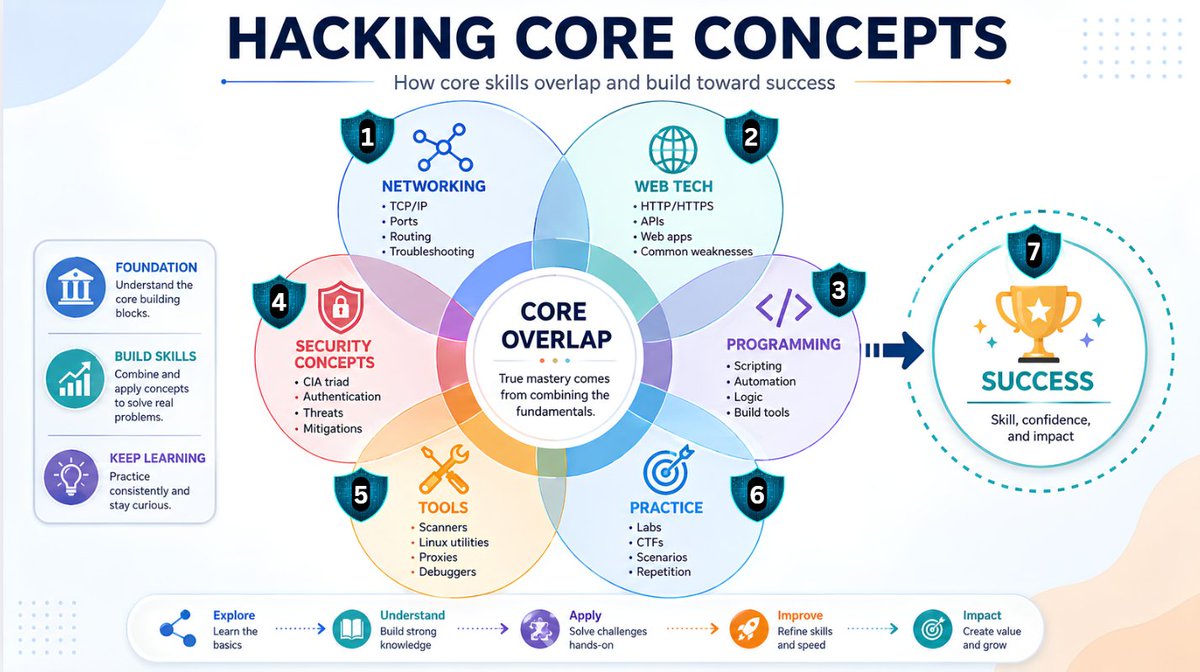
Networking is the foundation. DNS, Active Directory, Group Policy, DHCP, SNMP, centralized logging, and firewalls all depend on it. Poorly designed or misconfigured routers, switches, and network topologies create security gaps that higher layer controls cannot fully close.
Effective security requires consistent policies from the network edge to the endpoint. Authentication, Authorization, and Accounting (AAA) begins at the network layer.
Happy Hacking!!
@Maskoff023 MTR 🤔😃Not only does it show packet loss / connectivity, but it also reports latency and jitter for each hop along the path. These extra metrics make it much easier to spot where problems are occurring between hosts.
Keep Hacking!!!