Can a person's T-cell repertoire from a blood draw diagnose disease? Many methods say yes, but each was developed on different cohorts, splits, and metrics.
Excited to present BenchRep-T, a benchmark comparing methods head-to-head, at #NeurIPS2026 Evaluations & Datasets 1/🧵
Finally… Excited to share what I’ve been working on for the first half of my PhD!
ENCODE GRAMMAR: One of the largest collections of regulatory DNA seq2func models to date (3,865 in total) trained across ENCODE, with full model interpretations and annotations tracks. 1/n
Introducing the 2025 Stanford Bio-X PhD Fellows! 🎉
Congratulations to our 20 new Bio-X Fellows, who have joined a community that extends far beyond campus! Program alumni are founders, faculty, and successful scientists all over the world.
https://t.co/m8qAxwQJMG
Using protein large language models to optimize antibodies to #SARSCoV2 with >20-fold increase in binding affinity https://t.co/6AeAu4gl0E @PNASNews@lab_berger@MIT_CSAIL
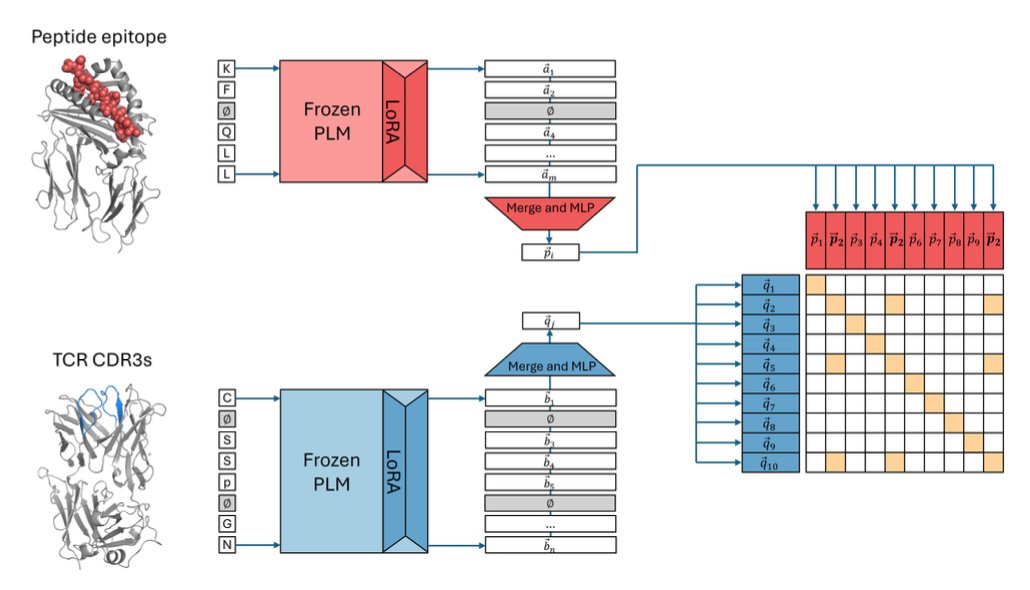
Sequence-based TCR-Peptide Representations Using Cross-Epitope Contrastive Fine-tuning of Protein Language Models
• This paper introduces ImmuneCLIP, a novel approach for predicting T-cell receptor (TCR) and epitope binding using contrastive fine-tuning of protein language models (PLMs).
• ImmuneCLIP aligns TCR and epitope embeddings in a shared latent space, improving binding predictions compared to traditional sequence-based metrics like Levenshtein distance and tcrdist3.
• The model demonstrates superior performance in multi-epitope binding prediction tasks, achieving high hit rates across multiple ranking thresholds (Top-1, Top-5, Top-10).
• By leveraging parameter-efficient LoRA fine-tuning, ImmuneCLIP maintains high performance with reduced computational overhead, making it scalable for large datasets.
• ImmuneCLIP significantly outperforms state-of-the-art models like TULIP and STAPLER on TCR-epitope binary interaction prediction, offering more biologically meaningful results.
• It exhibits strong generalization capabilities even with limited training data, making it effective for studying immune interactions involving rare or underrepresented epitopes.
• The framework provides a purely sequence-based solution, eliminating the need for structural data and facilitating applications in immunotherapy, vaccine design, and personalized medicine.
@anshulkundaje
💻Code: https://t.co/8WvXH4kyVJ
📜Paper: https://t.co/ULXBuwCHCf
#Bioinformatics #MachineLearning #TCR #ImmuneInteractions #AIforBiology #VaccineDevelopment #PersonalizedMedicine
here is my meticulously curated (and highly biased) summer paper reading list 📚:
Retrieval-Augmented Generation for Knowledge-Intensive NLP Tasks (2020)
╰╴ https://t.co/IbaElWz8na
LoRA: Low-Rank Adaptation of Large Language Models (2021)
╰╴ https://t.co/AArmQ3QaT8
Ring Attention with Blockwise Transformers for Near-Infinite Context (2023)
╰╴ https://t.co/G7fBGD09vV
Mamba: Linear-Time Sequence Modeling with Selective State Spaces
╰╴ https://t.co/G7fBGD09vV
The Era of 1-bit LLMs: All Large Language Models are in 1.58 Bits
╰╴ https://t.co/HTMr03Dt6N
Quiet-STaR: Language Models Can Teach Themselves to Think Before Speaking
╰╴ https://t.co/PWSIUfI4YP
Leave No Context Behind: Efficient Infinite Context Transformers with Infini-attention
╰╴https://t.co/glgLLlpqu3
The Illusion of State in State-Space Models
╰╴https://t.co/Yb4ZM1nahx
σ-GPTs: A New Approach to Autoregressive Models
╰╴https://t.co/MrfTbkge6Q
Rethinking LLM Memorization through the Lens of Adversarial Compression
╰╴https://t.co/CRx5ZLkyuF
Better & Faster Large Language Models via Multi-token Prediction
╰╴https://t.co/LgOsy1um63
xLSTM: Extended Long Short-Term Memory
╰╴https://t.co/2V32fpCdXn
Chameleon: Mixed-Modal Early-Fusion Foundation Models
╰╴https://t.co/kv4wlMajg5
Transformers Can Do Arithmetic with the Right Embeddings
╰╴https://t.co/MRwKcYgoyY
Scalable MatMul-free Language Modeling
╰╴https://t.co/HeqbyHvn5a