Andrew Stephens has just released "The Autonomous Horizon."
In it, he argues that in the race to digitize, most enterprises upgraded their systems without modifying their operating model. That the underlying architecture is still a digital version of the same processes organizations were using before the "digital-transformation."
In our new AI-driven world, organizations that do not develop an adaptive architecture will be left behind.
Link to the whitepaper below...
"The obstacle is the way."
Nobody, in 2026, is doing this better than an Anglo-Nubian goat called Keith.
5.51am. Latched pen door. Most goats experience a latched door as confinement. Keith experiences it as a structured opportunity. He addresses the latch. The latch yields.
6.14am. Bramble blocking the lane. The bramble has thorns. The bramble would defeat almost any other animal. Keith eats the bramble. The obstacle becomes the breakfast. The breakfast becomes the path.
6.31am. Steve, on his front step, in a dressing gown. Keith regards Steve. Steve regards Keith. After thirty seconds, Keith proceeds. The obstacle has been integrated.
7.42am. Closed gate. Keith cannot, by simple physics, open it. He could climb. Climbing would be effort. Effort, in Stoic terms, is for when necessary. He waits. At 7.47am the postman opens the gate. The obstacle resolves itself through patience and the postal service.
9.15am. Wet barn roof. A hazard, by every reasonable assessment. Keith reframes it as an opportunity to practice balance. He spends forty minutes on the wet roof. He does not fall. He descends a slightly more accomplished goat than he ascended.
11.20am. Dave, in the yard, in an attitude of mild remonstrance. Keith approaches Dave directly. He looks at Dave with the steady regard of an animal who has read his Epictetus and understands that what Dave thinks of him is not, fundamentally, in his control. Dave finds himself unable to remonstrate. The obstacle dissolves.
3.10pm. New reinforced fence on the north side. Keith assesses it for forty minutes. He identifies a section where the post has, in the recent rain, taken on a 4mm flex. He works the section. The section yields by 4pm.
The world will, daily, place obstacles in front of you. You can experience them as oppression, complain about them, file 28 complaints, and live the rest of your life in the dressing gown.
Or you can, like Keith, eat the bramble.
The bramble, in either case, is going to be there.
Eat the bramble. Be the goat.
When I point my remote directly at the TV, it barely works…
If I accidentally sit on it, it will change from Hulu to Netflix, turn on closed captioning, and turn the TV on and off 4 times.
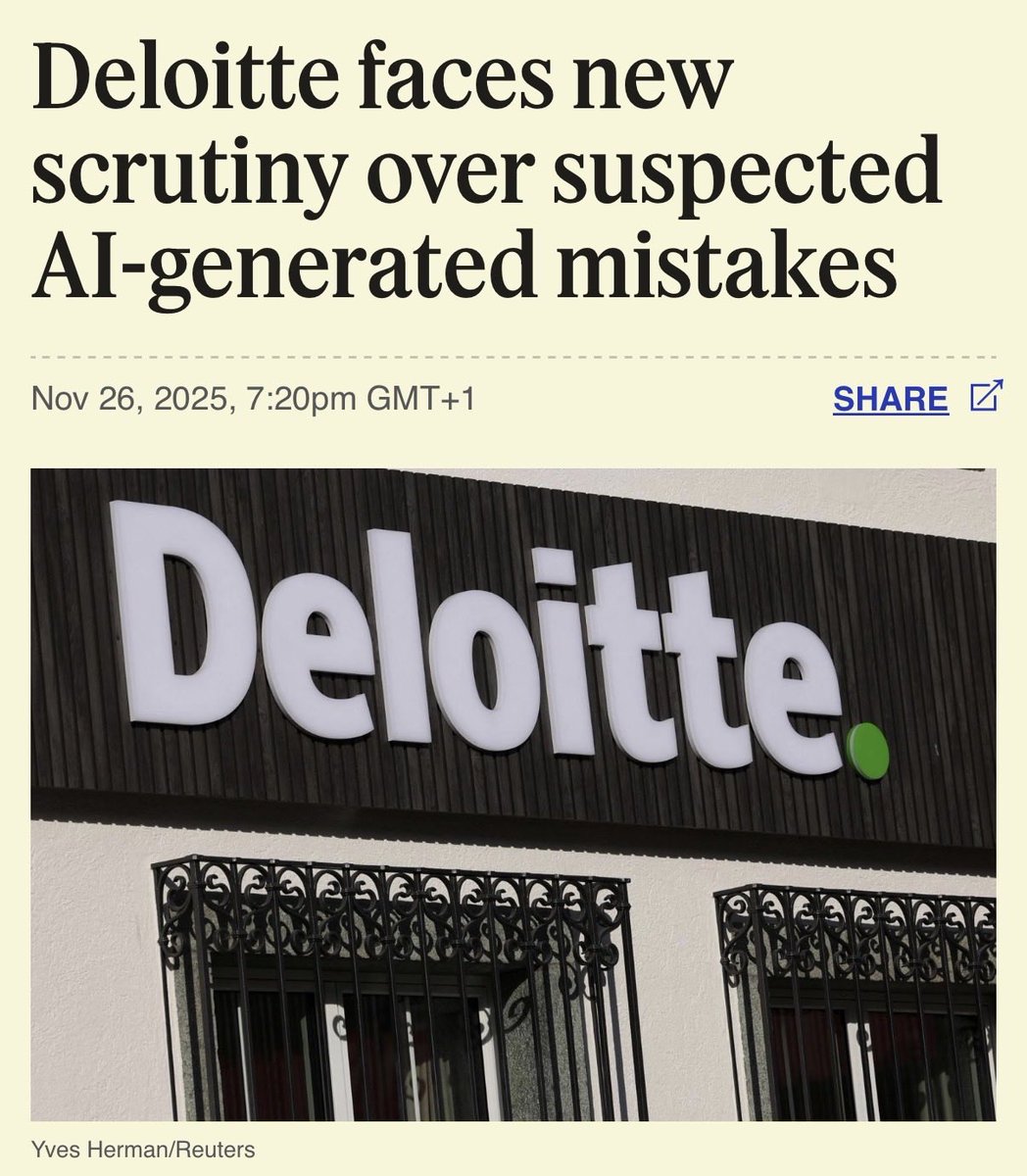
🚨 Holy shit… Deloitte was charged $1.6 million for a healthcare report filled with AI-hallucinated citations.
This is the second time in two months they’ve been caught.
First an Australian government agency. Now a Canadian province’s Department of Health.
And their response? They “stand by the conclusions.”
Let me translate that for you: “The AI made up the sources, but trust us, the advice is still good.”
That’s a $1.6 million report. For a healthcare system. With fake citations that nobody at Deloitte bothered to verify before submitting.
Not an intern’s draft.
The final deliverable.
The Australian incident was supposed to be a wake-up call.
Deloitte even partially refunded that government for the errors.
You’d think after publicly embarrassing themselves once, someone would have implemented a basic fact-checking step before hitting send on the next million-dollar engagement.
They didn’t.
And here’s what makes this story bigger than Deloitte.
Every major consulting firm is racing to integrate AI into their workflows. McKinsey, BCG, Bain, Accenture.
They’re all doing it. Because AI lets them produce reports faster with fewer junior analysts, which means higher margins on the same $500/hour billing rates.
But the entire consulting business model is built on one thing: trust. You’re paying for credibility.
You’re paying so that when you hand the report to your board or your minister, nobody questions the sources. The moment that trust breaks, the math changes completely.
Why pay $1.6 million for AI-generated analysis with fake citations when you could run the same prompts yourself for $20/month and at least know to check the sources?
That’s the real disruption nobody’s talking about. AI isn’t going to replace consulting firms by being smarter than them.
It’s going to replace them by revealing that a huge percentage of consulting work was always just expensive research and formatting.
And now the clients have access to the same tools.
Deloitte’s problem isn’t that they used AI. It’s that they used AI the way most people use AI: paste in a request, take the output at face value, ship it.
No verification layer.
No human review of citations.
No system.
The firms that survive this era won’t be the ones who use AI the fastest. They’ll be the ones who build actual verification systems around AI output. The ones who treat AI as a first draft, not a final product.
$1.6 million. Fake citations. Twice in two months. And they stand by the conclusions.
The consulting industry’s biggest threat isn’t AI.
It’s clients realizing they don’t need to pay someone else to hallucinate.
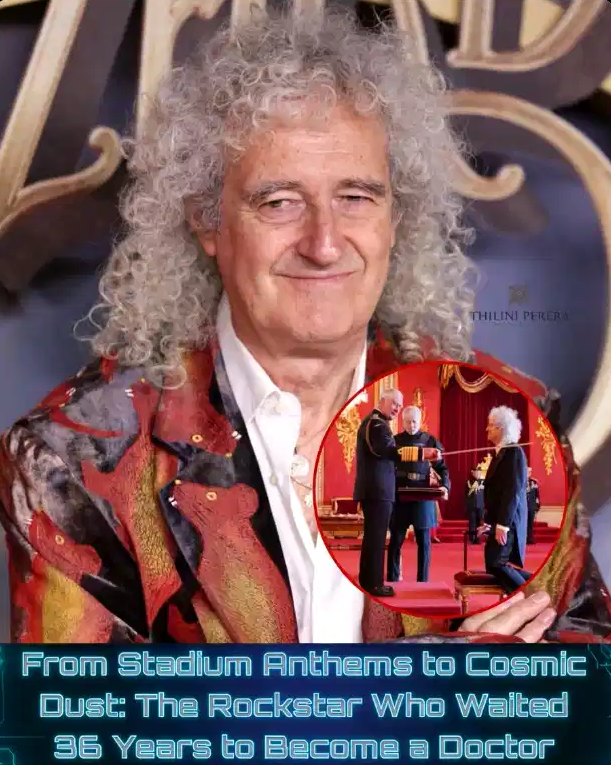
In 1970, a 23-year-old physics student at Imperial College London found himself at a life-altering crossroads.
Brian May was deep into his doctoral research on cosmic dust—specifically the zodiacal dust cloud, the tiny particles that drift through the solar system and scatter sunlight. His PhD was well underway, and a promising academic career in astrophysics lay ahead.
But there was another path calling him.
May was also the lead guitarist of a newly signed rock band named Queen. With a record deal secured and tours on the horizon, the band’s momentum was building fast. Faced with an impossible choice between the guitar and the telescope, May made his decision: he paused his studies and bet everything on music.
Queen’s ascent was meteoric. By the mid-1970s, they had become a global phenomenon. Timeless anthems like “Bohemian Rhapsody” and “We Will Rock You” exploded onto the charts, while May’s iconic homemade guitar, the Red Special, helped define the band’s legendary sound. Stadiums sold out worldwide, and millions of albums flew off the shelves.
Yet throughout his rock stardom, May never fully let go of his scientific passion. Even at the height of Queen’s fame, he stayed connected to astrophysics—reading journals, attending lectures when possible, and maintaining contact with his former supervisor, Professor Michael Rowan-Robinson, who had once told him: “You can always come back and finish.”
Thirty-six years after stepping away, in 2006, May decided the time had finally come. He reached out to Rowan-Robinson, and together they revived the long-dormant project. Though the field had moved forward and his original data needed updating, his early observations still held real scientific value.
Balancing his ongoing music career with late-night research sessions, May updated his work, incorporated new findings, and refined his analysis. In 2007, at the age of 60, Imperial College London officially awarded him a PhD in astrophysics—not an honorary title, but one earned through rigorous research and peer review.
Dr. Brian May had finally completed what he started more than three decades earlier.
His journey is a powerful reminder that passion has no expiration date. Whether on stage under stadium lights or studying the dust between the planets, Brian May proved it’s never too late to finish what you began.
"Allegro non molto" movement from Vivaldi's "Winter" performed by Latvian guitarist Laura Lāce, absolutely shredding the piece on a Harley Benton Fusion-III guitar.
[🎸 laura6100youtube]
@thomas_garrard Ender’s Game was great, but Ender’s Shadow set yet another standard. The same story, different perspective, and as reader I still couldn’t stop turning the page even when I knew the story.
As a manager, one of my biggest regrets is losing top performers. They said they we're leaving for a "better opportunity." I figured they left for more money. Turns out, they left because I failed these 3 tests:
Excellent advice.
My personal rule as an executive was to never discuss comp until we’ve mutually decided that the job is a good fit. I kept my focus on the value I bring, the relationship potential with the hiring manager, and my opportunities for growth.
When they’d bring up salary, my question was always “Are you offering me the position?” The answer was usually “no” or “not yet.” And my response was “I m sure if we dertermine that I’m the best fit for this role that we can come to mutual agreement on the comp package.” It refocuses them on fit instead of budget.
Note: this works for hiring managers. Too often, HR only cares about budget. Never negotiate with HR on comp. They are incentivized to “reduce costs” and from their perspective, you are a cost. Negotiate with the person whose bonus is going to depend on whether you do your job well. From the HM’s perspective, you are an investment.