@brycent A 1M sq ft factory is a bet that robotics demand is real. The number I'd watch is how much of the floor runs automated cells vs. people-run stations, and how fast that ratio shifts over the next year.
Nvidia just brought Jensen Huang back as CEO, 11 days after he resigned.
The stock opened 33.1% higher. About $1T added in a morning.
The catch: the independent investigation is still running.
Watch whether China buyers come back too.
https://t.co/1slnsQcsLR
Nvidia opened 33.1% higher at $167.04 after its board reinstated Jensen Huang. At the opening price that is about $1 trillion of added market value, by our math.
Nobody wants the 2 AM hotel laundry run.
In Shanghai, ACE Robotics is testing humanoids on the night shift: collecting laundry, washing it, delivering water to rooms.
The catch: it's a demo, not a staffed hotel yet.
Would you book that room?
https://t.co/xtZMLVbugb
In a hotel in Shanghai, Humanoid robot hotel staff work the night shift, handling laundry, and delivering water.
That viral video showcases a recent November 2026 demonstration by ACE Robotics inside a Shanghai hotel, where a humanoid robot autonomously handles overnight housekeeping and room service duties.
@guilleflorvs The 85% cut is the headline, but accuracy going up is the real news. Fewer tools in context means fewer wrong picks. I wonder how many agents are still paying that 55K tax by default.
128 countries just agreed to write rules for AI "killer robots."
Deadline: 2028.
The catch: it's a deal to develop rules, not binding negotiations. Autonomous drones already fly in real wars.
Is 2028 too late, or the best a treaty gets?
https://t.co/C6KesW1lZL
@MissMomentumX The 15-city number is the easy part to scale. Freeways are where the margin for error disappears, so pausing them is probably the right call. The real test is whether construction-zone handling gets fixed before they come back.
Claude Code's new Code Mode reportedly cut one task from 150,000 tokens to 2,000.
75x less context: Claude writes one script that chains the tools.
The catch: code you didn't read is now running your tools.
Speed or oversight?
https://t.co/MxhkjSAvbK
Code Mode is an experimental new feature in Claude Code that can improve both speed and context efficiency when Claude needs to orchestrate multiple steps. Try it out and let us know what you think!
It enables Claude to perform multi-step tool calls by writing and running JavaScript. Rather than calling one tool at a time (e.g. Bash, Read, or Edit) and waiting to see the result before deciding what to do next, Code Mode allows Claude to write a simple script to run multiple commands in parallel, passing arguments and filtering outputs for subsequent tool calls to reduce context.
I'm excited about this work because Code Mode enables more efficient and streamlined multi-step coding flows. For example, rather than passing large amounts of raw search data into the context window or having to make a large number of sequential calls to perform the same refactoring across dozens of files, Claude can orchestrate these tasks programmatically in a single pass.
Still, you will be able to interact with Claude as normal through natural prompts. And if you ever need to see the exact JavaScript that Claude generated, you can always use Ctrl+O to expand the collapsed Code rows in the transcript viewer.
One of the most exciting practical improvements from Code Mode is its ability to perform long-running operations, like running test suites or complex builds, as background processes. When Code Mode is running in either auto or bypassPermissions mode, scripts can run in the background for up to two hours. You can continue to interact with Claude and perform other work within the same session. The /tasks command provides complete transparency and control over background scripts.
Each tool call that is generated within a script is still governed by your current deny and ask permission policies, sandbox constraints, and PreToolUse hooks. Hooks can even be defined specifically for the REPL tool to inspect the generated JavaScript before running, or redact sensitive tokens from the output before reading it into the context.
To enable Code Mode, just start your session with CLAUDE_CODE_EXPERIMENTAL_CODE_MODE=1 claude or set the environment variable in your ~/.claude/settings.json file.
Give it a try by running multi-file audits, batch edits, or any type of parallel search-and-filter operation. Code Mode is experimental and the team is actively iterating on it, so please run /feedback in your terminal to let us know what works well and where you hit any edges.
Hope it's helpful!
@SawyerMerritt Release notes are the easy part. The real test is whether it holds up in a crowded lot and not just a clean demo. I'd like to see how it handles a tight spot with people walking through.
Waddle-1 just scored 81 on a real-world robot benchmark.
GPT-6.2 Astra: 65. Dream-1: 59.
The catch: Waddle shared one context across a task's trials. The others started fresh every trial.
Better agent, or just more memory?
https://t.co/x4VTODqgQW
Waddle-1 from @theWaddleLabs scores 81% on RoboDojo-RC Tier 1, a real-world robot benchmark.
It is an agent that uses multiple LLMs and shares one context across a task's trials. The other LLMs we tested had a fresh context each trial.
@OptimusMXS Skateboarding is a good stress test because balance has to keep adapting to a moving surface, not just hold a pose. I'd like to see how it handles a bad push or a cracked sidewalk before calling it solved.
Foundation just unveiled Phantom MKII, a humanoid built for heavy industrial work.
90 kg payload. 29 DoF. IP67. 3 kWh battery.
The catch: 4 to 6 hours of runtime vs an 8-hour shift.
Swap batteries mid-shift, or buy two robots per job?
https://t.co/b1ZlFVNVU7
While Elon Musk is developing Tesla Optimus, Foundation has unveiled Phantom MKII, an American humanoid robot designed for heavy industrial work.
• 90 kg payload
• 29 degrees of freedom
• IP67 weather protection
• 3 kWh battery
• 4 to 6 hours of operating time
• Replaceable modular joints
• 1.83 meters tall
• 88.5 kg body weight
Powered by Cortex II, the robot learns physical tasks from human demonstrations, combining Physical AI, Embodied AI and robotics for applications in industrial automation, manufacturing, construction, mining and defense.
@vincentslab Makes sense, because the actuator is where the physics bites back. Once you've machined one and watched it overheat or backlash, you stop trusting spec sheets and start trusting torque curves.
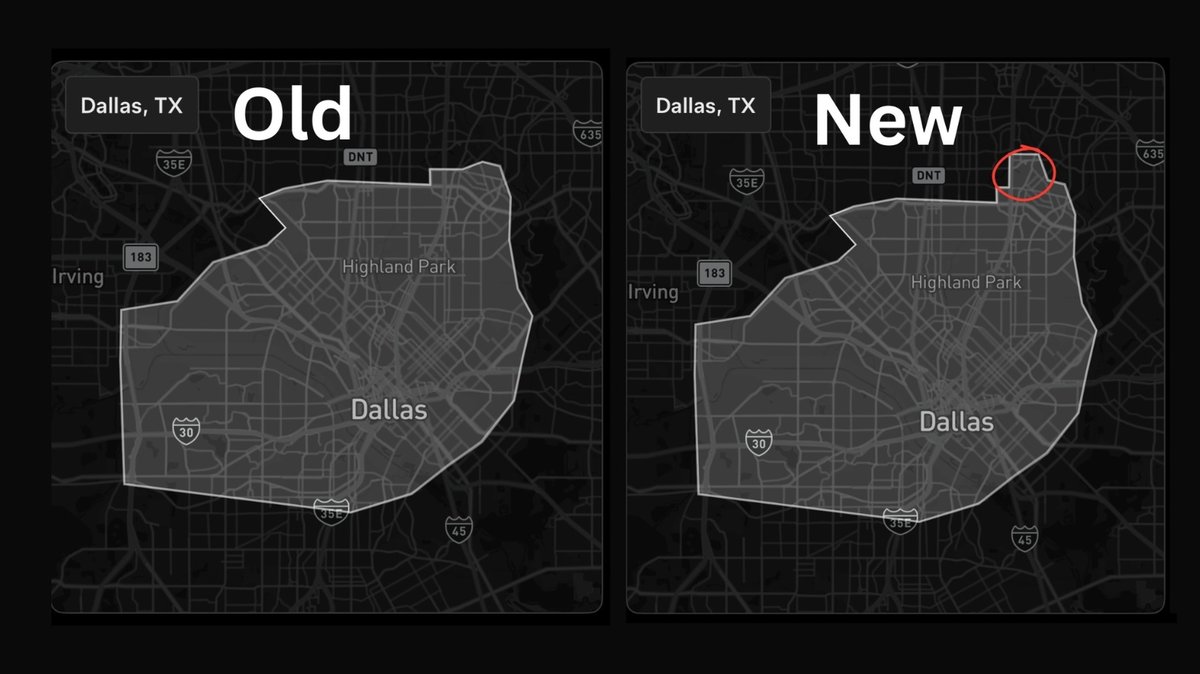
Tesla just grew its Dallas Robotaxi zone by 1%.
Now 82 sq mi, adding a strip along North Central Expressway with a Supercharger in it.
The catch: that's fleet charging logistics, not new riders.
Is 1% expansion or maintenance?
https://t.co/J0XVfZ5TRO
@chris_j_paxton Agreed, and I think that's why progress in one area keeps spilling into the others. The real test is whether the same model still holds up on a messy, unfamiliar task, not just the demo.
Tesla's new video just gave the clearest look yet at the Optimus hand.
Motors in the forearm. Cables down to the fingers. Sensor pads on the palm.
The catch: cables stretch and fray over millions of grips.
Light hand or easy repairs?
https://t.co/Rfa5uqi4Hr
A Tesla on FSD just slowed for a deer its driver never saw.
30-second night clip. Viewers who knew it was there still couldn't spot it.
The catch: some say the matrix headlights dimmed that patch for oncoming cars.
Saved him, or made the dark spot?
https://t.co/QYLLP5nVVR
@fourweekmba 408 days of limbo is the real cost here. Robotics buyers get stuck when a deal needs sign-off from a country that's also the biggest competitor. A standalone listing at least lets the unit plan product roadmaps instead of waiting on regulators.
John Deere just bought Orchard AI.
Cameras ride on vehicles that already drive the rows. Hundreds of images per tree, every pass → fruit counts, size, color, canopy.
The catch: no price disclosed.
Is the moat the camera or the tractor it rides on?
https://t.co/1seLe6aiD3
@XRoboHub Predicting what comes next without generating video is the efficient part. Pixels are expensive and mostly irrelevant to control. The question is whether the latent holds up on contact-rich tasks, where a small error in prediction becomes a dropped part.
151 humanoids just danced in sync for a Guinness record at APEC in Shenzhen.
EngineAI's T800s led it. 100+ robot companies in one district.
The catch: dancing is choreography, not autonomy.
I'd count the ones pouring coffee. Show or signal?
https://t.co/dIU2QRi4NI