The most expensive parts in humanoid robots are not the cameras.
The real hardware cost is hidden in the parts that move, carry load, survive impact and repeat the same motion thousands of times without failing.
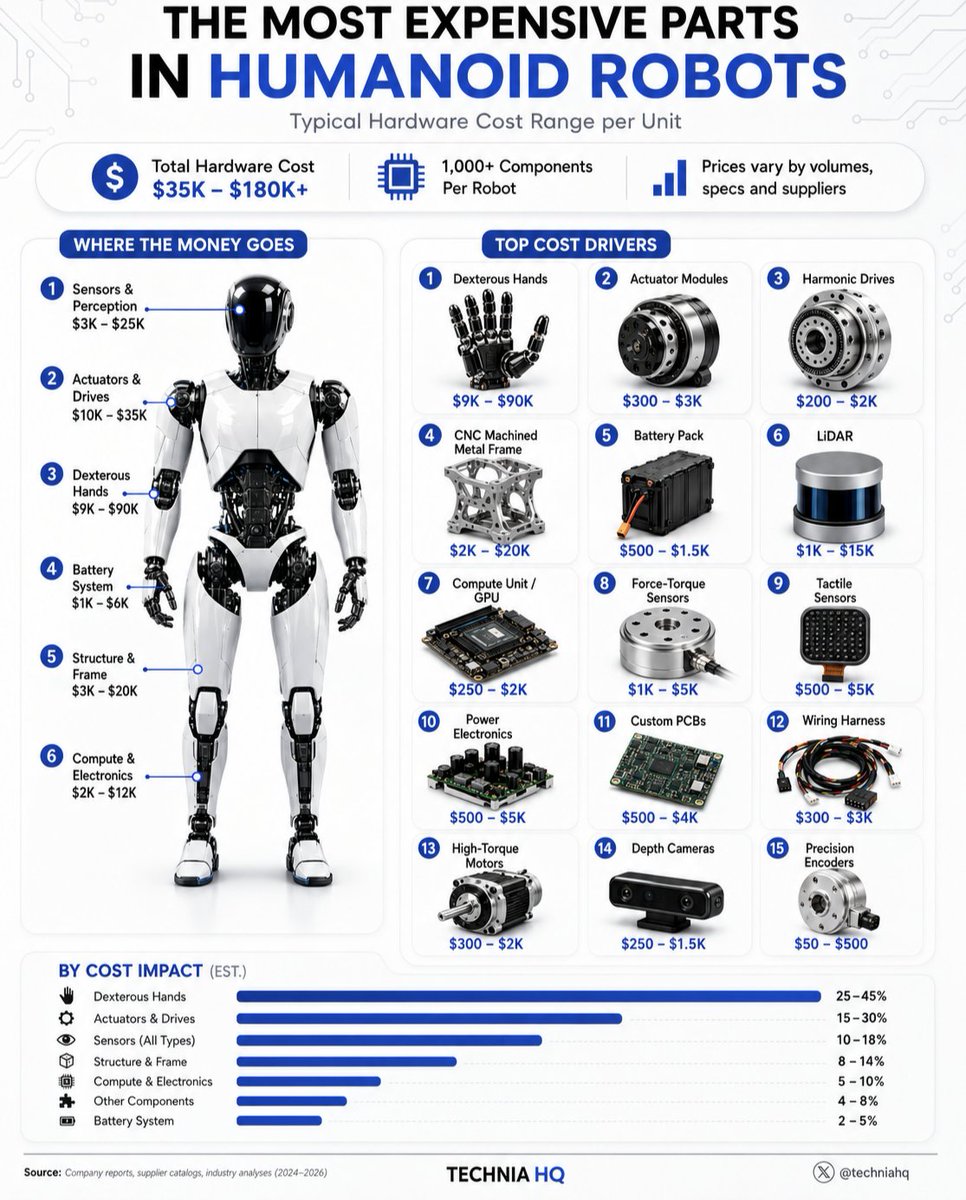
Typical hardware cost range per humanoid robot:
• Dexterous hands
➝ $9K–$90K
The hardest part to make cheap. Each hand needs small actuators, tendons or linkages, tactile sensing, finger joints, wiring and control boards packed into a very small space.
• CNC metal frame
➝ $2K–$20K
The skeleton must hold motors, batteries, electronics and impact loads. Low volume machining makes this expensive, especially for torso, hip, shoulder and leg structures.
• LiDAR
➝ $1K–$15K
Used for mapping, navigation and obstacle detection. Cost depends on range, resolution, scan type and whether the robot needs outdoor reliability.
• Force-torque sensors
➝ $1K–$5K
Critical for balance, manipulation and safe contact. These sensors help the robot measure pressure through wrists, ankles or joints.
• Tactile sensors
➝ $500–$5K
Needed when a robot must grip soft, fragile or uneven objects. The cost rises fast when sensors cover fingers, palms or large skin-like surfaces.
• Actuator modules
➝ $300–$3K each
One of the biggest cost drivers. A humanoid can use dozens of actuators across legs, arms, waist, neck and hands. Torque, cooling, gearbox quality and control electronics change the price fast.
• Battery pack
➝ $500–$1.5K
The battery must deliver high current while staying compact. Weight is a major constraint because every extra kilogram makes the legs work harder.
• Compute / GPU
➝ $250–$2K
The robot needs onboard compute for vision, control, planning and sensor fusion. Higher autonomy requires more compute, better thermal design and more power.
• Harmonic drives
➝ $200–$2K each
Used where compact high torque is needed. They are expensive because precision, backlash and durability matter in knees, hips, shoulders and wrists.
• Power electronics
➝ $500–$5K
Motor drivers, converters, protection circuits and power distribution decide how stable the robot is under heavy motion.
• Wiring harness
➝ $300–$3K
Humanoids have cables moving through arms, legs, torso and neck. Bad routing means broken wires, noisy signals and hard maintenance.
• Precision encoders
➝ $50–$500 each
Every joint needs position feedback. Better encoders give smoother motion, better balance and more accurate manipulation.
A serious humanoid robot can still carry $35K–$180K+ in hardware before software, assembly, testing, repair stock, certification and support.
That is why the cheapest demo robot is not always the cheapest robot to deploy.
1X just introduced a new 25-DOF tendon driven hand for its NEO humanoid robot built to handle the small, contact heavy tasks that usually expose the limits of robotic manipulation.
The architecture combines 22 fully actuated degrees of freedom across the fingers and palm with 3 DOF at the wrist.
Low-ratio tendon drives, roughly 5:1 to 15:1, keep the joints fully backdrivable. When a finger touches an object, the contact force can travel back through the transmission instead of being lost inside a high-ratio gearbox.
Key specifications released by 1X:
• 25 total degrees of freedom
• 22 actuated DOF in the fingers and palm
• 3 DOF wrist
• Up to 45 N distal finger force
• 17.75 Nm wrist torque
• ±0.2 mm positioning accuracy
• Pressure, contact-location and shear sensing
• Real-time slip detection
• IP68 sealing
• Food-safe materials
• Wrist testing beyond 2 million high-load cycles
The motors are positioned inside the forearm and pull proprietary tendons through the wrist.
This reduces mass in the fingers while preserving grip force, compliance and fast motion.
1X demonstrated the hand assembling LEGO, picking up screws and coins, installing a light bulb, operating a screwdriver, plugging in USB-C, zipping a jacket, handling a wine glass, pouring tea and catching a soft ball.
The important detail is sensing. NEO does not rely only on cameras. Its tactile skin measures normal force, contact position and shear across the fingers, allowing the control system to detect an object beginning to slip and adjust the grip.
1X says hundreds of these hands have already left its production line and that it has capacity to manufacture 10,000 units this year.
These are the hands planned for every NEO robot.
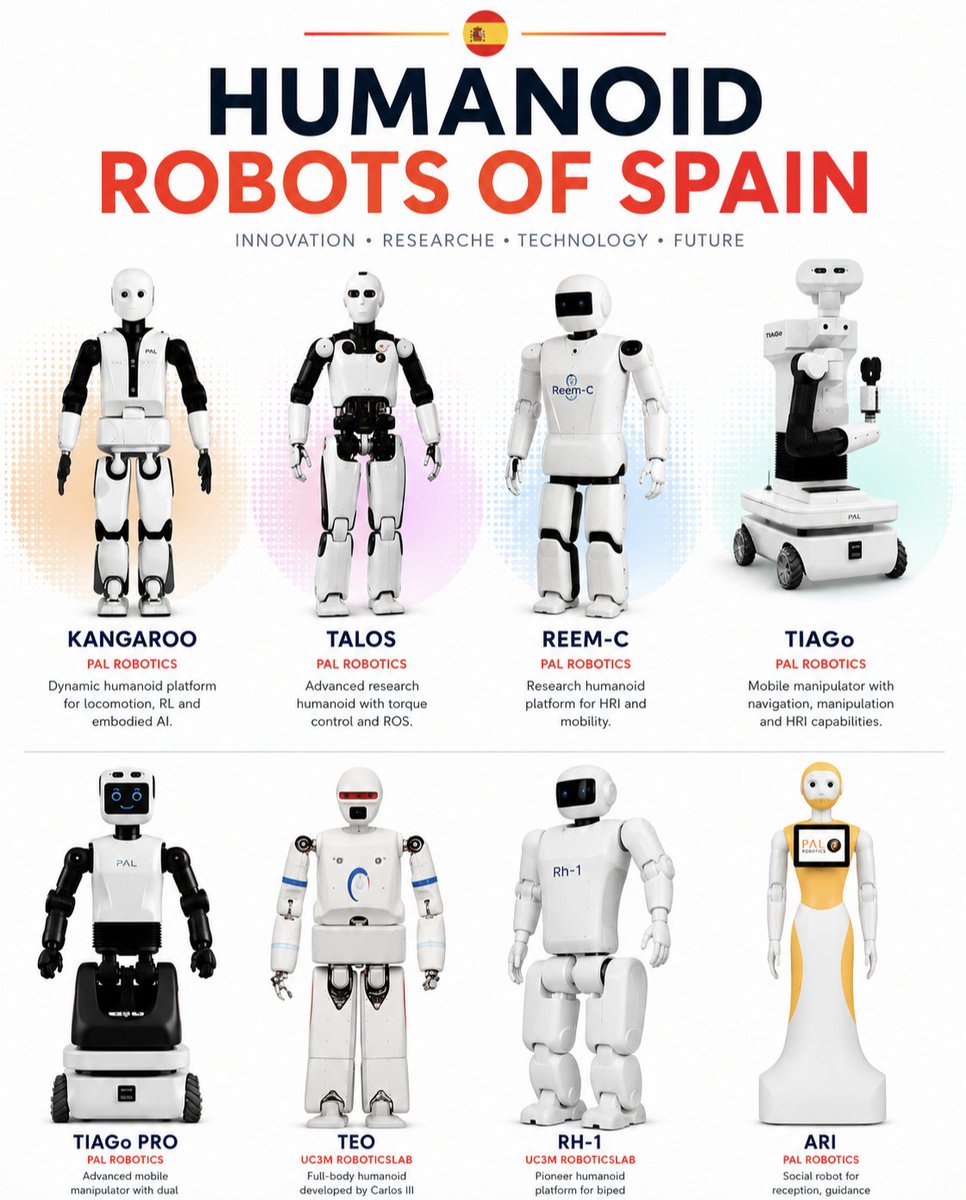
Spain has been building humanoid robots for years mostly through PAL Robotics in Barcelona and UC3M RoboticsLab in Madrid.
KANGAROO is PAL Robotics’ newer biped platform for dynamic locomotion research.
It is designed for walking balance reinforcement learning and footstep planning with optional arms force-torque sensors and RealSense D435i cameras for perception.
TALOS is PAL Robotics’ high performance full size humanoid. It stands 175 cm weighs 95 kg carries up to 6 kg per arm and uses torque sensing across most joints for whole body control research.
REEM-C is a 165 cm, 80 kg biped humanoid built for research in walking, balance, navigation and human-robot interaction. It runs on Ubuntu and ROS with torque sensors in the ankles and wrists.
TIAGo is not a biped, but it is one of Spain’s most used humanoid-style mobile manipulators.
It has a mobile base, lifting torso sensorized pan-tilt head and 7-DoF arm for grasping, navigation and HRI research.
TIAGo Pro is the newer ROS 2 mobile manipulation platform.
It adds dual-arm manipulation, Nav2, MoveIt 2 integration Wi-Fi 6 Bluetooth 5.2 and a more expressive head for research in service robotics.
TEO is a full-body humanoid from UC3M RoboticsLab. It was born in 2012 as an evolution of RH-1 and has been used for household companion robotics and Spanish Sign Language interaction research.
RH-1 is one of UC3M’s earlier full-size humanoid robots. It was used for biped walking gait generation and whole-body control research before TEO.
ARI is PAL Robotics’ social humanoid robot for reception, guidance and human interaction. It is more focused on service and communication than legged locomotion.
KANGAROO
TALOS REEM-C
TEO
RH-1
TIAGo
TIAGo Pro
ARI
REEM
REEM-A
REEM-B
PAL research prototype.
@RSI_Growers Honestly same. We're all waiting to transition from a clueless robot vacuum that gets stuck in the curtains to a truly autonomous home assistant.
Be honest would you trust this humanoid to tidy your home or would its speed test your patience?
This one shows the real-time teleoperation performance of Stardust Intelligence. There is no obvious response delay.
The motion looks smooth, responsive and closely synchronized with the operator
It uses both hands to sort soft toys place small objects and lift the entire rack.
What matters most here precision speed or reliability?
Credit : @胡大
1X may have built the most complete humanoid hand revealed so far.
NEO’s new tendon-driven hand combines:
• 25 force-controlled degrees of freedom
• 22 actuated joints across the fingers and palm
• 3-DoF wrist
• Pressure, contact location and slip sensing
• Full backdrivability
• Up to 45 N fingertip force
• ±0.2 mm positioning accuracy
• IP68 sealing and food-safe materials
• More than 2 million wrist test cycles
The reaction across X is focused on the speed, human-like range of motion and exposed tendon architecture. The harder question is whether robot policies can use all this hardware reliably during long, unedited household tasks. Some launch clips were machine-controlled while others were operated to demonstrate the hardware’s upper limits.
1X says hundreds have already been produced and its line can build 10,000 hands this year.
Humanoid robotics may live or die at the fingertips.
#HumanoidRobots #Robotics #PhysicalAI #EmbodiedAI #1XNEO
World Cup fever has reached Boston Dynamics HQ.
Atlas robots recreated Norway’s viral Viking Row in a tightly synchronized routine, turning one of the FIFA World Cup 2026’s biggest fan celebrations into robotic choreography.
From delivering the match ball during Brazil vs Norway to copying Haaland’s celebration and now joining the Viking Row Atlas is becoming an unexpected star of the tournament.
Football culture meets humanoid robotics.
Who performed it better Norway’s fans or Atlas?
#BostonDynamics #AtlasRobot #HumanoidRobots #FIFAWorldCup #Robotics
Be honest would you trust this humanoid to tidy your home or would its speed test your patience?
This one shows the real-time teleoperation performance of Stardust Intelligence. There is no obvious response delay.
The motion looks smooth, responsive and closely synchronized with the operator
It uses both hands to sort soft toys place small objects and lift the entire rack.
What matters most here precision speed or reliability?
Credit : @胡大
A humanoid robot doing gallbladder surgery sounds fake until you watch the instruments move.
This ARCLab / UC San Diego demo shows teleoperated humanoids working through a cholecystectomy benchmark:
• tissue handling
• anatomical clearance
• laparoscopic tool control
• surgeon guided motion
Important detail: this is not autonomous surgery.
The human surgeon is still in control.
But the body holding the tools is starting to change.
Would you let a teleoperated humanoid perform surgery on you?
#RoboticSurgery #HumanoidRobots
#MedicalRobotics #Teleoperation
#Surgery
At the UBTECH 2026 Global Launch Event a host of new friends hyper bionic robots made their debut.
A brand new era of human machine symbiosis and coexistence is just around the corner.
At the UBTECH 2026 Global Launch Event a host of new friends hyper bionic robots made their debut.
A brand new era of human machine symbiosis and coexistence is just around the corner.
@Cyn_Cyb3r071Qu3 I’m not ready to take that risk yet even if the robot is teleoperated by a surgeon. Maybe in ten years, once the technology has a longer safety record, I would reconsider.
French startup @WandercraftHQ just dropped the next model of its humanoid robot.
Calvin 0.5 is the company’s 4th hardware version in 9 months and is now close to the large-series version planned for 2027.
The robot is being industrialized with @renaultgroup, with a clear target:
• factory work
• heavy payloads
• accurate picking
• >99.9% success rate
No dancing.
No kung fu.
Just a humanoid built for industrial work.
@jlconstanza
Until now the humanoid race has mostly looked American Chinese and Japanese:
• Tesla Optimus
• Figure 03
• Boston Dynamics Atlas
• Unitree G1
• UBTECH Walker S
• AgiBot A2
• Toyota T-HR3
But many people completely forgot France.
This is Calvin-40 a French industrial humanoid developed by Wandercraft with Renault Group.
It is not built for a stage demo. It is built for factory work.
Calvin can walk carry heavy loads and adapt to its environment. Renault says it is being tested at the Douai factory, where it grabs tires two at a time, around 30 kg per trip. Its platform uses IMUs in the limbs, force sensors under the feet and an RGB-D camera to see the workspace.
Wandercraft describes Calvin-40 as the first humanoid designed for both heavy-load handling and precision tasks with a Europe-secured supply chain.
France has a humanoid too.
It just looks more industrial than flashy.
Mass production is where humanoid robots leave the lab and enter the hardware race.
Rows of small humanoid units assembled, packed and ready to ship. The signal is not one perfect demo. It is repeatable builds, identical parts and a supply chain that can deliver.
#HumanoidRobots #HumanoidRobot #Robotics #PhysicalAI #EmbodiedAI
A humanoid robot doing gallbladder surgery sounds fake until you watch the instruments move.
This ARCLab / UC San Diego demo shows teleoperated humanoids working through a cholecystectomy benchmark:
• tissue handling
• anatomical clearance
• laparoscopic tool control
• surgeon guided motion
Important detail: this is not autonomous surgery.
The human surgeon is still in control.
But the body holding the tools is starting to change.
Would you let a teleoperated humanoid perform surgery on you?
#RoboticSurgery #HumanoidRobots
#MedicalRobotics #Teleoperation
#Surgery
Spain has been building humanoid robots for years mostly through PAL Robotics in Barcelona and UC3M RoboticsLab in Madrid.
KANGAROO is PAL Robotics’ newer biped platform for dynamic locomotion research.
It is designed for walking balance reinforcement learning and footstep planning with optional arms force-torque sensors and RealSense D435i cameras for perception.
TALOS is PAL Robotics’ high performance full size humanoid. It stands 175 cm weighs 95 kg carries up to 6 kg per arm and uses torque sensing across most joints for whole body control research.
REEM-C is a 165 cm, 80 kg biped humanoid built for research in walking, balance, navigation and human-robot interaction. It runs on Ubuntu and ROS with torque sensors in the ankles and wrists.
TIAGo is not a biped, but it is one of Spain’s most used humanoid-style mobile manipulators.
It has a mobile base, lifting torso sensorized pan-tilt head and 7-DoF arm for grasping, navigation and HRI research.
TIAGo Pro is the newer ROS 2 mobile manipulation platform.
It adds dual-arm manipulation, Nav2, MoveIt 2 integration Wi-Fi 6 Bluetooth 5.2 and a more expressive head for research in service robotics.
TEO is a full-body humanoid from UC3M RoboticsLab. It was born in 2012 as an evolution of RH-1 and has been used for household companion robotics and Spanish Sign Language interaction research.
RH-1 is one of UC3M’s earlier full-size humanoid robots. It was used for biped walking gait generation and whole-body control research before TEO.
ARI is PAL Robotics’ social humanoid robot for reception, guidance and human interaction. It is more focused on service and communication than legged locomotion.
KANGAROO
TALOS REEM-C
TEO
RH-1
TIAGo
TIAGo Pro
ARI
REEM
REEM-A
REEM-B
PAL research prototype.
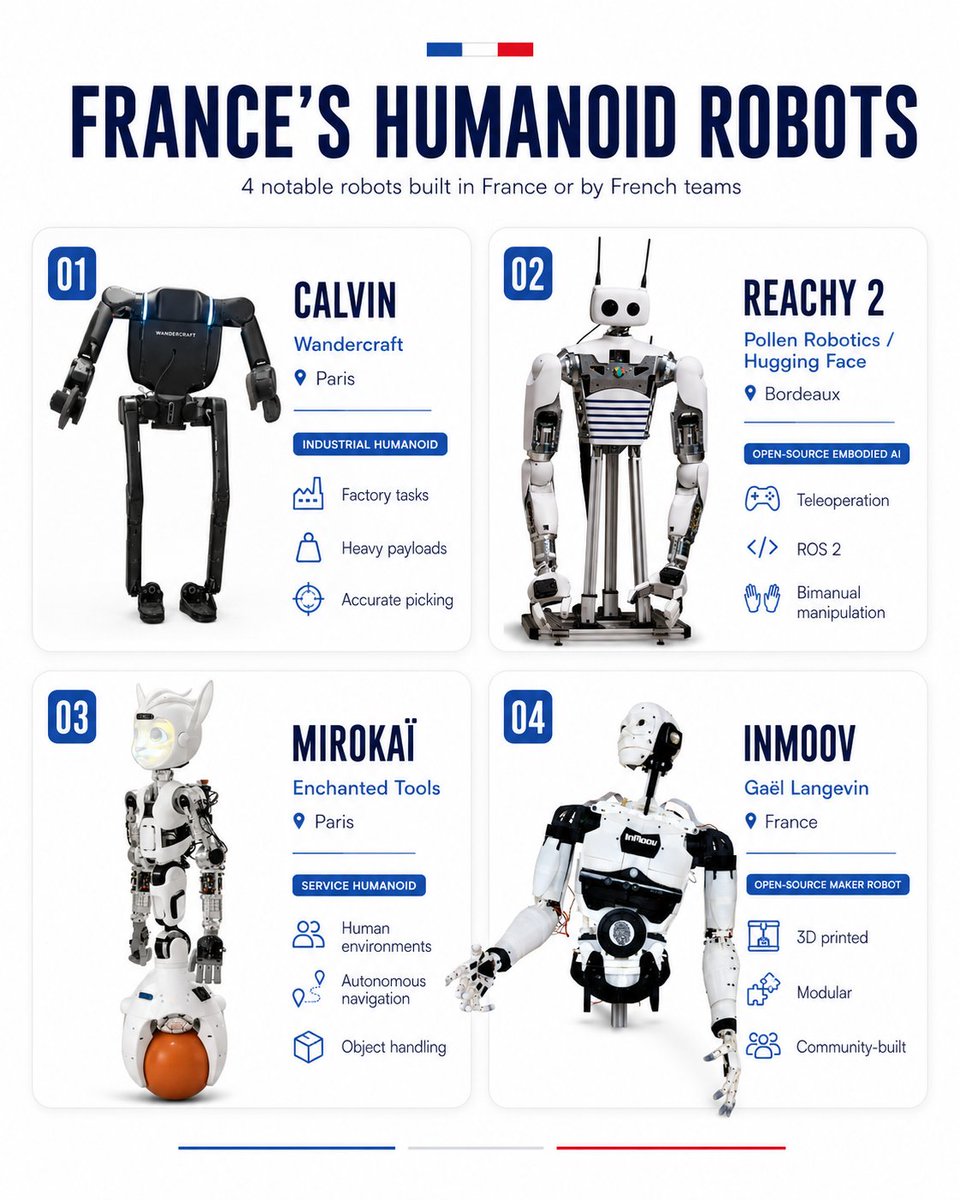
France is building humanoid robots from four very different angles:
industrial work lab research public service and open source robotics.
These are 4 robots worth watching.
Calvin
Wandercraft • Paris
Used for industrial environments and factory work.
Characteristics:
• biped humanoid
• factory tasks
• heavy payload handling
• accurate picking
• built from Wandercraft’s walking robotics stack
Reachy 2
Pollen Robotics / Hugging Face • Bordeaux
AI labs robotics research and remote manipulation experiments.
Characteristics:
• open source humanoid
• VR teleoperation
• Python control
• ROS 2
• 7-DoF arms
• bimanual manipulation
• mobile base with omniwheels and LiDAR
Mirokaï
Enchanted Tools • Paris
Used for: hospitals, senior living, airports, retail, museums and public facing service environments.
Characteristics:
• expressive service humanoid
• autonomous navigation
• autonomous charging
• multimodal interaction
• object grasping and carrying
• designed to work around people
InMoov
Gaël Langevin • France
Used in: maker spaces, universities, robotics education and open-source experiments.
Characteristics:
• 3D printed humanoid
• modular body
• Arduino based builds
• MyRobotLab software
• community built platform
• used as a base for learning and prototyping
France is not only building one type of humanoid.
It has factory robots, research robots, service robots and maker robots.
That makes the French ecosystem more interesting than people think.
It looks too real, almost beyond realistic.
Ultra-bionic humanoid robot.
Another day of being blown away by my “best friend” looking so beautiful and cool
The goddess I was waiting for finally showed up too
For context, this was developed by UBTECH, the Chinese robotics company behind the humanoid robot shown here.
This guy completely took apart his AgiBot humanoid robot just to show what is inside.
You can see the hardware layer that most people never talk about: EtherCAT communication DCU control boards power and communication cards motor control sections for the hands legs and waist and the computer boards placed in the lower body.
That is where humanoid robot management really starts.
Before a robot can be managed from a fleet dashboard assigned warehouse tasks or monitored remotely its own body has to stay synchronized in real time.
The arms waist hands and legs cannot work like separate machines. They need shared timing clean communication and fast fault detection.
Battery level and uptime are not enough. Humanoid management software will need to expose joint health motor temperature board status firmware versions EtherCAT errors failed motions and safety stops.
This is the part of robotics people rarely see.
What he is doing is incredible.
@Tech4Hlthcare I agree with you. Have you seen the projections from the humanoid manufacturers? Each is planning, like Tesla, Ubtech. figure .. I think 2027 is going to be a mass production war.
1X may have built the most complete humanoid hand revealed so far.
NEO’s new tendon-driven hand combines:
• 25 force-controlled degrees of freedom
• 22 actuated joints across the fingers and palm
• 3-DoF wrist
• Pressure, contact location and slip sensing
• Full backdrivability
• Up to 45 N fingertip force
• ±0.2 mm positioning accuracy
• IP68 sealing and food-safe materials
• More than 2 million wrist test cycles
The reaction across X is focused on the speed, human-like range of motion and exposed tendon architecture. The harder question is whether robot policies can use all this hardware reliably during long, unedited household tasks. Some launch clips were machine-controlled while others were operated to demonstrate the hardware’s upper limits.
1X says hundreds have already been produced and its line can build 10,000 hands this year.
Humanoid robotics may live or die at the fingertips.
#HumanoidRobots #Robotics #PhysicalAI #EmbodiedAI #1XNEO
Mass production is where humanoid robots leave the lab and enter the hardware race.
Rows of small humanoid units assembled, packed and ready to ship. The signal is not one perfect demo. It is repeatable builds, identical parts and a supply chain that can deliver.
#HumanoidRobots #HumanoidRobot #Robotics #PhysicalAI #EmbodiedAI
Perceptron has pushed egocentric video annotation to a new state of the art on WGO-Bench.
Its semantic end to end F1 reaches 0.280, compared with 0.158 for the strongest Gemini based pipeline.
What stands out is the workflow. Perceptron does not rely on contact sheets or isolated frames. It follows both hands across the full video and detects task boundaries from real grasp and release events.
That could make it a valuable reasoning layer for turning human demonstrations into structured robotics data.
We’re launching the first in a series of Embodied Reasoning offerings: Perceptron Egocentric. It achieves SOTA over the best robotic annotation pipelines built on Gemini 3.5 Flash and Gemini Robotics-ER 1.6. Early access is available to partners.
🤖Robots that think ahead and act in real time.
LingBot-VA 2.0 — the first embodied-native foundation model. Not fine-tuned from a video generator. Built from scratch for the physical world.
✅ 93.6% success on bimanual tasks
⚡ 150 Hz single-GPU inference
🎯 20 demos to generalize.
This is what happens when you stop adapting and start building natively. 🧵👇
@Tech4Hlthcare The thing is once one company starts moving in this direction others will compete with them and the curve could accelerate the same way it did with AI.
Big move for Japan’s humanoid robotics scene. Pairing a domestically developed Physical AI humanoid with Mitsubishi Motors’ manufacturing know how could turn “N” from a prototype into a real factory ready platform.
The mass production push is the part to watch closely.