Grok - No. Boards are not required to consult senior management on decisions about who the CEO is, and they often do not—especially for sensitive or high-stakes ones.
In U.S. public companies (including Nvidia, a Delaware corporation), the board of directors has the sole legal authority to appoint, remove, and reinstate the CEO. Officers serve at the pleasure of the board. Shareholders elect the board; the board selects the CEO. This is a core, non-delegable fiduciary responsibility under corporate law and typical bylaws. Management reports to the board, not the other way around.
Why boards frequently skip broad management consultation on CEO matters
•Confidentiality and conflicts: CEO selection/removal is usually handled by independent directors (often in executive session, with outside counsel). Involving the full senior team in advance risks leaks, lobbying, or conflicts—especially if the interim CEO or other executives could be candidates, have personal stakes, or might disagree.
•Best-practice process: Succession and CEO decisions are board-owned (typically led by a nominating/governance or independent committee). Management may provide input on talent pipelines or operations during normal succession planning, but the final call stays with the board. Affected parties are often recused.
•Practical reality in crises: In cases involving misconduct, investigations, national security questions, or external pressure, boards prioritize discretion. Informing senior leaders at the last minute (or after the decision) is common to control the narrative and maintain stability until the announcement.
Boards do routinely consult management on strategy, budgets, risk, M&A, product roadmaps, and day-to-day operations. CEO appointment is different because it is the board’s direct responsibility for leadership accountability.
In the Nvidia situation
Bloomberg reported (as highlighted by Gary Black) that the board reinstated Jensen Huang without consulting senior leaders, who were informed only at the last minute. The Sunday decision followed pressure from President Trump and excluded interim CEO Colette Kress and others. Nvidia’s public statement mentions discussions with Huang plus input from senior U.S. government officials (and no national-security risk), but does not reference prior management consultation.
This process is not unusual or a governance violation on its face for a CEO decision. However, the rapid reversal (after the board had publicly indicated it did not intend to reinstate him), the political involvement, and the incomplete independent investigation have drawn criticism from some governance observers about board independence and judgment. Gary Black’s point about possible added volatility in the senior ranks is a practical operational risk (executives may feel sidelined or uncertain), not evidence that the board broke required process.
In short: for decisions about the CEO role itself, the board is expected to decide independently. Consultation with management is discretionary and often limited or avoided in sensitive cases.
After 7 years of research and 6 months making this documentary, I'm handing you what I believe are some of the most valuable 51 minutes you'll ever spend.
I interviewed former @SpaceX, @Tesla, @neuralink and @PayPal employees. Read 40 books. Took 9,200 notes.
Are we giving patents to cab drivers now?”
No, but they are giving them to the guy who co-invented these (partial list, Elon Musk named as inventor):
•US 5,944,769 – Interactive network directory with maps & directions (Zip2, 1999)
•US 6,108,650 – Accelerated radius search (2000)
•US 6,148,260 – More maps + directory stuff (2000)
•US 6,185,194 – Internet-initiated phone calls (2001)
•D678154 – Vehicle door design (Tesla)
•D683268 – Vehicle design (Tesla)
•US 8,579,635 – Funnel-shaped charge inlet (Tesla)
•D724031 – Vehicle charge inlet design (Tesla)
•US 11,567,514 & US 12,164,310 – Autonomous vehicle summon to a target (Tesla Smart Summon family)
Plus a bunch of international equivalents.
Most CEOs don’t show up on the inventor line of the actual patents. Just saying. 🤷♂️
The car next to him gets wrecked. Debris everywhere. A car spinning across the lanes.
The Tesla on Full Self-Driving doesn't flinch.
He would have DIED too. Three angles. Watch the last one.
Best Tesla ad ever, and Tesla didn't pay a dime for it. @elonmusk@Tesla#Tesla#FSD #SelfDriving #ElonMusk
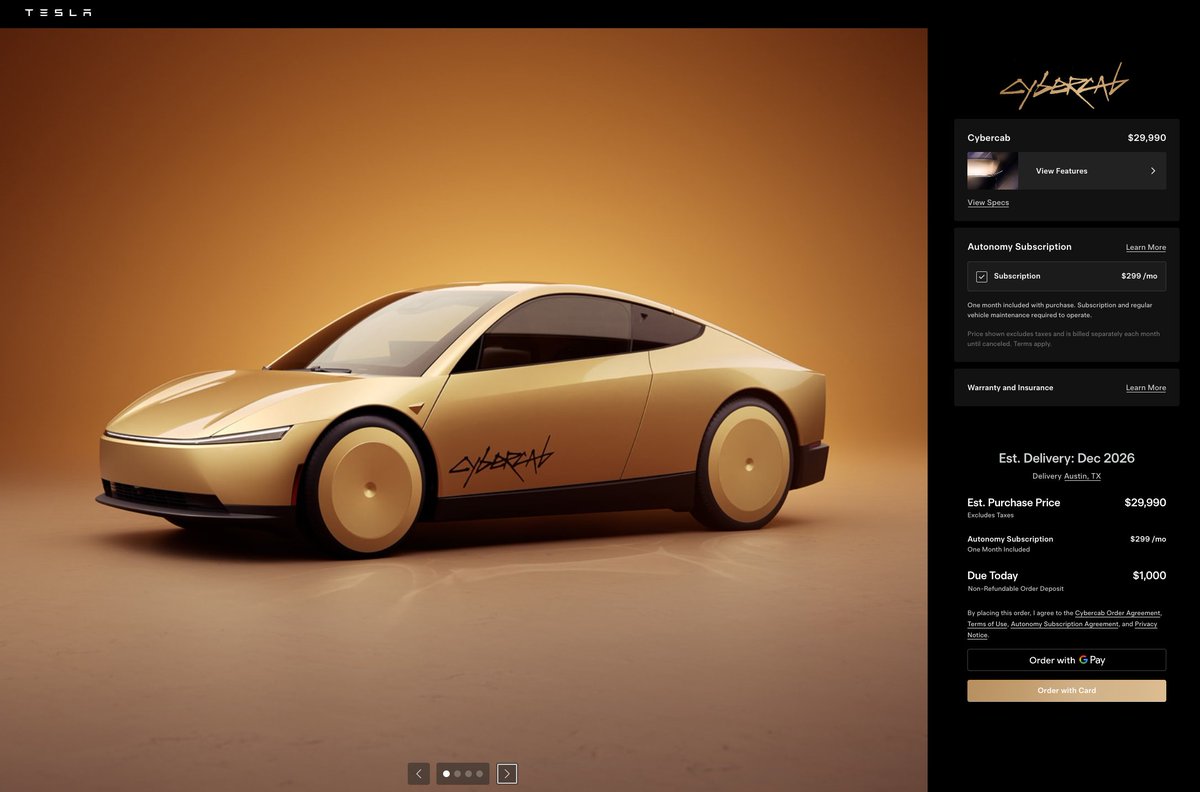
Tesla has just officially announced that select customers are now being invited to purchase Cybercab for personal use!
• Price: $29,990
• $1,000 non-refundable order fee
• $299/month autonomy subscription required. one mont included
• Deliveries start Dec 2026
It's happening!
maybe you were sleeping - Google services have had outages and degradations in recent years (2022–2026), though full global “Gmail and Calendar are completely down for everyone” events remain relatively uncommon compared with some other providers. Most issues are shorter, partial, regional, feature-specific, or limited to Cloud infrastructure.Statusgator
Notable incidents involving Gmail, Calendar, or broader Workspace:
June 12, 2025: A major global outage triggered by an invalid automated quota policy update that caused Service Control to crash-loop. It produced widespread 503 errors affecting dozens of Google Cloud products and Workspace services including Gmail, Google Calendar, Docs, Drive, Meet, Chat, and others for roughly 3 hours (longer recovery in some regions such as us-central1). Third-party services relying on Google Cloud (Spotify, Discord, etc.) were also heavily impacted.Google
September 18, 2025: Login failures to Google services (including Gmail and Workspace) lasting about 1 hour 10 minutes. Caused by resource contention in the authentication system after a traffic shift.Google
November 12, 2025: Access problems (SSL errors) with Google Drive, Sheets, Docs, Slides, and Forms lasting several hours. Google attributed it to an external/third-party issue.Google
November 19, 2024: Google Calendar web UI problems for roughly 1 hour 40 minutes due to a misconfigured denial-of-service rule (mobile apps were largely unaffected).
May 30–31, 2026: Brief (~75-minute) disruption affecting multiple Workspace products including Gmail, Calendar, Drive, Docs, Meet, Chat, and Voice.
Other smaller or more limited events have included Drive latency/connectivity issues, Gmail Android app login/inbox problems (some lasting days for affected users), image-loading failures, regional Meet or Chat degradations, spam-check banners, and delayed delivery for specific domains. Status aggregators have logged dozens to over a hundred minor-to-moderate Workspace incidents since 2022.Isdown
Google Cloud (infrastructure) examples:
Regional power-related outages, including a multi-hour disruption in the London region (europe-west2) on October 20, 2026, caused by a utility cable fault combined with a programmable logic controller (PLC) misconfiguration that prevented backup generators from starting. This affected many services in that zone/region (and some dependent customers such as banks).Computerweekly
Other regional incidents involving power/cooling failures, maintenance errors, or configuration issues have occurred in various zones.