[LIVE Session] Advanced Karpenter Optimization Techniques
Karpenter looks simple from the outside, but operating it well takes real understanding.
From overprovisioning to pending Pods to sudden rescheduling, it is rarely straightforward.
Join us for a live session as we explore how to use Karpenter beyond basic autoscaling to reduce Kubernetes costs and optimize cluster utilization.
You will learn:
- Key resource efficiency techniques with Karpenter.
- Practical hacks for disruption budgets, DaemonSet overhead, Graviton adoption, and more.
- How to cut hidden infrastructure costs without impacting performance.
- Multi-layer automation with Karpenter.
Only 50 seats left.
Join For Free Here: https://t.co/8iMQ81EW0j
🔁 Consider a Repost if this is helpful
Official documentation is concise - a good guide to get you started.
But actual problems in Kubernetes administration are vast 😅
This is well know.
- Official paths might lead to dead ends.
- Official guides won't cover every edge case.
- Official commands don't always do the trick.
- Official examples often don't match your setup.
- Official docs might not keep up with fast changes.
(Not in this particular order)
- Use your creativity to find workarounds.
- Use your failures as lessons for the future.
- Use your team to brainstorm tricky problems.
- Use your time to explore alternative solutions.
- Use your experience to build your own playbook.
48K+ read my DevOps and Cloud newsletter: https://t.co/wwkI6UOSo4
What do we cover:
DevOps, Cloud, Kubernetes, IaC, GitOps, MLOps
🔁 Consider a Repost if this is helpful
If you want to become good at Kubernetes in 2026, then learn these use cases:
1) How Kubernetes Applies Resource Quotas
↳ https://t.co/XovHfek2eF
2) How a Pod is Deleted - Behind the Scenes Breakdown
↳ https://t.co/7r6MUgUCKE
3) How To Fix Kubernetes Node Not Ready
↳ https://t.co/x93Bbczpqo
4) Kubernetes ImagePullBackOff Explained
↳ https://t.co/WcgKxGIFie
5) Kubernetes Architecture Crash Course
↳ https://t.co/PuZ6YEwSUV
6) How to Troubleshoot Unhealthy Kubernetes DaemonSets
↳ https://t.co/jiy5azetU1
7) pod.yaml File Structure Breakdown
↳ https://t.co/JhnPhMIDeK
48K+ read my DevOps and Cloud newsletter: https://t.co/WBucLdwdsb
What do we cover:
DevOps, Cloud, Kubernetes, IaC, GitOps, MLOps
🔁 Consider a Repost if this is helpful
[LIVE Session] Advanced Karpenter Optimization Techniques
Karpenter looks simple from the outside, but operating it well takes real understanding.
From overprovisioning to pending Pods to sudden rescheduling, it is rarely straightforward.
Join us for a live session as we explore how to use Karpenter beyond basic autoscaling to reduce Kubernetes costs and optimize cluster utilization.
You will learn:
- Key resource efficiency techniques with Karpenter.
- Practical hacks for disruption budgets, DaemonSet overhead, Graviton adoption, and more.
- How to cut hidden infrastructure costs without impacting performance.
- Multi-layer automation with Karpenter.
Only 50 seats left.
Join For Free Here: https://t.co/vlC6G44Fgz
🔁 Consider a Repost if this is helpful
DevOps Vs DevSecOps 👇
𝗗𝗲𝘃𝗢𝗽𝘀 focuses on collaboration and automation between development and operations.
𝗗𝗲𝘃𝗦𝗲𝗰𝗢𝗽𝘀 extends this approach to include security as a core consideration throughout the software development lifecycle.
DevSecOps adds value by implementing a "𝘀𝗵𝗶𝗳𝘁-𝗹𝗲𝗳𝘁" approach, where security is integrated early in development, following a "𝗳𝗮𝗶𝗹-𝗳𝗮𝘀𝘁" philosophy to catch and address vulnerabilities quickly.
48K+ read my DevOps and Cloud newsletter: https://t.co/wwkI6UOSo4
What do we cover:
DevOps, Cloud, Kubernetes, IaC, GitOps, MLOps
🔁 Consider a Repost if this is helpful
DevOps Learning Path for Beginners 👇
For individuals starting out, having proficiency in the following areas is recommended:
1. Version Control:
- Git: Focus on mastering basic commands, branching and merging, collaboration, conflict resolution, version tagging
2. Linux Administration:
- Understand system architecture, command line basics, file management, user administration, permissions, and shell scripting
3. Programming:
- Python and Go are recommended; beginners should focus on mastering the language syntax, data structures, control flow, functions, libraries
4. Databases:
- Learn SQL/NoSQL databases (e.g., MySQL, PostgreSQL, MongoDB) and master data modeling, querying, indexing, transactions, and database management for efficient data storage and retrieval
5. Networking:
- Grasp essential concepts like IP addressing, subnetting, firewalls, routing, TCP/IP protocols, network topologies, Load balancers, VPNs and security to manage and troubleshoot network infrastructure
6. CI/CD:
- Learn automating the build and deployment pipelines, version control integration, testing automation, containerization, and monitoring
7. Containerization:
- Docker/conatinerd: Containerization for portable app packaging
- Kubernetes: Container orchestration for scaling apps
- Helm: Kubernetes package manager for streamlined deployments
8. Cloud Platforms:
- Get Familiar with AWS, Azure, GCP, and their services
9. IaC:
- Terraform: Learn Terraform's HCL for efficient, automated cloud infrastructure provisioning
10. Software Configuration Management:
- Ansible: Focus on writing YAML playbooks, understanding modules and roles, and automating server and configuration management efficiently
11. Monitoring & Logging:
Learn defining metrics, data scraping, alert rule setup, and data visualization for monitoring and troubleshooting
48K+ read my DevOps and Cloud newsletter: https://t.co/WBucLdwLhJ
What do we cover:
DevOps, Cloud, Kubernetes, IaC, GitOps, MLOps
🔁 Consider a repost if this is helpful.
Starting with Kubernetes is smooth - all the online courses live up to this.
But managing multiple clusters quickly turns into a complex reality - you end up with this. 😅
That's ok, this is expected.
No one is immune to this.
- It takes time to deep dive.
- It takes small steps when scaling up.
- It takes perseverance to get it right.
- It takes continuous learning to keep up.
- It takes a team effort to manage complexities.
(Not in this particular order)
- Take advantage of your curiosity
- Take advantage of LinkedIn to outreach
- Take advantage of open-source resources
- Take advantage of mentorship opportunities
- Take advantage of industry webinars and talks
48K+ read my DevOps and Cloud newsletter: https://t.co/wwkI6UOSo4
What do we cover:
DevOps, Cloud, Kubernetes, IaC, GitOps, MLOps
🔁 Consider a repost if this is helpful.
Many Cloud Engineers don’t fully understand API Gateway vs Load Balancer implications.
API Gateway focuses on managing how clients access services.
Load Balancer handles where the traffic goes.
Here I've simplied this for you
48K+ read my DevOps and Cloud newsletter: https://t.co/WBucLdwdsb
What do we cover:
DevOps, Cloud, Kubernetes, IaC, GitOps, MLOps
🔁 Consider a Repost if this is helpful
If you're a DevOps Engineer targeting a top tier role these are the fundamentals that will get you there.
[1] Junior DevOps Engineer 0–2 yrs
- Linux basics
- Bash / Python scripting
- Git & version control
- Networking fundamentals
- TCP/IP & DNS
- CI/CD concepts
- Docker basics
- Environment variables
- Basic monitoring
Goal: Build pipelines that work correctly. Understand how code reaches a server. Don't jump to Kubernetes before this is solid.
[2] Mid level 2–5 yrs
- Kubernetes internals
- Helm & GitOps
- Infrastructure as Code
- Secrets management
- Zero downtime deploys
- Log aggregation
- Alerting strategies
- Rollback patterns
- Container security
- Service mesh basics
Judged on: Does it fail safely? Can the team recover fast? Is the blast radius contained?
[3] Senior & beyond 5+ yrs
Platform thinking at scale
- Multi region architecture
- Chaos engineering
- SLAs, SLOs & error budgets
- Cost optimization
- FinOps
- Security posture
- Compliance automation
- Capacity planning
- Incident command
You are paid to: Prevent outages. Prevent cost explosions. Build systems teams trust at 3am.
Juniors: stabilize fundamentals before touching orchestration
Mid levels: master safe delivery and failure patterns
Seniors: own cloud cost, security posture, and resilience
Today anyone can ship a pipeline.
Not everyone can keep it alive.
48K+ read my DevOps and Cloud newsletter: https://t.co/WBucLdwdsb
What do we cover:
DevOps, Cloud, Kubernetes, IaC, GitOps, MLOps
🔁 Consider a Repost if this is helpful
You do not really learn AI Agents by reading threads or copying prompts.
Production is different.
Agents forget context, Tools return noisy results, Token limits get wasted, One bad retrieval changes the entire output.
You learn it by debugging why an agent ignored instructions, or failed after 20 successful runs.
Luckily PerfectScale Community created a hands on workshop.
Learn how to handle AI Agents practically here: https://t.co/JAR45U3fyb
It is quite useful.
🔁 Consider a Repost if this is helpful
No cloud engineer can escape these outages caused by security groups.
Here, I've simplified this for you.
48K+ read my DevOps and Cloud newsletter: https://t.co/wwkI6UOSo4
What do we cover:
DevOps, Cloud, Kubernetes, IaC, GitOps, MLOps
🔁 Consider a repost if this is helpful.
If you want to become good at AWS in 2026, then learn these use cases:
1) AWS Networking Basics - AWS Subnets for Beginners
↳ https://t.co/EPwe1GTxMs
2) AWS Internet Gateway vs NAT Gateway – When to Use What?
↳ https://t.co/75zBT2vnGT
3) Hexagonal Architecture Patterns on AWS
↳ https://t.co/Cdx0ZThQ4C
4) How to Design a Scalable File Upload Architecture in AWS
↳ https://t.co/QZFqsaCCAm
5) How AWS Lambda Prevents Function Throttling During Traffic Spikes
↳ https://t.co/S2GyjDcvql
6) How to Automatically Block Suspicious Traffic in AWS
↳ https://t.co/5yjkbkA8p8
48K+ read my DevOps and Cloud newsletter: https://t.co/WBucLdwLhJ
What do we cover:
DevOps, Cloud, Kubernetes, IaC, GitOps, MLOps
🔁 Consider a Repost if this is helpful
→ A Cloud architect isn’t an architect because they hold 6 certifications.
→ A DevOps engineer isn’t DevOps because they practiced 500 exam questions.
I'm not against certifications. I know hiring folks make it a criterion.
Harsh truth?
Even someone who studies seriously for 3 months can clear a cloud certification.
But,
Real expertise comes only from designing, building, and fixing real systems.
1. Learn skills through hands-on experience
2. Apply what you learn in real-world projects
3. Deliver results
That's how you progress.
You're (REALLY) qualified. If you can deliver results.
Certifications open doors.
Results builds careers.
48K+ read my DevOps and Cloud newsletter: https://t.co/WBucLdwLhJ
What do we cover:
DevOps, Cloud, Kubernetes, IaC, GitOps, MLOps
🔁 Consider a repost if this is helpful.
DevOps and Cloud Key Metrics 👇
Each metric offers critical insights into the effectiveness and performance of cloud infrastructure and software delivery in DevOps.
48K+ read my DevOps and Cloud newsletter: https://t.co/wwkI6UOSo4
What do we cover:
DevOps, Cloud, Kubernetes, IaC, GitOps, MLOps
🔁 Consider a Repost if this is helpful
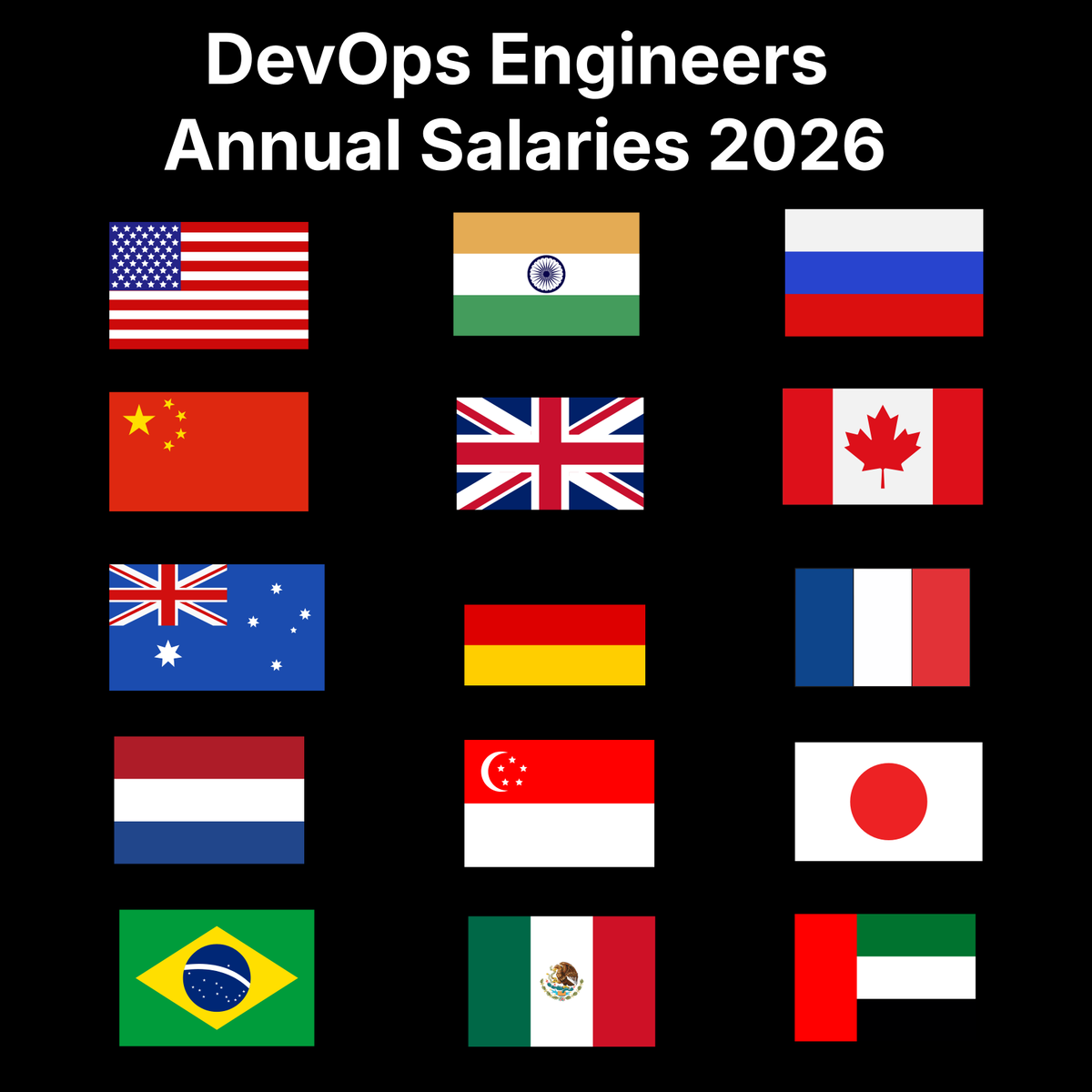
DevOps Engineers Annual Salaries 2026:
🇺🇸 USA ~ $115,172
🇦🇪 UAE ~ $78,938
🇷🇺 Russia ~ $23,343
🇨🇳 China ~ $53,888
🇬🇧 UK ~ $86,170
🇨🇦 Canada ~ $82,347
🇦🇺 Australia ~ $97,522
🇩🇪 Germany ~ $98,610
🇫🇷 France ~ $78,521
🇳🇱 Netherlands ~ $87,598
🇸🇬 Singapore ~ $88,222
🇯🇵 Japan ~ $56,967
🇧🇷 Brazil ~ $35,904
🇲🇽 Mexico ~ $33,106
🇮🇳 India ~ $22,160
(source: ERI SalaryExpert)
Still one of the highest paid jobs.
Receive real world use cases.
👉 https://t.co/WBucLdwdsb
48,000+ DevOps and Cloud Engineers already read it.
🔁 Consider a repost if this helps
EBOOK x KUBERNETES TROUBLESHOOTING GUIDE
Kubernetes is powerful, but when it breaks, it really breaks.
From OOMKills to throttling to broken HPA configs, troubleshooting under pressure can feel like chaos.
This practical free K8s Troubleshooting Guide breaks it all down:
- Clear explanations of common K8s failures
- Real logs, metrics, and event samples
- Root cause analysis (RCA) tips for over 12 failure scenarios
- Tactical advice to avoid the same issue twice
No fluff! Just battle-tested knowledge from production environments.
Download the full guide here: https://t.co/al7Bnu6TTM
It is quite useful.
🔁 Consider a Repost if this is helpful
If you are starting with Kubernetes – this will help you.
I spent 10 hours digging into Kubernetes concepts, tools, and best practices this week – so you don’t have to.
Here are 20 must-know updates and tips to get started with Kubernetes:
1. Always start with `kubectl` – it's your gateway to the cluster.
2. Use Minikube or Kind to practice Kubernetes locally.
3. Master the YAML syntax – it's everywhere in Kubernetes.
4. Learn the difference between Deployments, StatefulSets, and DaemonSets.
5. Namespace everything to avoid conflicts in multi-team setups.
6. Use ConfigMaps and Secrets to separate configuration from code.
7. Set up resource requests/limits to prevent pod starvation.
8. Understand Kubernetes Services – ClusterIP, NodePort, and LoadBalancer.
9. Learn about Ingress for HTTP routing into your cluster.
10. Use liveness and readiness probes to manage container health.
11. Avoid storing credentials in plain YAML files – use Secrets instead.
12. Familiarize yourself with Helm for managing application releases.
13. Explore Kustomize for environment-specific configuration.
14. Use metrics-server for resource monitoring.
15. Set up Role-Based Access Control (RBAC) for secure operations.
16. Start with a simple CNI plugin like Flannel for networking.
17. Use Kubernetes Dashboard cautiously – it's great for beginners but can expose your cluster.
18. Experiment with auto-scaling – both HPA (pods) and Cluster Autoscaler (nodes).
19. Regularly clean up unused resources like pods, services, and images.
20. Document everything – Kubernetes has a steep learning curve.
Save this post for reference.
48K+ read my DevOps and Cloud newsletter: https://t.co/WBucLdwdsb
What do we cover:
DevOps, Cloud, Kubernetes, IaC, GitOps, MLOps
🔁 Consider a Repost if this is helpful
Many DevOps Engineers don’t fully understand a Terraform project structure or the role each part plays.
Here, I’ve made this to help you better understand.
👋 PS - I wrote an article with visuals and a detailed breakdown of this use case in my newsletter here: https://t.co/scNwtDWeT1
🔁 Consider a Repost if this is helpful
Starting with Kubernetes is smooth - all the online courses live up to this.
But managing multiple clusters quickly turns into a complex reality - you end up with this. 😅
That's ok, this is expected.
No one is immune to this.
- It takes time to deep dive.
- It takes small steps when scaling up.
- It takes perseverance to get it right.
- It takes continuous learning to keep up.
- It takes a team effort to manage complexities.
(Not in this particular order)
- Take advantage of your curiosity
- Take advantage of LinkedIn to outreach
- Take advantage of open-source resources
- Take advantage of mentorship opportunities
- Take advantage of industry webinars and talks
48K+ read my DevOps and Cloud newsletter: https://t.co/wwkI6UOSo4
What do we cover:
DevOps, Cloud, Kubernetes, IaC, GitOps, MLOps
🔁 Consider a repost if this is helpful.


![techopsexamples's tweet photo. [LIVE Session] Advanced Karpenter Optimization Techniques
Karpenter looks simple from the outside, but operating it well takes real understanding.
From overprovisioning to pending Pods to sudden rescheduling, it is rarely straightforward.
Join us for a live session as we explore how to use Karpenter beyond basic autoscaling to reduce Kubernetes costs and optimize cluster utilization.
You will learn:
- Key resource efficiency techniques with Karpenter.
- Practical hacks for disruption budgets, DaemonSet overhead, Graviton adoption, and more.
- How to cut hidden infrastructure costs without impacting performance.
- Multi-layer automation with Karpenter.
Only 50 seats left.
Join For Free Here: https://t.co/8iMQ81EW0j
🔁 Consider a Repost if this is helpful](https://pbs.twimg.com/media/HKBK3Q6a0AAqmvV.jpg)


![govardhana_mk's tweet photo. [LIVE Session] Advanced Karpenter Optimization Techniques
Karpenter looks simple from the outside, but operating it well takes real understanding.
From overprovisioning to pending Pods to sudden rescheduling, it is rarely straightforward.
Join us for a live session as we explore how to use Karpenter beyond basic autoscaling to reduce Kubernetes costs and optimize cluster utilization.
You will learn:
- Key resource efficiency techniques with Karpenter.
- Practical hacks for disruption budgets, DaemonSet overhead, Graviton adoption, and more.
- How to cut hidden infrastructure costs without impacting performance.
- Multi-layer automation with Karpenter.
Only 50 seats left.
Join For Free Here: https://t.co/vlC6G44Fgz
🔁 Consider a Repost if this is helpful](https://pbs.twimg.com/media/HJyhPPYbgAA_5k3.jpg)


![govardhana_mk's tweet photo. If you're a DevOps Engineer targeting a top tier role these are the fundamentals that will get you there.
[1] Junior DevOps Engineer 0–2 yrs
- Linux basics
- Bash / Python scripting
- Git & version control
- Networking fundamentals
- TCP/IP & DNS
- CI/CD concepts
- Docker basics
- Environment variables
- Basic monitoring
Goal: Build pipelines that work correctly. Understand how code reaches a server. Don't jump to Kubernetes before this is solid.
[2] Mid level 2–5 yrs
- Kubernetes internals
- Helm & GitOps
- Infrastructure as Code
- Secrets management
- Zero downtime deploys
- Log aggregation
- Alerting strategies
- Rollback patterns
- Container security
- Service mesh basics
Judged on: Does it fail safely? Can the team recover fast? Is the blast radius contained?
[3] Senior & beyond 5+ yrs
Platform thinking at scale
- Multi region architecture
- Chaos engineering
- SLAs, SLOs & error budgets
- Cost optimization
- FinOps
- Security posture
- Compliance automation
- Capacity planning
- Incident command
You are paid to: Prevent outages. Prevent cost explosions. Build systems teams trust at 3am.
Juniors: stabilize fundamentals before touching orchestration
Mid levels: master safe delivery and failure patterns
Seniors: own cloud cost, security posture, and resilience
Today anyone can ship a pipeline.
Not everyone can keep it alive.
48K+ read my DevOps and Cloud newsletter: https://t.co/WBucLdwdsb
What do we cover:
DevOps, Cloud, Kubernetes, IaC, GitOps, MLOps
🔁 Consider a Repost if this is helpful](https://pbs.twimg.com/media/HJd_8uNacAAAhNd.jpg)