In "stuff that @Steve_Yegge said 9 months ago, when few believed it would be true, but now it's more visible"
The "vampiric" effect of running AI agents, and how it drains people
I don't know how he does it, but he rarely misses
Full: https://t.co/fYR25YHscJ
I recently balked at the idea that every team should build its own software factory.
Welp, I ended up making one for myself. Here's why it kicks ass (and how to build your own) https://t.co/m1Xj02kY9A
A lot of folks ask me "how do you work with agents in multiple repos at once?"
I have a very simple solution - the Home Repo
I have a single repo (the home) where all of my skills, steering files, wiki etc live.
I run my agent in the home repo, and then inside AGENTS.md I have pointers to the other repos:
```
For skills, clone mattpocock/skills to ~/repos/skills.
For Sandcastle, clone mattpocock/sandcastle to ~/repos/sandcastle
```
This is extremely simple and incredibly effective. The home repo lets you:
1. Put all your steering files and tooling in one place
2. Have a single spot to run all your agents in
3. Make sweeping changes over multiple repos
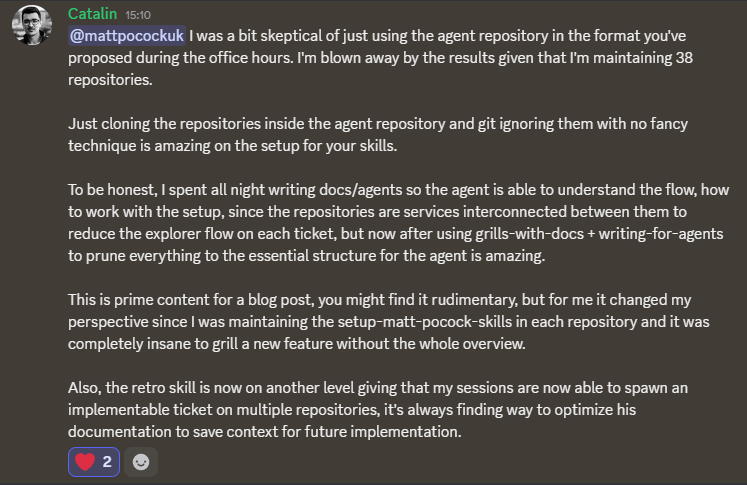
Talked about this in the course yesterday and folks are loving it (see below).
I'm sure you will too. Enjoy!
Everyone needs a secure and scalable agent plane, regardless of if you’re fully factory pilled or just running Claude code on a terminal TTY. I’m making my own because I think everything available isn’t paranoid enough.
Your factory should be accessible everywhere your team works. This is key for adoption across a team. This means multiplayer prompting in Slack, tagging from task boards like Linear or Jira, or fully automating against a backlog. It should also be accessible via MCP to put work in through local agents, and via API.
You’ll find over time that it's convenient to hop between all of these mediums throughout the lifecycle of a task.
Most companies didn't go remote — they digitized the office. Same meetings, same interruptions, now on Zoom.
Open and Async is out today: the open-source way of working — in the open, in writing, async by default — turned into a playbook for your team.
https://t.co/EUZSvwI0Jd
PSA: if you need the exact text off a page in Claude Code, don't WebFetch it. curl it.
WebFetch laundres the page through a small summarizer model. You get a paraphrase, not the bytes. Fine for the gist, wrong for exact docs/API signatures/llms.txt.
https://t.co/arVdMChbMx
@nateberkopec I think about it like guardrails along a cliffside road. Like, yes, it is now harder to go over the edge, but still possible to do in the right circumstances
Situation 1: dev A thinks approach X is correct, dev B thinks Y is the right way. They argue and try to convince each other.
Situation 2: dev A thinks approach X is correct, tells the LLM to implement it.
There is SO MUCH learning in Situation 1, lost when using LLMs....
@nateberkopec Came across https://t.co/fBj8fSv4HJ recently and it has been great for giving these patterns a name. And for feeding into ny writing voice skill to not do them 😅
@samsaffron I did some of the same things wrt to spelunking through the claude binary, but a) felt like a gray area and b) could be its own entire post
Claude Code prompts for `python3 -c '# comment\nprint(42)'` even with auto-mode on. Not a bug.
There's a Bash parser in there with opinions, one of 6 layers between your keystroke and execution. Mapped them all.
https://t.co/j6vyuHrPpX
two weeks running Claude Code with /sandbox. here's the config that actually works, the stuff that broke, and the stuff that's still broken.
https://t.co/8DLZzyBW4Q
"That's awesome, congrats" takes thirty seconds. "Great, now what about Y?" takes the same thirty seconds but leaves someone deflated.
Wrote about the skipped acknowledgment and why we keep doing it to each other
https://t.co/JY8YkgbBW1
@nateberkopec I was coming around to a similar idea, but slightly different motivation. I was working through architecture and design decisions, and found myself wanting to quote reply to stuff in a file, rather than replying and chatting about jt