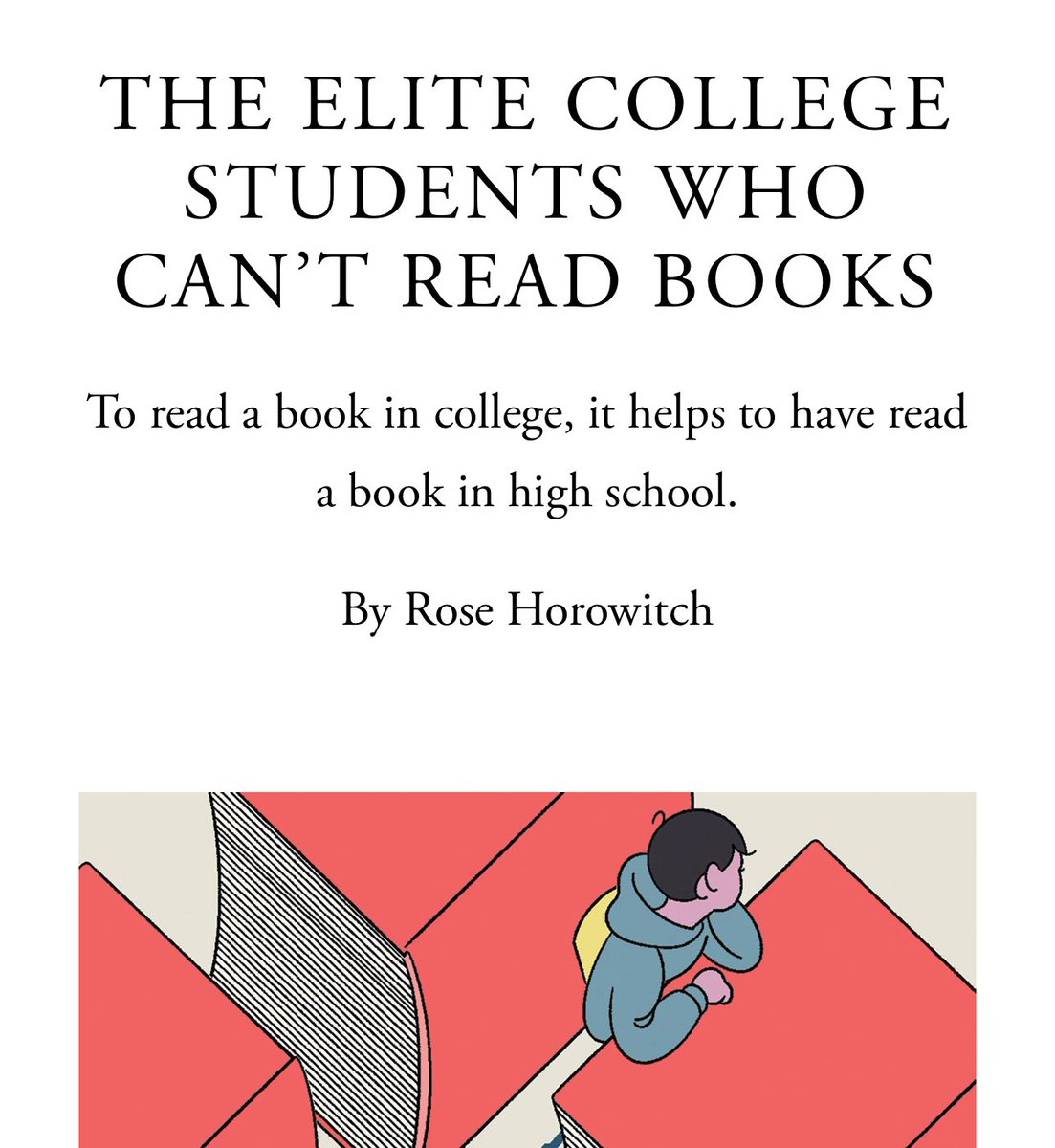
“A Princeton historian said his students arrive on campus with a narrower vocabulary and less understanding of language than they used to have. There are always students who “read insightfully and easily and write beautifully,” he said, “but they are now more exceptions.” Jack Chen, a Chinese-literature professor at the University of Virginia, finds his students “shutting down” when confronted with ideas they don’t understand; they’re less able to persist through a challenging text than they used to be. Daniel Shore, the chair of Georgetown’s English department, told me that his students have trouble staying focused on even a sonnet.”
ICYMI, @rosehorowitch’s grim coverage of the declining reading skills of American college students.
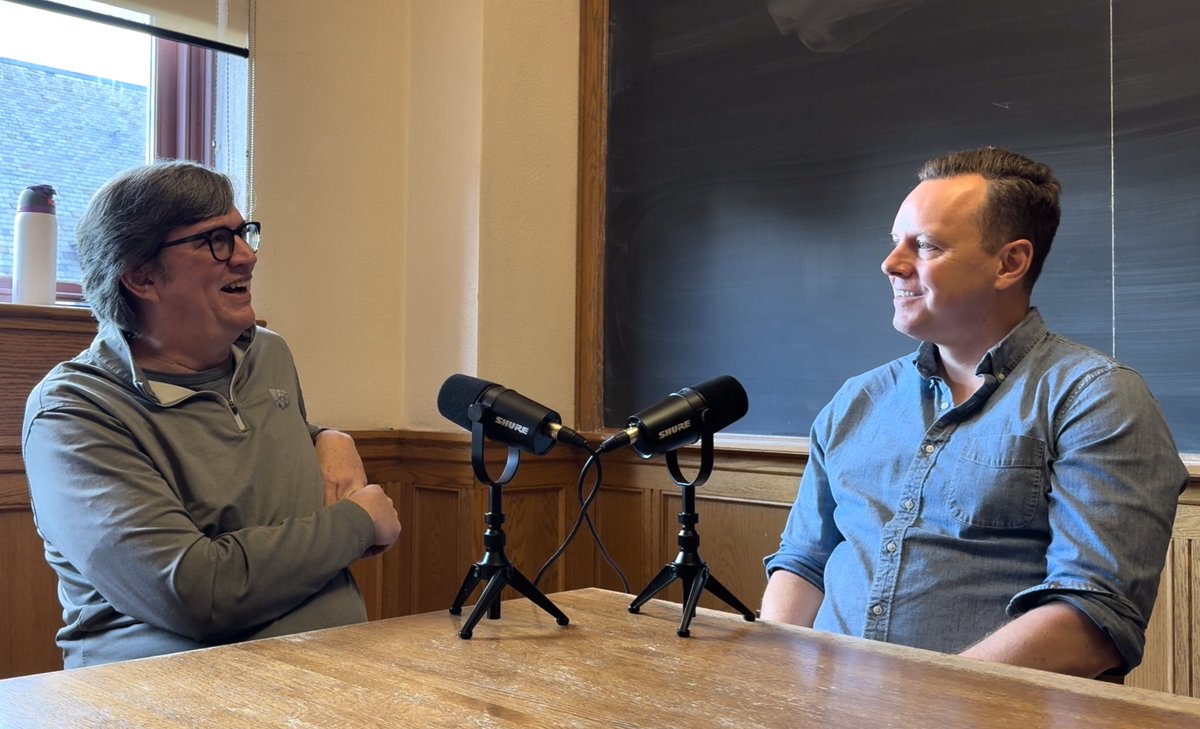
The role of education policy in these shifts gets attention; @DKThomp asked her about it in his podcast, too. It’s fair to point to No Child Left Behind and the pressures of standardized testing as a culprit.
The Common Core, on the other hand, is an unlikely culprit: nothing about introducing more nonfiction into classrooms – which primarily affected elementary grade curriculum – necessitates a move away from books and towards passages. In classrooms using the most Common Core-aligned curricula, you’ll find elementary students reading books about pollinators and sea mammals, and whole texts through HS.
Accordingly, Sue Pimentel, the lead author of the CCSS in ELA, has been the loudest advocate for placing texts at the heart of instruction.
I’d say the shift is probably as much culture as policy: schools are simply lowering the rigor bar, and few are challenging this shift. Or frankly, paying much attention to it.
Also, the shifts in book-centered curriculum are a supply-side story, as much as a demand-side story. It’s more profitable to sell a curriculum full of passages than it is to sell one full of books.
This supply-side story deserves more exploration.
coming next week @peez and @tamler return to Borges-land & talk about his story "Shakespeare's Memory" and the (?) "Everything and Nothing." Plus a cancelation at Cornell right after its president boasted about their ironclad commitment to free speech (doh!)
I really enjoyed this chat with @jed.co on his podcast @techsontexts.net
A Pattern Language is a special book. If you’ve read it I hope this conversation deepens your appreciation for it. If not I hope it encourages you to check it out for yourself
https://t.co/gJwm4UUnJ8
Read ahead! This month's episode (out sometime after the 26th), will about “The Truth of Fact, The Truth of Feeling” by Ted Chiang. Next month's episode will be about Childhood’s End by Arthur C. Clarke.
In a few days Flight Simulator 2024 is out
You might think it's just another video game
In reality it's the latest in a 40y+ series pushing the boundaries of graphics & mapping
Let me tell you the Story of how Microsoft accidentally made the best map -> https://t.co/cgH4g1vugU
One of the most important things you can realize in life is that even if there is knowledge contained in these books, it is a useless endeavor to read them. They won’t help you. You have to live it yourself to accumulate the wisdom. There are no shortcuts
Schedule for the rest of the year:
- Oct: @edyson on *Never Let Me Go* by Kazuo Ishiguro and Spike Jonze’s *Her*
- Nov: @mcoatney on *A Wizard of Earthsea* by Ursula K. Le Guin
- Dec: TBD on Francis Ford Coppola’s *The Conversation*
https://t.co/vdzTYXPWCf
Recorded another IRL episode yesterday with the great @mcoatney. We talked about *A Wizard of Earthsea* by Ursula K. Le Guin. Was great! Episode will post in November. Rest of the year's schedule at https://t.co/vdzTYXPWCf