Getting started on @DivvyBet takes less than a minute.
Connect your wallet, pick your games and place your bet. No sign up forms and no KYC.
Every bet earns Arena Points for Season 2. The top 100 wallets share $22K, and there's another $3K in raffles.
You can track your bets, results and leaderboard rank all in one place.
I put together a quick walkthrough.
Watch it below
Do I start ahead or behind? Ahead. Bonus tokens are added on top of the swap, and no launch can go live with buyers starting less than 1% ahead.
➠ Can the rates change later? No. They're fixed at launch with no admin switch, for creators and the team alike.
➠ What stops bots from sniping? A tax that starts at 99% and falls to zero within 3 seconds, with what bots pay going into the token's locked treasury.
➠ Where does the bonus come from? A treasury of at least 7% of supply, locked with no withdraw function, topped up by sell fees and snipe tax.
➠ Do I have to babysit it? No. No staking and no claiming, with payouts sent to your wallet through the day.
$REBATE
@RebateLaunch
GM CT ☀️
Imagine a token ecosystem where trading activity does more than move the chart👀
That’s the part of @uniwallhook worth paying attention to
UniWall connects swap activity to mining, gives eligible holders a path to ETH rewards and uses its 10 liquidity walls to buy tokens from eligible sells and burn them🤯
Different mechanisms, each with a role to play in the bigger picture
WELCOME TO THE FUTURE ���
#uniwall #wally
John Furrier breaks down why AI inference resellers could be in trouble as data centers and inference providers move toward full-stack “token factories.”
If the biggest players can control the entire stack, what’s left for the middle layer?
A bold take on the future of AI infrastructure.
John Furrier on theCUBE
Good morning, fam.
Creating a token should be about building the idea, not getting stuck in complicated setup.
That is the approach @RebateLaunch takes with Rebate Pad on Robinhood Chain.
You choose your token name, artwork, and trading pair, whether it is USDG, ETH, or another supported option. The platform handles the core setup, including token supply, liquidity, and treasury configuration.
What I find interesting is how much control creators get before launch. They can configure the bonus rate, holder payout rate, payout asset, and wallet exclusions within the platform's rules. Once launched, those settings are locked.
There is also a launch protection mechanism designed to reduce sniping, with the tax starting at 99% and fading to zero over three seconds.
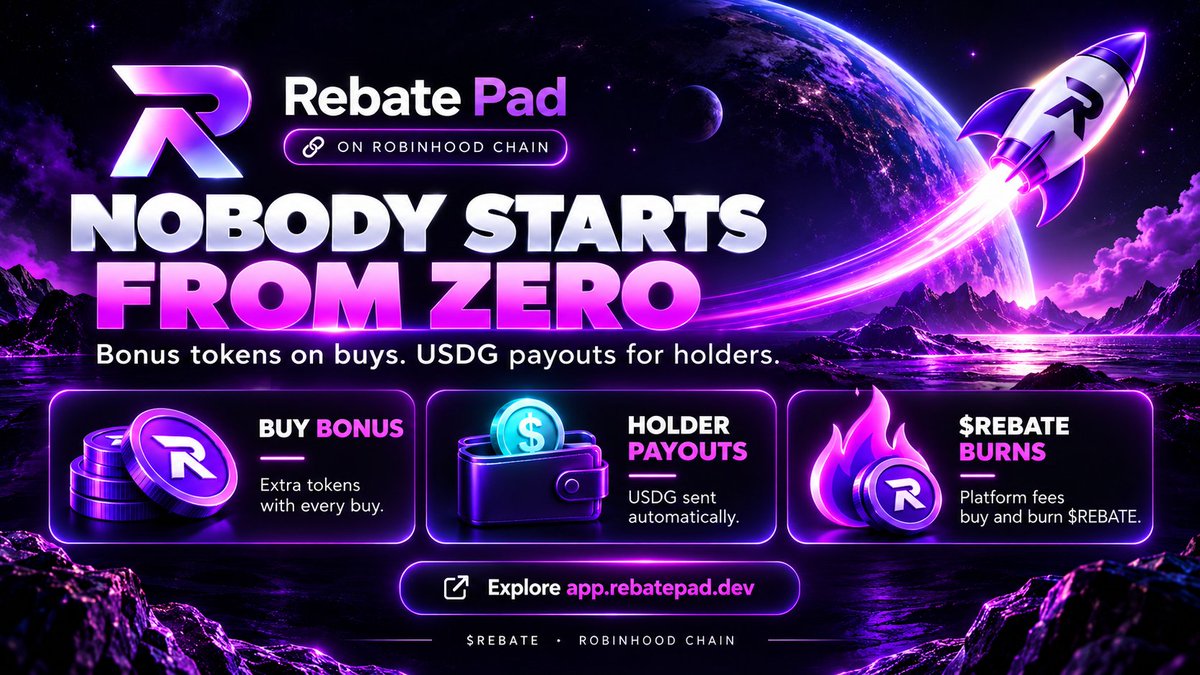
For buyers, every purchase comes with bonus tokens. For holders, eligible wallets can receive payouts without staking or manually claiming.
And beyond individual launches, platform fees feed into the $REBATE buyback and burn mechanism.
The real appeal is bringing token creation, buyer incentives, and holder rewards into one process. The next thing to watch is how well it performs as more projects launch.
Explore Rebate Pad: https://t.co/7dkG7mNSWa
@RebateLaunch@Starlisting
Good afternoon creators.
Rebate Pad is live on Robinhood Chain, and I'm taking it slow on day one.
The first thing I do with any new launch is check the contract. Fake tokens copy names fast, so I compare the address with what @RebateLaunch posts officially before I trade.
Here's the contract I'm using:
`0xb7Ff57631B97000d950236ef63bD463da5bEBA7e`
Then I look at what the design promises:
➠ Bonus tokens on every buy, shown in the quote before I confirm
➠ USDG payouts to holders, with nothing to stake or claim
➠ Platform fees used to buy and burn $REBATE
I've read the rules, but I haven't seen enough live results to judge them. What I want to know is whether the quote matches what lands in my wallet, whether payouts keep arriving, and whether the burns show up on chain.
Good mechanics are a starting point. Real usage will show whether they hold up.
Always verify the contract before trading. DYOR.
@starlisting partners with @RebateLaunch so creators can post and earn.
The real question behind any holder reward system is simple: where does the money come from?
When rewards depend on newly minted tokens, existing holders may pay the price through dilution.
But when rewards are connected to genuine platform activity and fees that drive token burns, the model ties incentives to usage rather than expanding supply.
That is the approach @RebateLaunch is taking.
Still, the long term test is whether real trading activity can consistently sustain these mechanisms.
Rewards alone mean little without an economic engine behind them.
Sustainable tokenomics starts with understanding who funds the rewards, how value flows through the system, and whether that model can hold up over time.
$REBATE
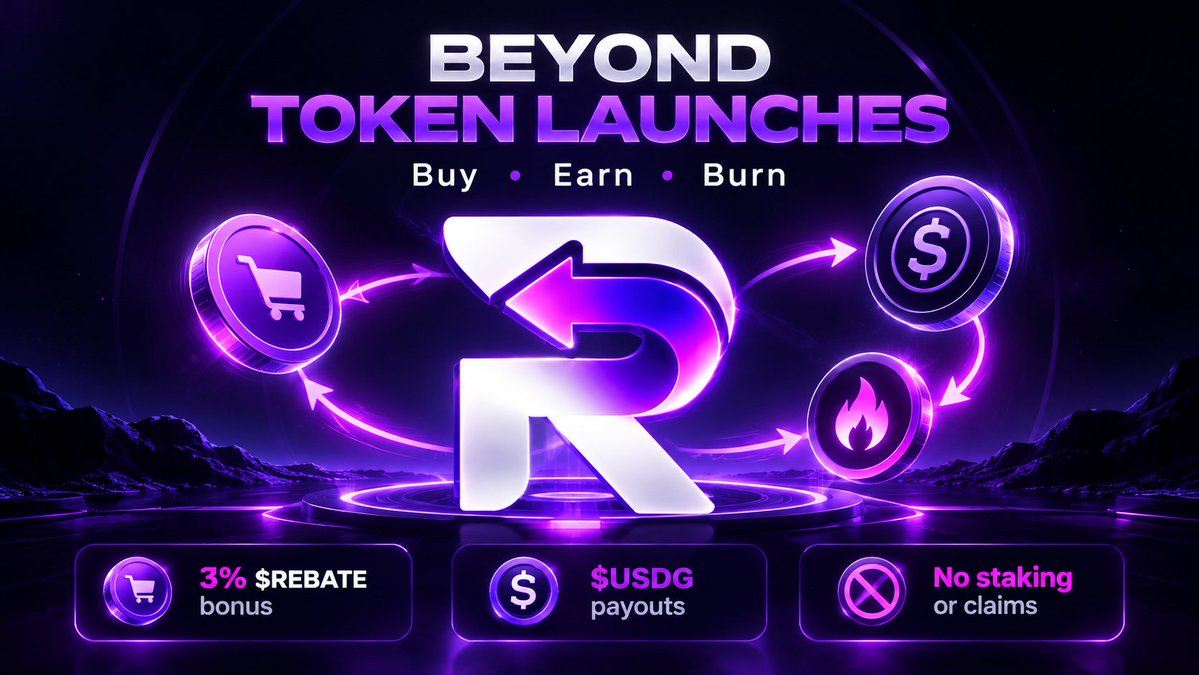
Beyond Token Launches: How Rebate Pad Connects Participation With Rewards.
A token launch is only the beginning. What happens after people buy is what makes the model interesting.
With Rebate Pad on Robinhood Chain, @RebateLaunch is introducing a reward focused approach:
➠ Every $REBATE purchase comes with a 3% bonus.
➠ Holders receive USDG payouts directly in their wallets.
➠ No staking or manual claims are required.
➠ Fees generated by launches are used to buy and burn $REBATE.
The interesting part is how these mechanisms connect user participation, platform activity, and the token's economy.
Still, the long term value of this model depends on real usage, consistent activity, and sustainable rewards.
Beyond launching tokens, Rebate Pad is building a system designed to give participation an ongoing role.
Watching its progress on Robinhood Chain.
Could reward-focused launchpads be the next big shift in token launches?
⚔️ $VTRX: WE’RE JUST GETTING STARTED!
The vision is clear, the community is growing, and the work continues. 💪
Every move counts. Every supporter matters. We’re staying focused on building VALTRIX and pushing toward the next milestone. 🚀
Stay active. Stay locked in. The journey continues! 👀
TG: https://t.co/5M1siZiifT
CA: Fe6KyLPHWerbHAYG7AFQk3LwgyQ4tViDzkfkCi5qpump
#VTRX #Solana # PUMPFUN