Quite a few people have been asking me about $OMNI lately, so I wanted to share some research and my thoughts after spending some time looking into the project
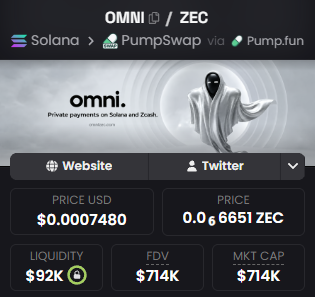
$OMNI launched less than an hour ago, so it's still a pretty risky gamble at this point. However, what caught my attention wasn't the initial price action, but the business model and the actual product behind the token
I've looked into the product, tokenomics, team activity, and some of the data they've recently shared. Personally, I think there's an interesting idea here, but it's still way too early to tell how far this project can go
1. First, what exactly is $OMNI building?
Omni Terminal is a data aggregation platform focused on graded Pokémon cards, including PSA, BGS, and CGC
If you've ever looked into the Pokémon TCG market, you'll know that pricing and buying these cards isn't always straightforward. The same card can be listed on eBay, Alt, Fanatics Collect, Goldin, or Collector Crypt at completely different prices
Buyers usually have to search multiple platforms, compare prices, and check sales history themselves
Omni is trying to solve this by bringing data from different marketplaces into a single terminal, making it easier to track listings, compare prices, and identify trading opportunities
Some of the features they've introduced include :
> Markets : Aggregates listings across multiple marketplaces.
> Omni500 : Tracks 500 cards ranked by market cap.
> Portfolio: Helps users manage their collections and compare cost basis against current market value.
> Auto-buy / Auto-bid : Automatically buys or places bids based on user-defined conditions
> Gacha : Integrates pack-opening activities from Collector Crypt
> Omni-SI : A tool for querying card market data
What I like here is that Omni is trying to solve an actual problem rather than building an entire narrative around a token
The collectibles market has existed for years, and if Omni can genuinely help users find better deals or save time, there's a reason for people to use the product even when memecoin activity slows down
That said, the product is still very new, and there's nowhere near enough operating history to judge whether it can build a lasting competitive advantage
2. The connection between $OMNI and $CARDS is pretty interesting
One detail worth mentioning is that $OMNI launched with an OMNI/CARDS trading pair on PumpSwap instead of the usual SOL pair
This connects directly to Collector Crypt, a platform operating in the tokenized Pokémon card ecosystem
Omni integrates Collector Crypt into its product, allowing users to access pack-opening activities, track cards, and compare data across other marketplaces
According to the team, Omni also generates revenue through its relationship with Collector Crypt, while $CARDS is included in the platform's user reward system
So pairing $OMNI with $CARDS isn't just about creating a narrative. It also connects the token to the ecosystem the product is targeting
Personally, I think the choice makes sense
However, there's an important distinction here. Integrating Collector Crypt and using $CARDS as a liquidity pair doesn't mean Collector Crypt guarantees the value of $OMNI or is committed to supporting its price
Those are two completely different things
3. Tokenomics and the buyback & burn mechanism are probably the most interesting parts
According to Omni's published model, the platform generates revenue from several sources :
> Auto-buy fees of around 2% and Auto-bid fees of around 5%
> Revenue generated through its relationship with Collector Crypt
> Data and index licensing
The team says 90% of revenue will be used to buy back and burn $OMNI, while the remaining 10% is allocated to Treasury operations and user rewards
More importantly, the project has announced that approximately 118.7M $OMNI has already been burned, representing nearly 11.9% of the initial supply
Following the burn, the supply displayed on the website was approximately 852.5M tokens
Another 99.5M $OMNI from the dev allocation has reportedly been locked through Streamflow until February 1, 2027
If these burns and lockups are fully verified on-chain, they're relatively positive developments from a supply management perspective
However, I wouldn't look at the burn percentage alone and assume the token has to go up
What matters more is whether the platform can continue generating revenue
A large burn immediately after launch can attract attention, but the long-term value of this model depends on whether the business can sustain its operations
Simply put, I want to see Omni continue attracting users, generating fees, and executing regular buybacks rather than relying on one impressive burn at launch
4. Omni's Treasury is another interesting part of the project
Instead of holding only stablecoins or tokens, Omni has built a Treasury consisting of actual graded Pokémon cards
According to the figures shared by the team, the Treasury currently holds 28 graded cards with a total acquisition cost of approximately $45,911
Their estimated market value is around $85,408, representing approximately $39,497 in unrealized profit, or roughly 86%
Those numbers look impressive, but it's important to remember that these are unrealized gains. An estimated market value doesn't necessarily mean every card can immediately be sold at that price
The team plans to use the Treasury to reward users and potentially sell cards to generate additional funds for token burns
Personally, I think this model fits the project's narrative quite well
If you're building a terminal for the Pokémon TCG market, holding an actual portfolio of graded cards creates a more direct connection between the product and its Treasury activities
Still, the effectiveness of this strategy needs to be demonstrated through real transactions rather than estimated asset valuations alone
5. What has the team actually accomplished, and are there real users?
Although $OMNI launched less than an hour ago at the time of writing, Omni Terminal had already been under development before the token launch
Based on the timeline shared, Omni began appearing publicly in early October
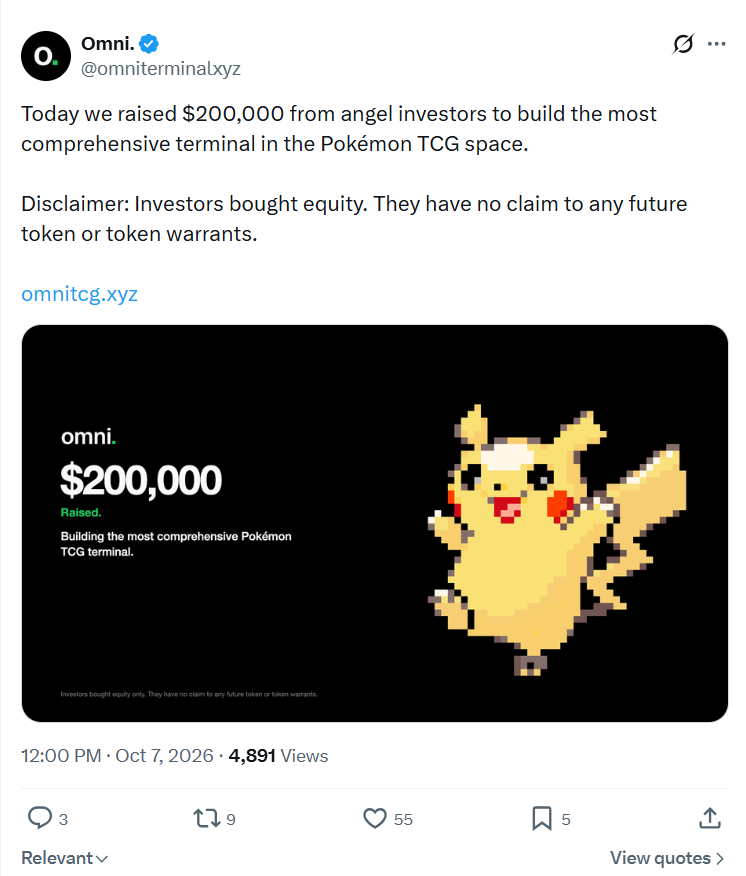
The team says it raised approximately $200K from angel investors to develop the terminal. This was described as an investment in the company rather than a direct fundraising round for the $OMNI token
Over the past 10 days or so, the team has been consistently shipping product updates
On October 8, they introduced Omni500 and improved card data coverage
Between October 11 and 12, they continued upgrading Portfolio, Dashboard, Treasury, search filters, and the mobile interface
Season 1 Points was introduced on October 13, followed by the $OMNI token launch on October 16, alongside announcements regarding the burn and dev token lockup
I think the pace of development is worth acknowledging, especially for such a new project
As for actual usage, the latest figures shared by the team show 694 accounts and approximately $725K in volume processed through the platform
For a product that's only been public for around 10 days, that's not a bad start
However, 694 accounts don't necessarily mean 694 regularly active users. Likewise, $725K in volume is not the same as $725K in revenue
I'd like to see more data on returning users, actual transactions, fee revenue, and how activity develops once the Points incentives are no longer driving participation
Those numbers will tell us much more about whether the product is gaining real traction
6. What are the next potential catalysts for $OMNI?
I haven't seen a sufficiently detailed public roadmap confirming major upcoming events such as CEX listings or new partnerships
However, there are a few things worth watching
The first is Season 1 Points
Users can earn points through Gacha, Auto-buy, and Auto-bid activities. These points are used to determine monthly reward distributions involving $OMNI, $CARDS, and $USDC
The top three users on the leaderboard can also receive graded cards from the Treasury, with first place reportedly receiving two cards
One thing to keep in mind is that Season 1 only started around October 13, so the first end-of-month reward distribution hadn't taken place at the time these details were shared
The second catalyst is future buybacks and burns
If Omni continues generating revenue and follows through on its commitment to use 90% of that revenue for token buybacks, it could create a recurring source of buying demand over time
Finally, there's the continued development of the terminal, including broader data coverage and improvements to the user experience
In my opinion, the most important catalyst isn't some unexpected listing announcement
It's whether Omni can prove that its product generates consistent revenue and retains users beyond the initial launch hype
7. There are still several risks I wouldn't ignore
+ First is the project's age
Omni had only been publicly active for around 10 days before launching its token, so there's very little history available to evaluate its long-term execution
+ Second is token distribution
Some on-chain analysts have raised concerns about the relatively high number of fresh wallets among the top holders
One analysis claimed that approximately 63 of the top 100 wallets were newly created and collectively controlled close to 43% of the supply, excluding locked tokens
I haven't independently verified those figures, so I wouldn't jump to conclusions about bundling or manipulation
However, it's definitely something worth investigating before taking a large position.
+ Third, I haven't seen a publicly disclosed formal audit
Locking part of the supply and burning tokens doesn't eliminate risks related to smart contracts, liquidity, or other wallets
Also, since $OMNI trades against $CARDS, traders need to pay attention to the liquidity and price movements of the paired asset as well
Finally, there's a big difference between a good product and a token that performs well in the market
Even if Omni continues developing, $OMNI could still face significant selling pressure if speculative capital leaves or liquidity becomes too thin to absorb large sell orders
8. Now, let's talk about the chart and my trading plan
$OMNI has already pulled back to around $1M market cap after initially running toward approximately $3 –3.5M shortly after launch
That's a pretty significant correction in a very short period of time
However, considering the token launched less than an hour ago, this kind of volatility isn't particularly surprising
What matters to me now is whether buyers return after the initial wave of selling, rather than trying to catch the bottom too early
Personally, I'm not rushing to enter at the current $1M market cap
I'm more interested in watching for a deeper dip toward the $700–800K market cap range
If price reaches that area and shows a decent buying reaction, I'll consider taking a small position as a gamble
On the other hand, if market cap drops below $400K, that's where I'll cut my losses, as the original setup would no longer fit my trading plan
Of course, these are simply the levels I'm watching, not confirmed support zones. The chart is still far too new to establish reliable technical levels
I like Omni's concept and business model, but having a good product doesn't automatically mean the token will pump immediately, especially with memecoin volume still relatively weak
So I'd rather stay patient and wait for a better entry than FOMO here
To wrap things up, I think $OMNI has a few interesting characteristics compared to the average newly launched token on https://t.co/MDT1D8rHCr
The Pokémon TCG narrative, its connection to Collector Crypt, the 90% revenue buyback & burn model, and a Treasury backed by actual graded cards all give it some differentiation
But I also don't want to overrate the project just because it has a product and attractive-looking tokenomics
It's still extremely early. The user base remains relatively small, sustainable revenue hasn't been proven, and token distribution risks still need further investigation
Most importantly, $OMNI launched less than an hour ago, so this is still a pretty speculative gamble
For me, the $700 – 800K range is where I'd be more interested in watching for a potential entry, provided the price reaction looks decent. Below $400K is where I wouldn't want to keep holding the position
I'll continue monitoring the team's activity, future buybacks, and how the chart develops over the next few hours
If the product keeps improving and revenue actually grows, this could be worth revisiting with a stronger thesis later on
For now, though, I'm prioritizing risk management and would only consider a small position
3dgGDYKaab1pAZhaEC6gZQS3PrbZdShXMcoWeVZJpump
Continuing today's memecoin recap series, and the first token I want to talk about is solana:DFMt2FyLpB6ekPNAzVErLXgpSnJ9CRf1VnxBAkTLpump
This is probably one of the hottest memecoins on Solana right now. Within roughly 24 hours of launching on https://t.co/MDT1D8rHCr, solana:DFMt2FyLpB6ekPNAzVErLXgpSnJ9CRf1VnxBAkTLpump went from a few hundred thousand dollars in market cap to nearly $6M before pulling back toward $5M
I've spent some time looking into its narrative, KOL activity, onchain data, and chart. Personally, I think this is a pretty interesting play, but there are also some significant risks that people might be overlooking while chasing the hype
1. How strong is the solana:DFMt2FyLpB6ekPNAzVErLXgpSnJ9CRf1VnxBAkTLpump narrative?
I think it's actually pretty strong, and that's probably the main reason this token managed to gain so much traction in such a short period
solana:DFMt2FyLpB6ekPNAzVErLXgpSnJ9CRf1VnxBAkTLpump takes inspiration from the Tesla Roadster and the story of Elon Musk launching his red Roadster into space aboard Falcon Heavy back in 2018, with Starman sitting behind the wheel
That story is now being connected to the October 15 demonstration of the next-generation Tesla Roadster, featuring SpaceX-related thruster technology and some pretty impressive aerial stunts
What I like about this narrative is how simple and easy it is to spread beyond crypto
You don't need to explain blockchain technology, tokenomics, or any complicated product. A video of a flying Tesla combined with Elon Musk's influence is already enough to attract attention
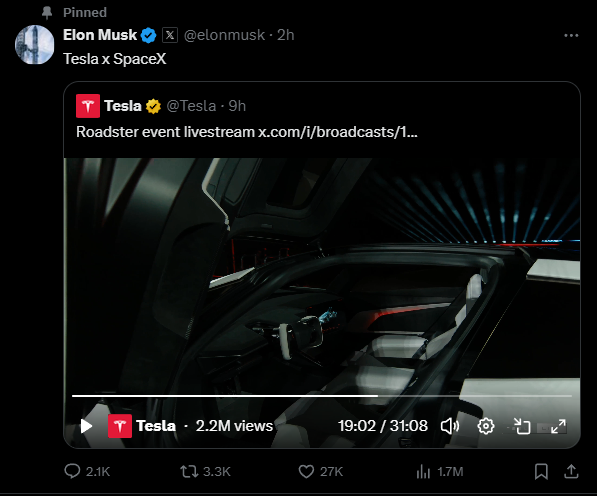
Elon's posts about the Roadster have also generated millions of views, while clips from the demonstration continue circulating across social media
But one thing needs to be clear: Elon Musk is talking about the actual Tesla Roadster, not solana:DFMt2FyLpB6ekPNAzVErLXgpSnJ9CRf1VnxBAkTLpump. There's no evidence of any official connection between this memecoin and Tesla, SpaceX, or Elon himself
So I see this as a strong attention-driven narrative, not a project backed by Tesla
2. Why did solana:DFMt2FyLpB6ekPNAzVErLXgpSnJ9CRf1VnxBAkTLpump pump so aggressively?
I think there are three main reasons
+ First is timing
The token launched right as attention around the Roadster event was exploding, allowing it to capture the initial wave of FOMO
+ Second is trading activity
Based on the data I've been tracking, 24-hour trading volume reportedly reached tens of millions of dollars while market cap was sitting around $5M. The reported holder count also surpassed 10K
That tells me there's a lot of speculative activity around this token. However, high volume doesn't necessarily mean fresh buying pressure, and a large holder count doesn't automatically mean healthy token distribution
+ Third is KOL participation
I've noticed quite a few KOLs and influential Solana traders starting to pay attention to solana:DFMt2FyLpB6ekPNAzVErLXgpSnJ9CRf1VnxBAkTLpump
One particularly interesting detail is that, based on the information I've gathered, @frankdegods reportedly bought around the $2M market cap level
That's a positive sign because when a token with a hot narrative starts attracting larger traders, attention can spread much faster
However, I wouldn't put too much weight on KOL buys alone
What matters more is whether they're still holding, adding to their positions, or already taking profits as the market cap increases
3. Onchain is my biggest concern
This is probably the most important part of my entire analysis
According to the onchain data I've been tracking, solana:DFMt2FyLpB6ekPNAzVErLXgpSnJ9CRf1VnxBAkTLpump has a bundle rate of approximately 60%
Personally, I consider that quite high, especially for a token that's only been live for around a day
It suggests that a significant portion of the initial buying activity was concentrated in bundled transactions
If those wallet clusters are still holding a substantial amount of supply, the potential selling pressure could become pretty serious as the price moves higher
That said, a 60% bundle rate doesn't automatically mean the dev controls 60% of the supply
To understand the actual concentration, we'd need to examine current balances, funding sources, and transfers between potentially connected wallets
Another thing worth mentioning is that the creator reportedly exited their position relatively early
That doesn't automatically mean the project is going to rug, but for a memecoin without real utility, a meaningful roadmap, or a strong publicly known team, these are risks I wouldn't ignore
With tokens carrying this much bundle exposure, I generally pay more attention to what the large wallets are doing than to the chart alone
If the price keeps pushing higher while those wallets begin transferring or distributing significant amounts of tokens, that's something I'd take very seriously
4. The main event is over, but Elon is keeping the narrative alive
This is actually one of the more interesting things about solana:DFMt2FyLpB6ekPNAzVErLXgpSnJ9CRf1VnxBAkTLpump right now
Although the Tesla Roadster demonstration has already taken place, @elonmusk is still actively posting about the Roadster and its SpaceX-related technology
And as you'd expect, his posts are consistently attracting millions of views
I think this matters quite a bit
Normally, event-driven memecoins tend to lose momentum once the main event is over. But in this case, Elon is continuing to generate attention around the exact narrative that solana:DFMt2FyLpB6ekPNAzVErLXgpSnJ9CRf1VnxBAkTLpump is built on
Every new post, video, or interaction gives the community another opportunity to bring the Flying Tesla Roadster story back into the spotlight
Of course, Elon is talking about the actual car, not the token. There's still no evidence that he has any connection to solana:DFMt2FyLpB6ekPNAzVErLXgpSnJ9CRf1VnxBAkTLpump
But from a memecoin perspective, direct endorsement isn't necessarily required for a narrative to benefit from someone's attention
As long as Elon keeps talking about the Roadster and those posts continue reaching millions of people, I think solana:DFMt2FyLpB6ekPNAzVErLXgpSnJ9CRf1VnxBAkTLpump could continue benefiting from that exposure
That said, millions of views don't automatically translate into buying pressure
What I'll be watching is whether each new wave of attention actually brings fresh liquidity into the token, or whether we're simply seeing existing holders trade among themselves
So while the biggest event has already happened, I wouldn't say the narrative is completely exhausted yet
For me, the key question now is whether Elon's continued attention can translate into sustained demand for solana:DFMt2FyLpB6ekPNAzVErLXgpSnJ9CRf1VnxBAkTLpump
5. My chart analysis and the levels I'm watching
solana:DFMt2FyLpB6ekPNAzVErLXgpSnJ9CRf1VnxBAkTLpump has already made an aggressive move from below $1M to nearly $6M market cap
After setting a short-term high, it pulled back toward $5M. The fact that it hasn't completely retraced the breakout is encouraging, but I still don't see a compelling reason to FOMO here
Especially considering that people who bought around $1–2M are already sitting on substantial profits
Combine that with the high bundle rate, and potential profit-taking becomes a serious factor
Here's my current plan :
> $3.5–4M : The first dip zone I'll be watching. We could see a short-term bounce if buying pressure remains strong, but I don't consider this a particularly attractive entry yet
> $2.5–3M : This is my preferred area to watch. If the price retraces here, selling volume starts drying up, and buyers step in to absorb the pressure, I might consider opening a small position
> $1.5–2M : A deeper retracement zone. There could be a technical bounce, but if price reaches this area, I'd need to reassess whether the narrative still has enough momentum
> Below $1M : I'd lean toward the scenario where momentum has significantly weakened. I wouldn't blindly buy just because the market cap looks cheap
On the upside, if solana:DFMt2FyLpB6ekPNAzVErLXgpSnJ9CRf1VnxBAkTLpump manages to break above the previous $5.8–6M high with convincing buying volume and holds that breakout, I think another leg higher is possible
But personally, I'd rather wait for a pullback than chase a token after such an aggressive move
Also, these dip zones are simply levels I'm watching, not guaranteed support
If major wallets start dumping simultaneously, price could easily slice through all of them without offering a meaningful bounce
6. My overall take
I think solana:DFMt2FyLpB6ekPNAzVErLXgpSnJ9CRf1VnxBAkTLpump has a strong narrative, excellent launch timing, and genuine speculative interest
The Tesla Roadster event created a story that's incredibly easy to spread, while participation from some KOLs gives the token another opportunity to attract attention
So I wouldn't rule out solana:DFMt2FyLpB6ekPNAzVErLXgpSnJ9CRf1VnxBAkTLpump continuing higher or even making a new ATH if Solana traders keep rotating liquidity into this narrative
However, there are three things preventing me from becoming overly bullish
First, the biggest catalyst has already happened. Most of the remaining momentum depends on the videos and social media posts continuing to circulate
Second, the reported 60% bundle rate represents a significant risk, especially when we don't yet know how much supply those wallet clusters are still holding
Third, market cap has already multiplied several times in roughly one day. Early buyers are sitting in a much better position, while new buyers are taking on considerably more downside risk
If you ask me whether solana:DFMt2FyLpB6ekPNAzVErLXgpSnJ9CRf1VnxBAkTLpump can still go higher, my answer is yes. But if you ask whether I'd buy around $5M right now, my answer is no
I'd rather wait for a clearer pullback, preferably toward the $2.5–3M area, provided the trading activity and price structure still look healthy
And if it keeps running without giving me an entry, I'm perfectly fine missing it
For me, solana:DFMt2FyLpB6ekPNAzVErLXgpSnJ9CRf1VnxBAkTLpump is more of a momentum and attention-driven trading opportunity than something I'd want to hold long term
A narrative can be incredibly strong, but at the end of the day, price still needs liquidity to sustain the move
DFMt2FyLpB6ekPNAzVErLXgpSnJ9CRf1VnxBAkTLpump
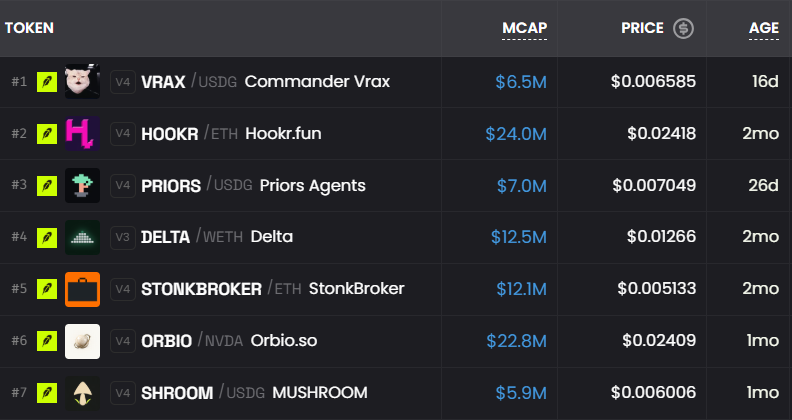
Volume on Robinhood Chain is still pretty weak, but I think another wave could be coming soon
I'm keeping an eye on projects with strong narratives, active teams, and potential catalysts
Skipping the well-known OG tokens, here are 7 projects currently on my watchlist
Feel free to share anything interesting I might have missed
1. $ORBIO
One of the more interesting AI projects I've come across on RH. The team raised around $1.2M to build an AI credit marketplace, allowing holders to stake ORBIO and earn CREDIT that can be used to access different AI models
Dev @0x_aster is also expanding into an agent launchpad and has already bridged CREDIT to Ethereum. Pairing the token with NVDA also gives it an interesting AI + stock narrative
What I like is that the team is actually building products rather than relying entirely on hype. Still, I'd like to see more real adoption before getting too bullish on its long-term potential
2. robinhood:0x18e674231a58c239dc7daedcffe15ec3a24cff5c
Probably one of the projects I rate the highest in terms of development activity on RH right now
Dev @NodarJ previously co-founded Zapper and is now focused on building modular Uniswap V4 hooks with features like anti-snipe protection, dynamic fees, auto-burn, and LP rewards
What's interesting is that the team keeps shipping updates and expanding partnerships, particularly with StonkBrokers to develop Pair Tokens and integrate hooks
I like the infrastructure direction here, especially if RH starts seeing more DeFi activity. However, third-party adoption and actual trading volume are still the two things that need to be proven
3. $VRAX
A pure meme built around Robinhood lore, but with a few interesting catalysts
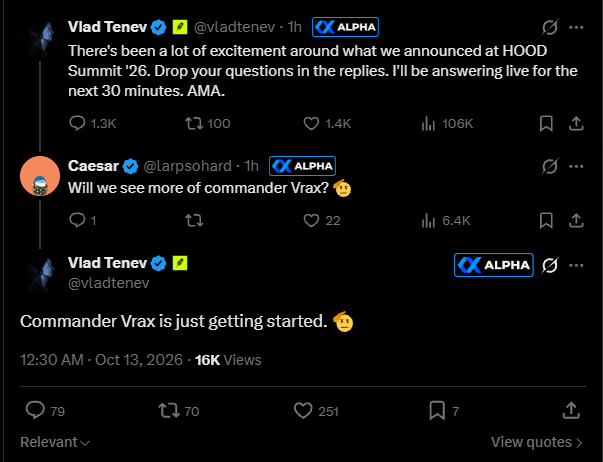
@vladtenev directly mentioned Commander Vrax twice during the October 12 AMA. On top of that, Bonk Guy (@theunipcs) has also bought $VRAX and has been sharing quite a few theses about it on FOMO
I think that's a pretty solid attention advantage, especially if Vlad mentions Vrax again or liquidity starts rotating back into RH
That said, it's still a pure meme driven mainly by narrative and KOL attention, without a real product supporting its long-term value
4. $STONKBROKER
Another project whose development direction I find pretty interesting
The team led by @OxSimpleFarmer is building several products around stock tokens, including ERC-6551 NFTs, NFT AMMs, loans, and Pair Tokens
They've also been working with HOOKR to develop applications using Uniswap V4 hooks
What I like is that they're trying to build an actual product ecosystem rather than relying entirely on memecoin hype
However, the products are still relatively complex, and the project needs more users and real trading volume to prove its value
5. $SHROOM
$SHROOM takes a slightly different approach by focusing on liquidity and stock tokens
The team has been developing single-sided LP mechanisms, MU rewards, and a system that uses part of the trading fees for token burns
The idea of turning memecoin attention into liquidity for stock tokens is pretty interesting, especially if the stock-paired meta continues to grow
Still, the project remains relatively small, most rewards depend on a limited number of pools, and development activity hasn't been as impressive as what we've seen from HOOKR or ORBIO
6. robinhood:0xedbf91223639800bcd5756815caf908df3b890be
robinhood:0xedbf91223639800bcd5756815caf908df3b890be follows the AI agent narrative, which I think could attract attention again if RH enters another wave
However, compared to ORBIO or HOOKR, I haven't seen enough evidence of a strong product or major development updates from the team
It's still worth keeping on the watchlist, but I'm not giving it much priority until we see clearer catalysts
7. robinhood:0xe8ffd7e24187f72afb08d75b1bb13088a989a791
A project focused on DeFi and liquidity, which could fit well if Robinhood Chain starts expanding further into onchain financial infrastructure
The idea itself isn't bad, but current TVL, usage, and actual activity still look pretty limited
I'd like to see more concrete progress from the team before becoming more bullish
+ Where I Stand
If we're talking about development activity, actual products, and long-term direction, my top three picks to watch are robinhood:0x18e674231a58c239dc7daedcffe15ec3a24cff5c, $ORBIO, and $STONKBROKER
For short-term attention, I'm keeping a closer eye on $VRAX, especially if Vlad mentions Commander Vrax again or the Robinhood narrative starts heating up
$SHROOM, robinhood:0xedbf91223639800bcd5756815caf908df3b890be, and robinhood:0xe8ffd7e24187f72afb08d75b1bb13088a989a791 are still on my watchlist, but I'd like to see stronger catalysts and more meaningful development before getting more interested
Overall, I'm still pretty bullish on the possibility of another wave coming to Robinhood Chain. But that doesn't mean every token in the ecosystem will benefit equally. Liquidity usually concentrates in a handful of projects with the strongest narratives and catalysts
Volume is still weak right now, so I'm not interested in FOMOing into anything. I'll keep tracking team activity, liquidity flows, and chart reactions to find better entries
This is just my personal watchlist, not a signal to buy right now
What other RH tokens are you guys watching? Drop them below. I'd love to discover a few interesting projects I might have missed
And the third token I want to cover in today's memecoin recap series is solana:5GDX5fJTQns4arM1J94wjxdA8KXFsV5qW46MLFpHpump
Unlike memecoins that rely purely on narratives or community hype, solana:5GDX5fJTQns4arM1J94wjxdA8KXFsV5qW46MLFpHpump is attempting to build a privacy toolkit on Solana, integrating Zcash and several other privacy-focused services
I've spent some time looking into its product development, the features introduced by the team, tokenomics, and the recent debate between the solana:5GDX5fJTQns4arM1J94wjxdA8KXFsV5qW46MLFpHpump and $VEIL communities
Overall, there are some interesting things happening on the product side. However, I still consider solana:5GDX5fJTQns4arM1J94wjxdA8KXFsV5qW46MLFpHpump a fairly risky gamble, especially after its sharp rally and subsequent correction, while major KOL attention and verifiable usage metrics remain limited
1. What is solana:5GDX5fJTQns4arM1J94wjxdA8KXFsV5qW46MLFpHpump actually building?
OMNI is built around the thesis "Everywhere. Unseen", aiming to let users make payments, transfer funds, swap tokens, and interact with blockchain services while minimizing the exposure of their primary wallet information
What's interesting is that the team isn't building its entire zero-knowledge infrastructure from scratch
Instead, OMNI uses Privacy Cash as one of its core privacy components, then builds additional interfaces and integrates other tools around it
Some notable features include :
> Private Balance : Allows users to deposit assets into shielded pools to reduce direct links to their primary wallets
> One-time Addresses and Session Keys : Help users receive funds and manage access without constantly exposing their main wallets.
> Random Delay Withdrawals : Introduce randomized withdrawal delays to make timing-based transaction correlation more difficult
> Shielded ZEC : Aims to connect the Solana ecosystem with Zcash's privacy capabilities
> Confidential AI Compute and MCP : Tools designed for private data processing and AI interactions
> Omni Vault : An asset protection mechanism using hash-based keys, marketed by the team as resistant to certain quantum-related risks
> Anonymous Launch : A tool designed to support token launches with greater privacy
What I find interesting is that the team isn't focusing on just one feature. They're trying to build a relatively comprehensive privacy toolkit
However, we need to distinguish between features that have a working interface, features that are actually functional, and technical claims that have been independently verified
Having a long list of features doesn't automatically mean they're all secure or have meaningful real-world adoption
2. Product development looks promising, but adoption remains questionable
One thing I like about OMNI is the team's shipping speed
According to their updates, they've been continuously adding and improving features such as address management, private balances, session keys, website performance, and user privacy protections
That's something I value more than projects that only have a polished website and a roadmap
However, when looking deeper into adoption, I still haven't found sufficiently convincing public data on actual users, total private transaction volume processed, revenue, or daily transactions specifically attributable to OMNI
The team has shared anonymity set figures of approximately :
> SOL : 854K notes
> USDC : 97K notes
> USDT : 9K notes
> ZEC : 1K notes
But these are team-reported figures and may reflect the underlying privacy infrastructure rather than activity generated exclusively by OMNI users
The anonymity set for ZEC also appears relatively small based on those numbers
So while I think OMNI's product direction is worth watching, I still want to see stronger evidence of adoption before considering it an established privacy project with proven market demand
3. Tokenomics and burn mechanism
Looking at tokenomics, solana:5GDX5fJTQns4arM1J94wjxdA8KXFsV5qW46MLFpHpump does have some mechanisms intended to create utility, but I don't think they're particularly strong yet
Based on the available information, users can pay with solana:5GDX5fJTQns4arM1J94wjxdA8KXFsV5qW46MLFpHpump to receive discounted fees when launching tokens through the anonymous launch tool
A portion of the tokens is also burned through related activities
The team has reported several burn events totaling approximately 6.89M solana:5GDX5fJTQns4arM1J94wjxdA8KXFsV5qW46MLFpHpump across four rounds, alongside additional burns associated with launch fees
That's a positive sign because the token has at least some utility and a supply-reduction mechanism rather than existing purely for speculation
But the real question is scale
With a reported supply of approximately 955M–965M tokens, burning 6.89M represents only around 0.7% of the supply
More importantly, the long-term impact depends on how many people actually use the product and pay fees in solana:5GDX5fJTQns4arM1J94wjxdA8KXFsV5qW46MLFpHpump
I haven't seen a mechanism strong enough to demonstrate that product adoption will consistently translate into meaningful buying pressure for the token
For now, I still see solana:5GDX5fJTQns4arM1J94wjxdA8KXFsV5qW46MLFpHpump primarily as a token driven by the privacy narrative and expectations surrounding future product development, rather than a utility token with a proven value-accrual model
4. The solana:5GDX5fJTQns4arM1J94wjxdA8KXFsV5qW46MLFpHpump vs $VEIL controversy
This is probably the most interesting part of my research
Recently, several members of the OMNI community have been accusing $VEIL of following the narrative OMNI introduced earlier
Their main argument is that solana:5GDX5fJTQns4arM1J94wjxdA8KXFsV5qW46MLFpHpump launched around October 2, while the $VEIL token launched around October 12
Both projects focus on privacy on Solana, private balances, and reducing the linkability of transactions to users' primary wallets
However, I don't think launch dates alone are enough to determine who copied whom
After looking into their product approaches, I see some fairly clear differences
solana:5GDX5fJTQns4arM1J94wjxdA8KXFsV5qW46MLFpHpump focuses more on integration and user experience
The team leverages existing privacy infrastructure, particularly Privacy Cash, and builds additional tools around it to serve different use cases
$VEIL positions itself as a project building deeper privacy infrastructure
According to VEIL's own claims, the team is developing its own ZK pool, using Groth16 circuits, browser-based proof generation, and its own onchain programs
VEIL has also introduced a mechanism that reportedly allocates 20% of protocol fees toward token buybacks
If properly implemented and sustained, this could create a more direct relationship between protocol activity and token demand
Of course, the technical claims, audits, and security guarantees of both projects still need independent verification
In my view, OMNI currently has an advantage in feature breadth and shipping speed, while VEIL has a more focused thesis around developing its own core privacy technology
Being first doesn't necessarily mean winning
In crypto, attention, adoption, product quality, and user retention matter far more over the long run
5. Community and KOL attention
This is one area where I'm not particularly impressed with solana:5GDX5fJTQns4arM1J94wjxdA8KXFsV5qW46MLFpHpump yet
Based on the information I've gathered, the token has approximately 2.9K–3K holders and has reportedly recorded around $1M–$2M in daily trading volume
However, most of the meaningful promotional activity still appears to come from the official team account, existing supporters, and a relatively small community
I haven't seen many major Solana or CT KOLs independently publishing detailed theses about solana:5GDX5fJTQns4arM1J94wjxdA8KXFsV5qW46MLFpHpump
Some of the recent attention also comes from the ongoing arguments between the OMNI and VEIL communities
Drama can generate short-term visibility, but it doesn't guarantee that capital will stick around
What I'd like to see next is influential accounts becoming genuinely interested in the product, rather than simply debating which project copied the other
Also, high trading volume doesn't necessarily mean sustainable buying demand. It can include short-term speculation and repeated trading activity between wallets
6. Current chart and trading plan
Looking at the 15-minute chart, solana:5GDX5fJTQns4arM1J94wjxdA8KXFsV5qW46MLFpHpump experienced a strong rally from a relatively low market cap to approximately $2M–$2.2M before facing heavy selling pressure
In the chart I reviewed, the token was trading around a $730K market cap, representing a correction of approximately 65–67% from its peak
What's particularly noticeable is the volume spike during the rally, followed by the price failing to hold its higher levels
That suggests significant selling and profit-taking pressure
I don't want to FOMO into a chart like this, especially when the token is still relatively new and highly volatile
Here's my current plan :
> Watch zone : $300K–$400K market cap. This is the area I'll be monitoring if the correction continues
> Potential entry : I'd only consider entering if the price holds support, selling pressure starts fading, and buying volume returns
> Invalidation : If it breaks below $300K and fails to reclaim that level quickly, I'll simply move on rather than trying to DCA into a falling chart
> Position sizing : If I decide to participate, it'll only be a small gamble. This isn't something I'd size heavily into
The $300K–$400K range is an area I'm interested in watching, not a guaranteed support zone
I also wouldn't rule out a strong recovery if the privacy narrative attracts fresh capital again
But at this stage, I don't see enough evidence to confidently expect solana:5GDX5fJTQns4arM1J94wjxdA8KXFsV5qW46MLFpHpump to revisit its ATH anytime soon
7. Risks worth considering
Despite the interesting product direction, there are still several important risks
First is the dependency on Privacy Cash
Integrating existing infrastructure allows OMNI to ship faster, but it also creates risks if the underlying protocol experiences technical problems or changes its policies
Second, token utility remains relatively limited
The burn mechanism is a positive, but it isn't enough to support a strong investment thesis without meaningful growth in actual usage
Third, there's still a lack of transparent public metrics showing OMNI's own user activity, revenue, and product adoption
Finally, there's market risk
solana:5GDX5fJTQns4arM1J94wjxdA8KXFsV5qW46MLFpHpump remains a small-cap token launched through https://t.co/MDT1D8rHCr, making it highly sensitive to speculative flows, liquidity conditions, and shifts in attention
I also don't have enough verified onchain data yet to draw conclusions about supply concentration, bundle clusters, or the extent of token control among potentially connected wallets
That's something I'd want to investigate further before increasing my conviction
8. Overall assessment
Overall, I think solana:5GDX5fJTQns4arM1J94wjxdA8KXFsV5qW46MLFpHpump is an interesting project to watch within the Solana privacy narrative
Its strongest points are a relatively clear product direction, fast development cycles, and the ability to combine multiple privacy tools within a single interface
However, I'm still not bullish enough to consider this a high-conviction long-term hold
Having a promising product doesn't automatically translate into strong token performance
OMNI still needs to prove real adoption, strengthen its token utility, and attract capital beyond its existing community
Compared with $VEIL, I believe the two projects are pursuing different approaches
OMNI focuses more on user experience and integration, while VEIL positions itself around building core ZK infrastructure
I wouldn't declare either project superior based solely on narratives or team claims
For me, solana:5GDX5fJTQns4arM1J94wjxdA8KXFsV5qW46MLFpHpump is currently a speculative gamble backed by an interesting product thesis, not a high-conviction investment
I'll continue watching the $300K–$400K market cap range
If price action looks healthy and buyers start stepping in, I might consider taking a small position
But if it loses $300K, I'll move on and look for another opportunity
In a low-volume market like this, protecting capital matters more than trying to catch the exact bottom of every token
5GDX5fJTQns4arM1J94wjxdA8KXFsV5qW46MLFpHpump
Continuing today's memecoin recap series
The first token I want to cover today is $WOLFPACK
This has been one of the hotter names on Robinhood Chain recently, and quite a few people have been asking me to take a closer look at it
After spending some time digging into the narrative, Hooke Protocol, liquidity structure, and the team's recent announcements, I think there's actually an interesting story behind $WOLFPACK
However, there are also several things worth understanding before putting money into it
1. First, what exactly is $WOLFPACK?
The most interesting part of this token is its narrative against Wolfpack Research, a well-known short-selling firm that previously published a highly critical report on XMax ($XMAX, formerly $XWIN)
The $WOLFPACK team is using the Wolfpack name to build an opposing narrative, positioning themselves as the "Wolfpack of Robinhood" and trying to turn the token into a Wall Street meme that rallies the community against short sellers
They've also been pushing the potential $XMAX short squeeze narrative, alongside memes like the dancing wolf to attract attention
According to figures previously circulated within the community, $XMAX short interest was reportedly around 9.22M shares, equivalent to nearly 17 days to cover
I haven't independently verified whether those figures are still accurate, so I wouldn't treat them as current short interest data
And of course, high short interest doesn't automatically mean a short squeeze will happen. Even if $XMAX stock rallies significantly, that doesn't necessarily mean $WOLFPACK will benefit directly
2. The connection with Hooke Protocol is where things get more interesting
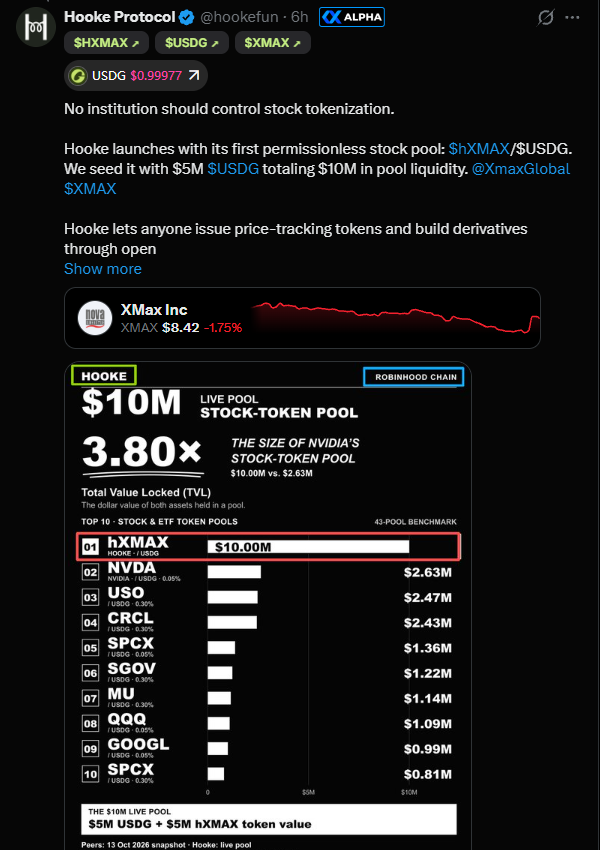
Hooke Protocol (@hookefun) is developing a permissionless stock tokenization model on Robinhood Chain, using Uniswap V4 hooks and a dynamic trading tax mechanism
One of its main products is $hXMAX, a tokenized stock designed to track the price of $XMAX shares through an oracle
It's important to understand that $hXMAX isn't actual XMAX equity. It's an onchain token designed to replicate the stock's price movements
According to Hooke's announcements, the protocol uses a dynamic trading tax of around 2–4%, with the collected revenue flowing into its treasury
The $hXMAX/USGD pool was initially announced with approximately $10M in liquidity. Hooke also stated that the liquidity had been locked for 21 days
However, a liquidity lock only restricts withdrawals during the lock period. It doesn't guarantee price stability or eliminate trading risks
And this is where $WOLFPACK comes into the picture
Rather than existing as a standalone meme, $WOLFPACK is directly paired with $hXMAX, creating a connection between memecoins, tokenized equities, and the short squeeze narrative in traditional markets
I actually find the structure quite clever
The meme attracts attention, that attention brings users toward $hXMAX, trading activity generates revenue for Hooke, and part of that revenue is expected to flow back into supporting $WOLFPACK
But there's a difference between a model that looks good on paper and one that has actually proven itself
3. The biggest catalyst right now is the buyback mechanism
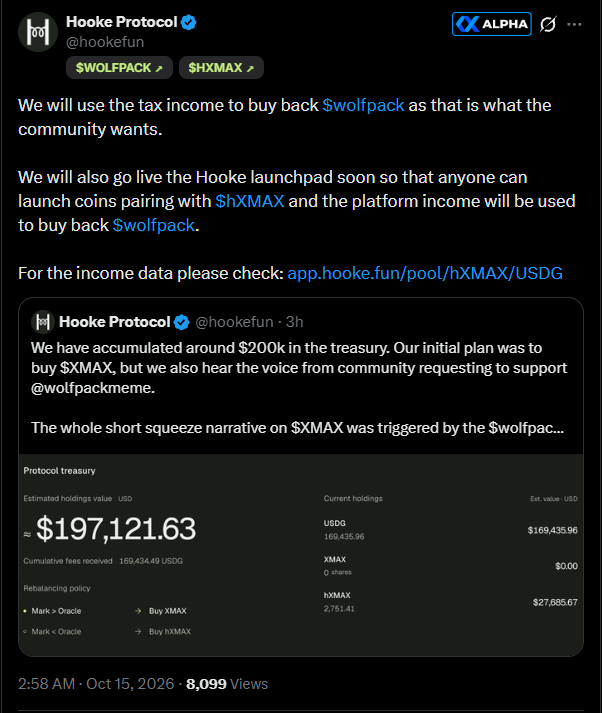
Hooke has publicly announced plans to use tax revenue generated from $hXMAX trading activity to buy back $WOLFPACK, instead of prioritizing $hXMAX buybacks as originally planned
They've also mentioned using future launchpad revenue to continue buying back the token
To me, this is what makes $WOLFPACK different from many ordinary memecoins
If Hooke actually implements consistent buybacks, the token could benefit from an additional source of demand beyond speculative community buying
But there's one extremely important detail here
$WOLFPACK itself is essentially a standard ERC-20 token
Based on the contract information available to me, its source code hasn't been verified. That's a significant risk because it prevents a complete review of potential administrative privileges and hidden contract functions
I also haven't seen evidence confirming any built-in tax, burn, or automatic buyback mechanism within the token contract itself
In other words, the proposed buyback mechanism operates outside the token contract and depends entirely on Hooke's decisions and execution
At the time of my research, I hadn't found onchain evidence confirming that Hooke had actually executed any $WOLFPACK buybacks
There were also no verified figures showing how many tokens had been repurchased or how much capital had been deployed
Hooke previously mentioned a treasury of approximately $200K, but I haven't seen a sufficiently detailed public dashboard to verify the balance, actual tax revenue, or funds allocated toward buybacks
So for now, I still consider this a commitment from the team rather than a proven mechanism generating consistent buying pressure
4. Another important point is $WOLFPACK's actual position within the ecosystem
In my view, the core alpha Hooke is trying to build lies in $hXMAX and its stock tokenization infrastructure, not necessarily $WOLFPACK itself
$hXMAX is the main product, while $WOLFPACK functions more like an attention layer attached to the ecosystem to attract users and strengthen the narrative
That's not necessarily a bad thing
In memecoin markets, attention can sometimes matter more than utility, especially when a token can continuously benefit from activity surrounding a related product
But it also means $WOLFPACK is heavily dependent on Hooke
If $hXMAX loses trading volume, the launchpad gets delayed, or Hooke stops supporting the token, the current narrative could weaken very quickly
It's also worth mentioning that the launchpad is still in the planning stage, and I haven't seen a concrete launch timeline
Therefore, any future launchpad revenue allocated toward buybacks remains speculative at this point
5. Let's talk about the team and transparency
The official @wolfpackmeme account was created on September 7, 2026
It's still relatively new, with no publicly disclosed founder or identifiable development team
Hooke Protocol also hasn't clearly disclosed the identities of the people behind the project, based on the information I've gathered
One interesting detail is that both @wolfpackmeme and @hookefun were reportedly created on the same day, September 7, 2026, and both show Taiwan as their signup country
That's an interesting coincidence worth paying attention to
However, it's nowhere near enough evidence to conclude that both projects are operated by the same team or individuals
I also haven't found evidence that Vlad Tenev, Robinhood, or other major public figures have directly acknowledged or officially supported $WOLFPACK
Just because a project is building on Robinhood Chain doesn't mean Robinhood itself is backing it
That's an important distinction
6. Now let's look at the chart, which is what matters most to me when planning an entry
$WOLFPACK had an explosive move from a very low market cap to an ATH of approximately $6.5–6.8M before correcting back toward $2M
That's nearly a 70% drawdown from the top
Looking at the current structure, selling pressure appears to have cooled significantly compared to the initial distribution phase
However, the chart is still forming lower highs, and trading volume has also been declining
Based on my personal observations, the current $2M market cap area looks relatively reasonable for a small speculative bet if you're comfortable with the risk
That said, there's still no confirmed reversal
For those looking for a more conservative entry, I'd personally prefer waiting for a dip toward the $1.4M market cap area and watching how price and buyers react there
If market cap breaks below $1M, I'd cut the position rather than stubbornly holding and hoping the narrative comes back
Another thing worth considering is liquidity
The token's liquidity is still relatively thin compared to its volatility, so don't focus solely on market cap while ignoring slippage and how difficult exiting a position could become during heavy selling
7. So what could actually push $WOLFPACK higher from here?
I think there are three main catalysts worth watching
First, Hooke needs to execute real buybacks and publicly share the onchain transactions
That would be the most important step in turning the current narrative from promises into something measurable
Second, the Hooke launchpad needs to go live
If the platform allows projects to launch tokens paired with $hXMAX and successfully generates revenue, the buyback model could gain a more sustainable source of funding
Third, we need to watch the performance of $XMAX stock and whether the short squeeze narrative continues attracting attention
If that story gains momentum, $WOLFPACK could benefit from the additional exposure
On the other hand, if there are no buybacks, no meaningful product updates, and trading volume continues fading, I think it'll be difficult for the token to maintain momentum purely through memes
Overall, I see $WOLFPACK as an interesting narrative play, but still a highly speculative one
I like how the team has connected Wolfpack Research, the $XMAX short squeeze story, and Hooke Protocol into a relatively unique narrative
The fact that Hooke has publicly committed to using revenue for buybacks is particularly worth monitoring
But before increasing my conviction, I want to see actual buyback transactions, more transparent treasury data, and clearer progress on the launchpad
For now, I think $WOLFPACK could be worth a small gamble at the right entry, but it's not something I'd size heavily into based on the current information
If you're already holding, I'd keep an eye on price action around $2M and any updates from Hooke
If you're not in yet, there's no reason to FOMO. I'd rather wait patiently for a better entry
The narrative is there. The attention is there. What's missing now is execution from the team
0x5199ea953D71D6a5413bE1b2EFeCD26aAcab0000
Back to solana:6Mix12LiHrQFojaQEnfPUC65Qkwd6X4Y5Qg93oFbordr
Quite a few things have changed since my previous research on solana:6Mix12LiHrQFojaQEnfPUC65Qkwd6X4Y5Qg93oFbordr, so I think it's time for another update
In my October 12 post, when solana:6Mix12LiHrQFojaQEnfPUC65Qkwd6X4Y5Qg93oFbordr was trading around $4–5M MC, I mentioned that the technology behind Bordrless looked pretty interesting, but the R/R wasn't attractive enough for me to chase. Instead, I was watching the $2.5–3M dip zone
Interestingly, solana:6Mix12LiHrQFojaQEnfPUC65Qkwd6X4Y5Qg93oFbordr pulled back right into that area before bouncing hard, breaking above $5M and eventually pushing toward $9.5M MC. That's roughly a 2.5–3x move from the dip, with the token currently trading around $7.4M
But the chart isn't the only reason I'm revisiting this project
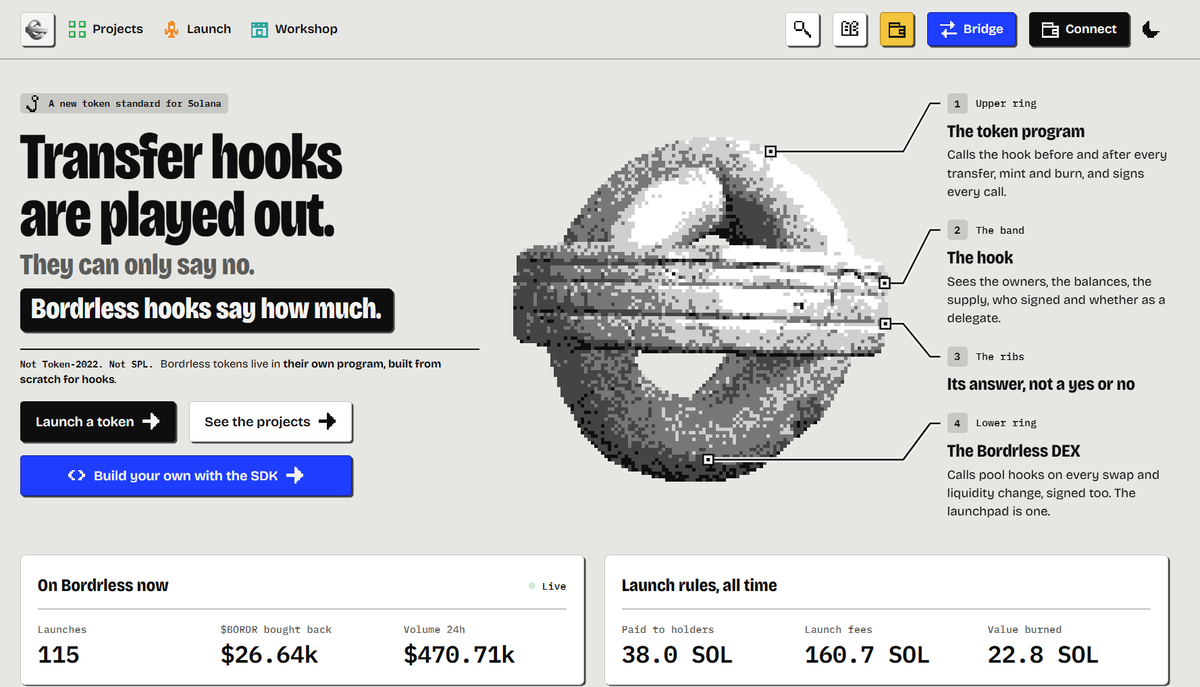
Over the past two days, the number of tokens launched on Bordrless has increased from 85 to 115, while the platform's 24-hour volume has grown from approximately $346.5K to $473K
More importantly, cumulative buybacks have climbed from $9.2K to around $27.38K, nearly tripling in just two days
Holder rewards have also increased from 19.8 to 37.9 SOL, creator fees from 65.3 to 160.6 SOL, and total SOL burned from 12.3 to 22.7 SOL
For a platform that only launched recently, I think these are pretty encouraging numbers
At least the mechanism allocating 50% of protocol revenue toward solana:6Mix12LiHrQFojaQEnfPUC65Qkwd6X4Y5Qg93oFbordr buybacks is actually operating rather than just sitting on a roadmap
One important detail, though: the repurchased tokens are held in the protocol treasury rather than automatically burned. And while the growth looks impressive, roughly $27K in cumulative buybacks is still relatively small compared to a token trading around a $7M MC
On the product side, the team has also been shipping at a pretty solid pace
Axiom integration is now live, allowing BTS tokens to trade through the terminal while their hooks continue functioning
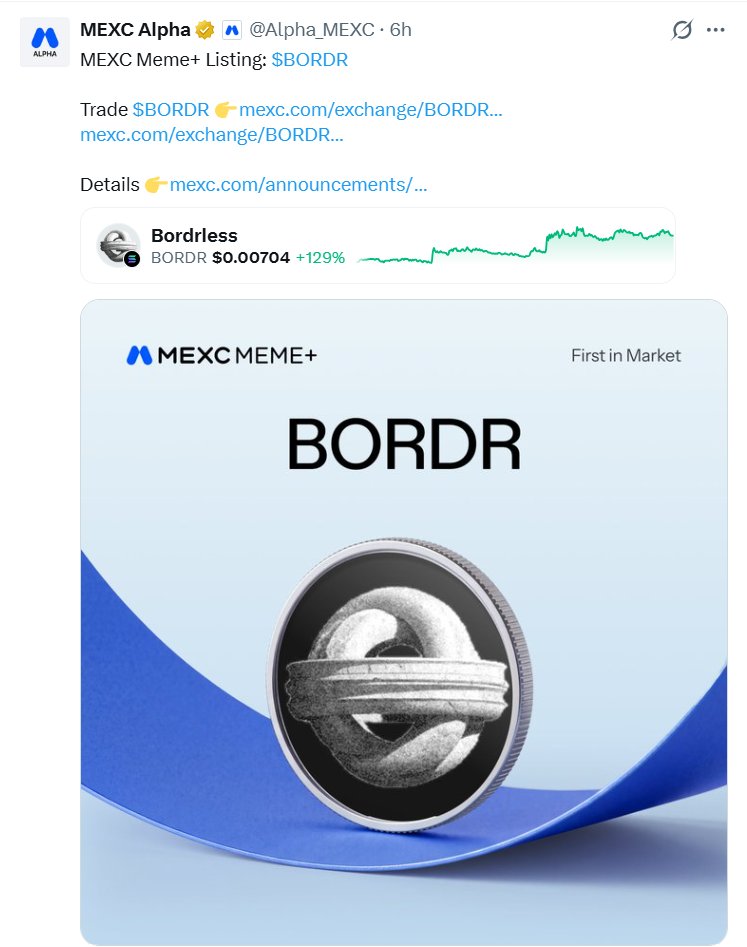
solana:6Mix12LiHrQFojaQEnfPUC65Qkwd6X4Y5Qg93oFbordr has also been listed on MEXC and verified on Fomo
On October 13, the team shipped five mainnet upgrades at once, including integration fees of up to 1% for terminals and bots, creator fee splitting across up to 10 wallets, improved SOL payments through Companions, a new router, and Workshop support that allows builders to create hooks with 0% fees
They also released SDK 0.10.0, which has surpassed 1,000 NPM downloads, increased the creator/partner fee limit to 10%, and introduced a Curve Fill update on October 14 to improve how purchases are handled at the end of the bonding curve
Another feature I find interesting is Lossback, a hook designed to read onchain P&L data and potentially distribute rewards to holders sitting at a loss
It's an interesting concept, although I'd still like to see how effectively it works in practice
What I like about Bordrless is that the team isn't simply building a new token standard and waiting for people to adopt it
They're actively improving the infrastructure for creators, builders, and trading terminals while expanding what programmable hooks can actually do on Solana
However, there's still one major issue I highlighted in my previous research that hasn't really changed
The launchpad still hasn't produced a meaningful runner
115 launches is a decent number for such a young platform, but most of those tokens are still sitting at relatively small market caps
$BCAT remains one of the more notable examples, and based on the data I've reviewed, I still haven't seen a confirmed runner breaking into the $200–300K MC range and attracting broader attention from Solana CT
This is probably the biggest weakness in the current thesis
Good technology can attract developers, but a launchpad also needs successful tokens to bring in traders, liquidity, and sustained attention
That's why I think the next integrations will matter quite a bit
Axiom is an important first step, but I'd still like to see Jupiter and GMGN supporting BTS directly
From the updates I've followed, the team submitted an integration request to Jupiter earlier on, but there's still no official confirmation that Jupiter or GMGN support is live
Fomo verification is also not the same as full BTS trading integration
If more major terminals start supporting BTS and the launchpad manages to produce a few runners around $300–500K MC using mechanisms like Half-Life, Companions, or Lossback, I think the solana:6Mix12LiHrQFojaQEnfPUC65Qkwd6X4Y5Qg93oFbordr thesis could become significantly more convincing
There's also an important technical risk worth mentioning
The protocol still retains upgrade authority, and I haven't seen confirmation of a transition to multisig and timelock controls
For infrastructure handling relatively complex tokenomics, I consider this one of the biggest remaining risks
Now, looking back at the chart
After moving from the $2.5–3M dip zone to nearly $9.5M MC, I don't find the R/R of chasing at current levels particularly attractive
The 4H chart shows strong buying pressure during the breakout, but also noticeable selling as price approached the recent highs
Volume expanded during the breakout compared to much of the earlier consolidation, although I'll be watching whether that activity can hold up once the initial excitement cools down
For those who caught the previous dip and are already sitting on profits, I'd lean toward securing some gains while keeping a smaller position to follow upcoming catalysts
For anyone without a position, I'd rather watch how price reacts around $5.5–6M MC if we get another pullback
The $4.5–5.5M area could offer a more attractive R/R, assuming the market structure and fundamentals remain intact
If solana:6Mix12LiHrQFojaQEnfPUC65Qkwd6X4Y5Qg93oFbordr loses $5M with significant selling pressure, I'd reassess the setup entirely
Overall, I'm slightly more positive on solana:6Mix12LiHrQFojaQEnfPUC65Qkwd6X4Y5Qg93oFbordr than I was in my first research post
The team is clearly building, development has been moving quickly, buybacks are growing, and market accessibility is gradually improving
But one thing hasn't changed in my view
Good technology doesn't automatically translate into a successful token
Right now, Bordrless is doing a pretty good job on the infrastructure side, but it still hasn't fully proven that its launchpad can attract meaningful and sustainable trading activity
I'll continue tracking new integrations, protocol revenue, buybacks, and especially the first major runner from the ecosystem
If all three start improving together, I think there's a legitimate case for the market to reassess solana:6Mix12LiHrQFojaQEnfPUC65Qkwd6X4Y5Qg93oFbordr's valuation
For now, though, I still like the thesis more than I like chasing a green candle
6Mix12LiHrQFojaQEnfPUC65Qkwd6X4Y5Qg93oFbordr
Back to solana:HgTGdc29D5bDMrDvsCLnorxz899VyDj7ZN7FPa6vpump
After my previous two deep dives into the product and onchain activity, I've spent more time tracking the major bundle clusters, the team's activity, and recent developments. There are quite a few interesting things worth discussing, and my perspective on this one has shifted slightly
First, the chart. solana:HgTGdc29D5bDMrDvsCLnorxz899VyDj7ZN7FPa6vpump ran from around $7M to nearly $19M market cap before pulling back toward $11–12M. Interestingly, it retraced into the dip zone I had been watching and bounced pretty nicely. I managed to catch that dip, and my position is currently in profit
But what interests me most is still the behavior of those bundled wallets
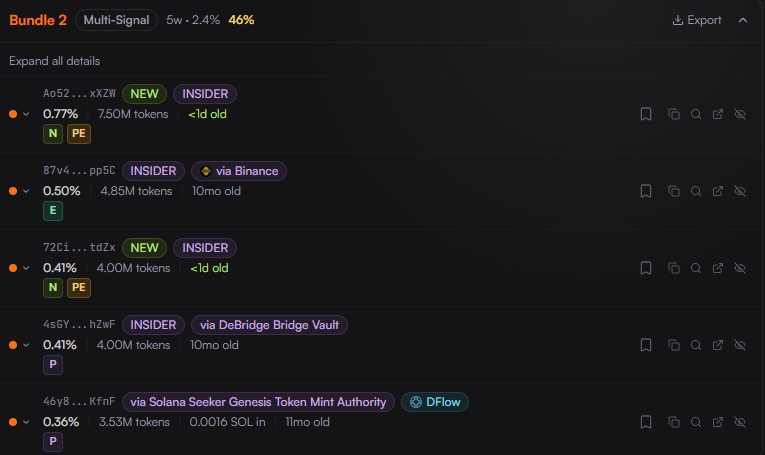
In my previous research, I identified 3 major bundle clusters involving 89 wallets, collectively holding around 28.3% of the total supply
After digging deeper into fresh wallets, funding sources, and related transactions, I now estimate that the actual supply potentially controlled by connected wallet groups could be as high as 70%
Most of these wallets are relatively new, with funding coming from multiple sources, including Binance, KuCoin, Bybit, Gate, Bitget, and various swap services. Using different funding routes makes it harder to identify every connection through Bubblemaps alone
Of course, that 70% figure is my own estimate based on onchain research, not a fully verified number. I also can't definitively say that every wallet belongs to the team or MM
What's interesting is that the major bundle clusters I've been tracking still haven't shown significant selling activity, even when solana:HgTGdc29D5bDMrDvsCLnorxz899VyDj7ZN7FPa6vpump reached nearly $19M market cap
That's what made me start looking at this differently
If this were simply a short-term pump, that valuation would have provided a pretty decent opportunity to distribute supply. Instead, I haven't observed major selling from the clusters I'm monitoring, while the team continues developing the product and maintaining attention around the token
I'm starting to lean toward the possibility that they're trying to position solana:HgTGdc29D5bDMrDvsCLnorxz899VyDj7ZN7FPa6vpump as a flagship token to bring more attention to their privacy product, rather than launching another memecoin and abandoning it
Still, not selling near the top doesn't guarantee they'll keep holding. If supply concentration really is close to 70%, even a relatively small portion being distributed could create substantial selling pressure
On the product side, I have to give the team credit for their execution so far
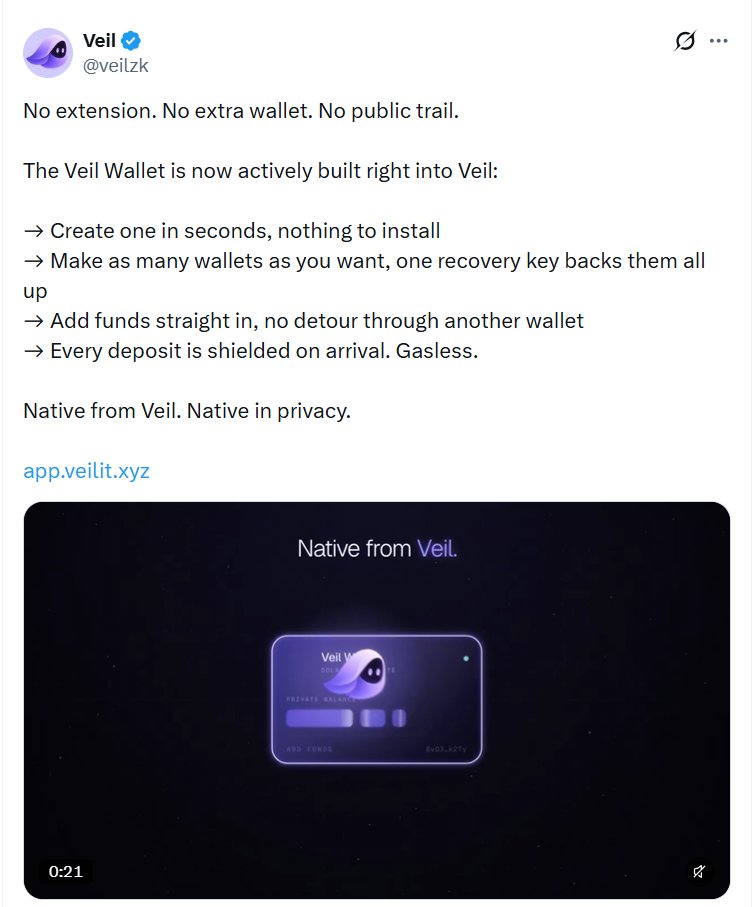
Veil Wallet has been introduced with the ability to create wallets directly inside the app/browser, manage multiple wallets through a single recovery key, shield assets, and provide a gasless experience
More importantly, the Veil Wallet Chrome Extension is already live, marking another step toward making its privacy tools more accessible to everyday users
The team has also shared updates on the referral program and upcoming features such as Private DCA, Google Wallet integration, and trading rewards
What I like is their focus on UX. They're trying to make privacy part of the everyday wallet and DeFi experience rather than simply promoting another complicated ZK solution
However, there are still things that need to be proven. The team's reported 95/100 audit score doesn't mean the entire system has been independently audited. The concerns I mentioned in my first research regarding ZK circuits, relayers, the anonymity set, and deployed program verification still need to be addressed
More importantly, actual adoption still hasn't caught up with the valuation
Based on the latest figures available to me, app volume remains around $18K+, crowd size is roughly 500, while private pool notes have increased from 496 to approximately 778
That's a positive improvement, but notes don't necessarily represent unique users, and those numbers are still relatively small compared with the token's current market cap
The proposed mechanism to allocate 20% of net revenue toward solana:HgTGdc29D5bDMrDvsCLnorxz899VyDj7ZN7FPa6vpump buybacks is also worth watching, but I'd still like to see actual buyback transactions publicly disclosed and verifiable onchain
With the Chrome Extension already launched, the next thing I'll be watching is whether it can actually attract new users and generate meaningful activity
Private DCA and other upcoming features could provide additional catalysts, but their real impact will depend on adoption rather than announcements alone
Another thing worth mentioning is that KOL attention remains relatively limited. I haven't seen many tier 1 KOLs actively pushing this narrative yet
If the team keeps delivering and fresh capital starts flowing in, I think solana:HgTGdc29D5bDMrDvsCLnorxz899VyDj7ZN7FPa6vpump still has room to attract more attention. But attention alone isn't enough to justify the valuation
As for my current plan, for those who caught the dip and are already in profit like me, I'd prioritize protecting gains. Taking some profits while leaving a portion running makes sense if the chart remains strong. I'll be watching the $14–16M area for potential price reactions if we get another push higher
For those who haven't entered yet, I wouldn't recommend chasing around $11–12M
I'm watching $10–10.5M as the first potential pullback zone, with $8–9M as a deeper area of interest if the market corrects further
These are areas where I'd look for buyers to step in, not automatic entry levels. A healthy consolidation or a confirmed breakout followed by a successful retest with strong volume could also present another opportunity
If the chart loses key support while major bundle wallets begin distributing aggressively, I'll reassess the thesis rather than blindly DCA
Overall, I'm slightly more positive on solana:HgTGdc29D5bDMrDvsCLnorxz899VyDj7ZN7FPa6vpump than I was in my previous two research posts
The team continues shipping updates, the Chrome Extension is already live, the major bundles haven't shown significant selling activity based on what I've tracked, and the chart has reacted relatively well after pulling back from its ATH
I wouldn't rule out the possibility that the team is trying to build solana:HgTGdc29D5bDMrDvsCLnorxz899VyDj7ZN7FPa6vpump into a flagship token for their privacy product. If that's the case, it could become an interesting narrative to follow
But with my estimated supply concentration potentially reaching 70%, the risks are still substantial
What I want to see next is meaningful growth in adoption, transparent buybacks, and enough independent buying demand to absorb the concentrated supply if larger wallets eventually start distributing
A team can hold supply to maintain momentum, but sustainable growth ultimately requires real users and genuine demand
For now, I'm still holding part of my position and keeping a close eye on developments
The thesis remains interesting, but I'm not going to get complacent just because the chart looks good and my position is in profit
HgTGdc29D5bDMrDvsCLnorxz899VyDj7ZN7FPa6vpump
This is the kind of research CT needs more of. Not just charts and narratives, but actual wallet tracking and supply analysis
Worth reading
$VEIL
HgTGdc29D5bDMrDvsCLnorxz899VyDj7ZN7FPa6vpump
Quite a few people asked me to dig deeper into $VEIL's onchain activity after my previous research, so I spent some more time looking into the bundle clusters, funding sources, and wallet behavior. There are a few interesting things worth highlighting
Based on the data I've checked, $VEIL currently has 3 major bundle clusters involving 89 wallets, holding around 28.3% of the total supply. The largest cluster consists of 81 wallets holding 24%, while the other two contain 5 wallets holding 2.4% and 3 wallets holding 1.8%
Here are the three main wallets for anyone who wants to check them onchain :
Bundle 1 :
AFex6BqxsUrghsK4mBPmcW3uftLr8xiC8Phu9NPddyLu
Bundle 2 :
3ro1o7ra67synwxkBSWty58exbVRF4Pm9uYpZWvXMLam
Bundle 3 :
AWx3ZWkGq3wg44myjaCcVbVPew6SUjAkKa8wBQEHHwGN
But I don't think 28.3% tells the full story of the actual supply concentration. Among the top 100 holders, there are still plenty of fresh wallets and wallets funded through different sources that haven't been linked to these three clusters
The funds I've traced are connected to Binance, KuCoin, Gate, Bybit, Bitget, and several other exchanges. Some funds have also been routed through different swap services
Most of these bundled wallets were less than a day old when I checked them. This makes me suspect the team or MM may have used tools to create wallets and distribute funds in bulk. That could also explain why the connections are still visible on Bubblemaps, and it definitely adds another layer of risk to this play
What's interesting, though, is that these bundle clusters haven't sold much so far, while $VEIL's chart is still holding up relatively well
Large bundles are nothing unusual in memecoins. If the team really controls this supply and continues holding, it could limit short-term selling pressure. But on the other hand, it also means a small group could create significant selling pressure once enough liquidity enters the market
Dev holding doesn't automatically mean accumulation. What I want to see is genuine buying demand, growth in independent holders, and organic trading volume, rather than a chart being supported mainly by MM activity
On the positive side, the $VEIL team seems to be putting serious effort into the product and continues shipping updates. KOL attention is still relatively limited, so the narrative may have more room to grow if fresh capital starts flowing in
However, the current valuation is already quite high. Even with an active team and bundles that haven't dumped, the R/R for new entries is no longer as attractive as it was earlier, especially when actual supply concentration could be higher than the detected 28.3%
Personally, I'm still waiting for a dip, but I'll be extremely cautious. For those who got in much lower, I'd prioritize managing profits. If you're not holding yet, I'd rather wait for a proper pullback or a clearer consolidation range instead of chasing at the current valuation
Overall, $VEIL has some positives in terms of product development and chart structure, but its onchain supply distribution remains the biggest risk
The real question isn't just whether the dev continues holding. It's whether fresh liquidity will be strong enough to absorb that concentrated supply once the larger wallets start distributing
A good-looking chart doesn't always mean a healthy holder structure
HgTGdc29D5bDMrDvsCLnorxz899VyDj7ZN7FPa6vpump
Continuing today's memecoin recap series
The first token I want to cover is $VEIL, a newly launched PumpFun token that's been getting quite a bit of attention around the privacy narrative on Solana
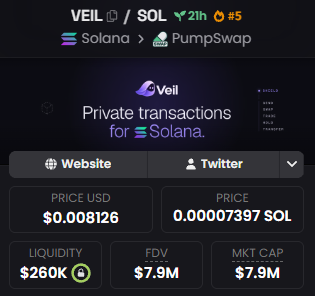
The chart has been pretty impressive. After its initial run toward $4–4.5M, $VEIL pulled back to around $2M, consolidated, and eventually broke out
Buyers stepped back in aggressively after the latest pullback, pushing the token past its previous highs to around $7.2M market cap, with the chart currently showing roughly $7.1M
I spent some time digging into the product, technology, team, tokenomics, and actual usage metrics. There's quite a bit worth discussing here, including a few things I think the market might be overlooking
1. What is Veil actually building?
Veil is essentially a privacy layer on Solana that allows users to hide their balances and DeFi activity through zero-knowledge proofs
Users can shield SOL, USDC, or other supported SPL tokens into a private balance, then make private transfers, swap through Jupiter, or access lending features without publicly exposing their entire transaction history
What caught my attention is the focus on UX
Instead of building another complicated privacy tool, Veil is trying to bring privacy into a familiar wallet experience, allowing users to shield once and continue using DeFi privately
Under the hood, the protocol uses Groth16 proofs, Poseidon Merkle trees, and client-side proof generation
According to the team, mainnet went live on October 4
That's already a meaningful difference compared with many PumpFun tokens. There's an actual application to examine rather than just a website and a roadmap
2. Is the Solana privacy narrative worth paying attention to?
Personally, I think so
Privacy has been gaining attention within the Solana ecosystem, but Veil isn't the first project exploring this space
Privacy Cash already has a much larger operational footprint. Umbra is working on private wallets and DeFi, while Arcium focuses on confidential computing infrastructure
Veil's approach is slightly different. The idea is to shield assets once and continue using multiple DeFi services within the same private balance
If the team executes well on UX, I can see why this could attract users
However, I wouldn't say Veil has established a strong competitive moat yet. ZK technology alone doesn't automatically make it better than existing privacy protocols
3. Team, technology, and security
According to the project's description, Veil was developed by former contributors to Monero's CLI and GUI
If true, that's a relevant background for a privacy-focused product. However, the team remains anonymous, and I haven't found enough independent evidence to verify those connections
On the security side, Veil reports a 95/100 ContractWolf audit score, with 522 automated checks and 27 attack scenarios tested
One technical detail I find particularly interesting is the Trusted Setup Ceremony
The team has published ceremony materials and hashes, allowing users to independently check the proving key, verification key, and ZK circuit artifacts
That's a meaningful step toward technical transparency
Veil also uses a 2-of-2 multisig and client-side ZK proof generation, meaning private keys don't need to leave the user's browser
Still, there are some important limitations
Veil doesn't provide absolute privacy
Shielding and withdrawal transactions remain publicly visible on-chain, relayers can see users' IP addresses, and the anonymity set is currently only around 500, which is relatively small for a privacy protocol
Another concern is audit coverage. The published audit primarily covers the on-chain program, and I haven't seen evidence of independent audits covering the entire ZK circuit, frontend, and relayer infrastructure
The team also hasn't published a verifiable build of the on-chain program, making it harder to independently confirm that the deployed program matches the intended source code
Personally, I think Veil has put meaningful effort into its technical architecture
But there's still a big difference between building a functional privacy protocol and proving that it's secure and transparent enough for users to trust with significant capital
4. Tokenomics and the buyback mechanism
This is one of the more interesting parts of the thesis
The team recently announced that 20% of the protocol's net revenue will be used to buy back $VEIL
The protocol charges a 0.3% fee for shielding, swapping, and withdrawals, while private transfers carry no additional Veil protocol fee
There's also an Invite & Earn program where referred users receive a 50% shield-fee rebate for their first 30 days, while referrers earn 20% of eligible shield fees for 12 months
In theory, growing protocol usage could eventually create recurring buy pressure for the token
However, there are two things worth pointing out
First, the buyback mechanism is still a team commitment. I haven't seen a sufficiently established on-chain buyback history to evaluate its effectiveness
Second, users don't actually need to hold $VEIL to use the application
That means protocol adoption doesn't automatically translate into token demand unless the buyback mechanism and future utility are executed properly
A good product doesn't necessarily mean a good token investment
5. Actual adoption versus market expectations
This is probably the most important part of my research
Based on the latest figures shared in the project's materials :
> App volume : approximately $18K+
> Crowd size : around 508
> Private pool notes : approximately 496
> No clearly disclosed TVL figure
It's worth noting that crowd size and the number of notes don't necessarily represent unique users
Meanwhile, $VEIL has already reached around $7.2M market cap, with reported token trading volume in the millions and thousands of holders
That's a pretty significant gap between token speculation and actual protocol activity
I don't necessarily see this as unusual for a project that only recently launched
But the current valuation is clearly pricing in future expectations rather than proven adoption
If app volume and user activity don't improve meaningfully after upcoming product releases, the fundamental thesis becomes much harder to justify
6. Upcoming catalysts and the latest team update
The nearest catalyst is the Chrome Extension rollout, which the team targeted for October 13–14
Beyond that, the roadmap includes private DCA trading, Google Wallet integration, improved referrals, and trading points and rewards
The team has also announced Jupiter token verification and submitted listing requests to CoinGecko and CoinMarketCap
Another interesting development is the team's latest comparison between Veil, MetaMask, Phantom, and Rainbow
According to their comparison :
> Trading fees : 0.3% on Veil versus 0.85–0.875% on the other wallets.
> Private trading : Supported by Veil.
> Hidden balances : Supported by Veil.
> Private DCA : Coming soon.
What I find interesting is that the team is starting to position Veil as a practical alternative to traditional wallets rather than simply promoting ZK technology
Lower fees combined with private DeFi functionality could become a meaningful advantage if the user experience is competitive
However, those figures come from the team's own comparison. Actual trading costs can vary depending on routing, network fees, and other charges
For me, the real question is whether these advantages can translate into meaningful user adoption
I'd rather see app volume grow substantially beyond $18K, the anonymity set expand, and actual buybacks executed transparently than simply watch another round of announcements
7. Chart and the levels I'm watching
Looking at the latest 15-minute chart, $VEIL's short-term structure remains bullish
After consolidating around $2–3.5M, the token broke out, pushed toward $6.7M, briefly pulled back to around $5M, and quickly recovered to establish a new high near $7.2M market cap
What stands out to me is how aggressively buyers stepped back in after that pullback
The momentum is still strong, although chasing at these levels comes with significantly higher risk
Here are the key levels I'm watching :
> $6–6.5M: First potential retest zone following the breakout
> $5–5.5M: Previous reaction area and possible deeper support
> $4–4.5M: A more significant pullback zone if selling pressure increases
> $7.2M: Current local high. A clean breakout with sustained volume could open the door for further upside
Personally, I wouldn't be too interested in chasing around $7M after such an aggressive move
I'd rather wait for a healthy pullback or a confirmed breakout followed by a successful retest
Another important factor is liquidity, previously reported around $200K–270K, which is relatively thin compared with trading volume
With liquidity like that, a few large holders taking profits simultaneously could trigger a sharp correction
The higher it runs without consolidation, the less attractive the R/R becomes for new entries
8. My overall take
Overall, I think $VEIL has a more interesting product thesis than many newly launched memecoins
There's a live application, documented ZK architecture, a published audit, a proposed revenue-based buyback mechanism, and several product catalysts
That's a decent foundation for an early-stage narrative play
But the other side of the thesis matters just as much
The team remains anonymous, its claimed Monero background hasn't been independently verified, the audit doesn't cover the entire stack, buybacks still need to be demonstrated, and actual adoption remains very limited
More importantly, a privacy protocol with an anonymity set of roughly 500 still has a long way to go
Privacy isn't just about cryptography. It also depends heavily on how many people are actually using the system
Personally, I'm treating $VEIL as a narrative + early product play, not an established privacy protocol with proven product-market fit
If the team keeps delivering, the extension attracts real users, app volume grows, and buybacks become transparent, the thesis could strengthen considerably
On the other hand, if the token keeps pumping while actual protocol activity barely changes, I'd view that primarily as speculation driven by narrative and attention
For now, $VEIL stays on my watchlist
I like the direction they're taking, but at this valuation, I'd rather be patient with entries and watch how the product develops than chase momentum
Having a real product is a good start. Proving that people actually need and use it is what matters next
HgTGdc29D5bDMrDvsCLnorxz899VyDj7ZN7FPa6vpump
I think it's time for another update on $VRAX
Quite a few things have been messy around this coin lately. But after following the recent developments and reading through the CTO team's explanations, I think there are some important points worth revisiting
> The narrative is still pretty strong. Commander Vrax originated from Robinhood's HOOD Summit and has been mentioned by Robinhood multiple times since. That's a pretty unique advantage for a memecoin, although Robinhood has never directly endorsed the token
> @vladtenev just brought fresh attention. His recent interaction helped $VRAX rally again, showing that the narrative still has the ability to attract attention and liquidity
> @theunipcs also bought $VRAX around a $3.7M market cap. That's another interesting development, especially as the token is starting to regain attention
> The concerns surrounding the previous X account now have an explanation. In my earlier research, I highlighted an account that had changed its name 11 times, promoted multiple CAs, and was followed by Vlad. According to the CTO team, it was actually an impersonator that hijacked the project's social links on Dexscreener to attract followers. That fake account has since changed its name again, and the team maintains it has no connection to them
> The social issues aren't over yet. Despite multiple attempts to fix the links on Dexscreener and FOMO, the team is still dealing with impersonators, including another group reportedly using fake X links on FOMO
> What stands out most to me is the CTO team's persistence. Even when $VRAX dropped hard and lost momentum, they kept posting updates, creating content, fixing social issues, and keeping the community active. That's something I genuinely respect
> The community is also picking up again. Blasts, leaderboard activity, and fresh attention from Vlad are helping $VRAX regain momentum
Overall, I'm more positive on $VRAX than I was in my previous research. The narrative remains interesting, and the CTO team has shown real commitment. Still, this is a memecoin heavily driven by attention, so sustaining the momentum will require continued interest and fresh liquidity
Important: The only official X account for $VRAX is @vraxerc. Be careful with impersonators and social links displayed on FOMO or Dexscreener
Lastly, I want to apologize to the $VRAX team for the misunderstanding regarding the X account in my previous research. My assessment was based on the information available at the time, and now that more context has emerged, it's only fair to update my perspective
Research is about following the evidence, not defending an old take