I don’t usually post my buys or sells, but a few days ago I added meaningfully to $NOW at around ~16x earnings. Time will tell whether I’m a genius or an idiot.
Sales were up ~22%, basically in line, and they slightly raised 2025 guidance. Nothing extraordinary, but nothing broken either. A few Middle East deals slipped because of the conflict. That looks like timing, not something structural.
This is where it gets interesting. The business didn’t suddenly deteriorate, but the multiple did. Forward PE was around ~16, which is as low as it’s been in many years.
Everyone is focused on AI as a risk to software. Maybe that plays out. But for a platform like $NOW, there’s a real chance AI becomes an accelerant, not a disruptor. We’ll see what happens over the next few years.
🌹
$NOW CEO Bill McDermott says the market is pricing in fear that LLMs could replace large parts of enterprise software.
But in an AI economy where companies need to operationalize agentic AI safely, ServiceNow looks more like the control layer for governance, context, routing and oversight.
The market is still struggling to separate software that gets disrupted by AI from software that becomes more valuable because AI needs exactly that control layer.
I think ServiceNow sits much closer to the second bucket.
$15 trillion.
that’s over 10x the market cap of bitcoin and it’s how much ai agents will spend by 2028
the 10x opportunity is knowing that there’s only one place that they spend it
the 10x question becomes: where do billions of machines go when they need to move money? well, please let me tell you
at the moment, nobody cares
by 2028, everyone will care
the money will be made in the window between “nobody cares” to “everyone cares”
𝐭𝐡𝐞 𝐜𝐨𝐫𝐞 𝐭𝐡𝐞𝐬𝐢𝐬
• ai agents can’t open bank accounts they’re not legal persons
• no ssn. no kyc. no signature. banks will never serve them.
• blockchain is the only financial system that doesn’t require permission or identity
• all you need is a private key no gatekeeper, no approval, no human co-signatory
• this isn’t a choice. it’s elimination. there is nowhere else for agents to go.
𝐭𝐡𝐞 𝐢𝐧𝐟𝐫𝐚𝐬𝐭𝐫𝐮𝐜𝐭𝐮𝐫𝐞 (𝐛𝐞𝐢𝐧𝐠 𝐛𝐮𝐢𝐥𝐭 𝐫𝐢𝐠𝐡𝐭 𝐧𝐨𝐰)
• coinbase launched “agentic wallets” for autonomous ai agents
• x402 protocol revived the http 402 “payment required” code for machine-to-machine micropayments
• visa built a “trusted agent protocol” for cryptographic verification of ai agent transactions
• lightning labs dropped agent-native tools for lightning network payments on the same day
• smart contracts = the only “contracts” a machine can execute (no lawyers, no courts, just code)
𝐚𝐠𝐞𝐧𝐭𝐬 𝐰𝐢𝐥𝐥 𝐨𝐮𝐭𝐧𝐮𝐦𝐛𝐞𝐫 𝐡𝐮𝐦𝐚𝐧𝐬
• salesforce ceo predicted 1 billion ai agents by end of fiscal 2026 looks conservative now
• ibm: “non-human identities will outnumber human users in organisations significantly”
• gartner: 40% of enterprise apps will embed ai agents by end of 2026 (up from 5% in 2025)
• 50% of enterprises using genai will deploy autonomous agents by 2027 (deloitte)
• every company deploys hundreds sometimes thousands of agents. billions globally. fast.
• agents spawn sub-agents. sub-agents spawn more. growth is exponential, not linear.
𝐭𝐡𝐞 𝐦𝐨𝐧𝐞𝐲
• gartner: ai agents will command $15 trillion in b2b purchases by 2028
• by 2030, 20% of all monetary transactions will be programmable (machine-initiated, machine-settled)
• ai automation projected to inject $2.84 trillion into us gdp by 2030
• agentic ai market obliterates $47-52 billion by 2030 (46% annual growth)
• banks report 77% roi on agent deployments
• smart factories save ~$300m/year with agentic systems
• agents don’t sleep. don’t take weekends. execute thousands of transactions per hour. 24/7/365.
𝐭𝐡𝐞 𝐬𝐜𝐚𝐫𝐲 𝐩𝐚𝐫𝐭
• ai agents already finding smart contract exploits autonomously $4.6m in vulnerabilities found (anthropic research)
• exploit capability doubling every 1.3 months. cost to scan one contract: $1.22.
• “death by ai” legal claims expected to exceed 2,000 by end of 2026 (gartner)
• agent-to-agent commerce creates closed loops humans can’t see into
• 75% of organisations have misconfigured agent policies rogue deployments are a bigger threat than outside hackers
• 40% of large enterprises will need “guardian agents” to police other agents by 2028
• financial agent alignment is unsolved over-leverage, manipulation, portfolio destruction in seconds
𝐭𝐡𝐞 𝐪𝐮𝐞𝐬𝐭𝐢𝐨𝐧 𝐧𝐨𝐛𝐨𝐝𝐲 𝐢𝐬 𝐚𝐬𝐤𝐢𝐧𝐠
• when most on-chain transactions are machine-to-machine, what happens to chain value?
• winning chains won’t have the best marketing they’ll have lowest latency, cheapest fees, most composable contracts
• crypto user base isn’t going from 500m humans to 1b humans
• it’s going from 500m humans to 500m humans + billions of machines
• machines transact at volumes humans physically cannot match
𝐭𝐡𝐞 𝐛𝐨𝐭𝐭𝐨𝐦 𝐥𝐢𝐧𝐞
• blockchain wasn’t built for ai agents it was built by cypherpunks who didn’t trust banks
• by accident of architecture, it became the only financial infrastructure for non-human economic actors
• every agent that needs to transact will use blockchain. not most. all. no alternative exists.
wow
BREAKING: AI can now build you a complete website in 2 hours (for free).
Here are 9 insane Perplexity + Replit prompts that create $5,000 websites in 2 hours (save for later):
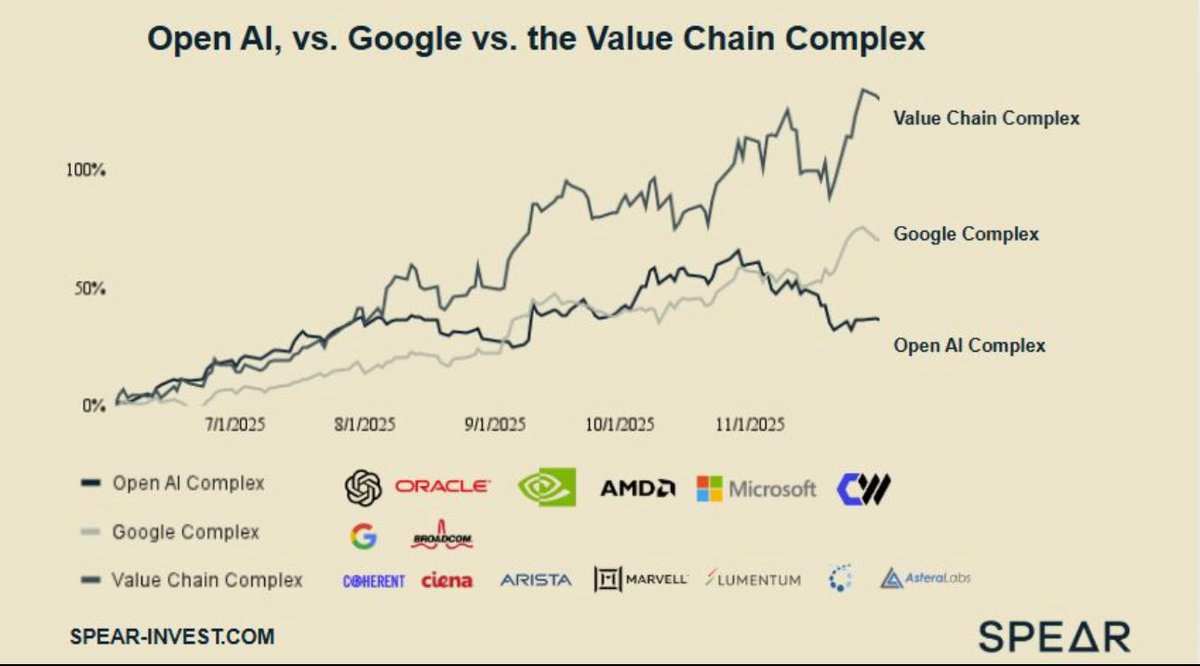
The market finally figured out that not all AI stocks are the same. But they are still missing the bigger opportunity.
From January through September, every AI stock moved together: $NVDA $AMD $GOOGL $ORCL all trading in lockstep.
The market treated AI as one giant bet.
But by October, everything changed.
Three distinct groups emerged:
1️⃣ The OpenAI Complex: Nvidia, AMD, Microsoft, Oracle, CoreWeave
Open AI’s promise to invest $1.3 trillion in infrastructure, with no profit to back it up, is raising many questions, driving the whole complex down.
◾ Oracle needs to issue $90B of debt over the next 3 years to fund capex/negative FCF
◾ Significant customer concentration risk: OpenAI represents 66% of Oracle backlog
◾ Credit market doesn't love this profile - both Oracle and Coreweve CDS spreads are widening
2️⃣ The Google Complex: Google & Broadcom
◾Google's TPUs are gaining serious traction
◾Broadcom is manufacturing these TPUs specifically for Google
◾This is becoming a credible alternative to NVIDIA-centric infrastructure, especially in recommender systems
…but remember, there are risks here too, as TPUs have stronger performance than Nvidia only in one application …will be hard to gain general-purpose traction.
3️⃣ The Value Chain: $CRDO, $COHR, $ALAB, $LITE, $CIEN, $ANET, $MRVL
◾ Credo's electrical cable demand is soaring - the company reported 272% growth YOY earlier this week
◾ Astera Labs' scale-up components are driving >100% YoY growth in the latest reported quarter
◾ Marvell, just yesterday, pointed to solid visibility into ‘26/27 expecting +25%/+40% YoY growth
◾ Coherent & Lumentum - optics suppliers are just getting traction in the next wave of infrastructure buildout.
These companies are under-promising and consistently beating numbers.
While investors and media are debating which complex will take over, they are placing binary bets on platform winners.
But they don’t realize that investing in the value chain doesn't require that bet as infrastructure companies supply everyone:
If Google's TPUs gain traction, they need Lumentum optics.
If AWS gains traction, it needs Astera Labs components.
If Nvidia continues to win, they need Credo cables.
So the difference in risk profile is significant.
Platforms carry individual technology risks: one wrong product cycle, one market-share loss, and valuations compress fast.
Value chain companies have diversified exposure across all platforms with lower company-specific risk and superior risk-adjusted returns.
The debate will intensify as more data comes in.
Fund managers will make more predictions about who will win the platform war.
The OpenAI and Google complexes will see more volatility as market sentiment shifts.
Meanwhile, the infrastructure layer keeps winning.
They supply everyone, so it doesn't matter which AI model or chip architecture dominates next quarter.
🔥 TOM LEE CALLS FOR $62,000 $ETH
"I think Ethereum's going to become the future of finance, the payment rails of the future and if it gets to .25 relative to Bitcoin that's $62,000. Ethereum at $3,000 is grossly undervalued."
To all $SBET holders:
I know many of you feel frustration or anxiety over the recent price action. But let me explain why there’s no need to worry.
The true essence of a treasury company is leverage through debt financing.