After 15 years, Indonesia’s rare Rafflesia bloomed, the world’s largest parasitic flower that smells like rotting meat, has no leaves, and lasts just 5 to 7 days.
Trump menandatangani PENYERAHAN TANPA SYARAT kepada Iran.
Selat Hormuz akan dibuka kembali.
Pasukan AS yang mengepung jalur pelayaran vital tersebut akan ditarik pulang.
Iran berhak mengembangkan program nuklir sipil.
Gencatan senjata total di seluruh lini, termasuk Lebanon dan Gaza.
Program rudal Iran tetap berjalan .
Sanksi terhadap Iran akan dicabut.
Pencairan dana dan asset milik Iran di seluruh dunia akan dilakukan secepatnya.
Iran telah membuktikan bahwa penutupan Selat Hormuz adalah senjata yang lebih mematikan dibandingkan hulu ledak nuklir.
😂
🟥🚨الجيش والحرس الإيراني يعلن لأول مرة عن تجهيز 500 صاروخ باليستي عابر للقارات للرد على الهجوم الامريكي القادم.🔥❤️🔥😱
رسمياً إيران لو تم مهاجمة طهران فسيتم مهاجمة الأراضي الأمريكية نفسها بما فيها العاصمة واشنطن ومدينة نيويورك!تابع حسابهم💥@bint_abiha_2
💥 Sitting Is Secretly Making Your Sciatica Worse
❌ It’s not just “sitting too much” causing your pain
It’s the position your spine goes into while sitting
Scientists have detected a vast underwater structure spanning approximately 9,000 miles that may be driving one of the strongest El Niño events in recorded history.
Known as a Kelvin wave, this giant pulse of unusually warm water is traveling eastward beneath the surface of the equatorial Pacific. In some areas, temperatures within the current are reaching up to 13.5 degrees Fahrenheit (7.5 degrees Celsius) above normal, an exceptionally high anomaly for deep ocean waters.
Kelvin waves form when strong wind bursts push warm surface water across the Pacific from west to east. As the heat spreads, it disrupts normal ocean circulation and helps trigger El Niño conditions, a climate pattern known for reshaping weather systems worldwide.
Researchers are particularly concerned because this wave resembles the one that preceded the devastating 1997-98 super El Niño, which caused widespread flooding, severe droughts, crop failures, wildfires, and disease outbreaks globally. Historical super El Niño events have even been linked to famines that claimed tens of millions of lives.
The situation may be even more severe this time. Global ocean temperatures are already at record levels, meaning the atmosphere holds significantly more heat and moisture than in previous major El Niño years. This extra energy is likely to intensify extreme weather events, including powerful storms, heat waves, heavy rainfall, and droughts.
El Niño impacts vary by region. Some areas face catastrophic flooding while others endure prolonged drought. Marine ecosystems often suffer as warm waters reduce nutrient upwelling, collapsing fisheries and triggering widespread coral bleaching.
Scientists are closely monitoring the evolution of this enormous Kelvin wave over the coming months as it continues to develop.
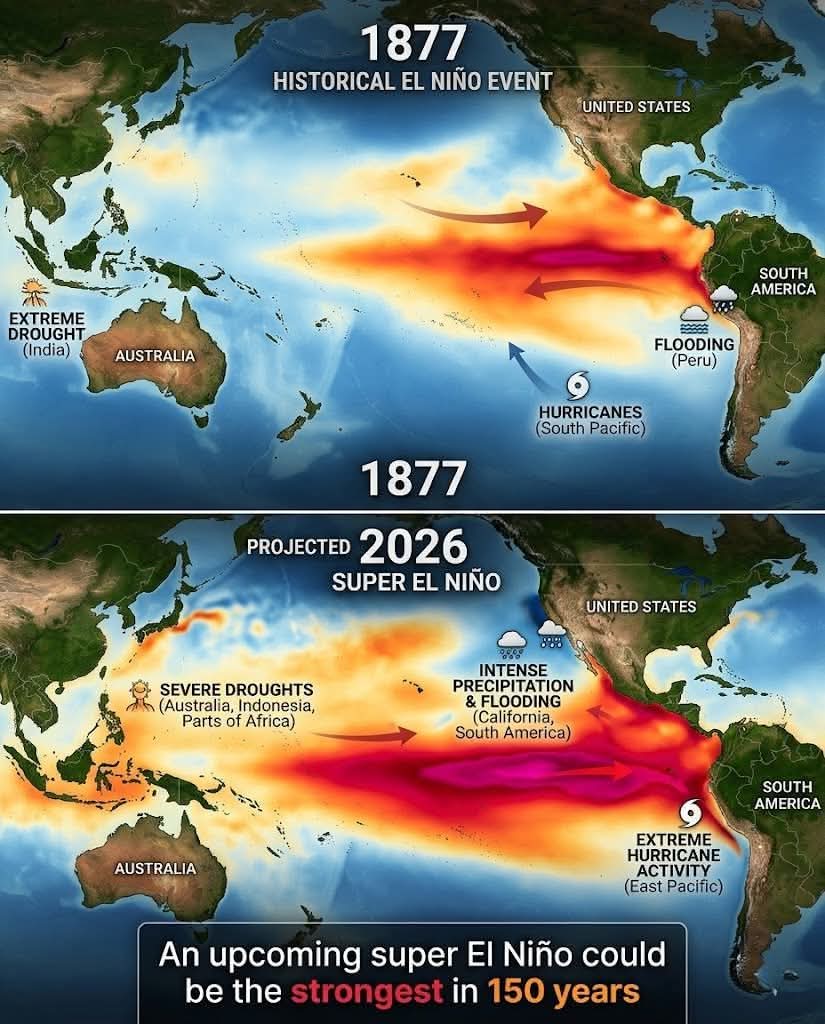
Scientists are warning that a potential Super El Niño could strike later this year and some fear it may become the most dangerous one seen since the 1800s
NOAA now says there’s a 65% chance El Niño conditions turn strong or very strong between October 2026 and February 2027
Some researchers believe it could rival the catastrophic 1877 El Niño an event linked to drought, crop collapse, famine, and more than 50 MILLION deaths worldwide
And this time, the planet is already hotter than ever before
El Niño begins when abnormally warm waters spread across the tropical Pacific Ocean. But the consequences ripple across the globe:
• Extreme heatwaves
• Historic flooding
• Severe droughts
• Crop failures
• Wildfires
• Fisheries collapse
• Stronger climate disasters worldwide
The last major El Niño (2023–2024) pushed global temperatures to record highs. Scientists warn the next one could hit an already overheated climate system making the impacts even more extreme
What’s different now is that our atmosphere and oceans are much warmer than in the 1870s, climate scientist Deepti Singh told The Washington Post
Past Super El Niño events caused tens of billions in economic damage and triggered worldwide humanitarian crises
Now experts fear rising food prices, water shortages, instability, and simultaneous extreme weather across multiple continents