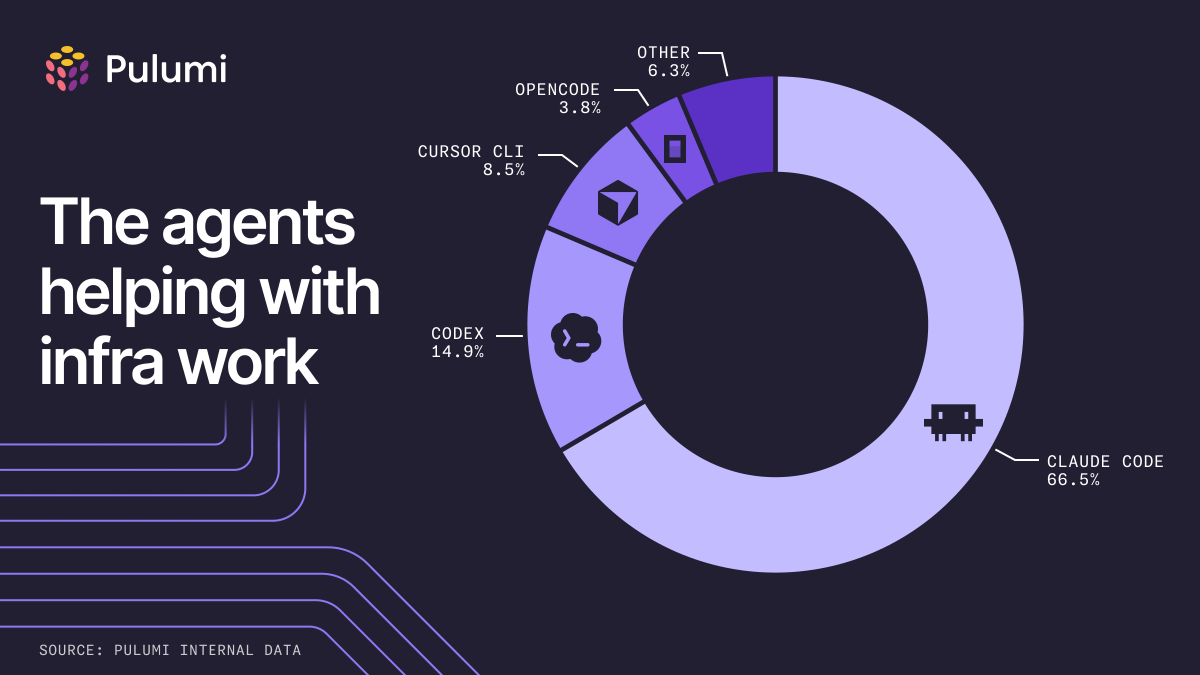
Earlier this week when we wrote about how agents are taking on more of the work of infrastructure, the share was already at 28%. Today it's even higher. Here's how it breaks down across the most popular coding agents:
everyone wants their product to work with AI agents. but no one wants their product to be abused. and let's be honest: AI means more + better "bad bots"
we are building a product that can help you, by letting you verify there's a real human behind AI agents. we think it'll be really useful for:
- dev products
- e-ticketing
- agent credit cards
- social networks
we are starting a private Beta of Human Principal with a few companies that want to integrate and give us feedback.
interested? https://t.co/l5lml4DIEq
What’s awesome about this, besides just giving Neo access to the local environment, is that you can drive it with other agents and harnesses.
I’m a huge @conductor_build fan for example. With this change, I can pull Neo into my Claude-driven Conductor sessions just by mentioning Pulumi in the chat. It’s pretty great. (Used it to fix a wedged stack just this morning in fact.)
This is a huge week. At Pulumi we are releasing lot of new features to empower your agents (and you!) to allow your infra enter the agentic... my favorite bits on 🧵
Infrastructure is entering its agentic era.
Agents are moving from writing code to operating infrastructure directly, with previews, policy checks, audit trails, and human-review built into the workflow.
https://t.co/NwOg9godnc
3. Pulumi Neo where you are
Neo is our infrastructure agent for Pulumi. Use it from the CLI (pulumi neo), Slack, or GitHub. With integrations like Datadog and CloudWatch, Neo brings your infra context into one place.
Pulumi Neo Integration Catalog
https://t.co/OD9gCTHC9h
2. Agent friendly docs for providers
All of our provider docs have their own version for agents, now we have expanded this to being context aware: eg, if you are working on a Typescript project, code examples will be limited to that (keeping your precious context window clean)
Como manager, es interesante el sentimiento de pedirle algo a alguien del equipo, ver el “typing…” por un rato y que finalmente solamente haya un 👍 como reacción …. Cuantos insultos sin decir
If anything, I expect AI to lead us to build more complex software (not just the same but faster), so until context rot is solved, the architecture of your solutions and the abstractions of your code are more relevant than ever.
Writing elegant code was never meant to be about "reading it like prose and being poetic" but about reducing cognitive load when writing a new feature or fixing a bug. That's true for humans and agents. At least today.
@losalfajores En Resistencia (Chaco) en el 97 se conseguía por 350. Mismo precio que la psx. Con 10 años, me convencieron de comprar la play porque los juegos de N64 andaban por los 100 y los de Psx a 10
I strongly believe there are entire companies right now under heavy AI psychosis and its impossible to have rational conversations about it with them. I can't name any specific people because they include personal friends I deeply respect, but I worry about how this plays out.
I lived through the great MTBF vs MTTR (mean-time-between-failure vs. mean-time-to-recovery) reckoning of infrastructure during the transition to cloud and cloud automation. All those arguments are rearing their ugly heads again but now its... the whole software development industry (maybe the whole world, really).
It's frightening, because the psychosis folks operate under an almost absolute "MTTR is all you need" mentality: "its fine to ship bugs because the agents will fix them so quickly and at a scale humans can't do!" We learned in infrastructure that MTTR is great but you can't yeet resilient systems entirely.
The main issue is I don't even know how to bring this up to people I know personally, because bringing this topic up leads to immediately dismissals like "no no, it has full test coverage" or "bug reports are going down" or something, which just don't paint the whole picture.
We already learned this lesson once in infrastructure: you can automate yourself into a very resilient catastrophe machine. Systems can appear healthy by local metrics while globally becoming incomprehensible. Bug reports can go down while latent risk explodes. Test coverage can rise while semantic understanding falls. Changes happens so fast that nobody notices the underlying architecture decaying.
I worry.