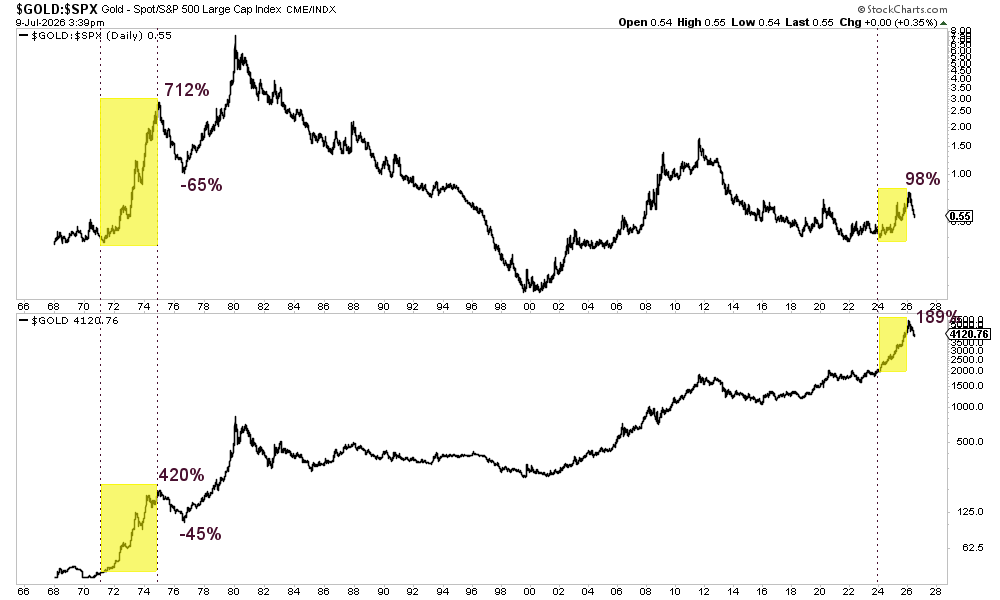
Gold isn’t showing the classic topping characteristics we saw in 1980, 2011–12, or 1975–76: no prolonged distribution, no major relative peak vs stocks, no true bearish consolidation.
The 1975–76 ~50% decline came after an extreme move. Gold surged 5x in 4 years and +712% vs stocks.
Compare that to today: 189% over 2 years and ~100% vs stocks. Strong, but not remotely the same magnitude.
Even the 2018–2026 advance, which is closer to 1971–74, included a 3-year-long consolidation.
In 1975–76, Gold retraced ~58% of its prior gain. A similar retracement today would imply $3450. Not a prediction, just historical context.
Bottom line: The real rotation phase (1971–74, 2001–03) still lies ahead.
New statement from CENTCOM regarding the Strait of Hormuz.
The U.S. Central Command (CENTCOM) stated in its announcement that claims made by Iranian media, stating that passage through the Strait of Hormuz is only permitted along routes determined by Tehran, are incorrect.
In recent weeks, the United States has proposed a new route for ships to pass through the Strait of Hormuz.
U.S.-IRAN CONFLICT ESCALATES, THREATENING FRAGILE MIDDLE EAST CEASEFIRE
• THE U.S. AND IRAN EXCHANGED A NEW ROUND OF MILITARY STRIKES, RAISING FEARS THAT THE FRAGILE CEASEFIRE COULD COLLAPSE INTO A BROADER REGIONAL CONFLICT
• THE U.S. SAID IT STRUCK 90 TARGETS INSIDE IRAN TO WEAKEN TEHRAN'S ABILITY TO THREATEN SHIPPING THROUGH THE STRAIT OF HORMUZ, WHILE IRAN RETALIATED WITH MISSILE AND DRONE ATTACKS TARGETING U.S.-ALIGNED COUNTRIES
• PRESIDENT TRUMP WARNED THAT ANY FURTHER ATTACKS ON SHIPPING WOULD TRIGGER A STRONGER U.S. RESPONSE, WHILE IRAN VOWED RETALIATION IF STRIKES CONTINUE
• THE ESCALATION HAS PUT PEACE TALKS AND NEGOTIATIONS OVER IRAN'S NUCLEAR PROGRAM AT RISK, RENEWING CONCERNS OVER GLOBAL ENERGY SUPPLIES AND SECURITY IN THE STRAIT OF HORMUZ
LNG found a shortcut to Asia that skips both Hormuz and the Panama Canal.
TotalEnergies shipped the first cargo from Mexico's ECA LNG terminal, US Permian gas piped cross-border, liquefied and shipped straight to Asia
TotalEnergies owns 16.6% and is exclusive offtaker during ramp-up, locked into 1.7 mtpa for 20 years once commercial ops start
The Pacific site skips the Panama Canal, a shorter, cheaper route to Asia than Gulf Coast terminals
TotalEnergies' global LNG book is already 44 mtpa, this adds a corridor right as Qatar pulls back its own ramp-up
Qatar is choosing security over speed through Hormuz. US gas just opened a route around the chokepoint.
So the US SPR fell another 6.2 million barrels (1983 year low). This means the cushion relieving this crisis is nearly gone. Even more conveniently, it drained into the same week Iran re-closed the strait. Brent, naturally, moved back above $78.
The timing is worrying. If you want to know where the strain is, you can look at what most have been noting: the crack spreads. The 3-2-1 crack spread is above $64. near record highs, which means refined product is tight as hell even with the SPR bleeding to hold crude down.
This is one of the worser sequences. Trump is losing leverage before the midterms.
Iranian MiG-29 fighter jets, from their "Non existent Airforce" were filmed escorting the aircraft carrying the body of the Imam Khomeini, and his family, as it approached the airport in Mashhad.
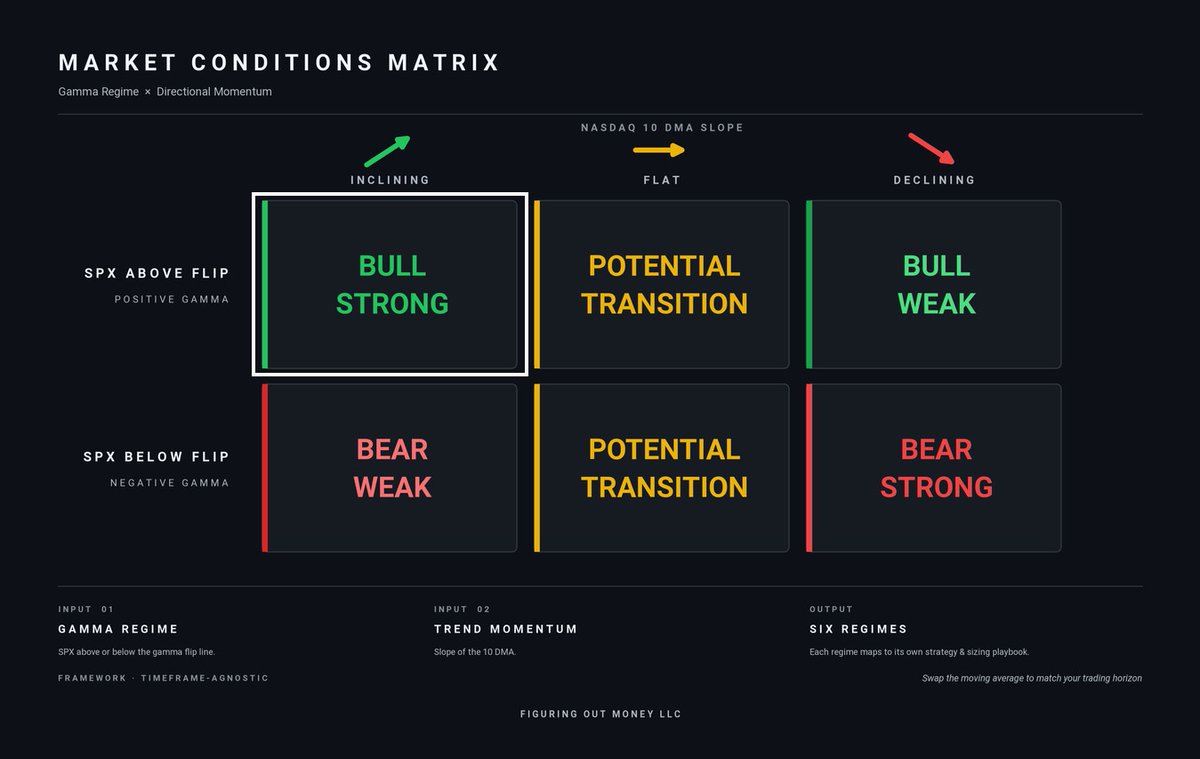
After today's price action, we moved into "Bull Strong" conditions on my Matrix. First time since early June.
What does that mean? The $SPX is back above the Gamma Flip Line, and the Nasdaq Composite is above a now-rising 10DMA.
In this regime, volatility tends to compress as dealers buy dips, and sell into rallies. From my experience, as a swing trader, you get far fewer fakeouts and shakeouts.
Worth noting: many prior market leaders are sitting in wide and loose bases, and rotation is still very much in play. Scan for names showing relative strength and look for follow-through out of tight consolidations.
Caution flag: if the Nasdaq Composite breaks today's low and the SPX drifts back toward the Gamma Flip Line, the setup weakens fast.
But right now, after this consolidation, the bulls have their best opportunity in weeks to break out.
This is from today. It clearly states Iran's objective: control of the Strait. The MOU was always a deception, with little resemblance to reality.
Islamic Revolutionary Guard Corps Navy Command
In the name of God, the Most Compassionate, the Most Merciful.
Peace be upon the insightful and honorable nation, whose astonishing presence and tens-of-millions-strong funeral processions for their martyred leader in Iran and Iraq showed that this is the era of the end of the bullying of powers, and the century of the triumph of nations' will.
And peace be upon the brave warriors of Islam, who, with their crushing response to the aggressions of the child-killing American army, proved that the outcome of battle is determined not by the abundance of weapons, but by the power of faith.
These warriors, by stabilizing management of the Strait of Hormuz, establishing its security over the past two weeks, and gradually reopening it, have increased passage capacity to about 50% of prewar traffic. They are also increasing the transit capacity of vessels that, while observing the security regulations with discipline, obtain permission from the IRGC Navy to pass through the routes designated by the Islamic Republic.
Once again, we declare that foreigners have no stake in this land or in the Strait of Hormuz. The adventurism of the terrorist American army and its interference in determining traffic routes will not only bring our crushing response, but will also seriously disrupt the process of gradual reopening and seriously endanger the interests of countries that benefit from the Strait of Hormuz.
U.S. CENTCOM:
🚫 CLAIM: Iranian state media claims that transit through the Strait of Hormuz is only permitted through routes designated by Iran.
✅ TRUTH: Iran does not control the Strait of Hormuz. Since early May, U.S. forces have helped facilitate the successful transit of more than 800 commercial vessels and 380 million barrels of crude oil through the vital international trade corridor.
Konarak Governor:
Iran’s Navy's military area was targeted by enemy fighter jets in 2 stages this evening.
Responsible agencies, rescue forces, and security forces immediately arrived at the scene, and an investigation into the dimensions and details of this attack is underway.
It’s unclear who attacked.
Trumps Wresting the Oil Map From Beijing
Donald Trump’s second-term national security doctrine is, at bottom, America First applied to the hard geography of energy. It starts not with speeches, but with a toppled strongman and a wrested petrostate: Venezuela and Nicolás Maduro.
What has stunned markets is not the arrest itself but the speed of the oil response. Consensus energy experts insisted that meaningful Venezuelan output gains would take years, requiring stable governance, new capital, and major repairs to crumbling infrastructure. Instead, within months of Maduro’s removal, Venezuela is exporting hundreds of thousands of barrels of oil a day to the United States, with total production up roughly 20 percent.
Most of that crude used to move quietly to China. A flow that was supposed to be structurally stranded has been rapidly redirected, blindsiding a research community that treated Venezuelan capacity as a distant upside rather than an immediate geopolitical lever.
Yet many of the same analysts who missed this turn still dismiss Trump’s strategy as incoherent. That criticism now says more about their priors than about the policy. In Trump’s framework, this is not regime change for its own sake; it is America First energy policy.
The goal is clear: secure supply for American industry, deny easy lifelines to hostile powers, and turn the world’s petrostates into assets aligned with U.S. interests rather than subsidies to Beijing.
A socialist petrostate that had drifted into China’s embrace has been structurally reoriented so that what once functioned as an off-books gift to a rival now underwrites American workers and American factories.
Then comes the plot twist. While barrels are being redirected in the Western Hemisphere, steel and concrete are being shattered along China’s overland and maritime escape routes. Strikes on a critical bridge along the China–Iran corridor, hits on Iran’s deep-water port outside the Strait of Hormuz, pressure on Kharg Island, the hub of Iran’s oil export system, and a calibrated assault on Iran’s financial wiring all fit the same doctrine.
An America First strategy that treats energy routes and balance sheets as instruments of national power naturally looks to these chokepoints, and to the Strait of Malacca beyond, as the next layer of leverage over Beijing’s lifelines.
The only real question now is what’s next for Kharg Island and its surrounding routes, and whether Trump is prepared to turn that critical export hub into the latest reminder that, in this era, energy geography bends toward American power, not Chinese wishful thinking.