🚨 6 REPOS DE GITHUB QUE PARECEN ILEGALES PERO SON 100% LEGALES
1. yt-dlp: descarga vídeo y audio de casi cualquier web. 206.8K estrellas.
https://t.co/W761YoBoRP
2. Invidious: otra forma de ver YouTube, sin anuncios y sin cuenta. 25.9K estrellas.
https://t.co/WcaIzlza0S
3. LocalSend: pasa archivos entre Android, iPhone, Windows y Mac como si fuera AirDrop. 98.3K estrellas.
https://t.co/8gt6eJIshq
4. Stirling-PDF: edita, une, firma y convierte PDFs en tu propio equipo. 96.2K estrellas.
https://t.co/nG0bBqn6Xo
5. Immich: tu propio Google Fotos, en tu servidor. 118.8K estrellas.
https://t.co/cEjdJmhrSO
6. Sure: tus finanzas personales en tu servidor, sin depender de la app de otra empresa. 12.3K estrellas.
https://t.co/BspSm9aNXs
Qwen3.8-27B reportedly went from 55.6GB to just 5.9GB, while retaining 98.2% of its aggregate benchmark performance.
That’s an approximately 89.4% reduction in model size.
The result comes from PrismML, the team behind Bonsai, which has introduced its second-generation compression system.
Here are the reported numbers:
Original Qwen3.8-27B: 55.6GB
Bonsai 2 compressed version: 5.9GB
Model size reduction: 89.4%
Aggregate benchmark performance retained: 98.2%
Previous Bonsai 27B version: approximately 95% retention
Evaluation coverage: 20 benchmarks
The interesting part isn’t just how much smaller the model becomes. It’s how much capability reportedly survives such aggressive compression.
How does Bonsai 2 achieve this?
The underlying technique is ternary quantization.
Most conventional model weights use numerical representations with multiple possible values. Depending on the format, each weight may use 16, 8 or 4 bits.
Ternary quantization takes a more aggressive approach.
Instead of preserving a large range of numerical values, weights are represented using three possible states, typically:
-1
0
+1
Scaling factors help recover useful numerical ranges from these compact representations.
Because each weight has only three possible states, the storage requirement can be dramatically reduced compared with conventional higher-precision formats.
But there’s a difficult trade-off.
A model’s weights encode the information that allows it to reason, follow instructions, write code and solve problems. Compressing them too aggressively can destroy distinctions that matter to those capabilities.
The challenge is therefore not simply reducing the number of bits. It’s finding a way to remove numerical precision without removing too much useful information.
What improved in Bonsai 2?
PrismML reports better capability retention than its previous 27B compression, moving from approximately 95% to 98.2% aggregate benchmark performance.
The team also highlights improvements in:
Coding agents
Multimodal reasoning
Long-horizon tool use
The agentic side is particularly interesting.
Consider a coding agent working on a real project. It may need to inspect a codebase, understand dependencies, modify multiple files, run tests, interpret errors and repeat the process until the requested feature works.
Preserving that kind of behaviour after reducing the model to 5.9GB is more interesting than simply maintaining accuracy on short question-and-answer tests.
An agent needs to maintain context, make decisions across multiple steps and recover when something goes wrong.
If those abilities survive compression, the practical value goes well beyond having a smaller model file.
Why this matters for local AI
A 5.9GB model is considerably easier to distribute, store and experiment with than a 55.6GB version.
It could make a 27B model more accessible to people using consumer GPUs, laptops and systems with limited memory.
There is one important distinction, though:
5.9GB is the reported compressed model size, not necessarily the total VRAM required to run it.
Inference still needs memory for the KV cache, activations, temporary buffers and runtime overhead. Context length and concurrency can increase those requirements.
The 98.2% figure also represents aggregate performance across 20 benchmarks. It does not mean the model performs identically to the original on every task. Some capabilities may retain more performance than others.
Independent testing will be important for understanding where the remaining performance loss occurs, particularly on coding agents, complex reasoning and long-running tool workflows.
Still, moving from approximately 95% retention in the previous Bonsai version to 98.2% with Bonsai 2 is a notable reported improvement.
The real test of compression isn’t how many gigabytes you remove. It’s how much useful capability remains after you remove them.
uncensored gemma 4 e4b 5.3gb file should be banned but huggingface let anyone download it 😳
its free uncensored llm, apache-2.0, no gate, dropped today
- google gemma 4 e4b base, runs on a normal pc
- refuses 2 out of 100 prompts, the original refused all 100
- mmlu barely moved: 0.707 → 0.701
try it here:
https://t.co/CJCEkxaAuZ
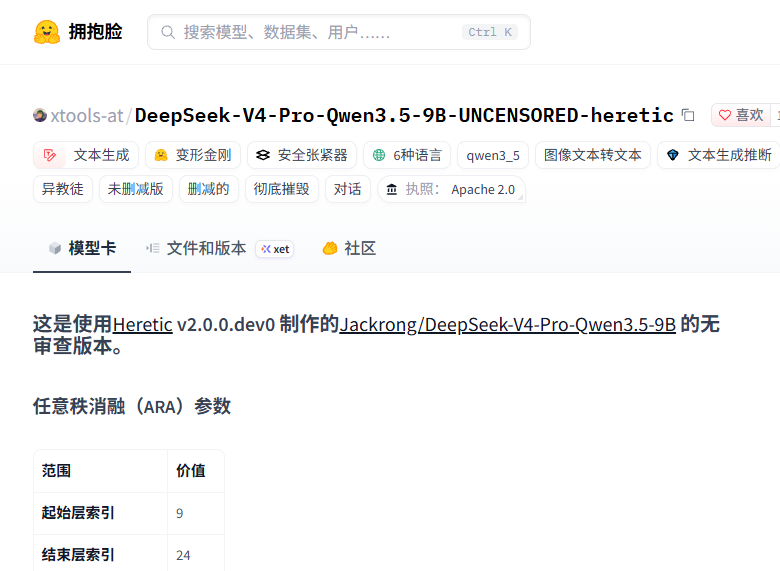
UNCENSORED DEEPSEEK-V4-PRO 5.6GB FILE SHOULD BE BANNED BUT HUGGINGFACE LET IT TREND 😳
Free uncensored reasoning model. No gate. No lectures. Just answers.
→ Qwen3.5 9B with DeepSeek-V4-Pro reasoning distilled in
→ Refuses only 3 out of 100 prompts (original refused all 100)
→ Runs on a normal PC, GGUF starts at ~4.4GB
→ Heretic uncensor method
→ 4.8k+ downloads already
→ Apache 2.0, fully open
DeepSeek-V4-Pro-Qwen3.5-9B-UNCENSORED-heretic GGUF.
Try it here: 👇
https://t.co/fKmTWPa6TP
Qwen3.8-27B can now control a web browser and complete interactive tasks without human intervention, thanks to Unsloth’s browser-use capabilities.
In the demonstrations, the model successfully:
Played chess by interacting with the game.
Used browser-based drawing tools to create paintings.
Navigated web interfaces and carried out actions autonomously.
This goes beyond asking an LLM to generate instructions. The model actually interacts with the browser, observes what happens and decides what to do next.
How it works
Browser automation requires an agent to operate in a continuous loop:
Understand the user’s instruction.
Inspect the current browser page.
Identify buttons, menus, inputs and other interactive elements.
Execute actions such as clicking, typing and navigating.
Observe the results.
Adjust its next action based on what happened.
The model has to understand the interface, make decisions and execute them in the right sequence.
Why this is interesting
Local LLMs are moving beyond chat and code generation into direct interaction with software.
This opens up possibilities for:
Automating repetitive website tasks.
Researching information across multiple pages.
Filling forms and interacting with web applications.
Testing websites and browser-based tools.
Building personal AI agents that can carry out multi-step workflows.
There are still challenges around visual accuracy, failed actions, recovery and safe browser access. A successful demonstration doesn’t mean every website or complex task will work reliably.
But seeing Qwen3.8-27B operate a browser and complete interactive tasks locally is another step toward more capable local AI agents.
GitHub: https://t.co/mgEBCnslcM…
Guide: https://t.co/EdfPyHo7Sd…