Generative AI is great at writing code.
It’s terrible at deleting it.
The next frontier is Subtractive AI: systems rewarded for what they remove and simplify — not what they add.
8/8 TL;DR:
Looped transformers = better quality per token, but 3-5× more compute.
Smaller models. Higher latency. More GPUs needed for same throughput.
The frontier is getting deeper, not wider.
And the hardware bill is coming.
1/8 Looped transformers are coming.
OpenMythos, recurrent-depth architectures, weight recycling — the frontier labs are all exploring this.
But here's what nobody's talking about: the hardware implications are massive.
Let me break it down. 🧵
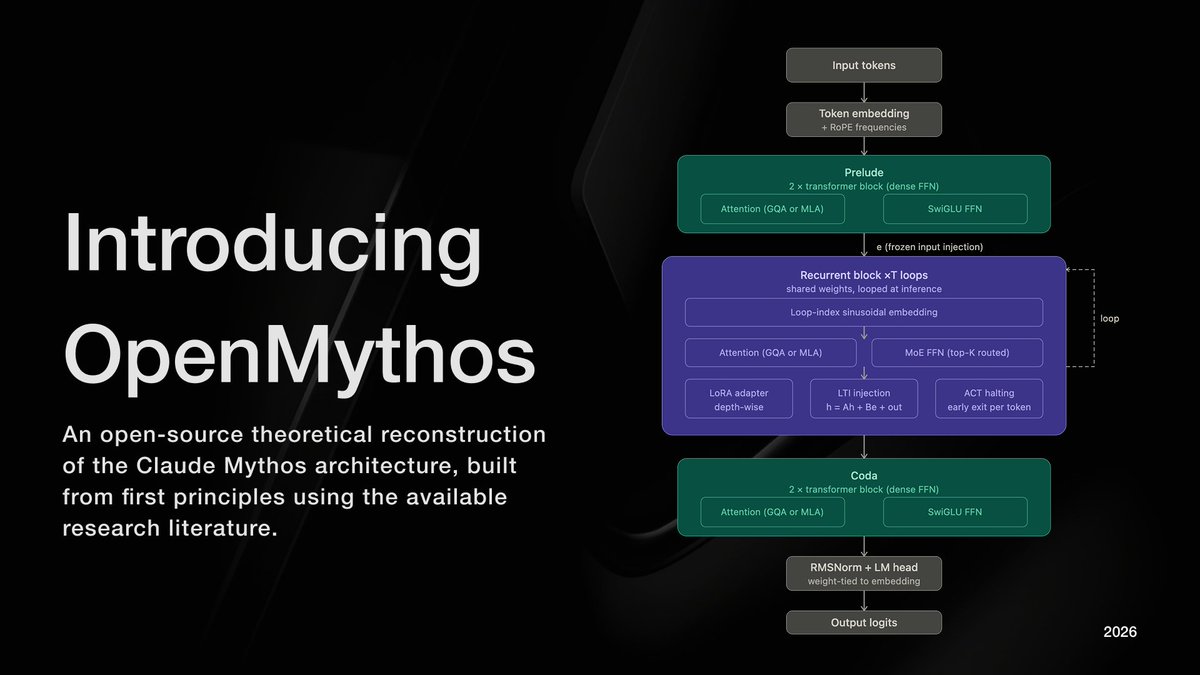
Introducing OpenMythos
An open-source, first-principles theoretical reconstruction of Claude Mythos, implemented in PyTorch.
The architecture instantiates a looped transformer with a Mixture-of-Experts (MoE) routing mechanism, enabling iterative depth via weight sharing and conditional computation across experts.
My implementation explores the hypothesis that recursive application of a fixed parameterized block, coupled with sparse expert activation, can yield improved efficiency–performance tradeoffs and emergent multi-step reasoning.
Learn more ⬇️🧵
7/8 Investment takeaway:
Don't just watch VRAM demand. Watch:
• Compute density per token
• Cache efficiency
• Interconnect tech
• Specialized recurrent hardware
The next hardware cycle won't look like the last one.
Introducing Trellis for Kimi K2 Thinking.
It's post-training code that's 50x faster than the best single-node open-source version and 2x cheaper than training APIs.
After safety testing, we're open-sourcing it, giving builders the best tools to customize a frontier model.
🧵
@steipete@nakulsinglla Try using the latest OpenAI Symphony with Codex and others like Gemini CLI and Claude Code behind a Codex gateway over WebSocket https://t.co/w4FKCEhB1Y
@xeophon The performance is substantially below the medium models (unsurprisingly at less than 10% size) but can be useful for fine-tuning and further domain specific RL for edge devices