If inflation is an economic necessity, can/should/will general price levels ever come down?
Or do we keep relying on war, inequality, market failures, financial crisis to adjust?
🤔
Great take @_aaadedapo
Many do not understand that exact same transaction could have different tax implications depending on many different factors.
Selar can definitely get out of this, despite the fact that the tax authority's claims about WHT on royalties might be accurate.
Some points for Selar's advisers to consider:
- A consumer buying an online course or e-book on Selar is purchasing a single digital copy of a finished product for personal use.
- Those consumers are not acquiring the commercial licensing rights to exploit the underlying copyright. Therefore, this transaction yields standard trading/retail income, not a royalty
- The laws in-force at the time exempt Sales in the Ordinary Course of Business from WHT (See Tetrapak vs FIRS)
- Physical books and educational materials are income tax exempt in Nigeria. A digital product is legally identical to a physical book sold in a bookstore.
- If there is a "tax invoice" argument, it wouldn't hold water if invoice is issued from the Creator directly to the end-customer. Selar in this case, is therefore merely the digital cash register holding the money in escrow. By law, an escrow agent or a payment processor cannot demand a tax invoice from a vendor for funds belonging to a third-party buyer.
- There is no explicit law requiring market place withholding obligations and there are no backup withholding regulations in Nigeria.
Hopefully this can set a beautiful precedence and end in the +ve for @tryselar
The old Personal Income Tax Act provides that where any royalty is paid or credited to an individual or other non-corporate entity, 5% of the payment must be withheld and remitted to the tax authority of the beneficiary’s state of residence.
The critical issue here is whether the payments passing through Selar to creators legally constitute ‘royalties’. This is fundamentally a question of classification and cannot be answered without examining the facts and contractual terms of the transactions.
The consequence can be punitive because the tax was never Selar’s liability in the first place. It is a withholding tax on the creators’ income, which the creators would ordinarily claim as a credit against their own income tax liabilities.
However, if it is ultimately determined that Selar had an obligation to withhold and failed to do so in its capacity as the paying agent, the liability may shift to Selar, together with any applicable interest and penalties.
Hopefully your tax advisers/lawyers are able to make a good argument.
Emotions aside.
I believe this is a WHT conversation that the tax authority just needs to handle with grace. Legally, they are right.
On the lettering of the law, the way you pay your staff salaries and have to withhold personal income tax, or pay your vendors and have to withhold income tax, if your customer earns through your platform and you happen to be the one that collects the money, take your portion, and pay them, you should withhold tax from their earnings before it is disbursed to them. Think Facebook, X, or YouTube, creators earn on their platform, and taxes are withheld before they give you your share. That’s the tax agent relationship we all inadvertently signed up to.
And this law cuts across all states of the fed, not just Lagos.
My concern is that the tax authority in this part never, ever educates tax payers and if you don’t educate, it is ethically inept to hound them.
We know how the IRS and HMRC will notify you multiple times of your next compliance requirement. We enact similar laws but will refuse to follow suite in the tax admin aspect.
All the best.
Hi @jidesanwoolu, @hanneymusawa
I'm deeply disappointed in your @lirs_govng team hounding Selar in the name of claiming creator royalty taxes. I turn 30 in Oct and I've spent the last 10 years building Selar, so this is what the youth mean by policies being created to crush growing businesses. We are the pioneering and largest creator company in Nigeria (Africa actually), and instead of being supported by the government, the LIRS team is keen on trying to scapegoat us to set a precident.
Beyond the huge numbers seen in the headlines, we are still a young company just trying to make our mark for the creator economy in a country where we've never been supported once, we're literally a bootstrapped company. In 2025 alone, we've fulfilled our tax obligation in almost 9 figures and we've never missed out on any of our tax obligation over the years. You can check the records.
We are a software company, we make our ecommerce software available to our thousands of creators in not just Nigeria but 13 other African countries and for that, we earn a small commission of 4%, most of which goes to our payment provider. This is the same business as shopify, teachable, e.t.c There is no reason LIRS is hounding us for a backdated 5% royalty fee on all sales when we've clearly explained our line of business to them and shared everything to prove we are not a royalty based business.
What they're asking us to do is raise our pricing to extort these funds from our creators which is odd considering our creators still pay taxes on their income. No creator company in the world charges as high as even 5%.
Also, less payment gateway charges we get 1-3% max, so where do we pay backdated 5% fees from?
The government would have to decide if it wants the Nigerian creative economy to grow or not.
This conversation is important to me because we pioneered this industry of monetizing digital products online in Nigeria and today we host over 400k creators selling using our platform.
This is an opportunity for the government to show it's committment to making Nigeria work for young Nigerians especially in the creator economy.
Time and money we should be spending investing into our business and it's growth for the GDP of this nation is being spent in long back and forth.
We can't catch up with the west if this is what we're facing at home. Above everything else, disputes like this are distracting from the real work.
If anything, for all our CSR contributions to the education system in the country with our Smart Hustle Anti fraud initiative and our other efforts, we should be getting tax rebates, but we're not even asking for anything but to be left alone to build our business.
Thank you.
This has nothing to do with the new laws in force today.
Based on what I read from Douglas, they are asking for 5% WHT backdated (and that’s likely due to a tax audit being conducted)
The new laws, despite its flaws, exempts small businesses from deducting WHT from payments less than 2m, and the penalty for failure to deduct is 40% of the amount not deducted as against 100% that they’ll be asking from Selar for the backdated ones.
Nonetheless, there has never been proper tax or financial literacy in this country but even if there was, tax is very complex and taxpayers typically to employ the services of professionals to make sure understand their risks and structure their businesses and operations in such a way that they pay the least tax possible.
Some say this stance is wrong and I’m genuinely open to learning. My position is based on the law and some precedence.
See Bolt Vs FIRS for example and this also affect platforms like Selar. https://t.co/hLbKEujkCB
Happy to learn from those who might have contrary positions based on fact, law, and precedence.
For organizations and business owners, you know better than to listen to voices of the opposite of reason. Review your tax strategy and get proper advisory.
Selah
@__LuQQQ I’d love to learn. What aspect of the tax laws support this stance?
My stance is based on law and a tax appeal precedent
Even Bolt lost against the FIRS when it didn’t charge VAT on rides and food sold by vendors via its platform
@OoTheNigerian@KendysonD Unfortunately, the only way out of this kind of issue is to not have Nigerian users (or broadly speaking, users in jurisdictions with WHT regulations)
Yes, they had their lapses
But realistically, if they had come up with the 86k on their own (it seems like it), cost of debt is zero, what will have been their cost of equity?
Could they have come up with a reliable estimate of WACC at all?
When I watched this that year, I genuinely thought Unc Kyari meant to ask them about Weighted Average Interest Rate or Weighted Average APR or something along those lines.
Still, that accountant could have done better… Perhaps it’s time for this decagon/alt school for finance, accounting, and financial compliance🤔
His Accountant said he doesn't know what WACC is because he hasn't come across it before.
Bolaji Balogun now said they're not well equipped for the business, doesn't understand the business and it is morally incorrect for students.
All we got is the still buggy Rev360 that logs "hello", undefined, "Data cached to sessionStorage", endpoints, client id, some oidc key, jwt expiry et al in console.
Arrgh. I expected a lot more honestly.
PS. If you run payroll and want accurate computation, we made this free payroll tool for our clients earlier in the year. Feel free to try and send in your feedback.
https://t.co/RETnBm06EV
https://t.co/KQERgX5cZb
3/3
Rant.
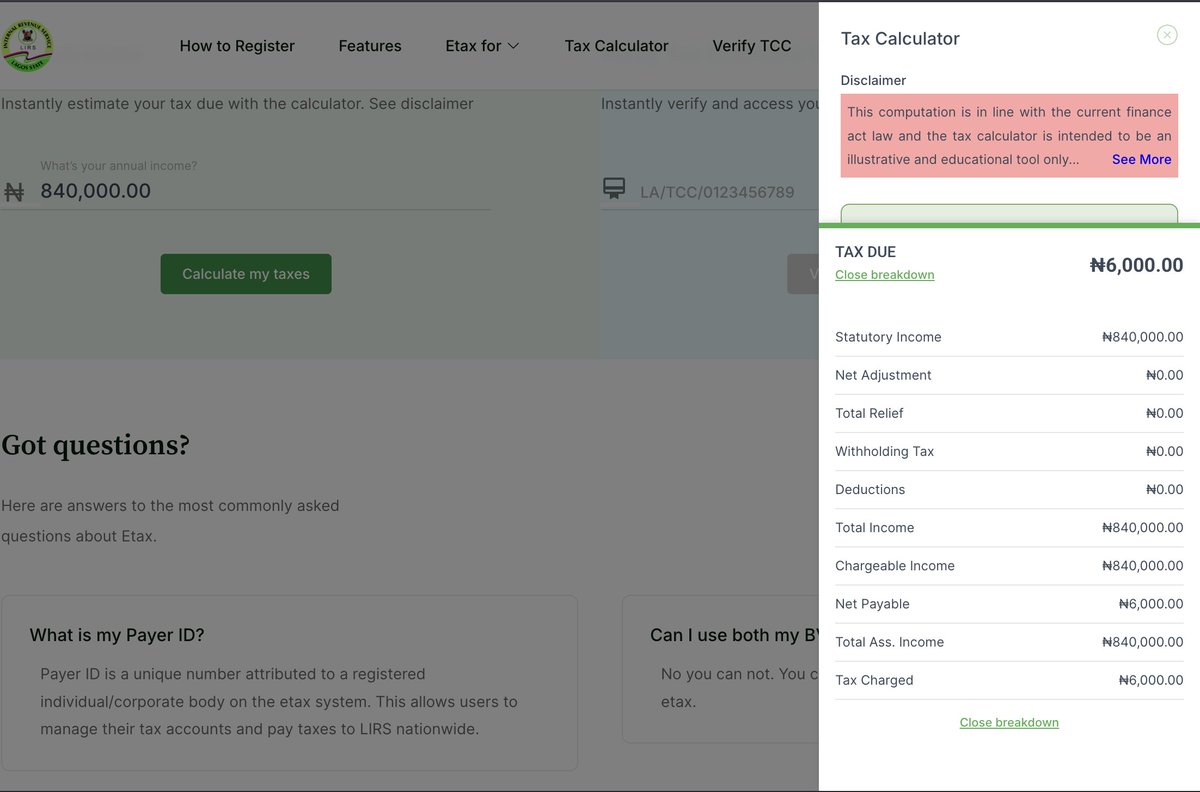
If you make ₦840k, annual income tax is ZERO.
If you make ₦840,001, annual income tax becomes ~₦6k if no deductibles.
Why are tax calculators are showing ₦6k tax for ₦840k annual income? In fact, all state tax authorities that have a calculator, are calculating it wrong.
The calculator on the fiscal reforms website reverted to the old laws.
If govt calculations are computing taxes wrong, how can one then blame the myriad of tax calculators doing the same, misleading tax payers.
1/3
Only found two free tools computing correctly
@Taxcalcng@smepayrollng
Other issues like the NRS retroactive application feels like BS. Implementation guideline coming in June was just weird. NRS sending letters telling taxpayers the exact opposite even causing more confusion.
3rd module of the Train the Trainers session commenced by the committee is abandoned (AFAIK)
Little to no word on presumptive tax framework
2/3
Building an app doesn’t make you a tech company. Track traditional metrics. Any small thing, ARR, ARPU, even for walk in fruit shop with an app. Mtchew.
Went down the rabbit hole of Markov chains recently and found Borel–Cantelli and ergodicity. By the former, anything with a non-zero chance eventually happens if you keep trying; by the latter, a system that keeps moving eventually reaches every state.
Both theorems teach one lesson: try enough times and it'll happen. Persistence isn't just faith or optimism, it's math.