🌍 The Largest Empires in History
At their peak, these empires controlled vast portions of the world’s land.
1. 🇬🇧 British Empire: 35.5 million km²
2. 🇲🇳 Mongol Empire: 24.0 million km²
3. 🇷🇺 Russian Empire: 22.8 million km²
4. Qing Empire: ~14.7 million km²
5. 🇪🇸 Spanish Empire: ~13.7 million km²
🌍 The world’s most spoken languages.
Here’s how the top languages compare by total speakers and number of countries where they have official status:
🗣️ Most Spoken Languages
1. English — 1.49B (59 countries)
2. Mandarin Chinese — 1.18B (1 country)
3. Hindi — 611M (1 country)
4. Spanish — 561M (20 countries)
5. Standard Arabic — 335M (22 countries)
6. French — 334M (29 countries)
7. Bengali — 274M (1 country)
8. Portuguese — 269M (10 countries)
9. Indonesian — 255M (4 countries)
10. Urdu — 246M (1 country)
11. Russian — 210M (4 countries)
12. German — 133M (6 countries)
13. Japanese — 126M (1 country)
14. Nigerian Pidgin — 121M (0 countries)
15. Egyptian Arabic — 118M (0 countries)
Top Portugal Players with the Highest Assist Impact
🇵🇹 Cristiano Ronaldo
🇵🇹 Luís Figo
🇵🇹 Bernardo Silva
🇵🇹 Nani
🇵🇹 Bruno Fernandes
🇵🇹 João Moutinho
🇵🇹 Ricardo Quaresma
🇵🇹 João Cancelo
🇵🇹 Deco
🇵🇹 Rui Costa
🇵🇹 João Félix
🇵🇹 Rafael Leão
🇵🇹 Diogo Jota
🇵🇹 Sérgio Conceição
🇵🇹 João Pinto
🇵🇹 Vitinha
🇵🇹 Pepe
🇵🇹 Nuno Mendes
🇵🇹 Ricardo Carvalho
🇵🇹 Simão Sabrosa
According to the latest UN Human Development Index (HDI), these are the highest-ranked countries in West Africa:
🇨🇻 Cabo Verde
🇬🇭 Ghana
🇳🇬 Nigeria
🇨🇮 Côte d'Ivoire
🇹🇬 Togo
🇸🇳 Senegal
🇬🇲 The Gambia
🇬🇳 Guinea
🇲🇷 Mauritania*
🇧🇯 Benin
🇱🇷 Liberia
🇬🇼 Guinea-Bissau
🇸🇱 Sierra Leone
🇧🇫 Burkina Faso
🇲🇱 Mali
🇳🇪 Niger
HDI measures development using three dimensions:
📚 Education
❤️ Life Expectancy
💵 Income per Capita
Sources: United Nations Development Programme (UNDP), Human Development Report.
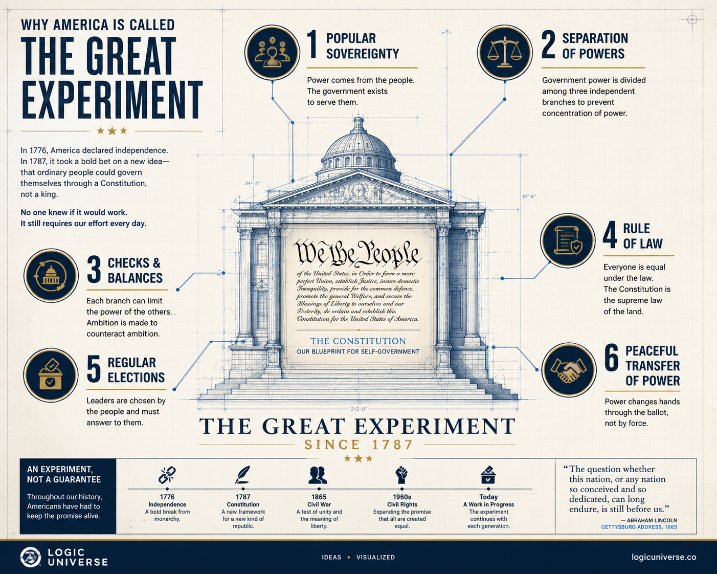
🇺🇸 Why America Is Called “The Great Experiment”
The United States was built on a bold question:
Can a people govern themselves without a king?
In 1776, America declared independence.
In 1787, it created a constitutional republic based on:
• Popular sovereignty
• Written constitutional law
• Separation of powers
• Checks and balances
• Regular elections
• Peaceful transfer of power
The experiment was never perfect. Slavery, exclusion, civil war, segregation, and political conflict tested its ideals.
But the central idea remains powerful:
A nation can keep correcting itself while trying to live up to its founding promise.
That is why America is often called “the great experiment.”
🇺🇸 America's Biggest Trading Partners
The United States trades with nearly every country in the world, but a handful account for the majority of its international trade.
🌎 European Union — Largest trading partner (as a bloc)
🇲🇽 Mexico
🇨🇦 Canada
🇨🇳 China
🇹🇼 Taiwan
🇯🇵 Japan
🇻🇳 Vietnam
🇰🇷 South Korea
🇨🇭 Switzerland
🇬🇧 United Kingdom
Together, these economies account for the majority of U.S. goods trade, reflecting deep supply chains across North America, Europe, and Asia. (Visual Capitalist)
Sources: U.S. Census Bureau, U.S. Bureau of Economic Analysis.
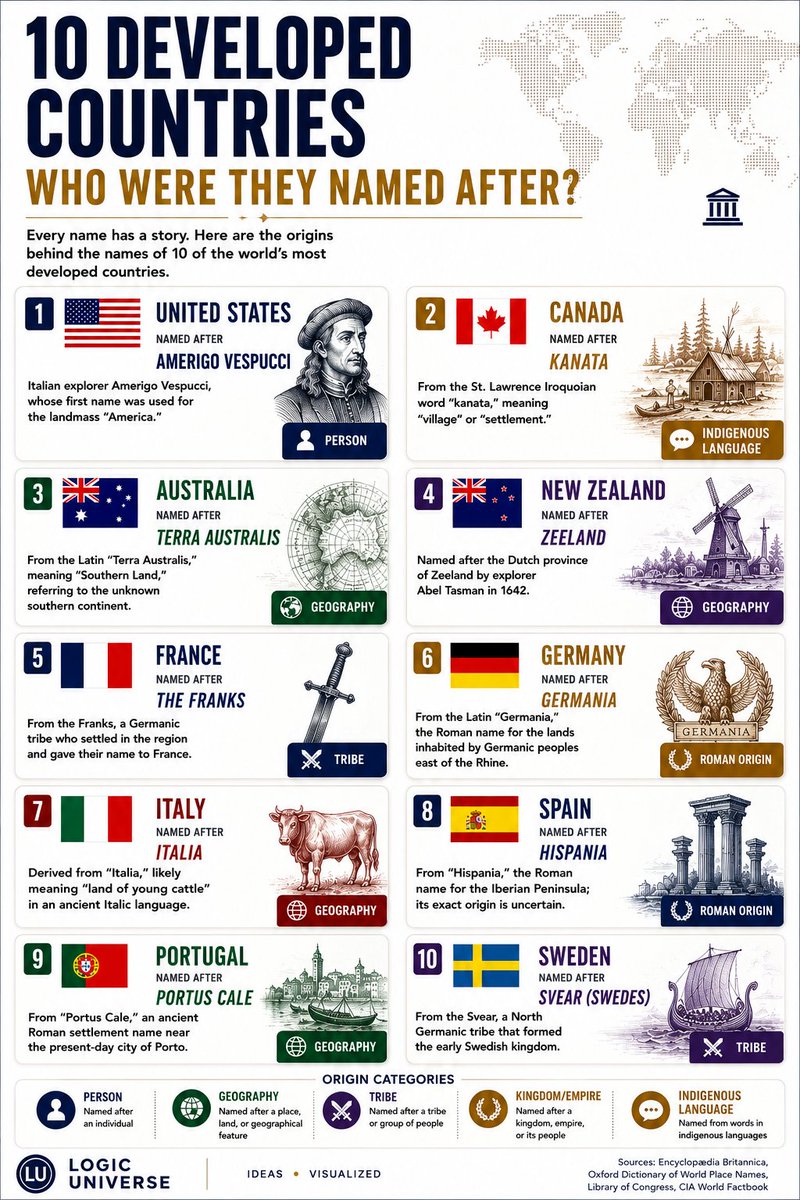
🌍 Developed Countries and Who They Were Named After
Many developed nations derive their names from explorers, monarchs, saints, tribes, or geographic features.
🇺🇸 United States — Named after Amerigo Vespucci, whose first name was used for "America."
🇨🇦 Canada — From the St. Lawrence Iroquoian word kanata, meaning "village" or "settlement."
🇦🇺 Australia — From the Latin Terra Australis, meaning "Southern Land."
🇳🇿 New Zealand — Named after the Dutch province of Zeeland.
🇫🇷 France — Named after the Franks, a Germanic people who settled in the region.
🇩🇪 Germany — English name derived from the Latin Germania, the Roman name for the lands east of the Rhine.
🇮🇹 Italy — Derived from Italia, likely meaning "land of young cattle" in an ancient Italic language.
🇪🇸 Spain — From the Roman name Hispania, whose exact origin remains uncertain.
🇵🇹 Portugal — Named after Portus Cale, an ancient settlement near present-day Porto.
🇸🇪 Sweden — Named after the Svear (Swedes), the North Germanic tribe that formed the early Swedish kingdom.
Every country's name tells a story—of ancient tribes, explorers, languages, kingdoms, or geography that shaped its identity.
Sources: Encyclopædia Britannica, Oxford Dictionary of World Place Names, Library of Congress, CIA World Factbook.
Which empire lost the most countries?
1. 🇬🇧 British Empire (United Kingdom): 49 countries
2. 🇫🇷 French Colonial Empire: 29
3. 🇪🇸 Spanish Empire: 18
4. 🇷🇺 Soviet Union: 15
5. 🕌 Ottoman Empire: 11 countries
6. 🇵🇹 Portuguese Empire: 9 countries
7. 🇧🇪 Belgian Colonial Empire: 4 countries
8. 🇯🇵 Japanese Empire: 4 countries
9. 🇳🇱 Dutch Empire: 3 countries
10. 🇮🇹 Italian Colonial Empire: 3 countries
Which universities have produced the most billionaires?
Our analysis of the Forbes Top 1,000 Billionaires reveals a clear hierarchy.
1. 🇺🇸 Harvard University
2. 🇺🇸 Stanford University
3. 🇺🇸 University of Pennsylvania
4. 🇺🇸 University of Southern California
5. 🇺🇸 Massachusetts Institute of Technology
6. 🇺🇸 Yale University
7. 🇺🇸 Columbia University
8. 🇺🇸 Dartmouth College
9. 🇺🇸 Princeton University
10. 🇺🇸 University of Chicago
11. 🇨🇳 Zhejiang University
12. 🇹🇼 National Taiwan University
13. 🇺🇸 Cornell University
14. 🇨🇳 Tsinghua University
Most billionaires are builders, not heirs.
Our analysis of the Forbes Top 1,000 Billionaires shows:
1. 61.6% are self-made
2. 31.5% inherited their wealth
3. 5.2% had mixed wealth origins
4. 1.8% came from privatization or political/royal origins
The data suggests billionaire wealth is built more often than inherited.
Source: Forbes Billionaires List
We analyzed the Top 300 billionaires, and one chart changed how we looked at billionaire wealth.
Here’s what we found:
1. 257 men (85.7%)
2. 43 women (14.3%)
The 5 richest women are:
🇺🇸Alice Walton — ≈ $134B
🇫🇷Françoise Bettencourt Meyers — ≈ $100B
🇺🇸Julia Koch — ≈ $81B
🇨🇱Iris Fontbona — ≈ $52.6B
🇺🇸Jacqueline Mars — ≈ $49.1B
The gap is not just in representation. It is also in the amount of wealth collectively controlled.
This is not about who is more capable.
It is about understanding where extreme wealth is concentrated today and asking what economic, historical, and structural factors shaped that outcome.
After analyzing the age distribution of the Top 300 billionaires in the world:
• 228 (76.0%) are over 60 years old
• 48 (16.0%) are between 50–60
• 15 (5.0%) are between 40–50
• 8 (2.7%) are between 30–40
• None are below 30
In other words, more than 3 out of every 4 billionaires are over the age of 60.
Among the Top 300 billionaires, a handful of families occupy multiple seats in the billionaire club:
1. Mars Family — 6 members
2. Walton Family — 5 members
3. Johnson Family — 4 members
4. Rausing Family — 3 members
That's 18 billionaires from just 4 families.
The biggest lesson?
Wealth doesn't just compound.
It compounds across generations.
We analyzed the world's Top 300 billionaires using Forbes data.
77.3% of billionaires have a college degree.
Only:
• 11.3% never earned a degree
• 8.3% dropped out of college
• 3.0% were unverified
The dropout billionaire story gets all the attention.
The graduate billionaire story is far more common.
Data doesn't suggest a degree guarantees success.
But it does suggest that among the world's wealthiest people, higher education is the norm—not the exception.
What do you think: Is college becoming more important, less important, or simply different than it was 20 years ago?
The “college dropout CEO” story is overhyped.
Among the world’s top 80 largest companies, advanced education still dominates.
MBA / Master’s: 35 CEOs
Doctorate-level: 24 CEOs
Bachelor’s only: 19 CEOs
No completed degree: 2 CEOs
Engineering is the most common technical background.
But if you group MBA, economics, finance, business, and management together, business-related education becomes the biggest overall pathway.