Don’t know where to start with crypto?
Just ask Elsa, your AI-Powered crypto agent.
💬 “What’s my portfolio performance?”
💬“Bridge ETH from Arbitrum to Base”
💬 “Buy $50 of ETH”
Natural language in, onchain actions out.
GM Creators
Privacy becomes more important when you’re collecting spatial data from everyday environments.
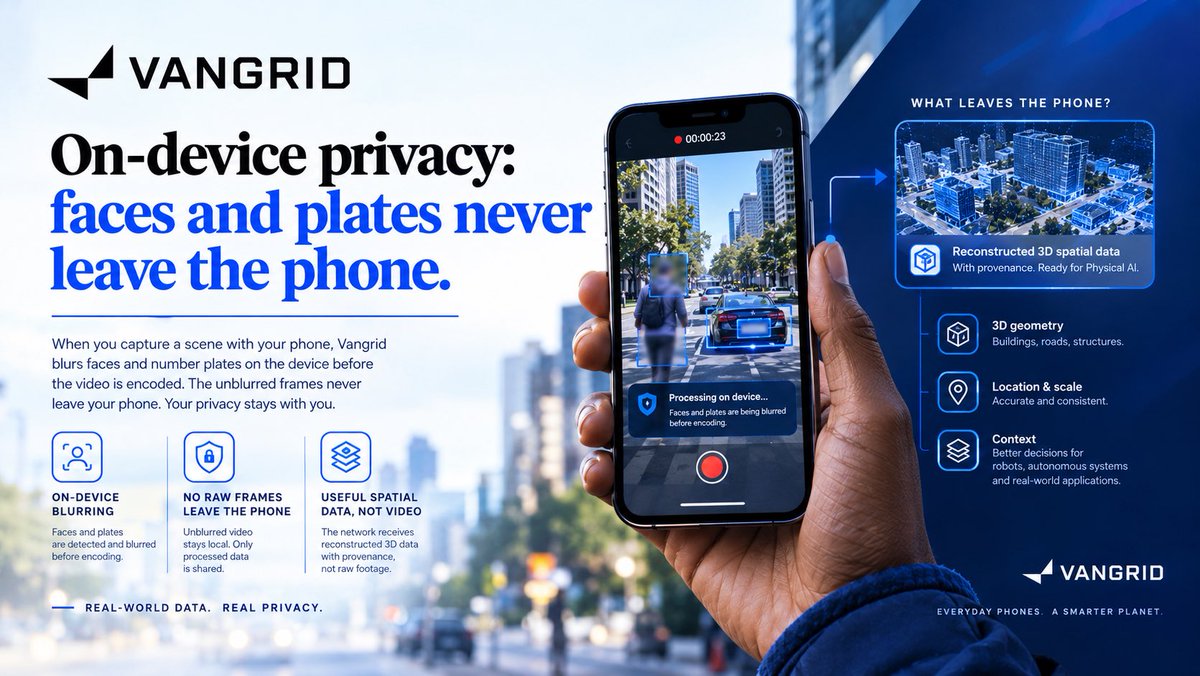
@vangrid_io approaches this by putting part of the privacy process directly on the device. When a contributor captures an environment with their phone, faces and number plates are blurred before the video is encoded, meaning the unblurred frames are not sent away from the phone.
The important distinction is that Vangrid isn’t simply trying to create another database of raw street footage. The intended output is reconstructed 3D spatial data that can be used for Physical AI, while the source imagery remains protected at the edge.
That creates a different model for collecting ground-level data at scale: phones can act as sensors, but sensitive visual information can be processed locally before the useful spatial information moves through the network.
For a system that depends on real-world data, privacy shouldn’t be something added at the end. It needs to be part of the data pipeline from the beginning.
GM builders
A detail I find interesting about @0xCyberThrone Genesis is the decision to build around full-body traits instead of the usual “same base, different hat” approach.
The collection is described as having 200+ pop-culture-inspired traits designed to change the character’s overall appearance, not just add small accessories.
That matters because full-body traits give the art more room to create genuinely different characters. The silhouette, clothing, colors and overall identity can change together rather than every NFT feeling like the same character with a few swapped features.
For an 8,888-piece collection, that approach also makes the art more important to the identity of each NFT.
It’s still a trait-based collection, but the goal seems to be making the traits shape the whole character rather than simply decorating a fixed template.
That’s a subtle difference, but one worth noticing when judging the artwork.
GM builders
A detail I find interesting about @0xCyberThrone Genesis is the decision to build around full-body traits instead of the usual “same base, different hat” approach.
The collection is described as having 200+ pop-culture-inspired traits designed to change the character’s overall appearance, not just add small accessories.
That matters because full-body traits give the art more room to create genuinely different characters. The silhouette, clothing, colors and overall identity can change together rather than every NFT feeling like the same character with a few swapped features.
For an 8,888-piece collection, that approach also makes the art more important to the identity of each NFT.
It’s still a trait-based collection, but the goal seems to be making the traits shape the whole character rather than simply decorating a fixed template.
That’s a subtle difference, but one worth noticing when judging the artwork.
The interesting part is tying reputation to actual onchain behavior instead of social activity alone.
If zScore can make that history useful across ecosystems, it gives reputation a more practical role.
I’m definitely locked in on @zerufinance
Good Night CT 🌌
This quoted post is exactly why you need to explore @vangrid_io
Raw video is just the input. The real value comes from turning it into structured spatial data that machines can actually understand and use.
See y’all tomorrow.
Good Night CT 🌌
This quoted post is exactly why you need to explore @vangrid_io
Raw video is just the input. The real value comes from turning it into structured spatial data that machines can actually understand and use.
See y’all tomorrow.
ZeruAI is one of the projects I’m keeping an eye on as the @NucleusCodes campaign begins.
Formerly Zeru Finance, @zerufinance is building around a simple idea: making onchain behavior more useful for understanding reputation and trust.
Its zScore turns real wallet activity like lending, trading, staking, and governance into a reputation score, while Zaps focuses on rewarding actual onchain activity.
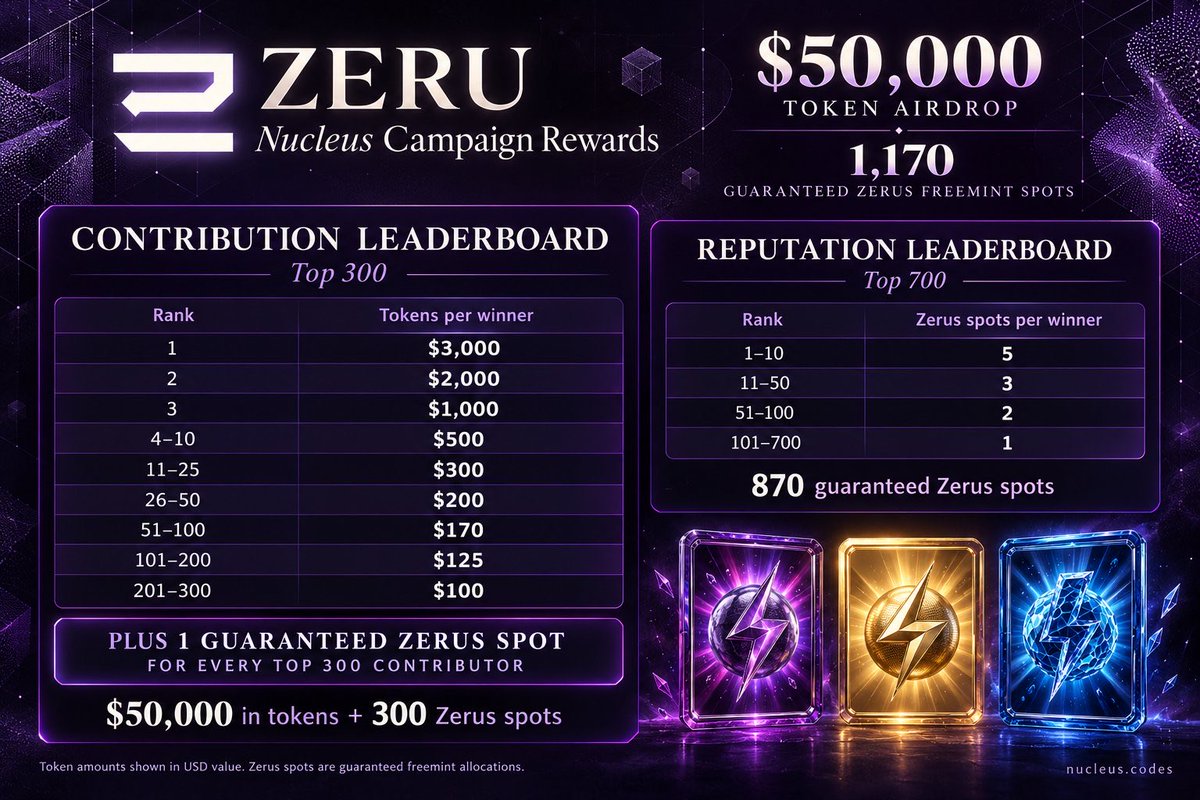
The Nucleus campaign runs for 60 days, with $50,000 in tokens and 1,170 guaranteed Zerus freemint spots available across its contribution and reputation leaderboards.
Day 1 of 60. Let’s see how this develops.
ZeruAI is one of the projects I’m keeping an eye on as the @NucleusCodes campaign begins.
Formerly Zeru Finance, @zerufinance is building around a simple idea: making onchain behavior more useful for understanding reputation and trust.
Its zScore turns real wallet activity like lending, trading, staking, and governance into a reputation score, while Zaps focuses on rewarding actual onchain activity.
The Nucleus campaign runs for 60 days, with $50,000 in tokens and 1,170 guaranteed Zerus freemint spots available across its contribution and reputation leaderboards.
Day 1 of 60. Let’s see how this develops.
GM CT… Happy Tuesday.
A lot of spatial data starts as video, but for Physical AI, raw video isn’t necessarily the useful end product.
That’s an important distinction with @vangrid_io.
The goal is to take short captures from ordinary phones and reconstruct them into structured 3D representations of real environments. That gives systems more useful spatial information about things like geometry, position and surroundings than simply handing them hours of unstructured footage.
So the phone is the sensor, but the 3D reconstruction is where the data becomes much more useful.
For Vangrid, the point isn’t to build another library of videos. It’s to turn real-world captures into spatial data that machines can actually work with.
GM CT… GM NFTs lovers
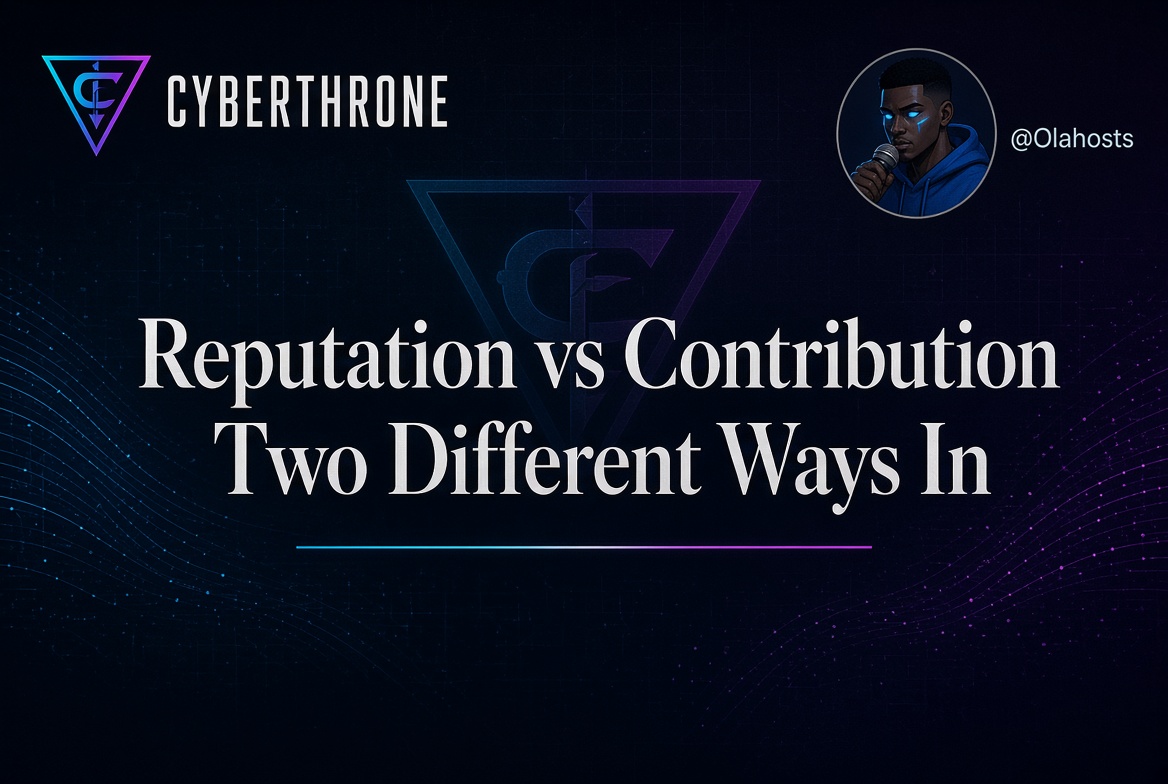
The CyberThrone Genesis campaign on @NucleusCodes has an interesting structure: there are two different ways to qualify for GTD access.
The Reputation board is based on your existing reputation within Nucleus. The top 250 receive 3x GTD, while positions 251–1000 receive 1x GTD.
The Contribution board works differently. It rewards people contributing original content around @0xCyberThrone , with the top 300 receiving 1x GTD.
I like the distinction because it separates established reputation from what you contribute specifically to the project.
You don’t necessarily need to already have a strong reputation to participate. There’s also a path through actual contribution and creating content based on the project’s real features.
And the two routes aren’t meant to stack. If you qualify through multiple spots, the highest eligible tier takes precedence.
It makes the campaign less about one single leaderboard and more about two different forms of participation.
Good Afternoon CT
Very important we keep exploring @vangrid_io
The contributor-buyer loop is the key piece here.
Bounties turn data collection from passive mapping into a demand-driven network, which makes the model much more interesting.
Your privacy should not stop when you leave the browser. Your wallet should also give you control over your funds.
The @BeldexCoin Electron Wallet is a desktop wallet made for storing, sending, and receiving $BDX. It works on Windows, Linux, and Mac, and the interface is simple enough to use without making things complicated.
One thing I also like is that the wallet can be used to set up and manage a Beldex masternode.
It is a simple part of the Beldex ecosystem, but an important one if you want more control over your $BDX and your transactions.
Privacy, control, and a simple user experience all in one wallet.