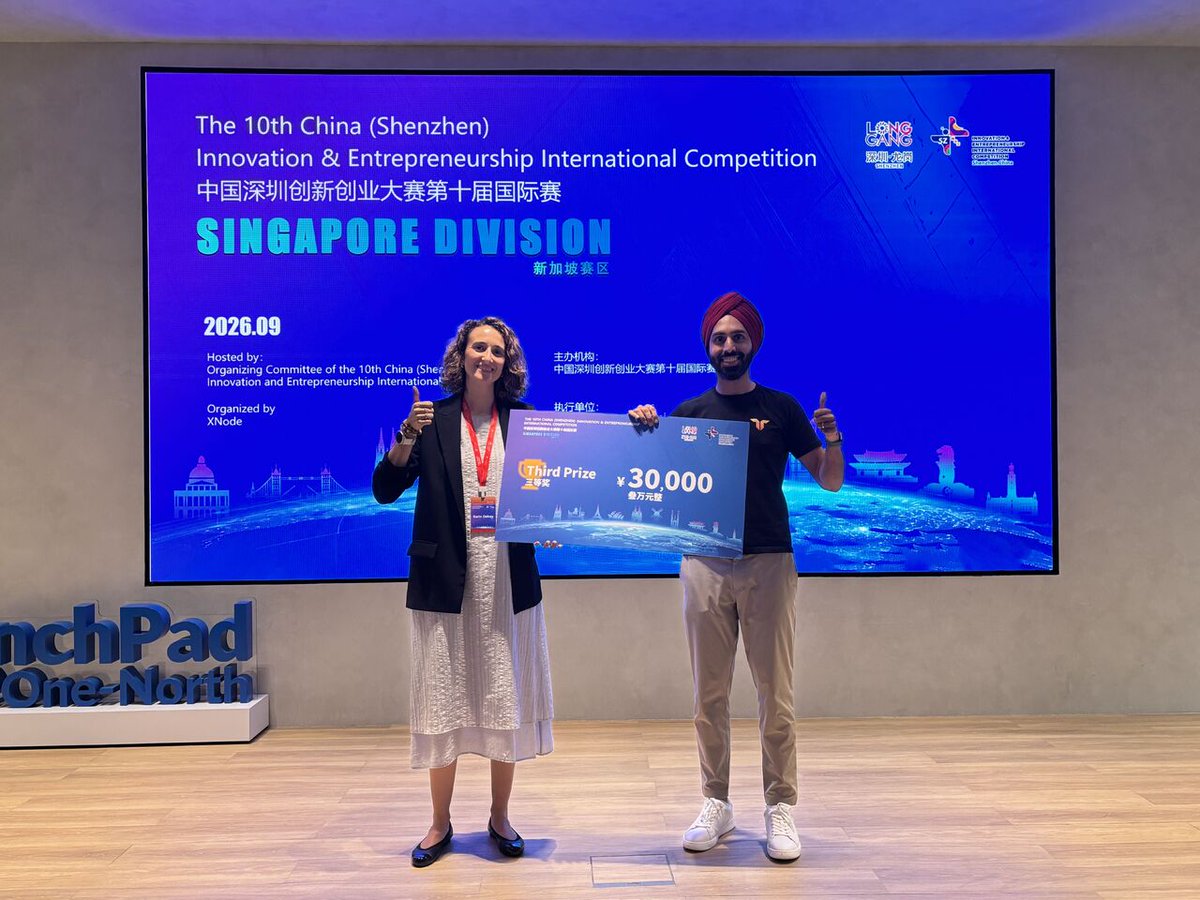
We placed 3rd at the 10th China (Shenzhen) Innovation & Entrepreneurship International Competition (Singapore Division)!
Honored to stand out among a stacked field of deep tech, health, and sustainability startups.
Big congrats to Averywell for taking the top spot, and shoutout to every team that pitched.
Thank you to IPI Singapore (@ipisg) and @XNodeAccelerate for putting this together! 🚀
Tashi is headed to KBW 🇰🇷
Tashi will be in Seoul for @kbwofficial! Looking forward to catching up with partners, connecting with the community, and sharing what we’ve been building.
Catch us at #KBW2026 — reach out if you'll be in town!
CBO Community Update | Key Takeaways 👇
🌐 Global Expansion & Market Traction
• Drone & Defense First: High-stakes autonomous applications driving immediate commercial demand and proving our tech at scale.
• 7 Nations & Growing: Active trials and corporate partnerships across Singapore, India, the UK, Germany, Greece, and beyond.
• Strategic US Entry: Securing battle-tested momentum with allied partners before scaling into the US market.
⚡ Upcoming Milestones
• Agentic Network Launch (Early Oct): Transforming our 100k+ node network into a fully agentic system, unlocking direct community revenue-sharing.
Catch the full recording below! 🎙️
Hardware innately designed to cooperate presents an interesting shift from the "do-it-all" humanoid sitting at the end of everyone's rainbow.
Demos like this offer an on-the-nose picture of a subtler philosophy:
Specialization is actually optimized generalism when autonomous coordination bridges the gap.
Drones are great. Humanoids are great. AVs are great. But an aerial guide, a ground utility vehicle, and a humanoid operator acting as one intelligent system? That's transformative.
Physical AI, both at its core and at mass scale, will ultimately be about enabling specialized hardware to coordinate so fluidly that their collective intelligence becomes far greater than the sum of its parts.
"Warfare is evolving — with innovation cycles compressed from years into months."
A hard lesson is currently being learned in the "forced" automation of the Ukrainian battlefield. A reality that budget alone cannot solve.
The competition is no longer over who gets the new tech first. It's over who can effectively orchestrate dozens, hundreds, or even thousands of vendors into coherent solution sets... and then keep doing it through every rapid iteration.
The race for the new-age "war machine" will be won by whoever can consistently turn independent innovations into an adaptable, universal capability.
As endearing as this interaction is, it presents the start of a larger problem. Robots SHOULDN'T have to check both ways...
Robots currently interact as two separate entities. They should be operating as a single, intelligent swarm. Shared context, shared reflexes, shared world view.
If only someone was building a universal coordination layer that would provide a collective intelligence to all machines 🤔
In 1440, Gutenberg invents the printing press and unleashes a catalyst that comes to define the Renaissance and ignite the Scientific Revolution.
A massive spike in productivity meant people could focus on being people: creating, exploring, and sharing.
The humanoid will be to this era what the printing press was to the Renaissance: an opportunity to amplify everything that makes us human.
The key word here is opportunity. What's coming is coming regardless. What we do with it, what standards we set, and what we create; that part is still up to us.
"This is not in the stage of wishful thinking or a desire to engage in this environment. This is happening as we speak."
Our CTO, Ákos Maróy, on field-testing Tashi's stack in live drone-flying environments. 🎙️
What's the real difference between multiple autonomous drones flying in a group and a truly unified intelligent Swarm?
🎙️ Our CTO, Ákos Maróy, explains the Tashi difference.