This is the result of the work done by many across multiple administrations, and assigning such credit to one person in the same boot-licking manner shows how ill fit they are for these positions.
“Alleged affair”.
What’s @CRCMaldives going to do about this? Are they going Jail AJ now? Send a court summons to their Doha office? Or Qazf prosecution? @abbas_sharyf you are going to end your judicial career with a legacy of shame?
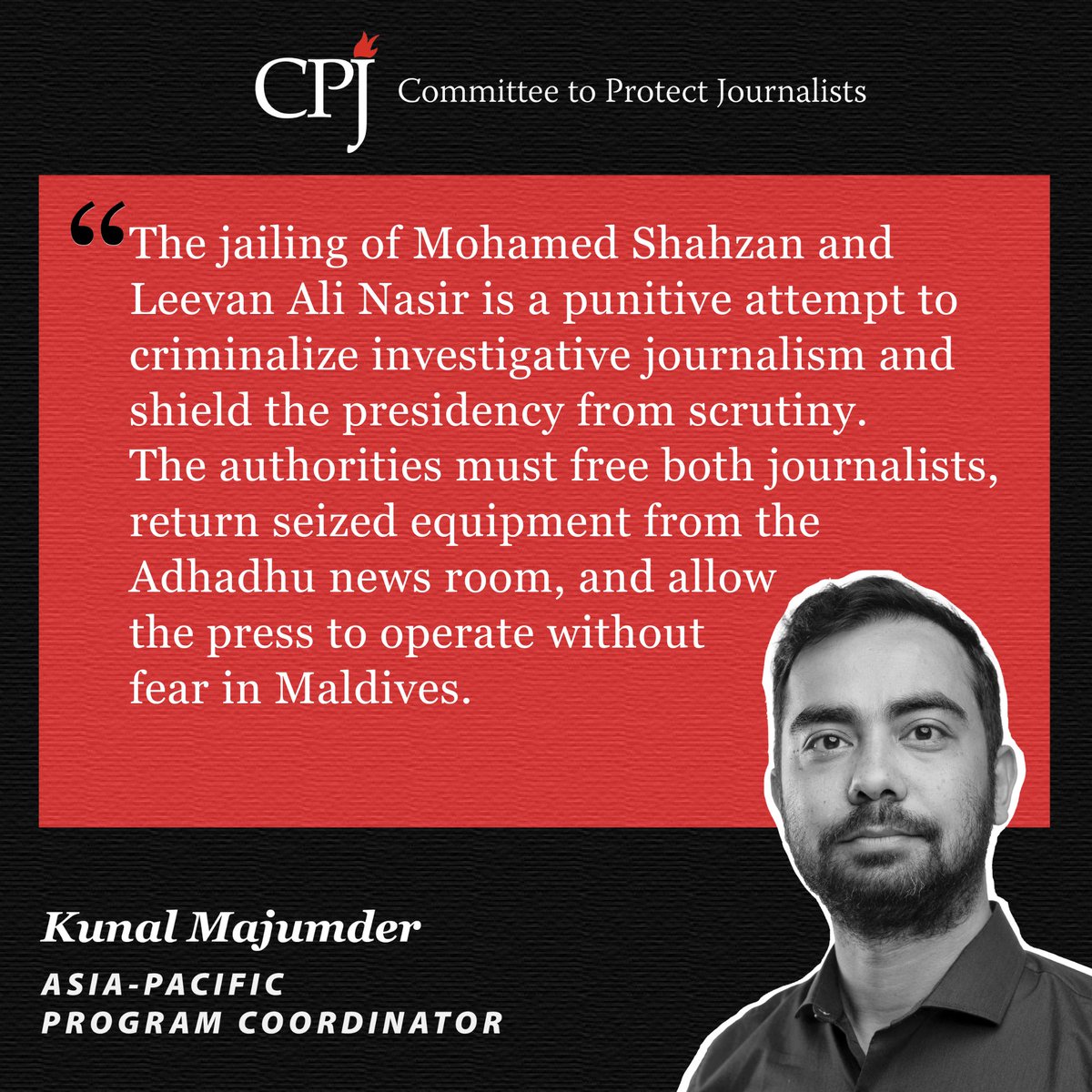
#Maldives: Authorities must immediately release journalists Mohamed Shahzan and Leevan Ali Nasir and end judicial harassment of their news outlet, Adhadhu, the Committee to Protect Journalists said Tuesday.
According to a report by Adhadhu and a post on X by the Maldives Journalists Association, a court in the capital Malé sentenced Shahzan, a reporter with Adhadhu, to 15 days in jail after he was removed from a May 11 press conference for questioning President Mohamed Muizzu about allegations of sexual misconduct and abuse of power raised in the outlet’s documentary, “Aisha.” Authorities later barred Adhadhu from briefings, citing a criminal court gag order on discussing the film.
In a separate case, Nasir, a journalist with the same publication, received a 10-day sentence over a report on the same gag order, which the court deemed a violation, Adhadhu reported.
More: https://t.co/pPjqrjgfF8
#PressFreedom #JournalismIsNotACrime
Following a 10-day assessment of the Maldives, UN Special Rapporteur Tlaleng Mofokeng highlighted a critical issue: the management of pharmaceutical supplies. From availability to affordability and quality, patients are feeling the impact.
📄: https://t.co/U42yRVnD5H
The USD 400 million facility was settled in full, with interest. The INR 30 billion facility is a separate arrangement altogether, in a different currency and for a smaller amount. No amount of political spin will change those basic facts.
Three countries. One war. Three timelines.
Thailand’s Tourism Minister announced the pivot on March 5. Five days into the conflict. Cash assistance for stranded tourists, fuel price caps, visa overstay fee waivers. By April 1, the Thai Hotels Association was in emergency session deciding stimulus measures. Bank of Thailand revised its GDP forecast. The Tourism Authority published loss scenarios publicly: $390M for a two-week conflict, $1.21B for eight weeks, $4.6B for six months. The country was operating with full transparency about the damage and full speed on response.
Sri Lanka moved faster. March 15, fuel rationing began. March 16, emergency four-day work week declared with the country admitting it had six weeks of fuel reserves left. March 18, state institutions, schools, and universities shifted to four-day operations. Public ceremonies suspended. President Dissanayake chaired the emergency meeting personally. Tourism was ring-fenced inside the austerity, with carve-outs for hotels, a 24/7 hotline, and a dedicated task force. The country with no fiscal space and an active IMF program acted decisively within 15 days.
The Maldives waited.
The war started February 28. Tourism arrivals collapsed 41.5% by early March. Cargo backed up in Sri Lanka. Fuel prices spiked. Resorts laid off staff. European DMCs lost millions. The government’s response: silence, then optimism, then more silence.
Then April 4 happened. The referendum was rejected by 69%. PNC lost every mayoral race. The opposition swept Male’.
Suddenly, on April 5, MIFCO announced a six-hour workday to save diesel. On April 14, ten ministers “resigned” and the cabinet was restructured. Press releases about a “Special Cabinet Committee on essential supplies” appeared. Forty-five days after the war started. Ten days after the election.
The pattern is impossible to miss. Thailand acted because the economy was hurting. Sri Lanka acted because the country was running out of fuel. The Maldives acted because the government was running out of votes.
Sri Lanka has IMF conditions, no fuel reserves, and a default risk. It still moved within 15 days. Thailand has 68% debt-to-GDP and limited fiscal room. It still announced response measures within a week. The Maldives, with 127% debt-to-GDP and no buffer, took 36 days to acknowledge the crisis and only after losing an election.
While Sri Lanka’s SLTDA was canceling European campaigns and pivoting to short-haul markets including the Maldives as a target source, Maldivian ministers were preparing referendum talking points. While Bangkok was modeling worst-case scenarios for parliament, Male’ was insisting the economy was “stable and fast-growing.”
The most damaging line in this entire crisis came from the government’s own sukuk repayment press release on April 2: “Recent developments in the Middle East are expected to adversely affect the medium-term growth and macro-fiscal outlook.” They knew. They knew on April 2. They had known for weeks. They just weren’t willing to say it out loud until the voters forced them to.
Sri Lanka’s tourism authority is now actively recruiting Maldivian visitors. Thailand absorbed 500,000 Chinese tourists who redirected from Japan. Both countries turned a regional crisis into a strategic pivot. The Maldives turned it into a cabinet reshuffle.
When a fishing company is told to cut its workday to save diesel before the government cuts a single political appointment, when essential supply committees are formed 45 days late, when “reform” means rotating loyalists into different chairs, the message to citizens is clear. The crisis isn’t the war. The crisis is a government that responds only when its own survival is on the line.
Sri Lanka’s president called an emergency meeting on March 16. Thailand’s tourism minister announced measures on March 5. Maldives’ president went on Umrah and came back to find his cabinet had to resign.
That’s the difference between governing and surviving.